Drill Rig Hydraulic Repair in Dallas: Minimizing Downtime with Mobile Service
Every hour a drill rig remains stationary on a Dallas job site, operational losses can exceed several thousand dollars in missed benchmarks and labor costs. You understand that the logistical complexity of hauling a non-functional rig to a distant service center often creates more disruption than the mechanical failure itself. It’s a significant burden when project momentum is halted by technicians who lack the specific engineering expertise required for high-pressure drilling systems. For companies seeking drill rig hydraulic repair Dallas, the traditional approach of off-site maintenance is increasingly inefficient in a market where oilfield service costs have jumped significantly according to recent Dallas Fed data.
This article explains how expert on-site hydraulic diagnostics and mobile repair can eliminate these costly delays and secure your project timeline. You’ll learn about the technical precision of mobile hose fabrication and how rapid, field-based interventions restore critical system pressure to keep your operations moving forward with minimal interruption.
Key Takeaways
- Quantify the economic impact of hydraulic failure and the technical necessity of specialized high-pressure expertise for drilling operations.
- Identify how North Texas environmental factors, specifically extreme vibration and soil contamination, accelerate component degradation.
- Evaluate the logistical advantages of professional drill rig hydraulic repair Dallas services that perform diagnostics under actual load at the job site.
- Implement preventative maintenance protocols, including hydraulic fluid analysis, specifically calibrated for the Dallas summer heat index.
- Discover how on-site hose fabrication and mobile diagnostic units eliminate the operational disruption of transporting heavy equipment to a service center.
The Critical Impact of Hydraulic Failure on Dallas Drilling Projects
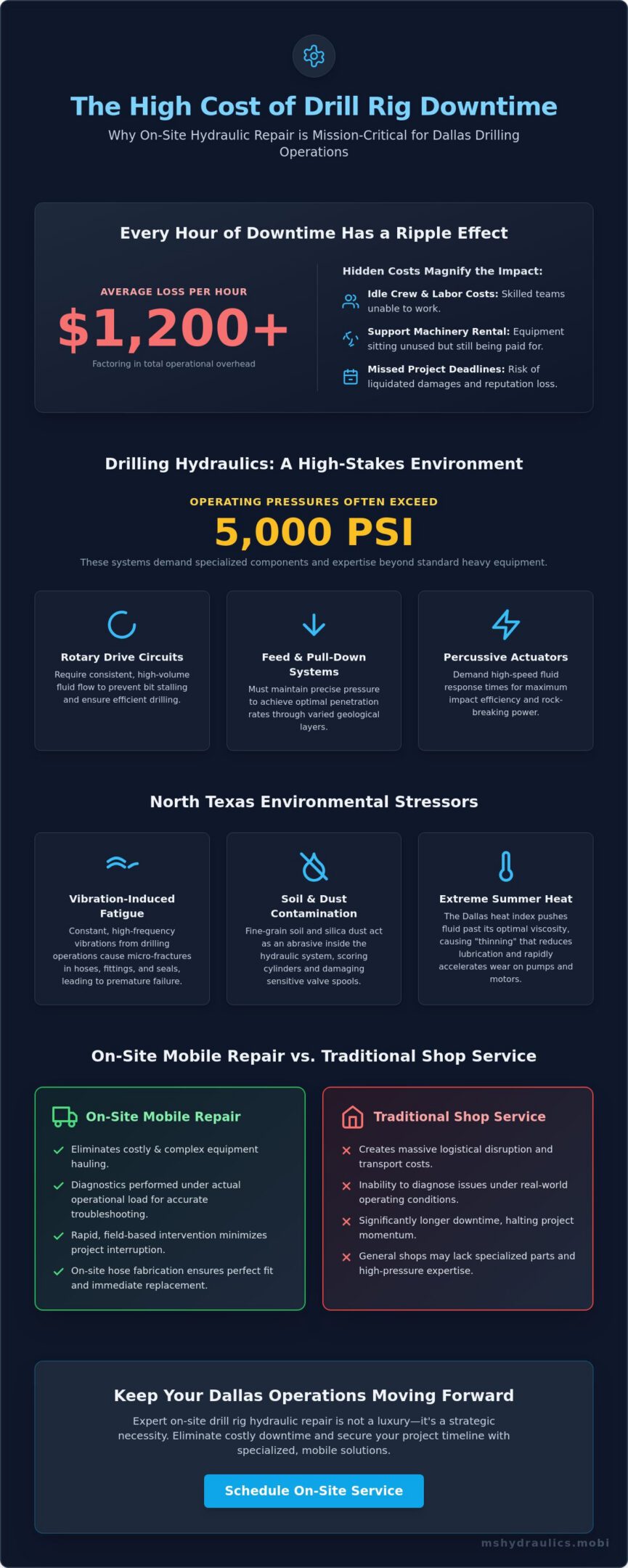
Precision drill rig hydraulic repair Dallas represents a specialized engineering discipline that exceeds the scope of standard heavy equipment maintenance. Drill rigs rely on high-pressure fluid power systems to execute complex rotary and percussive movements, often operating at pressures exceeding 5,000 PSI. These systems require a technical understanding of high-flow auxiliary circuits and the precise calibration of torque management systems. When a primary hydraulic circuit fails, it’s not merely a mechanical issue; it’s a total cessation of the project’s primary production tool. Standard hydraulic shops frequently struggle with the scale of these machines, as they lack the high-capacity diagnostic equipment and specialized component inventory required for 40-ton drilling platforms.
Understanding how hydraulic machinery works in a drilling context is essential for effective troubleshooting. The system must balance the power requirements of the feed system with the rotational needs of the drill string. This equilibrium is maintained through a series of sophisticated valves and pumps that must withstand extreme thermal and mechanical stress. A failure in any of these sub-systems can lead to catastrophic pressure loss or fluid contamination, necessitating immediate intervention from technicians who specialize in drill rig hydraulic repair Dallas.
Why Time is the Most Expensive Component
In the North Texas construction and utility sectors, project schedules are calculated with minimal margin for error. The economic reality of a halted rig involves more than just the repair invoice. You must account for the hidden costs of an idle crew, the rental fees for support machinery, and potential liquidated damages for missed deadlines. The average hourly loss for a mid-sized drill rig in a commercial environment is estimated to be approximately $1,200 when factoring in total operational overhead and lost productivity. This ripple effect means that a single failed hydraulic hose can effectively freeze the budget of an entire job site until the equipment is restored to full functionality.
Specialized Requirements for Drilling Hydraulics
Drilling hydraulics are subject to unique stressors that are not present in standard excavation equipment. High-frequency vibrations and constant axial loads demand components that meet rigorous international standards for durability. Precision valving is critical for maintaining the specific bit pressure and torque required to penetrate the varied soil and rock layers found throughout the Dallas region. Generic hydraulic parts often fail prematurely under these conditions because they aren’t engineered for the duty cycles of a modern drill rig. Technical excellence in this field requires a commitment to using verified, high-performance parts that can maintain system integrity during peak load operations.
- Rotary drive circuits require consistent flow to prevent bit stalling.
- Feed and pull-down systems must maintain precise pressure for optimal penetration rates.
- Percussive actuators demand high-speed fluid response times for maximum impact efficiency.
Identifying Common Hydraulic Failures in Drill Rigs
Drill rigs operate in environments that are inherently hostile to hydraulic integrity. Unlike stationary industrial machinery, these units face constant high-frequency vibration and external particulate ingress. Effective drill rig hydraulic repair Dallas begins with recognizing that failure is often cumulative rather than instantaneous. Micro-fractures in seals and the gradual erosion of internal pump surfaces represent the primary precursors to total system collapse. Identifying these issues early requires a technical understanding of how external stressors translate into mechanical degradation.
In the North Texas region, fine-grain soil and silica dust pose a constant threat to open hydraulic circuits. When a system is opened for field repair without rigorous environmental controls, these particulates enter the fluid stream. They act as an abrasive that scores cylinder walls and valve spools. Thermal degradation also plays a critical role in component failure. The Texas summer heat index can push hydraulic fluid past its optimal viscosity range, leading to “thinning.” This reduced viscosity fails to maintain the necessary lubricating film between moving parts, which rapidly accelerates wear in pumps and motors.
Vibration-Induced Hose Fatigue
The drill mast serves as a primary source of intense mechanical stress. Standard hydraulic hoses often lack the reinforced braiding required to withstand the harmonic resonance generated during deep boring operations. Over time, this vibration causes the internal wire reinforcement to fatigue, leading to sudden bursts. Proper hose routing and the application of heavy-duty abrasion sleeves are essential field modifications to prevent premature failure. You should monitor for “weeping” at the crimp points. These small fluid traces indicate that the fitting’s internal seal has compromised, which often precedes a catastrophic blowout under peak load. If you observe these indicators, professional on-site diagnostic services can identify vulnerable lines before they fail.
Pump and Motor Degradation
Sluggish rotation or a decrease in pull-back force often signals that the hydraulic pump is losing volumetric efficiency. Internal bypass, where fluid leaks past worn internal components instead of performing work, manifests as increased system heat and decreased bit pressure. You might notice an audible change in the pump’s pitch, often described as a high-pitched whine or a sound similar to “marbles in a can.” This usually indicates cavitation. This phenomenon occurs when air bubbles implode within the pump, pitting the metal surfaces and destroying the component from the inside out. Monitoring these symptoms is vital for maintaining the high-pressure performance required for successful drill rig hydraulic repair Dallas and ensuring long-term equipment reliability.
Slow leaks are frequently dismissed as minor operational nuisances, but they are “silent killers” of hydraulic efficiency. A small leak not only wastes expensive fluid but also provides a pathway for air and moisture to enter the system. This leads to oxidation and the formation of sludge, which can clog precision valving and cause unpredictable rig behavior. Regular inspections of all connection points and thermal imaging of the hydraulic reservoir can reveal these hidden issues before they result in an unscheduled project shutdown.
Mobile On-Site Repair vs. Traditional Shop Service
The decision between transporting a 40-ton drill rig to a service center or utilizing a mobile technician involves a complex evaluation of logistical risk and operational downtime. Moving oversized drilling equipment through Dallas traffic requires specialized hauling permits, escort vehicles, and significant lead time. These logistical hurdles often consume an entire production day before the actual repair even begins. By selecting drill rig hydraulic repair Dallas as a field-based service, you bypass the hazards of transit and the high costs associated with heavy-duty rigging and transport.
Field repairs provide a technical advantage that shop environments cannot easily replicate: the ability to diagnose the hydraulic system under actual operational load. In a controlled shop setting, technicians often rely on bench testing or simulated loads. While useful, these methods may fail to reveal intermittent pressure drops or thermal issues that only manifest during active boring. Mobile service allows for real-time monitoring of the rig’s performance in its specific working environment, ensuring that the root cause of the failure is identified and rectified with engineering precision.
Logistical and Cost Comparison
When you compare the total cost of ownership for a repair, hauling fees often represent a significant portion of the invoice. Mobile service call-out rates are typically more predictable and eliminate the sunk costs of equipment transport. A standard on-site intervention often concludes within four hours, whereas a traditional shop visit can easily extend to three days due to queueing and intake procedures. This timeline disparity is critical for maintaining project momentum. Immediate testing following a field repair ensures the rig is ready for the next shift without the delay of a return haul.
On-Site Diagnostic Capabilities
Modern mobile units are equipped with high-precision portable pressure gauges and digital flow meters that provide granular data on system performance. These tools allow technicians to pinpoint failures in complex load-sensing circuits without dismantling the entire machine. During a primary repair, experienced field engineers often identify secondary issues, such as minor seal leaks or worn abrasion sleeves, which might have been overlooked in a generic shop inspection. Utilizing On-Site Diagnostic Services ensures that every component is verified against its original equipment manufacturer (OEM) specifications before the rig returns to service.
On-site hose fabrication is another essential component of the mobile advantage. Instead of waiting for a courier or making multiple trips to a parts store, technicians can fabricate high-pressure hoses with precise lengths and fitting orientations directly at the job site. This capability is paired with rigorous environmental controls. Field technicians use specialized spill containment systems and vacuum extraction tools to ensure that hydraulic fluid is managed responsibly, maintaining a clean and safe work area that complies with local Dallas environmental standards. This methodical approach to drill rig hydraulic repair Dallas prioritizes both mechanical reliability and site safety.
Preventative Maintenance for North Texas Drilling Environments
Preventative maintenance in the Dallas-Fort Worth area requires a strategy that acknowledges the region’s extreme thermal and environmental stressors. While standard OEM manuals provide a baseline, they often fail to account for the sustained 100°F plus temperatures and high particulate counts common in North Texas drilling sectors. Effective drill rig hydraulic repair Dallas is best achieved by preventing failure through a rigorous, climate-specific protocol. Maintaining system cleanliness and fluid stability is the primary defense against the mechanical erosion caused by local soil conditions.
Fluid and Filter Management
During peak summer months, hydraulic fluid viscosity must be managed with technical precision. When ambient temperatures exceed 100°F, standard fluids can thin beyond their protective range, leading to metal-on-metal contact within pumps and motors. Utilizing high-viscosity index (HVI) fluids helps maintain a consistent lubricating film under these conditions. Additionally, the fine silica dust prevalent in local soil necessitates a more aggressive filter replacement schedule. In high-particulate environments, filter bypass valves can open earlier than expected, allowing contaminants to circulate through precision valves. For a more detailed technical overview, refer to our guide on Heavy Equipment Maintenance.
Cylinder and Seal Care
Exposed cylinder rods are particularly vulnerable during active drilling operations. The abrasive nature of North Texas soil creates a grinding paste when mixed with the minor oil film present on the rod. This leads to rod scoring and eventual seal bypass. Operators must inspect wiper seals daily to ensure they’re effectively clearing debris before the rod retracts into the barrel. If you identify deep vertical scoring or excessive fluid leakage at the seal head, you may require a professional Heavy Equipment Cylinder Rebuild in Texas to restore hydraulic integrity and prevent pressure loss.
Fluctuating humidity and rapid temperature shifts in Texas can cause seals to harden or lose their elastic memory. A daily inspection checklist should include verifying reservoir levels and checking for aeration, which often appears as foam. Operators should also inspect all high-pressure hose connections for thermal cracking and check the hydraulic oil cooler for dust accumulation that restricts airflow. Monitoring case drain flow provides critical data on internal pump wear before a total failure occurs. Proactive management of these parameters is a core component of any drill rig hydraulic repair Dallas strategy aimed at long-term reliability. If your equipment shows signs of thermal degradation or pressure loss, contact Ms. Hydraulics for professional Mobile Hydraulic Repair to secure your operational uptime.
Ms. Hydraulics: Expert Drill Rig Hydraulic Solutions in Dallas
Ms. Hydraulics functions as a specialized industrial entity dedicated to maintaining the operational integrity of heavy drilling equipment. Unlike general repair shops, our organization focuses exclusively on the high-pressure fluid power systems that drive modern drilling platforms. Our technicians are experienced industrial veterans who understand that drill rig hydraulic repair Dallas requires more than a standard component swap. It demands a holistic evaluation of the rig’s hydraulic circuits to ensure all physical and mechanical parameters meet OEM specifications. By deploying fully-equipped service units, we provide a level of technical precision that was previously only available in a factory setting.
Every mobile unit in our fleet is engineered to function as a self-contained repair facility. These trucks carry the specialized tooling required for on-site Hydraulic Hose Fabrication and On-Site Diagnostic Services, allowing us to address failures at the source. This mobile capability eliminates the logistical burden of transporting 40-ton machinery, as discussed in previous sections, and ensures that the system is tested under the actual loads encountered on the job site. Our focus on engineering excellence and factual accuracy builds a foundation of trust with major international players operating in the North Texas region.
For these major players, safety is a non-negotiable priority, often requiring specialized solutions such as the hot work safety enclosures manufactured by PetroHab LLC to secure hazardous work areas during maintenance.
Our Technical Approach to Rig Repair
The engineering requirements for drilling hydraulics involve extreme pressure peaks and constant mechanical vibration. Our technical staff undergoes rigorous training to manage these specific stressors, focusing on the calibration of load-sensing pumps and high-torque motors. We utilize only high-grade fittings and reinforced hoses designed for the duty cycles of the drilling industry. This commitment to quality ensures that once a repair is completed, the system is verified for long-term stability rather than just a temporary fix. To support the continuous nature of industrial projects, we maintain 24/7 responsiveness for emergency field calls to ensure that a midnight hydraulic failure doesn’t derail the next morning’s production.
Serving the Dallas-Fort Worth Metroplex
Our logistical footprint is designed to provide rapid intervention across the entire North Texas region. From our primary hub, we coordinate mobile service teams to support projects in the following areas:
- Dallas and Fort Worth proper
- Arlington and Mansfield
- Grandbury and Cleburne
- Surrounding counties in the DFW Metroplex
We coordinate directly with site supervisors to integrate our repair processes into the existing project workflow. This methodical communication ensures that our presence on-site causes minimal disruption to other crew activities. Whether the task involves a complex Hydraulic Pump Repair or immediate on-site hose fabrication, our objective remains the same: restoring your equipment’s functionality with engineering excellence. This disciplined approach to drill rig hydraulic repair Dallas positions Ms. Hydraulics as a dependable partner for the region’s most demanding drilling projects. For stakeholders requiring immediate technical support, contact us to schedule mobile hydraulic repair and secure your operational uptime.
Securing Operational Uptime for North Texas Drilling
Maintaining the technical integrity of a drilling operation requires a shift from reactive shop repairs to proactive mobile interventions. Mobile service eliminates the logistical and financial drain of equipment transport while ensuring that system failures are identified under actual working conditions. This approach prevents the recurrence of intermittent pressure issues that bench testing might miss. Additionally, adhering to climate-specific maintenance protocols remains the most effective defense against the thermal and particulate stressors unique to the region.
Ms. Hydraulics has provided expert solutions throughout the DFW Metroplex since 2021, focusing on the precision required for high-pressure industrial systems. Our service units deliver specialized on-site hose fabrication and advanced diagnostic tools directly to your job site. This eliminates the significant costs associated with equipment transport and traditional shop delays. For reliable drill rig hydraulic repair Dallas that prioritizes your project timeline, our technicians provide the engineering expertise necessary to restore full mechanical performance.
Request Immediate Mobile Drill Rig Repair in Dallas to minimize your downtime and ensure your drilling operations remain productive and efficient.
Frequently Asked Questions
Can you fabricate hydraulic hoses on-site at a Dallas drilling location?
Yes, we perform on-site Hydraulic Hose Fabrication directly at your location. Our mobile service units are equipped with high-pressure crimping technology and a comprehensive inventory of fittings and hose types. This capability allows our technicians to create custom assemblies that meet OEM specifications without the rig leaving the job site. By fabricating hoses in the field, we eliminate the transit time normally required to source parts from a brick-and-mortar facility.
How quickly can a mobile technician arrive at my job site in DFW?
Response times for a mobile technician vary based on current dispatch volume and your specific location within the DFW Metroplex. It’s our priority to address emergency calls to minimize operational downtime for critical drilling projects. Our coordination team provides an estimated time of arrival once the service request is processed. This structured dispatch system ensures that a technician with the appropriate diagnostic tools reaches your site as efficiently as possible.
What types of drill rigs do you typically provide hydraulic repairs for?
We provide comprehensive hydraulic repairs for a wide range of industrial drilling equipment, including rotary rigs, percussive hammers, and auger drills. If you are looking for high-performance piling solutions, you can learn more about the specialized vibrohincadores and hydraulic hammers manufactured by Anteng México. Our expertise extends to both crawler-mounted and truck-mounted platforms used in foundation drilling and utility sectors. Technicians are trained to service the complex load-sensing circuits and high-torque motors found in major international equipment brands. This technical versatility ensures reliable drill rig hydraulic repair Dallas regardless of the machine configuration.
Is it better to rebuild a hydraulic cylinder on-site or in a shop?
The optimal location for a Hydraulic Cylinder Rebuild depends on the extent of the mechanical damage. Minor seal replacements can often be executed on-site to restore functionality quickly. However, if the cylinder rod requires machining or the barrel exhibits significant scoring, a controlled shop environment is necessary for precision engineering. Our diagnostic team evaluates the component’s condition in the field to determine the most effective and durable restoration path for your equipment.
What are the most common causes of hydraulic pump failure in drill rigs?
Hydraulic pump failure in drill rigs is frequently caused by fluid contamination, aeration, or thermal degradation. Fine silica dust from North Texas soil can enter the system and act as an abrasive, destroying internal tolerances. Cavitation occurs when air bubbles implode within the pump, leading to metal pitting. Additionally, operating in extreme Dallas temperatures can cause fluid thinning, which reduces the lubricating film necessary to protect internal components from friction-induced wear.
Do you provide emergency hydraulic repair services in Dallas after hours?
Yes, we maintain 24/7 responsiveness for emergency field calls throughout the Dallas-Fort Worth area. We recognize that drilling operations often run on tight schedules where any delay results in significant financial loss. Our mobile units are prepared to deploy outside of standard business hours so a failure doesn’t halt your progress. This commitment to availability ensures that your project maintains momentum even when mechanical issues arise during night shifts or weekend operations.
How do I know if my drill rig’s hydraulic fluid needs to be changed?
You can identify the need for a fluid change through visual inspection and technical analysis. Milky fluid indicates water contamination, while a dark, burnt appearance suggests thermal oxidation. However, the most accurate method is professional fluid analysis to check for particulate counts and additive depletion. Regular testing is a core part of drill rig hydraulic repair Dallas preventative strategies, as it reveals internal component wear before a total system failure occurs.
What information do I need to provide when calling for a mobile repair?
When requesting a mobile repair, please provide the rig’s make and model along with a detailed description of the symptoms, such as pressure loss or sluggish rotation. Identifying the specific hydraulic circuit involved helps our technicians prepare the necessary diagnostic tools and parts. Providing the exact job site coordinates and any site-specific safety requirements ensures our mobile unit arrives prepared to begin work immediately. It’s helpful to have this data ready for dispatch.