Waxahachie Hydraulic Pump Rebuild: Restoring OEM Performance and Efficiency
Replacing a failed hydraulic pump with a brand-new OEM unit often represents an unnecessary capital expenditure that ignores the technical viability of a precision restoration. Most fleet managers in North Texas recognize that equipment downtime is the single greatest threat to operational profitability. With the global hydraulic components repair services market projected to reach USD 2.48 billion by 2035, industry leaders are increasingly prioritizing restoration over replacement. A professional Waxahachie hydraulic pump rebuild offers a disciplined alternative, aligning with the rigorous engineering standards required for heavy industrial applications.
You’ll learn how a comprehensive rebuild restores system pressure and flow to original specifications, effectively extending the lifespan of your machinery without the cost of a new unit. We examine the critical role of component-level diagnostics and system flushing in preventing repeat failures. This guide also details how mobile hydraulic repair services minimize transportation logistics. By the end, you’ll understand why engineering-grade restoration is the preferred strategy for maintaining peak operational standards in the Waxahachie area.
Key Takeaways
- Identify early indicators of declining volumetric efficiency and understand how North Texas environmental factors impact hydraulic fluid viscosity.
- Explore the engineering standards of a Waxahachie hydraulic pump rebuild, utilizing clean-room disassembly and precision measurement to restore OEM performance levels.
- Compare the economic benefits of component restoration, which often yields 40% to 60% cost savings while bypassing global supply chain delays for new units.
- Learn how to implement rigorous preventative maintenance and filtration protocols to protect your hydraulic system from premature wear and contamination.
- Discover how on-site diagnostic services and mobile repair reduce equipment downtime by addressing pump, valve, and cylinder issues at your operational site.
Identifying Hydraulic Pump Failure in Waxahachie Heavy Equipment
Technical diagnostics begin with an evaluation of volumetric efficiency. When a pump’s internal clearances expand due to wear, a portion of the pressurized fluid bypasses the outlet and returns to the suction side. This internal leakage reduces the total flow available to the actuators. In the North Texas climate, these issues are often compounded by extreme temperature fluctuations. High summer heat thins hydraulic fluid, reducing its lubricity and allowing for increased metal-to-metal contact. Conversely, cold starts in winter can cause pump starvation if the fluid is too viscous to enter the inlet port efficiently. Understanding how hydraulic pumps work is fundamental to diagnosing whether a performance drop is due to a simple hose leak or a terminal internal bypass. While a hose leak results in a visible loss of fluid, an internal bypass is a loss of energy that manifests as heat and sluggish operation.
Failure points vary significantly between pump architectures. Axial piston pumps, common in heavy excavators, typically fail at the cylinder block face or the piston shoes. Gear pumps, often found on smaller skid steers, usually exhibit wear on the aluminum housing or the wear plates. Identifying these specific mechanical failures early is the primary driver for a successful Waxahachie hydraulic pump rebuild. Catching wear before a catastrophic “seizure” occurs prevents metallic debris from contaminating the entire hydraulic circuit.
Symptom Analysis: Noise, Heat, and Sluggishness
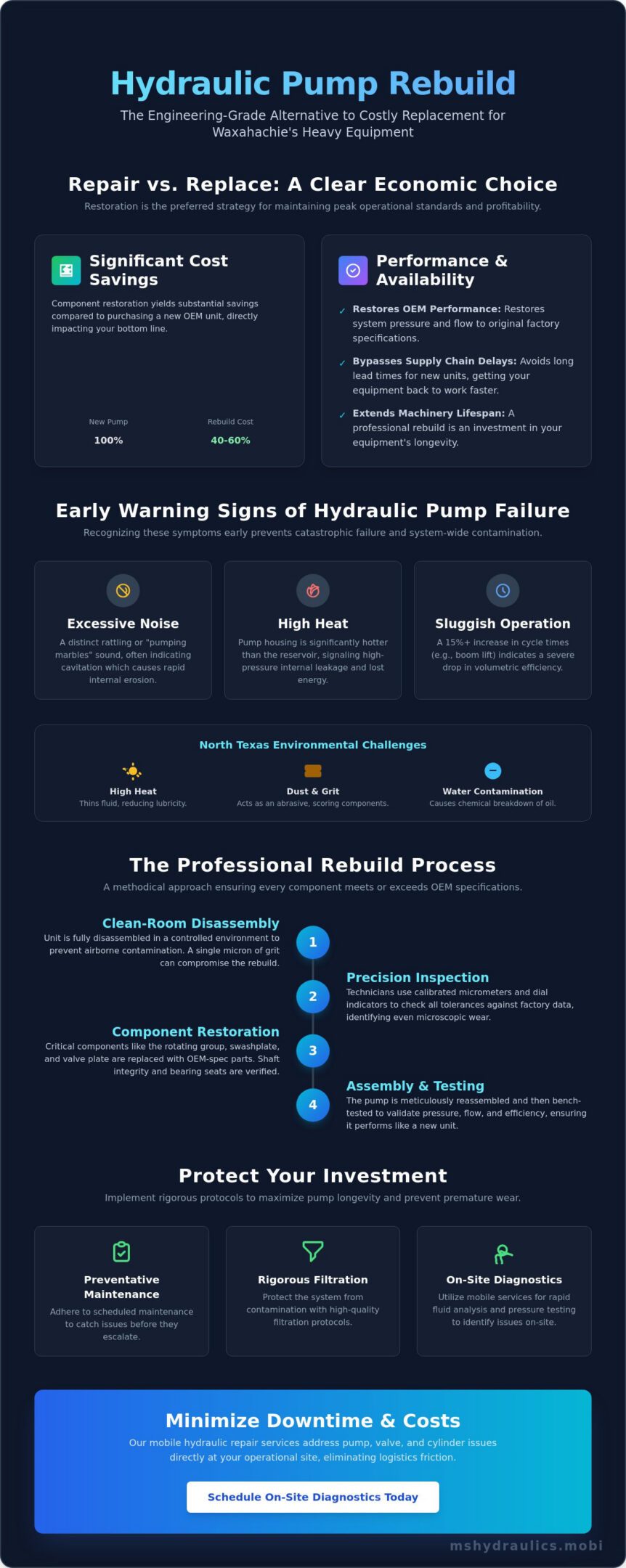
Cavitation remains a leading cause of premature pump failure. It occurs when air bubbles form in the fluid and collapse violently against internal metal surfaces. This creates a distinct rattling sound often described as pumping marbles. This process causes rapid material erosion and pitting. Excessive heat generation is another critical indicator. If the pump housing temperature exceeds the reservoir temperature by a wide margin, it indicates high-pressure fluid is leaking internally. Operators should measure cycle times for specific functions. If an excavator’s boom lift time increases by 15% or more under standard load, the pump is likely operating well below its rated volumetric efficiency. A Waxahachie hydraulic pump rebuild can restore these cycle times to factory specifications by correcting these internal tolerances.
The Role of Contamination in Ellis County Operations
Ellis County job sites present unique environmental challenges for hydraulic systems. Fine dust and abrasive grit act as a grinding compound when they enter the system. This leads to deep scoring on swashplates and valve plates, which quickly destroys the pump’s ability to hold pressure. Water contamination is equally destructive. It leads to hydrogen embrittlement and chemical breakdown of the hydraulic oil additives. Utilizing on-site diagnostic services allows for rapid fluid analysis and pressure testing. This proactive approach identifies contamination levels before they necessitate a complete system flush or the replacement of expensive valves and cylinders.
The Technical Process of a Professional Hydraulic Pump Rebuild
Executing a professional Waxahachie hydraulic pump rebuild requires a level of precision that exceeds standard field repairs. The process begins in a controlled environment to mitigate the risk of airborne particulates. Even a single micron of grit can compromise the tight tolerances of a high-pressure system. Technicians use calibrated micrometers and dial indicators to verify that every component aligns with original equipment manufacturer (OEM) specifications. This methodical approach ensures the unit operates with the same volumetric efficiency as a new component. Without this level of environmental control, the longevity of the rebuild is significantly compromised by latent contamination.
Disassembly and Precision Inspection
The unit undergoes a complete teardown to expose the rotating group, swashplate, and valve plate. Technicians look for more than just visible scoring. They identify “unmeasurable” wear patterns, such as localized heat discoloration or microscopic pitting, which often signal imminent failure. We verify shaft integrity by checking spline wear and bearing seat tolerances against factory data. If the shaft shows even minor eccentricity, it can lead to seal failure or housing damage. This level of scrutiny distinguishes a professional rebuild from a temporary fix.
Restoration and Component Replacement
Restoring metal-to-metal seals is the most critical phase. Technicians lap valve plates and cylinder blocks to light-band flatness standards. This process involves using abrasive pastes and precision plates to achieve a mirror finish that prevents high-pressure bypass. We replace all dynamic seals and gaskets with high-performance materials like Viton or Nitrile, depending on the application’s thermal requirements. While we resurface some internal pistons, we replace slippers and pistons if they show signs of material fatigue. For those managing complex fleets, integrating these steps into your hydraulic pump repair strategy ensures long-term reliability.
The final stage involves rigorous testing on a specialized hydraulic test stand. This isn’t a simple check. We monitor the pump under full load to verify pressure, flow, and temperature stability. We document the volumetric efficiency to ensure it meets or exceeds the original OEM curve. This data-driven verification provides the transparency needed to confirm the unit’s readiness for the demanding conditions of North Texas job sites. A successful Waxahachie hydraulic pump rebuild isn’t complete until the performance data matches the engineering requirements of the machine’s original design.
Repair vs. Replace: Economic Analysis for Waxahachie Fleet Managers
Capital allocation for heavy machinery maintenance requires a rigorous evaluation of both immediate costs and long-term asset value. For most operators in North Texas, a Waxahachie hydraulic pump rebuild represents the most efficient use of resources. This process generally results in a 40% to 60% cost savings when measured against the price of a new OEM replacement. Beyond the direct invoice price, fleet managers must account for the logistical advantages of local restoration. While new units are often subject to global supply chain disruptions and extended freight lead times, a professional rebuild utilizes locally available expertise and components to return the machine to service faster. Choosing a Waxahachie hydraulic pump rebuild ensures the equipment remains within original design parameters while optimizing the maintenance budget.
Sustainability also plays a pivotal role in modern industrial operations. Restoring a pump housing and rotating group significantly reduces the demand for raw materials and the energy required for new manufacturing. This approach aligns with international standards for circular economy practices in heavy industry. Additionally, maintaining a machine with OEM-standard rebuilt components preserves its resale value. It demonstrates a history of disciplined, engineering-grade maintenance that appeals to future buyers who value documented reliability.
Cost-Benefit Framework
A true analysis of the Total Cost of Ownership (TCO) extends beyond the repair bill. It includes the hourly cost of lost production while a machine sits idle. If a new pump requires three weeks for delivery, the cumulative loss often exceeds the cost of the component itself. A local rebuild mitigates this friction by providing a predictable timeline. Regarding warranties, while new units offer factory protection, a high-quality rebuild provides comparable performance assurances on the specific work performed. This ensures the unit operates reliably under the high-pressure demands of North Texas job sites.
When Replacement is the Only Option
There are instances where a rebuild is technically unfeasible. If a catastrophic failure has compromised the structural integrity of the pump housing, restoration is no longer an option. Similarly, if internal scoring on the valve plate or cylinder block exceeds safe machining tolerances, the component can’t be lapped back to OEM standards. In these scenarios, sourcing high-quality replacement components becomes necessary. You can consult our comprehensive guide to hydraulic parts to evaluate sourcing options for various heavy equipment brands. Identifying these technical limits early prevents wasted investment in a component that can’t be safely restored.
Maximizing Pump Longevity on the Job Site
The completion of a Waxahachie hydraulic pump rebuild marks the beginning of a new maintenance cycle rather than the end of technical oversight. Protecting this investment requires a disciplined approach to operational parameters and fluid cleanliness. Most premature pump failures originate from external factors that are entirely preventable through rigorous on-site management. When a pump is restored to OEM specifications, its tight internal tolerances are highly sensitive to even minor levels of particulate contamination. Maintaining these standards ensures the machine delivers the required volumetric efficiency throughout its service life.
Fluid Management and Filtration
Proper fluid management serves as the primary defense against component degradation. Fleet managers must select the correct ISO viscosity grade to account for North Texas temperature swings, which can range from sub-freezing winters to summer heat exceeding 100 degrees Fahrenheit. Using a fluid that’s too thin during peak summer months fails to maintain a sufficient lubricating film, while fluid that’s too thick during cold starts can cause inlet cavitation. Mixing different brands or types of hydraulic fluids is a significant risk, as it often leads to additive dropout and the formation of harmful sludge. We recommend establishing a strict 500-hour filter change interval for high-duty cycle equipment. This frequency ensures that the filtration system effectively captures wear particles before they can circulate back into the pump’s rotating group.
Operator training is equally critical. Drivers and technicians should be trained to recognize tactile and auditory feedback from the hydraulic circuit. Increased vibration, unusual whining noises, or a noticeable rise in reservoir temperature are all indicators of hydraulic stress. Routine pressure testing identifies internal leakage early. Catching these issues prevents a catastrophic pump “grenading,” a failure mode where internal components shatter and contaminate the entire system with metallic debris.
On-Site Maintenance Strategies
Establishing daily pre-check protocols is essential for fleet-wide reliability. Operators should verify reservoir levels and check fluid clarity through the sight glass every morning. Cloudy fluid indicates water contamination, while dark, burnt-smelling oil suggests thermal degradation. Utilizing our heavy equipment maintenance guide helps organizations implement these standards consistently across their entire inventory. Professional inspections should be scheduled before peak seasonal usage to verify that all relief valves are set correctly and that cooling systems are functioning at maximum capacity.
If you suspect a decline in system performance, don’t wait for a total failure. Contact our team for Mobile Hydraulic Repair to perform a precision diagnostic at your location, ensuring your equipment stays operational without the need for costly transport.
Waxahachie Mobile Hydraulic Repair: Eliminating Logistics Friction
Logistics often present the most significant hurdle in heavy equipment maintenance. Moving a non-functional excavator or bulldozer from a job site in Waxahachie to a static repair facility involves substantial freight costs and specialized hauling permits. Mobile hydraulic repair eliminates this friction by bringing diagnostic and repair capabilities directly to the machine’s location. This approach allows for a “system-wide” assessment where technicians can evaluate the pump, hoses, and cylinders simultaneously under real-world operating conditions. Identifying the interplay between these components is vital for a successful Waxahachie hydraulic pump rebuild, as it ensures the root cause of the failure is addressed rather than just the symptoms.
The Mobile Advantage for Heavy Equipment
A mobile unit equipped for high-pressure diagnostics provides a distinct technical advantage. It allows for the identification of root causes that might be obscured once a component is removed from the machine. For instance, a pump failure is often the symptom of a restricted suction line or a malfunctioning relief valve elsewhere in the circuit. By performing the initial assessment on-site, technicians ensure that a Waxahachie hydraulic pump rebuild addresses the entire failure chain. Our expert mobile hydraulic repair capabilities include on-site hydraulic hose fabrication. This integration allows us to replace compromised lines immediately. It prevents the re-introduction of contaminants into a newly rebuilt system and ensures the entire hydraulic circuit meets OEM pressure ratings.
Partnering with Ms. Hydraulics LLC
Ms. Hydraulics LLC operates with a commitment to engineering excellence along the I-35E corridor. We understand the specific demands of the construction and agriculture industries in Ellis County. Our approach is defined by technical accuracy and a disciplined adherence to OEM standards. We don’t just swap parts; we analyze mechanical parameters to ensure long-term reliability. Whether your fleet requires heavy equipment maintenance or an emergency pump assessment, our mobile teams provide the rapid response necessary to maintain project timelines. We focus on restoring volumetric efficiency and system integrity with every service call.
Reliability is the foundation of industrial productivity. When a critical pump fails, the resulting downtime can derail an entire project’s schedule. Our mobile diagnostics pinpoint the exact nature of the failure, allowing for informed decisions regarding repair versus replacement. Schedule a diagnostic call with Ms. Hydraulics LLC today to restore your equipment’s performance and minimize logistical costs.
Optimizing Equipment Reliability Through Precision Restoration
Maintaining a high-performance fleet requires more than reactive maintenance; it demands a disciplined approach to component restoration. A professional Waxahachie hydraulic pump rebuild provides an engineering-grade solution that restores volumetric efficiency while avoiding the high capital expenditure of new OEM units. By focusing on precision tolerances and clean-room assembly, operators can significantly extend the service life of their hydraulic systems. Mobile diagnostics further streamline this process by identifying failure points directly on the job site, ensuring that secondary issues like contaminated hoses don’t compromise newly rebuilt components.
Ms. Hydraulics LLC has provided technical expertise in heavy equipment since 2021. Our service model prioritizes accuracy through on-site mobile diagnostics and custom hose fabrication to ensure a holistic repair. This methodical approach minimizes downtime and protects your project timelines along the I-35E corridor. Don’t let hydraulic inefficiency degrade your operational output. Contact Ms. Hydraulics LLC for Expert Pump Diagnostics in Waxahachie to verify your system’s performance. Investing in precision today ensures your machinery remains a dependable asset for years to come.
Frequently Asked Questions
How long does a typical hydraulic pump rebuild take in Waxahachie?
Lead times for a Waxahachie hydraulic pump rebuild typically range from several business days to over a week. This duration depends on the availability of specific internal components and the extent of machining required to restore the valve plates or cylinder blocks. Technicians prioritize a methodical restoration process to ensure the unit meets original engineering specifications upon completion.
Can you perform a hydraulic pump rebuild on-site at my job location?
A full rebuild requires a controlled, clean-room environment to prevent microscopic contamination during assembly. While we provide on-site diagnostic services to pinpoint failure modes and mobile hydraulic repair for external components, the pump itself must be transported to a specialized facility for precision lapping and internal restoration. This ensures the integrity of the rotating group and dynamic seals.
What is the cost difference between rebuilding and buying a new pump?
Rebuilding a hydraulic pump generally results in a 40% to 60% cost savings compared to the procurement of a new OEM unit. This financial efficiency allows fleet managers to allocate capital toward other maintenance priorities. Additionally, rebuilding bypasses the extended lead times often associated with global supply chain disruptions for new heavy equipment parts.
Do you provide a warranty on your hydraulic pump rebuild services?
You should consult directly with the service provider to verify specific terms and performance guarantees for your equipment. Professional shops often provide detailed performance data from test-stand evaluations to document the pump’s volumetric efficiency. This data-driven approach ensures the unit is ready for the high-pressure demands of industrial applications.
Which brands of hydraulic pumps do you specialize in rebuilding?
Our technical expertise covers a broad spectrum of manufacturers found on North Texas job sites, including Caterpillar, John Deere, Komatsu, and Rexroth. We handle various architectures, such as axial piston and gear pumps. Technicians follow specific factory tolerances for each brand to ensure the rebuilt unit integrates seamlessly with the machine’s existing hydraulic circuit.
How do I know if my pump is failing or if it is just a bad hydraulic hose?
Internal pump failure typically manifests as a systemic loss of power, excessive heat generation, or unusual whining noises. Conversely, a bad hydraulic hose usually results in a visible external leak or a localized burst. If you notice sluggish cycle times without a visible drop in reservoir levels, it’s likely that internal bypass is occurring within the pump housing.
Is it worth rebuilding a pump on an older piece of equipment?
Rebuilding is often the most viable strategy for legacy machinery where new replacement parts are obsolete or prohibitively expensive. As long as the pump’s main housing remains structurally sound, a Waxahachie hydraulic pump rebuild can restore the unit to its original performance standards. This approach extends the asset’s service life and preserves its overall resale value.
What causes most hydraulic pump failures in the Waxahachie area?
Contamination from dust and abrasive grit on Ellis County construction sites is the primary cause of internal component scoring. These particulates act as a grinding compound, destroying the mirror finish on valve plates. Furthermore, the extreme North Texas summer heat can cause hydraulic fluid to thin, leading to a loss of lubricity and accelerated wear on internal slippers and pistons.