Arlington TX Skid Steer Hydraulics: Expert Repair and Maintenance Guide
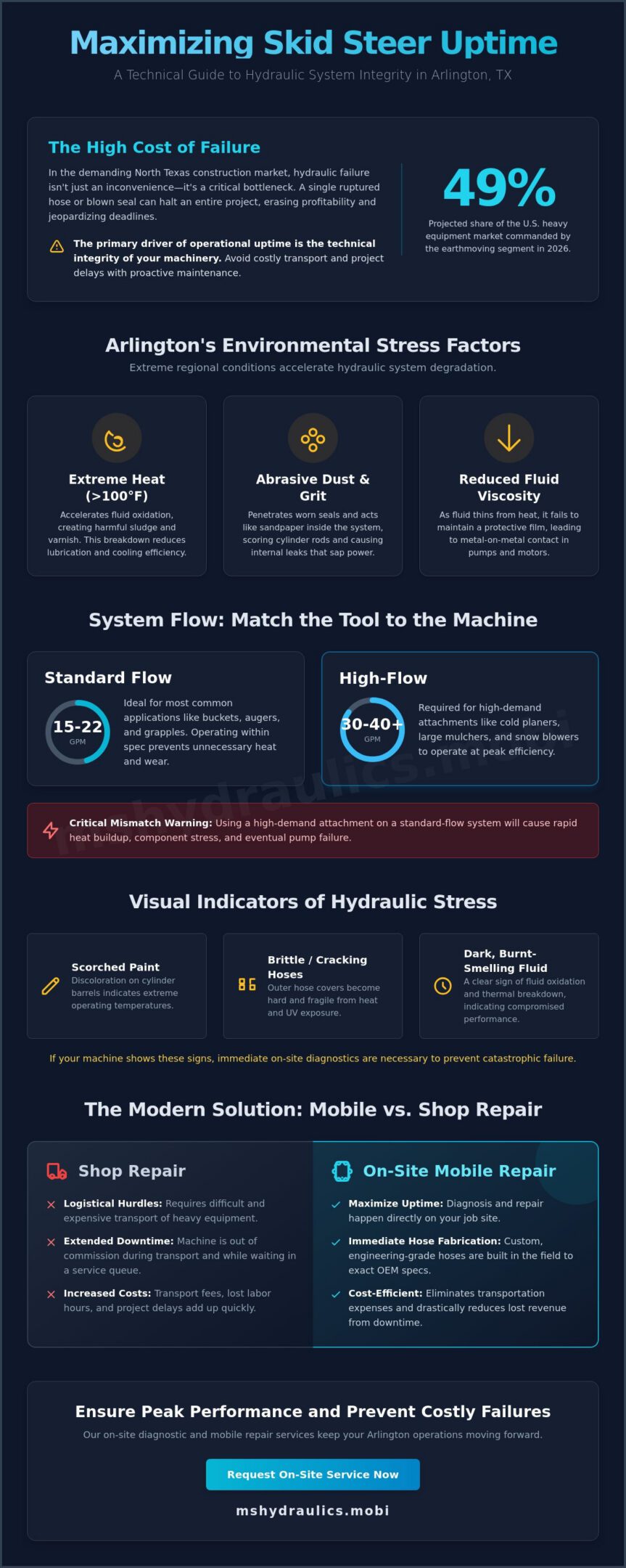
With the earthmoving segment estimated to command a 49.0 percent share of the U.S. heavy-duty construction equipment market in 2026, the technical integrity of your machinery is the primary driver of operational uptime. You recognize that a blown seal or a ruptured hose on a job site isn’t just a minor inconvenience. It’s a costly disruption that often involves the difficulty of transporting heavy equipment to a fixed shop while project deadlines loom. Maintaining Arlington TX skid steer hydraulics at peak specification is essential to avoid these logistical hurdles and keep your operations moving forward.
This guide provides a professional framework for diagnosing, maintaining, and repairing skid steer hydraulic systems with engineering precision. We will explore how mobile hydraulic repair and on-site diagnostic services allow for immediate hose fabrication and component restoration without removing the machine from the field. By implementing these expert maintenance strategies, you can ensure your equipment delivers the reliable performance required for complex excavation and demolition applications while minimizing expensive downtime.
Key Takeaways
- Understand how Arlington’s extreme thermal conditions accelerate hydraulic fluid oxidation and the specific maintenance protocols required to mitigate heat-related component degradation.
- Learn the engineering specifications of multi-wire reinforced hoses and the precision standards necessary for durable hydraulic cylinder rebuilds.
- Evaluate the cost-efficiency of mobile repair services compared to the logistical expenses and downtime associated with transporting heavy equipment to a fixed facility.
- Discover how on-site diagnostics for Arlington TX skid steer hydraulics enable immediate hose fabrication and system restoration directly at your project location.
- Implement technical troubleshooting frameworks to identify hydraulic fluid contamination and prevent premature failure of pumps, valves, and motors.
The Critical Role of Skid Steer Hydraulics on Arlington Job Sites
The hydraulic system is the operational core of any modern Skid-steer loader. It functions as the machine’s lifeblood, translating engine horsepower into the precise mechanical force required for lifting, digging, and attachment operation. In the high-stakes North Texas construction market, where the earthmoving segment accounts for an estimated 49.0% of the heavy equipment market share in 2026, the reliability of Arlington TX skid steer hydraulics is a fundamental requirement for project success. A failure in this system doesn’t just stop a single machine; it creates a bottleneck that can halt an entire project timeline.
Operating in Arlington presents unique challenges due to the regional climate and the intensive nature of local construction projects. From driving augers for pier drilling to operating concrete breakers for urban redevelopment, the hydraulic system is under constant load. In the competitive DFW metroplex, where bidding is aggressive and margins are tight, the high cost of equipment downtime can quickly erase a project’s profitability. Maintaining hydraulic integrity is a technical necessity, not an optional service.
Environmental Impact on Hydraulic Fluid and Seals
North Texas summers, where temperatures frequently exceed 100°F, impose extreme thermal stress on hydraulic systems. High ambient heat accelerates fluid oxidation, a chemical reaction that breaks down the oil’s molecular structure and leads to the formation of harmful sludge and varnish. When fluid viscosity drops due to heat, the oil becomes too thin to maintain a protective film between moving components. This results in metal-to-metal contact within pumps and motors. Additionally, the fine dust and grit prevalent on Arlington job sites can penetrate worn wiper seals. These contaminants act as abrasives, scoring hydraulic cylinder rods and causing internal leaks that reduce lifting capacity. Selecting the correct fluid grade with a high viscosity index is essential for equipment longevity in this environment.
High-Flow vs. Standard Flow Systems
Understanding the distinction between standard and high-flow systems is critical when pairing attachments with your skid steer. Standard systems typically operate between 15 and 22 gallons per minute (GPM), while high-flow systems can reach 30 to 40 GPM at similar pressures. Using high-demand attachments like cold planers or large mulchers on a standard system will lead to rapid heat buildup and eventual pump failure. Visual indicators of hydraulic stress in the DFW area include scorched paint on cylinder barrels, brittle or cracking hose covers, and darkened, burnt-smelling fluid. If your machine shows these signs, immediate on-site diagnostics are necessary to prevent a catastrophic system failure that requires expensive component replacement.
High-Performance Components: Hoses, Cylinders, and Pumps
The operational output of Arlington TX skid steer hydraulics is a direct result of the synchronization between the pump, hoses, and cylinders. The main hydraulic pump serves as the system’s heart, converting mechanical energy into hydraulic flow. Maintaining precise system pressure is mandatory for attachment performance. When a pump loses volumetric efficiency, the entire machine suffers from reduced cycle times and increased thermal load. This degradation often stems from internal wear that allows fluid to bypass critical tolerances, resulting in a loss of power that’s most noticeable during heavy lifting or digging operations.
Distribution requires engineering-grade hoses. Standard Arlington TX skid steer hydraulics applications demand multi-wire reinforced hoses capable of withstanding constant pressure spikes and mechanical abrasion. Unlike generic replacements, custom-fabricated hoses are built to match specific OEM bend radii and fitting requirements. Precision is vital; a mismatch in thread pitch or seat angle leads to high-pressure leaks. For detailed safety protocols regarding high-pressure systems, referencing Skid-Steer Safety for Farm and Landscape provides essential context on the risks of fluid injection and mechanical failure.
Custom Hydraulic Hose Fabrication
Achieving a leak-free seal requires an exact match of fitting types, including JIC (Joint Industry Council), NPT (National Pipe Thread), and ORFS (O-Ring Face Seal). Using the wrong fitting isn’t just a maintenance error; it’s a safety hazard. On-site fabrication eliminates the “wrong part” delay that frequently occurs when sourcing generic components in the Arlington area. Technicians can verify the exact length and orientation of the hose while it’s still on the machine. If your operations extend beyond the immediate metro area, you might find Custom Hydraulic Hose Fabrication in Cleburne, TX useful for maintaining fleet consistency.
Cylinder Rebuilds and Rod Polishing
The anatomy of a hydraulic cylinder involves a precision-honed barrel, a high-tensile piston rod, and a complex seal package. Over time, the rod can develop scoring or pitting from environmental debris. Simple seal replacement is often insufficient if the rod surface is compromised. Professional Heavy Equipment Cylinder Rebuild in Texas: The Engineering Guide to Restoration explains why machining and polishing are necessary to restore OEM tolerances. A properly rebuilt cylinder prevents internal bypass and restores the machine’s full breakout force. For operators experiencing lifting lag, on-site diagnostic services can quickly determine if the issue lies within the cylinder seals or the control valve.
Mobile vs. Shop Repair: Maximizing Uptime in Arlington
For heavy equipment operators, the decision between a fixed shop and mobile service is a matter of logistical cost analysis. Transporting a disabled skid steer to an Arlington repair facility involves significant overhead, including specialized towing fees and the labor required for loading and unloading. In the high-traffic DFW area, these logistics are further complicated by congestion on major arteries like I-30 and Highway 360. Mobile service models eliminate these transport bottlenecks by bringing the repair facility directly to the job site. This approach allows for Arlington TX skid steer hydraulics maintenance to occur during planned machine idle time, ensuring the equipment’s operational when the crew arrives for the next shift.
Mobile technicians utilize service trucks that function as fully-equipped mobile fabrication centers. These units carry the specialized crimpers and fitting inventory necessary for immediate hydraulic hose fabrication in the field. By performing repairs on-site, companies avoid the “dead time” where a machine sits idle in a shop queue. This efficiency is particularly valuable in North Texas, where the rental segment is projected to lead the construction market in 2026. Whether a machine is owned or rented, every hour it’s out of service represents a direct hit to project profitability.
On-Site Diagnostic Capabilities
Technical accuracy in the field is achieved through the use of high-precision flow meters and digital pressure gauges. These tools allow technicians to isolate internal component failures without the guesswork associated with speculative repair strategies. By measuring the pressure drop across a control valve or the flow rate from a pump, a mobile technician can pinpoint specific points of failure. This level of precision is documented in our On-Site Diagnostic Services for Heavy Equipment in Cleburne & North Texas, where data-driven troubleshooting replaces trial-and-error component replacement. Identifying an internal leak early prevents secondary damage to expensive hydraulic motors and pumps.
Emergency Response in the Arlington Area
In hydraulic engineering, an emergency is defined by catastrophic pressure loss or a burst line that compromises machine safety and environmental standards. Rapid response is critical to contain hydraulic fluid spills, which can lead to soil contamination and regulatory complications. Mobile units operating near Arlington’s industrial corridors provide the proximity needed for immediate containment and repair. These vehicles are equipped for Arlington TX skid steer hydraulics restoration, allowing for the immediate replacement of ruptured lines. By restoring system integrity at the point of failure, operators avoid the environmental and financial risks associated with moving a leaking machine. This proactive field response is the most effective method for maintaining performance in high-demand construction environments.
Troubleshooting and Preventative Maintenance Protocols
Proactive maintenance is the primary defense against the mechanical degradation of Arlington TX skid steer hydraulics. Operators must implement a rigorous daily inspection protocol to identify minor irregularities before they escalate into systemic failures. This checklist should prioritize the verification of fluid levels, the inspection of all hydraulic couplings for torque loss, and the examination of hose routing to ensure no contact with moving chassis components. For a comprehensive overview of fleet preservation, refer to our guide on Heavy Equipment Maintenance in Cleburne & North Texas: A Technical Guide.
Technical indicators of hydraulic fluid contamination are often subtle but destructive. Contamination typically manifests as a change in fluid clarity or the presence of a burnt odor, signaling thermal oxidation. In the abrasive environment of North Texas construction sites, particulate matter can bypass standard filtration if maintenance intervals are neglected. These particles cause internal erosion in high-precision components like valve spools and pump pistons. Utilizing fluid analysis as a predictive tool allows fleet managers to monitor wear metal concentrations and particle counts, providing a data-driven basis for scheduling heavy equipment maintenance before a component reaches its fatigue limit.
Identifying Early Warning Signs
Operators should be trained to interpret machine feedback as diagnostic data. “Spongy” or unresponsive controls often indicate aeration, where air is ingested into the suction line, compromising the fluid’s incompressibility. Conversely, a high-pitched “whining” sound usually points to pump cavitation, a condition where the pump is starved of fluid, causing vacuum bubbles to implode and pit internal metal surfaces. Visual inspections must include a search for weeping seals at the cylinder head and outer cover abrasion on hoses. If the steel reinforcement wires are visible through a hose’s rubber carcass, the component’s structural integrity is compromised and requires immediate replacement.
Establishing a Maintenance Schedule
A structured maintenance schedule must account for the specific environmental variables of Arlington job sites. In high-dust conditions, hydraulic filters often reach their bypass pressure before the manufacturer’s suggested hourly interval. We recommend system flushes and filter replacements based on fluid analysis results rather than generic timelines. Maintaining grease points on pivot pins and cylinder mounts is equally vital; seized pins increase the mechanical load on the hydraulic circuit. Maintaining precise service records ensures warranty compliance and preserves the machine’s resale value in a competitive market. Consistent documentation reflects a commitment to engineering excellence and operational reliability.
Expert Skid Steer Hydraulic Services in Arlington, TX
Ms. Hydraulics LLC provides specialized technical support for Arlington TX skid steer hydraulics, utilizing a mobile service model designed to eliminate the logistical inefficiencies of traditional brick-and-mortar shops. Established in 2021, our organization is built on a foundation of industrial excellence and technical rigor. We understand that in the DFW metroplex, performance is verified through machine uptime and mechanical reliability. By bringing specialized diagnostic equipment and fabrication tools directly to the project site, we ensure that your machinery remains operational without the need for expensive transport or extended downtime. Our localized presence in Cleburne allows us to serve the Arlington area with the responsiveness required for high-stakes construction environments.
Our commitment to engineering precision means we don’t settle for surface-level repairs. We recognize that the hydraulic system’s integrity is the primary factor in a skid steer’s breakout force and cycle speed. When a component fails, it’s often a symptom of a broader system issue, such as fluid degradation or pressure imbalances. Our technicians are trained to look beyond the immediate failure to identify the root cause, ensuring that once a machine is repaired, it stays in the field. This methodical approach to Arlington TX skid steer hydraulics has positioned us as a dependable partner for firms that value technical accuracy and long-term equipment health.
Our Technical Capabilities
Our mobile units are equipped to handle complex hydraulic tasks that typically require a fixed facility. This includes on-site hydraulic hose fabrication, where we match OEM specifications for pressure ratings and fitting geometry. We also provide on-site hydraulic cylinder rebuilds, including professional resealing and rod inspection. Our expertise extends to the high-pressure systems of industry-leading brands, including Bobcat, Caterpillar, John Deere, and Kubota. Whether you require a hydraulic pump repair or a precise hydraulic motor repair, our focus remains on restoring the machine to its peak engineering parameters. We utilize digital flow testing and pressure monitoring to verify that every valve and motor operates within its designated performance envelope.
Scheduling Your Arlington Service Call
Managing a fleet in North Texas requires a proactive maintenance partner. For immediate needs, such as a burst line or a failing cylinder, our mobile hydraulic repair units provide rapid intervention to minimize project delays. Beyond emergency repairs, we offer custom maintenance plans for Arlington-based construction and landscape fleets. These plans incorporate the troubleshooting and preventative protocols discussed earlier in this guide, including regular fluid analysis and system flushes. To request a technical consultation or to schedule a mobile service call, contact Ms. Hydraulics directly. We provide the engineering-grade service necessary to maintain the mechanical legacy and operational efficiency of your heavy equipment.
Optimize Your Operational Uptime with Technical Precision
Maintaining the technical integrity of Arlington TX skid steer hydraulics requires a disciplined approach to both diagnostics and preventative maintenance. This guide has detailed how environmental factors in North Texas accelerate fluid oxidation and why precision-engineered components are vital for system reliability. Transitioning to a mobile service model eliminates the logistical bottlenecks associated with fixed-shop repairs and towing overhead. By prioritizing on-site diagnostics and immediate fabrication, you’ll ensure your machinery operates at peak engineering specifications without unnecessary delays.
Since 2021, Ms. Hydraulics LLC has provided the Arlington and North Texas region with engineering-grade mobile support. Our expert technicians utilize on-site diagnostics and custom hose fabrication to restore machine performance directly on your job site. This methodology ensures that your equipment meets the rigorous demands of the DFW construction market while maximizing project profitability. Schedule Your Mobile Skid Steer Hydraulic Repair in Arlington Now to secure the reliability your operations demand. Implementing these rigorous technical protocols will ensure your fleet remains a high-performance asset in any construction environment.
Frequently Asked Questions
How quickly can a mobile technician reach my Arlington job site for a burst hose?
Response times depend on current technician proximity and traffic flow along major industrial corridors like I-30 and Highway 360. We prioritize calls involving catastrophic pressure loss to ensure your project remains on schedule. Our mobile units are strategically positioned to provide the most efficient response possible within the North Texas region.
Is it better to repair or replace a leaking skid steer hydraulic cylinder?
A professional hydraulic cylinder rebuild is typically the most efficient solution when the barrel and rod remain within OEM tolerances. We focus on replacing the seal package and polishing the rod to restore system integrity. If the rod is severely scored or the barrel has sustained internal damage, we will recommend a full component replacement to ensure safety.
What are the most common causes of hydraulic pump failure in North Texas?
Thermal degradation and particulate contamination are the primary drivers of pump failure in this region. Extreme summer temperatures reduce fluid viscosity, which leads to inadequate lubrication of internal rotating groups. Additionally, fine North Texas dust can enter the system through worn seals, causing abrasive wear on high-precision pump pistons and swash plates.
Can you fabricate custom hydraulic hoses on-site for any skid steer brand?
Yes, our mobile service trucks are equipped with the specialized crimpers and fitting inventory required for all major equipment manufacturers. We provide on-site hydraulic hose fabrication for Bobcat, Caterpillar, John Deere, and Kubota systems. Every hose is built to match the specific pressure ratings and thread geometries required by your machine’s engineering specifications.
What type of hydraulic fluid is best for Arlington’s extreme summer heat?
High-viscosity index (VI) fluids are essential for maintaining a stable protective film when ambient temperatures exceed 100°F. While you should always verify the manufacturer’s requirements, many operators in the DFW area transition to ISO 46 or ISO 68 grades during the summer. These heavier grades help mitigate the fluid thinning that leads to component wear and power loss.
How do I know if my skid steer’s hydraulic system is contaminated with water or air?
Water contamination is typically identified by a milky or cloudy appearance in the hydraulic oil. Air ingestion, or aeration, creates a foamy fluid consistency and often results in “spongy” or erratic control response. Both forms of contamination compromise fluid incompressibility and require immediate technical intervention to prevent catastrophic pump cavitation.
What is the typical turnaround time for an on-site hydraulic diagnostic service?
Most on-site diagnostic services for Arlington TX skid steer hydraulics are completed within sixty to ninety minutes. Our technicians utilize digital flow meters and pressure gauges to isolate the specific point of failure. This data-driven approach eliminates the guesswork of speculative part replacement and allows for an immediate transition to the repair phase.
Do you offer preventative maintenance plans for small equipment fleets in Arlington?
We provide structured heavy equipment maintenance plans designed to align with your fleet’s specific duty cycles. These programs include scheduled fluid sampling, filter replacements, and comprehensive system inspections. Consistent maintenance is the most effective method for ensuring the long-term reliability of Arlington TX skid steer hydraulics and protecting your capital investment.