Drill Rig Hydraulic Maintenance in Alvarado, TX: A Professional Technical Guide (2026)
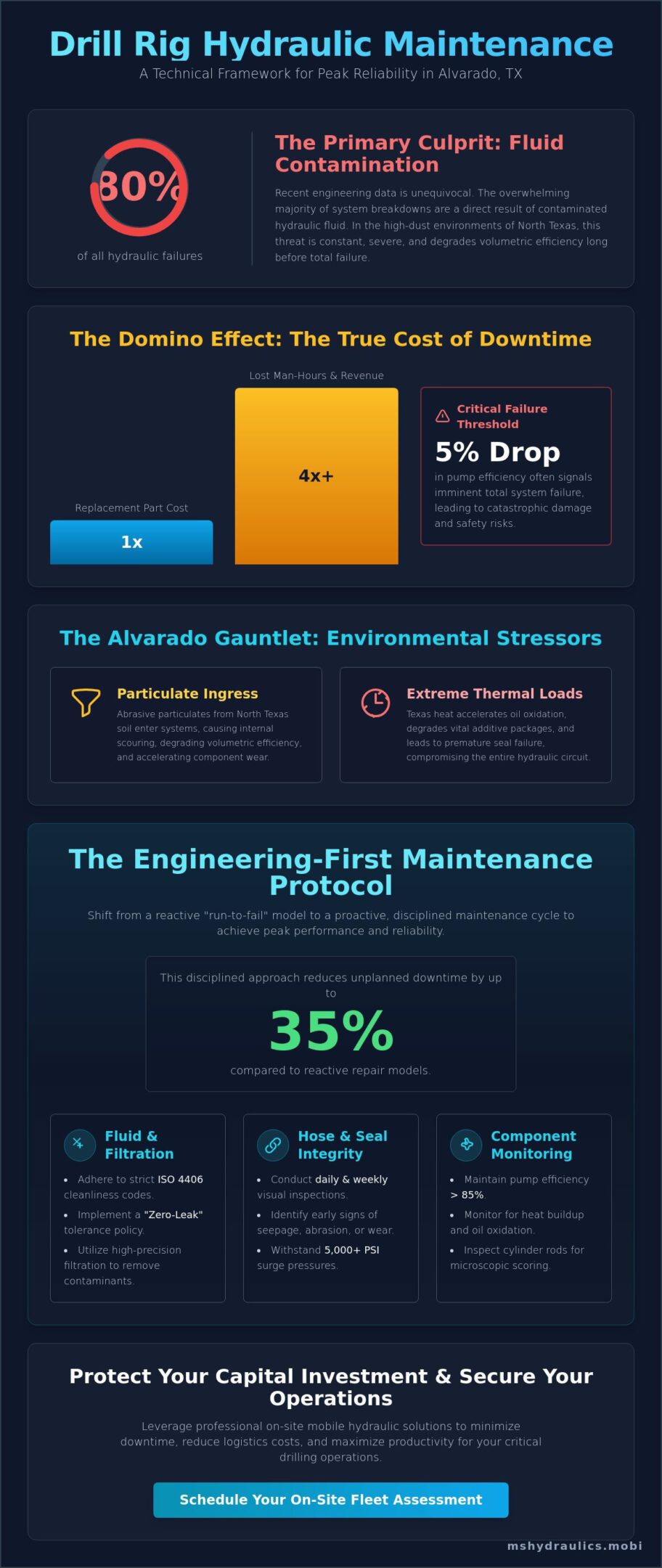
Recent engineering data confirms that 80% of hydraulic system failures are the direct result of fluid contamination. In the high-dust environments of North Texas, particulate ingress often degrades the volumetric efficiency of axial piston pumps long before a total breakdown occurs. You understand that in professional drilling, every hour of unplanned downtime represents a significant loss of operational momentum and revenue. Maintaining precise pressure and displacement isn’t just about functionality; it’s about protecting your capital investment.
This technical guide provides a rigorous framework for drill rig hydraulic maintenance Alvarado to ensure your fleet achieves peak reliability through 2026. We’ll detail a methodical approach to ISO 4406 cleanliness standards, thermal management for extreme Texas climates, and proactive hose assembly inspections. By following these engineering protocols, you’ll secure extended equipment lifespans and maintain a predictable operational schedule that meets the highest industrial benchmarks.
Key Takeaways
- Establish a systematic approach to fluid and seal integrity to ensure maximum uptime within Alvarado’s demanding industrial and oil production sectors.
- Analyze the critical relationship between pump displacement and motor efficiency to optimize the hydraulic circuit’s overall performance and output.
- Implement specialized drill rig hydraulic maintenance Alvarado protocols to mitigate the impact of North Texas temperature fluctuations and particulate contamination on fluid viscosity.
- Adopt rigorous daily and weekly inspection schedules to identify early signs of hose seepage or component wear before they escalate into catastrophic system failures.
- Leverage professional mobile hydraulic solutions to execute on-site repairs, significantly reducing logistics costs and minimizing downtime for critical drilling operations.
The Strategic Importance of Drill Rig Hydraulic Reliability in Alvarado
Drill rig hydraulic maintenance Alvarado is a rigorous, systematic protocol centered on fluid chemistry, seal integrity, and hose assembly resilience. In Alvarado, where industrial activity focuses on critical water well production and oilfield support, hydraulic reliability determines the difference between a profitable contract and a catastrophic loss. A single component failure doesn’t just stop a motor; it halts entire crews. This leads to lost man-hours that often exceed the cost of replacement parts by 400 percent. Maintaining these systems ensures equipment longevity and aligns with the technical standards established for Heavy Equipment Maintenance in Cleburne & North Texas.
Effective drill rig hydraulic maintenance Alvarado ensures that high-pressure components don’t succumb to the abrasive particulates common in North Texas soil. By 2026, the demand for deeper water access in Johnson County has increased the average load on hydraulic pumps by 18 percent. This heightened demand makes the integrity of every valve and cylinder paramount. Proactive care isn’t a luxury; it’s a fundamental requirement for operational safety and project continuity.
Alvarado’s Drilling Demands and System Stress
Modern rigs in Alvarado operate under extreme thermal and mechanical loads that push components to their physical limits. The hydraulic system remains the most vulnerable point of failure because it’s responsible for power transmission through pressurized fluid. High-torque requirements for deep-well drilling place immense stress on pumps and actuators. Operators must understand the core physics of hydraulic machinery to appreciate why a 5 percent drop in efficiency often signals an imminent total system failure. Maintaining peak displacement and pressure is essential for teams aiming to meet 2026 production targets while remaining in strict compliance with OSHA safety standards. A well-maintained system reduces the risk of high-pressure injection injuries and environmental contamination from fluid leaks.
The Engineering Logic of Preventative Maintenance
Ms. Hydraulics advocates for an engineering-first approach that moves away from the “run-to-fail” model common in smaller, less disciplined operations. In industrial settings, we implement a “zero-leak” tolerance policy. Since the industry-wide adoption of stricter ISO 4406 cleanliness codes in late 2023, the focus has shifted toward high-precision filtration and fluid analysis. Even a minor weeping seal allows external contaminants to enter the closed-loop system, which degrades the lubricating properties of the hydraulic oil and causes internal scouring. Our focus on technical precision ensures that every component meets specific performance benchmarks. This disciplined maintenance cycle reduces unplanned downtime by as much as 35 percent compared to reactive repair models. We don’t just fix parts; we optimize the entire hydraulic circuit for long-term stability and maximum torque output.
Critical Hydraulic Components Requiring Technical Oversight
A standard mobile drill rig operates on a complex hydraulic circuit where pump displacement directly dictates motor efficiency and torque output. In Alvarado, operators must maintain a precise balance between flow and pressure to ensure optimal penetration rates. If a pump’s volumetric efficiency drops below 85 percent, the resulting heat buildup accelerates oil oxidation and degrades additive packages. This thermal stress often leads to premature seal failure and internal component wear. Monitoring cylinder rod surfaces is vital; even microscopic scoring can introduce silica or metallic contaminants into the high-pressure loop. Recognizing these early indicators of surface fatigue is the first step toward a necessary heavy equipment cylinder rebuild Texas.
Hydraulic Hose Integrity and Fabrication
High-pressure drilling circuits rely on multi-wire braided hoses to withstand surge pressures that frequently exceed 5,000 PSI during peak load cycles. Common failure points include external abrasion from mast movement and heat aging caused by proximity to engine manifolds. Generic replacements often fail because they lack the specific bend radius or fitting tolerances required for 2026 rig specifications. Custom hose fabrication ensures that every connection meets exact ISO 18752 standards, providing the durability needed for drill rig hydraulic maintenance Alvarado. Precise fitting selection prevents the leak paths that lead to environmental contamination and pressure loss.
Pump and Motor Performance Metrics
Identifying cavitation or aeration is critical before these conditions cause catastrophic pump destruction. Aeration typically manifests as a milky appearance in the hydraulic fluid, while cavitation produces a distinct metallic rattling sound. Technicians should perform regular case drain monitoring to evaluate internal leakage. If case drain flow increases by more than 10 percent over the established baseline, it indicates significant internal wear or plate scoring. These technical indicators allow for proactive repairs before a total system failure occurs. Monitoring these metrics ensures the rig maintains its rated mechanical advantage throughout the drilling cycle.
Cylinder and Valve Block Maintenance
Visible drift in leveling jacks or feed cylinders indicates internal bypass or valve spool wear. Operators should inspect valve spools for scoring, which often results from 5-micron or larger particles bypassing filtration systems. Adhering to OSHA preventive maintenance guidelines ensures that pressure relief valves remain set to manufacturer specifications, preventing structural overstress and hydraulic shock. Maintaining precise settings on the valve block is a core requirement for drill rig hydraulic maintenance Alvarado. For those managing high-duty cycle fleets, scheduling a technical system audit can identify these latent issues before they escalate into expensive field failures.
Managing Environmental Stressors: The Alvarado Climate Factor
Alvarado’s geographical position in North Texas subjects drill rigs to extreme thermal cycling. In 2026, regional climate models indicate a 12% increase in days exceeding 100°F compared to the previous decade. This heat causes hydraulic fluid to thin, dropping viscosity below the minimum requirements for high-pressure pumps. When viscosity falls, the lubricating film between moving parts vanishes. This leads to metal-to-metal contact in components like axial piston pumps. Effective drill rig hydraulic maintenance Alvarado requires transitioning to high-viscosity index (HVI) fluids that resist thinning under these intense thermal loads.
Dust is the secondary environmental threat. Alvarado’s local geology produces fine particulate matter during drilling operations. These abrasive particles settle on exposed cylinder rods and are pulled past primary seals. Once inside the system, they accelerate wear on valve spools and orifices. Maintaining seal integrity involves more than just inspections; it requires a proactive replacement schedule based on duty cycles rather than failure. Technical data from 2025 field tests shows that rigs using secondary rod wipers saw a 30% reduction in internal valve scarring.
- Utilize ISO VG 46 or 68 fluids with a viscosity index above 150 for summer operations.
- Implement synthetic lubricants to maintain shear stability at operating temperatures reaching 100°C.
- Schedule fluid sampling every 500 hours to monitor for oxidative thickening.
Thermal Management in High-Pressure Systems
Operators must track the delta between ambient air and reservoir temperature. If the hydraulic fluid exceeds 180°F (82°C), the chemical bonds in the oil begin to break down. This process, known as oxidation, creates sludge and varnish that clog sensitive proportional valves. Technicians should clean hydraulic oil coolers weekly using low-pressure compressed air to ensure maximum heat rejection. A 5% reduction in cooler efficiency can result in a 15°F rise in operating temperature, which shortens component life by 40%.
Contamination Control and Filtration
Modern drill rigs utilize tolerances measured in microns. Relying on visual fluid checks is a technical error since the human eye can’t see particles smaller than 40 microns. High-performance systems require fluid cleanliness levels of ISO 4406 16/14/11. To achieve this in dusty Alvarado environments, install 3-micron absolute-rated breather filters on all reservoirs. These breathers prevent atmospheric dust from entering the tank as fluid levels fluctuate during cylinder extension. It’s essential to use synthetic media filters that maintain their beta rating even under high-flow surges.
Protocol for Drill Rig Preventative Maintenance
Effective drill rig hydraulic maintenance Alvarado requires a disciplined, tiered approach to ensure component longevity and operational safety. In the high-demand environments of North Texas, equipment operators must move beyond reactive repairs. A structured maintenance protocol prevents the common 15% to 20% efficiency loss often seen in neglected hydraulic systems. By adhering to a rigorous schedule, technicians can identify minor seal weeping before it escalates into a catastrophic pump failure or environmental spill.
The Daily Inspection Checklist
Daily pre-start procedures are the first line of defense. Operators must perform a visual sweep of all critical connection points, specifically searching for “wet” fittings. A damp fitting is a clear indicator of seal degradation or a loosening connection due to vibration. It’s vital to verify hydraulic reservoir levels and inspect the fluid’s condition through the sight glass. If foam or aeration is present, it usually indicates air entrainment from a suction line leak or a low fluid level that’s causing pump cavitation. Finally, test all controls for responsiveness; any hesitation or “spongy” feedback suggests air in the lines or internal bypass issues.
- Daily: External leak checks and fluid level verification.
- Weekly: Detailed hose and fitting audit, looking for cover abrasion, cracking, or seepage at crimp points.
- Monthly: Filter replacement and fluid sampling. Most 2026-standard rigs utilize 5-micron or 10-micron high-efficiency filters.
- Annual: Full system pressure testing and relief valve calibration to ensure the system operates within its 3,000 to 5,000 PSI design parameters.
Advanced Fluid Analysis Procedures
Precision drill rig hydraulic maintenance Alvarado relies on data rather than guesswork. To obtain an accurate fluid analysis, technicians must take a representative oil sample from a pressurized sampling port while the system is at operating temperature. Samples taken from the bottom of a static reservoir often contain settled contaminants that don’t reflect the actual fluid quality circulating through the valves and motors.
Interpreting lab reports requires a focus on ISO 4406 particle counts and the presence of wear metals like iron, copper, and lead. If a report shows an ISO cleanliness code higher than 18/16/13, immediate filtration or fluid replacement is necessary. This data-driven approach allows for the optimization of oil change intervals. Rather than changing oil based on a fixed 1,000-hour schedule, it’s possible to extend fluid life safely if the chemical properties and particle counts remain within specified limits.
For complex issues that exceed standard field checks, operators can utilize On-Site Diagnostic Services for deep system audits. These audits employ electronic flow meters and pressure transducers to map the entire hydraulic circuit and identify internal leakage that visual inspections miss. To maintain your equipment at peak performance, schedule a professional system calibration with our technical team today.
Mobile Hydraulic Solutions for Alvarado Drilling Operations
Operational efficiency in the drilling sector depends on the immediate availability of technical support. Transporting a heavy-duty drill rig from an Alvarado job site to a fixed repair facility often results in 12 to 24 hours of lost productivity. Ms. Hydraulics eliminates these logistical bottlenecks by providing specialized mobile units equipped to handle complex drill rig hydraulic maintenance Alvarado requirements directly in the field. This on-site approach reduces transportation costs and prevents the structural risks associated with moving compromised heavy machinery.
Emergency On-Site Hose Fabrication
Hydraulic hose failure is the primary cause of unplanned downtime in drilling operations. Our mobile units function as fully integrated workshops, capable of reducing downtime from several hours to under 45 minutes. We maintain an inventory of industrial-grade fittings and multi-spiral hoses designed for high-impulse applications up to 6,000 PSI. Our technicians prioritize professional hose routing to eliminate mechanical abrasion and thermal degradation, which are common issues in compact rig configurations. By crimping hoses on-site, we ensure exact length specifications and fitting orientations that meet or exceed OEM standards from manufacturers like Epiroc or Sandvik.
Professional Diagnostic Expertise
Inefficient repair strategies often rely on “parts-swapping,” a method that increases repair bills by 30% or more without addressing the root cause. Ms. Hydraulics utilizes advanced diagnostic tools, including digital flow meters and pressure transducers, to analyze system performance in real-time. Our team possesses the technical depth to troubleshoot both open-loop and closed-loop hydraulic circuits. This precision allows us to pinpoint internal leakage in piston pumps or valve bank malfunctions before they lead to catastrophic component failure. This level of technical proficiency makes us the leading provider for mobile hydraulic repair Cleburne TX and the greater Alvarado region.
Maintaining the integrity of a drill rig’s hydraulic system requires more than just reactive repairs. It demands a structured approach to fluid power management. Our field technicians are trained to identify early signs of cavitation, aeration, and particulate contamination that can compromise rig torque and penetration rates. It’s a comprehensive service model designed to keep your equipment within its optimal performance envelope.
Contact Ms. Hydraulics today to schedule a comprehensive drill rig audit. Our technical team will provide a detailed assessment of your system’s performance parameters to ensure maximum uptime for your Alvarado drilling project.
Securing Hydraulic Integrity for Alvarado Drilling Operations
Achieving peak operational efficiency in the 2026 drilling season requires a rigorous commitment to system integrity. Maintaining high-pressure components and managing thermal expansion under Alvarado’s specific environmental conditions isn’t optional for professional operators. Effective drill rig hydraulic maintenance Alvarado protocols focus on precise displacement measurements and the mitigation of particulate contamination within the fluid stream. Since 2021, MS Hydraulics has delivered technical excellence across North Texas by prioritizing engineering accuracy over reactive repairs. Our technicians provide expert on-site diagnostics for heavy equipment to identify potential failures before they result in catastrophic downtime. We specialize in high-pressure hose fabrication, ensuring every assembly meets rigorous industrial standards for torque and pressure retention. By implementing a structured preventative schedule, you secure the mechanical longevity and reliability of your fleet. It’s time to transition from basic oversight to professional technical management. Let’s ensure your equipment remains a high-performing asset on every job site.
Schedule Your Drill Rig Hydraulic Audit with Ms. Hydraulics Today
Frequently Asked Questions
How often should I change the hydraulic filters on my drill rig?
You should replace hydraulic filters every 500 operating hours or as soon as the differential pressure indicator reaches the 80% threshold. Operating beyond this point triggers the bypass valve, which allows unfiltered oil to circulate through the system. This practice ensures that the fluid stays within the ISO 4406 cleanliness parameters required for sensitive valves. Regular intervals prevent 90% of premature wear in high-pressure circuits.
What are the first signs of hydraulic pump failure on a rig?
The primary indicators of pump failure include a distinct increase in audible noise and a 15% reduction in cycle speed. Aeration usually produces a loud banging sound, while cavitation sounds like high-pitched rattling. If the pump housing temperature exceeds the reservoir temperature by more than 20 degrees Fahrenheit, internal leakage is likely occurring. These mechanical signals require immediate diagnostic attention to prevent total system seizure.
Can I repair a leaking hydraulic hose on-site in Alvarado?
You shouldn’t attempt to patch a hose; instead, replace the entire assembly to ensure safety and performance. Field repairs often fail to meet SAE J517 burst pressure requirements. For drill rig hydraulic maintenance Alvarado technicians, installing a factory-certified assembly is the only way to prevent catastrophic fluid loss. It’s safer to keep a stock of pre-crimped hoses for your specific rig model.
Is it worth rebuilding a hydraulic cylinder or should I buy new?
Rebuilding a cylinder is the preferred option if the internal bore and piston rod remain within 0.005 inches of their design tolerances. If the rod shows deep scoring or the chrome layer has worn through, the cost of machining often makes a new unit more economical. We’ve found that 70% of cylinders can be successfully restored with a high-quality seal kit and light honing.
What hydraulic fluid viscosity is best for the North Texas summer?
An ISO VG 68 or VG 100 weight oil is the most effective choice for the North Texas summer when ambient temperatures regularly hit 105 degrees Fahrenheit. These heavier grades maintain a minimum viscosity of 13 centistokes, which is vital for lubricating pump bearings under high loads. Using a lighter VG 46 oil in extreme heat can lead to film breakdown and accelerated component wear.
How do I prevent contamination when changing hydraulic components in the field?
You can prevent contamination by using plastic plugs to seal all open ports and cleaning the work area with a vacuum instead of compressed air. Compressed air often forces 50% more particulates into the open system. Always use lint-free rags and ensure that any new fluid added to the system has been pre-filtered to an ISO 16/14/11 level or better.
Does Ms. Hydraulics offer 24/7 emergency service for drill rigs in Alvarado?
MS Hydraulics provides 24/7 technical support and component dispatch for all drilling operations in the Alvarado region. We understand that downtime costs are high, so we’ve established a rapid response protocol for urgent repairs. Our team maintains a 60-minute deployment window for critical site failures. This commitment to drill rig hydraulic maintenance Alvarado ensures your project remains on schedule regardless of the hour.
What ISO cleanliness level should I aim for in my drilling hydraulics?
High-pressure drilling systems should maintain an ISO 4406 cleanliness level of 18/16/13 to maximize the life of piston pumps and proportional valves. This code tracks the concentration of particles at the 4, 6, and 14-micron levels. Achieving this standard can extend the mean time between failures by 200%. It’s a critical metric for any rigorous and professional maintenance program.