Agricultural Equipment Hydraulic Service in Dallas: Mobile Field Repairs (2026)
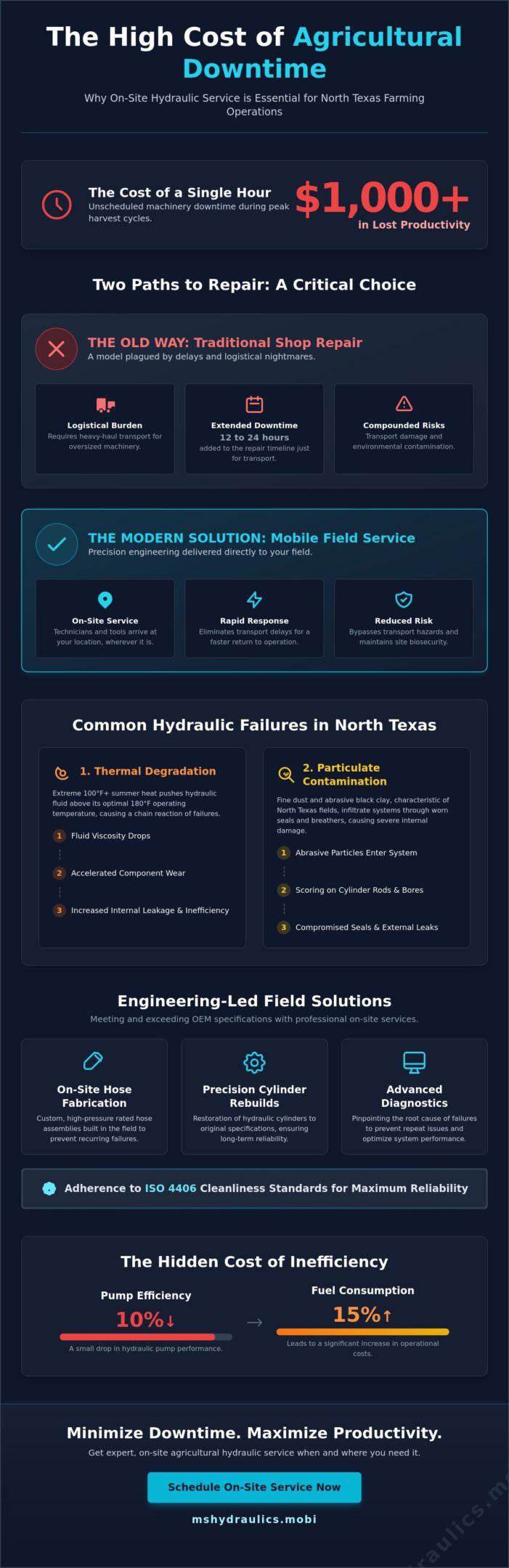
Unscheduled machinery downtime during peak harvest cycles costs North Texas operators upwards of $1,000 per hour in lost productivity according to regional agricultural data. You recognize that the logistical burden of transporting heavy machinery to a fixed facility often compounds these losses. This is why professional agricultural equipment hydraulic service Dallas providers have shifted to a mobile-first model. By bringing precision engineering directly to the field, operators bypass the risks associated with equipment transport and environmental contamination.
Maintaining high-pressure systems in dusty, field-grade environments requires more than a temporary patch. You require components that meet or exceed ISO 4406 cleanliness standards to ensure long-term mechanical reliability. This article details how mobile hydraulic expertise eliminates agricultural downtime through on-site hose fabrication, cylinder rebuilds, and advanced diagnostic services. You’ll learn about the specific technical protocols that ensure high-pressure rated replacements and professional diagnostics. These methods prevent recurring failures and ensure a rapid return to operational status.
Key Takeaways
- Understand how precision maintenance for high-torque systems mitigates the operational risks associated with large-scale agricultural machinery in North Texas.
- Identify the critical impact of thermal degradation and particulate contamination on hydraulic fluid performance during extreme Dallas-Fort Worth climate conditions.
- Compare the response times and cost-efficiencies of on-site agricultural equipment hydraulic service Dallas against the traditional logistics and downtime of dealership scheduling.
- Gain technical insight into the SAE and ISO standards governing professional-grade hose fabrication and precision hydraulic cylinder restoration.
- Explore the comprehensive mobile service coverage area and the engineering-led approach used to restore hydraulic performance directly in the field.
The Critical Impact of Hydraulic Reliability on North Texas Agriculture
Agricultural hydraulic service involves the specialized maintenance and recalibration of high-torque, high-pressure systems designed for heavy-duty earthmoving and harvesting. Unlike standard industrial applications, Hydraulic machinery used in North Texas agriculture operates under extreme thermal loads and volatile environmental conditions. In the Dallas-Fort Worth metroplex and surrounding areas like Cleburne, agricultural operations manage thousands of acres that require 100% equipment availability during peak seasons. The demand for specialized agricultural equipment hydraulic service Dallas has grown as machinery becomes more complex. When a combine or tractor fails, the financial impact is immediate. Industry data suggests that unscheduled downtime during the harvest window can cost operators upwards of $1,000 per hour in lost productivity and crop degradation. Standard industrial repair shops often lack the specific field experience to address these high-stakes requirements.
The Logistics of Agricultural Machinery in Dallas
Transporting oversized implements from fields in Waxahachie, Alvarado, or Mansfield to a centralized repair facility presents significant logistical hurdles. Moving a 20-foot wide planter or a 40,000-pound harvester requires specialized permits and heavy-haul trailers; this adds 12 to 24 hours to the repair timeline. This delay is unacceptable when weather windows are closing. Modern precision farming technologies rely on hydraulic actuators to manage variable-rate seeding and automated steering. By 2026, the integration of electro-hydraulic controls in North Texas fleet operations is expected to increase by 22%. Reliable agricultural equipment hydraulic service Dallas providers must offer mobile field solutions to keep these complex systems operational where they sit. It’s the only way to maintain the pace required by modern production schedules.
Why Field-Ready Hydraulics Matter
Effective heavy equipment maintenance focuses on system integrity and fluid cleanliness. Hydraulic efficiency directly correlates to fuel consumption. A 10% drop in pump efficiency can increase fuel burn by 15% under heavy load. Maintaining these systems also prevents environmental fluid leaks, which is essential for ISO-compliant operations and soil health. Key maintenance priorities include:
- Monitoring pump displacement and torque outputs to ensure peak performance.
- Inspecting high-pressure seals to prevent catastrophic fluid loss.
- Analyzing hydraulic fluid for particulate contamination that causes internal scoring.
- Calibrating precision valves used in automated steering and implement depth control.
A disciplined approach to hydraulic health ensures that North Texas producers don’t face unexpected failures during the most critical weeks of the year. Reliability isn’t just about fixing what’s broken; it’s about maintaining the engineering tolerances that define modern agricultural output.
Identifying Common Hydraulic Failures in High-Torque Ag Machinery
High-torque agricultural machinery in the Dallas-Fort Worth corridor operates under extreme thermal stress. North Texas summer temperatures frequently exceed 100°F, causing hydraulic fluid to reach critical temperatures above 180°F. This heat reduces fluid viscosity, leading to accelerated wear on internal pump components and increased internal leakage. Maintaining proper viscosity is essential for lubricating high-pressure interfaces. When fluid thins, the protective film between moving metal parts vanishes, resulting in metal-on-metal contact that generates additional heat and debris.
Particulate contamination remains a primary cause of system degradation in local farming operations. The fine dust and black clay characteristic of North Texas fields infiltrate systems through breather caps and worn seals. These abrasive particles cause rod scoring in cylinders, which compromises seal integrity and leads to external leakage. Effective agricultural equipment hydraulic service Dallas requires a technical understanding of these failure modes to prevent recurring issues. Operators must remain vigilant regarding agricultural hydraulic system hazards, particularly pinhole leaks that occur when hoses are subjected to constant vibration and pressure spikes during heavy tillage. For precision diagnostics and field support, owners often rely on specialized mobile repair teams to address these vulnerabilities before they cause total system collapse.
Signs of Impending Hydraulic System Failure
- Audible cues: Cavitation sounds like marbles rattling inside the pump. This indicates air entry or restricted suction lines. High-pitched whining often signals a pump struggling against high pressure or internal wear.
- Visual indicators: Fluid weeping at fittings signals loose connections or cracked housings. Hose abrasion is common where lines rub against the chassis or other implements.
- Performance drops: A 15% reduction in cycle times often indicates pump wear or internal bypass in control valves. Erratic cylinder movement or “spongy” controls suggest air entrainment or mechanical binding.
Agricultural-Specific Component Vulnerabilities
Hose fatigue is prevalent on folding implements and spray booms due to constant flexing. These lines experience mechanical fatigue at the crimp points, which are common failure sites during peak harvesting windows. High-cycle harvesting equipment puts immense pressure on pumps, often leading to volumetric efficiency losses that aren’t immediately visible but degrade performance over time. Valve bank contamination is a specific risk for multi-function tractors where multiple implements are swapped frequently. Each connection point is a potential entry for contaminants that can jam spool valves or erode precision-machined orifices. Maintaining ISO 4406 cleanliness standards is vital for the longevity of these complex hydraulic circuits.
Mobile Field Service vs. Traditional Shop Repair for Ag Equipment
Choosing between field service and a traditional shop depends on more than just location. Traditional dealerships in the Dallas-Fort Worth metroplex often require equipment to be scheduled weeks in advance. For a professional agricultural equipment hydraulic service Dallas provider, the response window is typically measured in hours. This immediacy eliminates the 10 to 14 day lead times common in stationary facilities during peak harvest or planting seasons.
Transporting a disabled tractor or combine involves significant logistical overhead. Hauling fees, permit acquisitions for oversized loads, and the labor hours lost during transit represent “hidden costs” that often surpass the actual repair invoice. Mobile units eliminate these variables by bringing technical expertise directly to the turn-row. This specialized agricultural equipment hydraulic service Dallas relies on mobile workshops equipped with digital flow meters and pressure transducers capable of measuring up to 10,000 PSI.
Technical capabilities of modern mobile units allow for complex procedures that were once restricted to the shop. Technicians perform pump swaps, control valve resealing, and cylinder overhauls directly on the farm. While catastrophic housing failures might require a clean-room environment, 85% of hydraulic failures are resolved on-site through precise component replacement and system flushing.
The Advantages of On-Site Diagnostics
Real-time analysis is the primary benefit of on-site work. Testing a system under actual load conditions provides data that a shop floor cannot replicate. By utilizing on-site diagnostic services, operators identify specific failure points in the circuit, such as internal bypass in a cylinder or cavitation in a pump, before the component experiences total failure. This precision prevents the unnecessary replacement of functional parts and reduces the risk of further mechanical damage that can occur when moving a compromised machine.
Maximizing Uptime in Johnson and Dallas Counties
Reliability across North Texas requires a structured response network. MS Hydraulics manages service routes through Cleburne, Crowley, and Cedar Hill to ensure rapid deployment. Our emergency protocols prioritize time-sensitive operations where a four-hour delay can impact seasonal yields. Key benefits of this localized approach include:
- Strategic Routing: Technicians are positioned near major ag corridors to minimize travel time.
- Fleet Records: We maintain digital logs of pressure settings and component history for every machine.
- Immediate Parts Access: Mobile units carry high-frequency wear items, including ISO-standard seals and fittings.
Maintaining a consistent service record ensures that technical specifications are available to the technician before they arrive. This methodical approach to fleet reliability keeps equipment in the field rather than on a trailer.
Technical Standards for Ag Hydraulic Hose Fabrication and Cylinder Rebuilds
Adherence to SAE J517 and ISO 18752 standards ensures that hydraulic assemblies withstand the 3,000 to 6,000 PSI pressures common in modern tractors and harvesters. For an effective agricultural equipment hydraulic service Dallas providers must distinguish between wire braid and spiral reinforcement. Braided hoses offer superior flexibility for tight routings on implements, while four or six wire spiral hoses prevent wire fatigue in high impulse applications like hydrostatic drives. Using the wrong reinforcement leads to premature failure in 40% of field cases due to internal wire abrasion.
The engineering behind heavy equipment cylinder rebuilds requires more than simple seal replacement. It involves restoring the rod surface finish to a specific Ra (Roughness Average) value, typically between 0.2 and 0.4 micrometers. This precision prevents seal abrasion and fluid bypass. If a rod shows pitting or scoring deeper than 0.005 inches, it requires industrial polishing or chrome plating to maintain a leak free interface under heavy loads. Precision machining ensures that the piston and gland tolerances remain within 0.001 inches of original equipment manufacturer (OEM) specifications.
Custom Hose Fabrication in the Field
Field technicians must identify and match JIC (Joint Industry Council), NPT (National Pipe Thread), and ORFS (O-Ring Face Seal) fittings with zero margin for error. Mismatched threads cause 15% of hydraulic leaks in the Dallas sector. Mobile units utilize adjustable crimping technology to achieve factory spec compression on site. Proper routing is equally critical; technicians ensure a minimum bend radius that exceeds SAE standards by 10% to prevent kinking during full equipment articulation. This attention to detail preserves the flow characteristics and prevents heat buildup in the system.
Cylinder Restoration and Resealing
The restoration process begins with systematic disassembly and a solvent based cleaning to remove abrasive Texas field grit. Technicians select high performance Viton or polyurethane seal kits capable of withstanding 225°F operating temperatures during the peak Dallas summer. Every agricultural equipment hydraulic service Dallas operation concludes with a static and dynamic pressure test. We verify the cylinder integrity at 125% of its rated working pressure to guarantee safety and performance before the machine returns to the field. This methodical approach eliminates the risk of catastrophic failure during critical planting or harvest windows.
Professional Mobile Hydraulic Solutions for Dallas and Johnson County
MS Hydraulics delivers engineering-grade solutions for complex fluid power systems. Our approach prioritizes technical accuracy and system reliability. We understand that a hydraulic failure in the field represents a total halt in production. Our service radius extends from Granbury to Arlington and Waxahachie, ensuring that North Texas operators have access to certified technicians. Integrating expert mobile hydraulic repair into your pre-season checklist is a strategic necessity. This proactive stance mitigates the risk of catastrophic pump failure or valve bank malfunctions during critical windows. We focus on the fundamental physics of your machinery, ensuring every agricultural equipment hydraulic service Dallas farmers receive meets rigorous performance standards.
Comprehensive Fleet Maintenance Plans
We provide customized maintenance schedules for tractors, harvesters, and support equipment. Our process utilizes ISO 4406 fluid cleanliness standards to monitor system health. We perform preventative pressure testing to ensure that components operate within their specified 3,000 to 5,000 PSI ranges. This data-driven approach allows us to identify wear patterns before they lead to downtime. Our technicians measure volumetric efficiency and check for internal leakage in cylinders and motors. Long-term partnerships with MS Hydraulics provide Dallas agricultural operators with a predictable maintenance cadence and improved machinery resale value. We treat your fleet as a high-performance industrial asset, not just a collection of machines.
Contacting MS Hydraulics for Immediate Support
Accurate mobile dispatch requires specific technical data. When calling for an agricultural equipment hydraulic service Dallas technician, please have your equipment’s serial number and a description of the hydraulic malfunction ready. We need to know if you’re experiencing slow cycle times, excessive heat, or unusual noise coming from the pump. Our on-site diagnostic includes a full circuit analysis and temperature check of the hydraulic oil using calibrated sensors. We focus on identifying the primary failure point, whether it’s a worn piston pump or a contaminated directional control valve. We don’t just swap parts; we restore system integrity. Schedule your agricultural hydraulic service today to maintain your fleet’s peak performance and ensure operational continuity throughout the 2026 season.
Optimize Your Field Operations with Precision Hydraulic Support
North Texas agricultural operations depend on the peak performance of high-torque machinery to meet 2026 seasonal demands. Maintaining these complex systems requires more than basic maintenance; it demands technical precision and rapid response. MS Hydraulics has provided specialized agricultural equipment hydraulic service Dallas and the surrounding North Texas region since 2021. Our on-site diagnostic specialists identify critical component failures before they lead to catastrophic system downtime. We eliminate the logistical delays of traditional shop repairs by offering custom hose fabrication in the field. This mobile approach ensures your equipment meets rigorous technical standards for pressure and torque without leaving the job site. Whether you’re managing a fleet in Dallas or Cleburne, our commitment to industrial excellence remains constant. Our team focuses on restoring your machinery to its original engineering specifications with speed and accuracy. Reliability in the field is a product of disciplined engineering and timely intervention. We’re ready to ensure your equipment remains a dependable asset throughout the harvest season.
Request Expert Mobile Ag Hydraulic Service
Frequently Asked Questions
How quickly can a mobile hydraulic technician reach my farm in Dallas?
Our average response time for emergency field calls within the Dallas County perimeter is between 90 and 120 minutes. MS Hydraulics dispatches service units equipped with GPS tracking to optimize routes and ensure the closest technician is assigned to your location. Every mobile unit carries 250 plus standard fittings to facilitate immediate repairs upon arrival. This speed is critical during peak seasons where hourly productivity losses can exceed 1,000 dollars.
Can you fabricate custom hydraulic hoses on-site for any tractor brand?
We fabricate high-pressure hydraulic hoses on-site for all major OEM brands including John Deere, Case IH, and New Holland. Our mobile units utilize crimping technology capable of handling 4-wire spiral hoses up to 2 inches in diameter. We use ISO 18752 compliant materials to meet or exceed original manufacturer specifications for agricultural equipment hydraulic service Dallas. This ensures total compatibility with your tractor’s existing system pressures and flow rates.
Is it possible to rebuild a large hydraulic cylinder in the field?
Technicians perform on-site cylinder resealing and rod replacements for components up to 8 inches in bore diameter. If the barrel requires precision honing or chrome plating, we secure the unit and transport it to our specialized machining facility for advanced restoration. Field repairs focus on replacing catastrophic seal failures and clearing contaminated fluid from the system. We utilize 10,000 PSI torque multipliers to disassemble heavy-duty gland nuts safely in outdoor environments.
What are the main causes of hydraulic hose failure on agricultural implements?
External abrasion accounts for 80 percent of premature hose failures on tillage and seeding equipment. Constant contact with metal frames or soil debris wears through the outer carcass, exposing the wire reinforcement to oxidation and eventual bursting. Improper routing and tight bending radii also contribute to 15 percent of failures during high-cycle operations. We install heavy-duty polyethylene spiral guards to protect new hoses from mechanical wear and UV degradation.
Do you provide hydraulic services for specialized machinery like harvesters?
MS Hydraulics provides comprehensive technical support for complex harvester systems, including hydrostatic drives and header lift circuits. We diagnose pressure drops in closed-loop systems using digital flow meters that are accurate to 1 percent. Our expertise extends to cotton pickers and combine harvesters where multi-valve manifolds manage critical timing. We ensure every agricultural equipment hydraulic service Dallas call addresses the specific torque and flow requirements of these high-capacity machines.
How much does mobile hydraulic repair cost compared to a shop visit?
Mobile service eliminates the logistics costs of transporting 20,000-pound machinery, which often requires specialized hauling permits and heavy-duty trailers. While field service includes a dispatch fee, it prevents the 4 to 6 hour labor loss associated with loading and unloading equipment at a facility. According to 2024 industry benchmarks, on-site repair reduces total machine downtime by an average of 70 percent compared to traditional shop-based models.
What areas in North Texas does MS Hydraulics cover for ag services?
Our service radius extends 75 miles from central Dallas, covering Collin, Denton, Rockwall, and Ellis counties. We maintain active service routes through Sherman, Waxahachie, and Kaufman to support regional farming operations during critical windows. Technicians are stationed strategically to reach 95 percent of North Texas agricultural zones within a 2-hour window. This coverage ensures rural operators receive the same technical precision as industrial clients in urban centers.
Can you perform preventative maintenance on an entire agricultural fleet?
We implement scheduled maintenance programs that include fluid analysis and ultrasonic leak detection for fleets of 10 or more units. Our technicians monitor ISO 4406 cleanliness levels to prevent 90 percent of component failures caused by particulate contamination. We document the service history of every tractor and implement to track wear patterns over 2,000-hour intervals. This systematic approach extends the service life of expensive pumps and motors by 25 percent.