Cost to Rebuild Hydraulic Cylinder in Texas: 2026 North Texas Pricing Guide
For every hour an industrial press or earthmoving machine remains idle in the Dallas-Fort Worth metroplex, operational losses can exceed $500 in lost productivity. Calculating the cost to rebuild hydraulic cylinder in Texas requires more than a simple quote; it demands an engineering perspective on seal geometry, rod resurfacing requirements, and ISO 4406 cleanliness standards. You’ve likely faced the frustration of opaque pricing and the logistical burden of transporting heavy components across the state. It’s a common challenge for fleet managers who must balance immediate cash flow with long-term mechanical reliability.
This 2026 pricing guide delivers a disciplined breakdown of North Texas market variables and technical repair expenses. We’ll examine how precision machining impacts your total investment and provide a framework to determine whether a rebuild or a complete replacement offers the superior return on investment for your specific application. By focusing on certified quality and on-site service efficiency, you can minimize downtime and ensure your hydraulic systems meet the rigorous performance parameters your operations demand.
Key Takeaways
- Understand the projected 2026 market benchmarks for the cost to rebuild hydraulic cylinder in Texas, differentiating between basic resealing and comprehensive structural restoration.
- Analyze how specific technical parameters, such as bore diameter and high-tensile metallurgy, directly dictate labor requirements and material procurement expenses.
- Evaluate the Total Cost of Ownership (TCO) by comparing the long-term ROI of precision-restored components against the extended lead times of new OEM replacements.
- Identify critical field service factors, including mobile logistics fees across the DFW Metroplex and the financial impact of emergency diagnostic premiums.
- Discover how detailed teardown reports and itemized quotes ensure pricing integrity and technical precision for industrial hydraulic operations.
Understanding Hydraulic Cylinder Rebuild Costs in North Texas
Calculating the cost to rebuild hydraulic cylinder in Texas requires a precise evaluation of component wear and the specific performance parameters required for the application. In the 2026 North Texas industrial market, pricing is dictated by the complexity of the mechanical intervention. A basic reseal focuses on internal fluid retention, while a comprehensive structural rebuild addresses the integrity of the rod, barrel, and piston assembly. Professional restoration ensures that the hydraulic cylinder maintains its original displacement and pressure ratings, preventing premature system failure in high-torque environments. Precision engineering during the rebuild process is vital for maintaining the operational safety of heavy machinery.
Typical Price Ranges for Common Cylinder Services
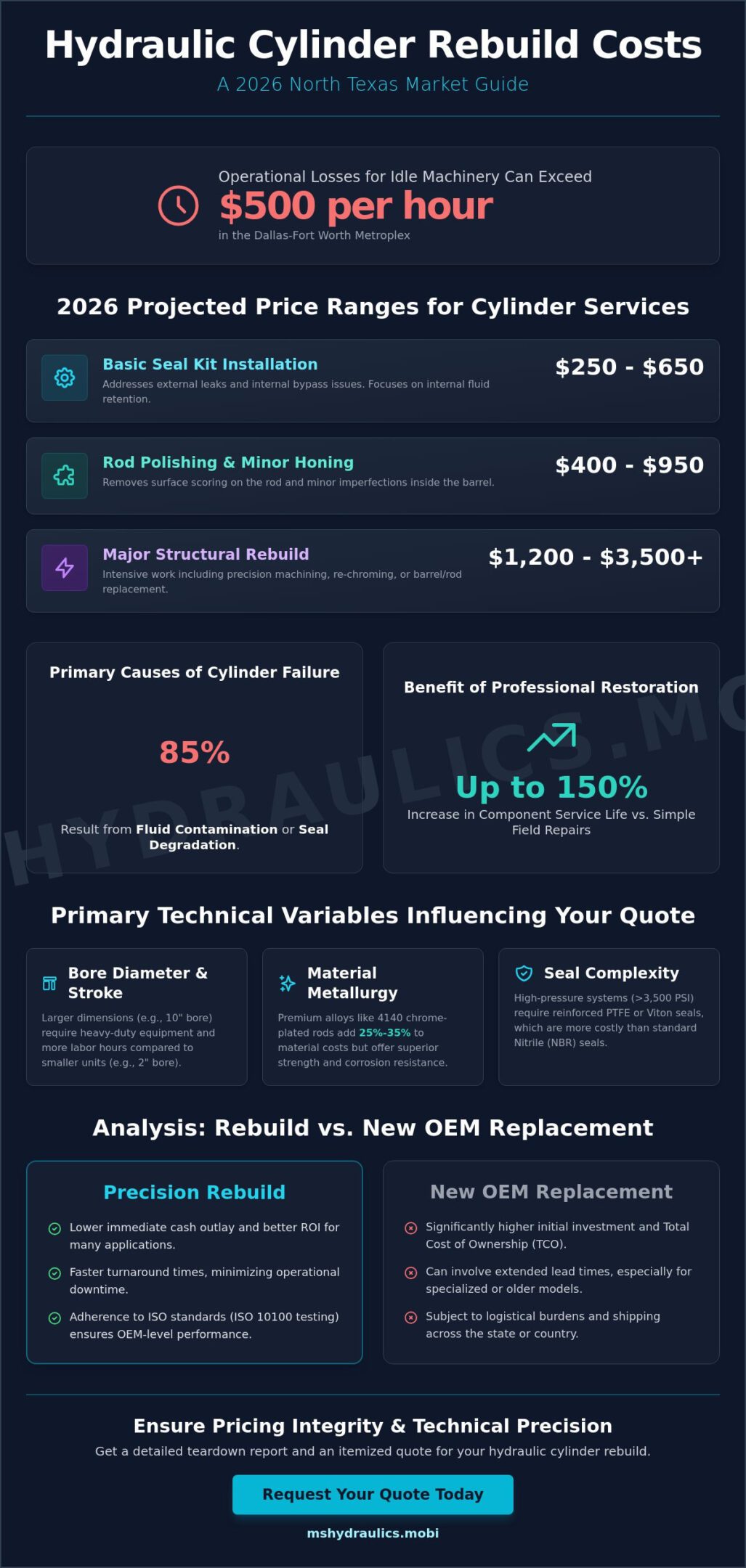
Standard service rates in the Dallas-Fort Worth (DFW) region are categorized by the depth of the repair. For basic seal kit installation, operators can expect costs between $250 and $650. This service addresses external leaks and internal bypass issues. If the unit requires rod polishing or minor bore honing to remove surface scoring, pricing typically scales to the $400 to $950 range. Major rebuilds are more intensive. These projects involve precision machining, rechroming of the rod, or barrel replacement. Such operations demand specialized equipment and carry a price tag ranging from $1,200 to $3,500 or more, depending on the bore size and stroke length. These figures reflect the 2026 market average for industrial grade components.
The Regional Economic Context of Cleburne and Fort Worth
The 2026 economic environment in Cleburne and Fort Worth directly impacts service lead times and labor overhead. Local construction and agricultural sectors drive a high volume of repair requests. This demand influences the availability of specialized technicians. Proximity to major DFW logistics hubs generally reduces shipping costs for parts, but high regional demand often offsets these savings. North Texas labor averages remain competitive with national benchmarks, yet the concentration of heavy industry in the region necessitates a focus on ISO certified processes. Adherence to ISO 10100 standards for testing ensures that every rebuilt unit meets rigorous safety and performance metrics. Professional shops in the region prioritize these certifications to provide reliability that matches original equipment manufacturer (OEM) specifications. This disciplined approach to engineering ensures that the 2026 cost to rebuild hydraulic cylinder in Texas reflects a high standard of technical accuracy and long-term durability.
- Basic Seal Kit Installation: $250 – $650
- Rod Polishing and Minor Honing: $400 – $950
- Major Structural Rebuilds: $1,200 – $3,500+
Technical data indicates that 85 percent of cylinder failures result from fluid contamination or seal degradation. Addressing these issues through professional restoration rather than simple field repairs extends the service life of the component by up to 150 percent. This methodical flow of maintenance protects the capital investment of the fleet owner and ensures predictable performance in the field.
Primary Technical Variables Influencing Your Repair Estimate
Estimating the cost to rebuild hydraulic cylinder in Texas requires a detailed analysis of specific mechanical parameters. Labor hours scale directly with bore diameter and stroke length. A cylinder featuring a 10-inch bore requires overhead cranes and heavy-duty lathes for disassembly, whereas a 2-inch unit is manageable with standard bench tools. In North Texas industrial environments, technicians often find that material metallurgy significantly impacts the final quote. Standard 1045 cold-finished steel is the baseline, but high-cycle applications often necessitate 4140 chrome-plated induction-hardened rods. These premium alloys provide superior yield strength and corrosion resistance, though they typically increase raw material expenses by 25% to 35%.
Seal complexity is another critical cost driver. While standard Nitrile (NBR) seals are sufficient for basic mineral oils, high-pressure systems exceeding 3,500 PSI require reinforced PTFE or Viton compounds. These specialized materials prevent seal extrusion under extreme thermal loads. Implementing a consistent preventative maintenance plan helps operators identify seal degradation before it leads to catastrophic internal bypass. During the initial teardown, technicians look for non-visible wear, such as piston nut galling or internal tube swelling, which can add hours to the machining process.
Rod and Barrel Condition Assessment
The physical state of the rod determines if the repair stays within a standard seal-and-hone budget. Surface pitting can often be polished out, but deep scoring exceeding 0.015 inches usually demands a full rod replacement or industrial hard chrome plating. If the barrel shows internal cavitation or “wasboarding,” standard honing might be insufficient. In these instances, the shop must perform re-sleeving or a complete barrel fabrication. Precision engineering is mandatory here; maintaining machining tolerances within 0.001 inches ensures the new seals don’t fail prematurely under load.
Specialized Component and Application Requirements
Telescopic cylinders represent a higher level of complexity compared to standard double-acting units. Each stage requires its own set of seals and individual machining, which multiplies the labor hours. High-duty cycle applications, such as those found on drill rigs or large excavators, often utilize integrated load-holding valves and electronic position sensors. These components require specialized testing and calibration to meet ISO 4406 cleanliness standards. For projects involving complex multi-stage units, reviewing technical specifications from a qualified manufacturer can help clarify the necessary rebuild steps. The cost to rebuild hydraulic cylinder in Texas will always reflect the precision required to restore these sophisticated systems to their original OEM performance levels.
Economic Analysis: Rebuilding vs. Purchasing New Components
The financial decision to restore hydraulic components depends on a rigorous Total Cost of Ownership (TCO) calculation. In 2026, the cost to rebuild hydraulic cylinder in Texas remains a primary strategic advantage for fleet managers facing 12 to 18 percent increases in OEM part prices. While purchasing a new unit requires a 100 percent capital outlay, a precision rebuild typically costs between 50 percent and 70 percent of that total. This 30 to 50 percent savings directly improves operational margins without sacrificing mechanical integrity.
Lead time is a critical variable in the TCO equation. Current industrial projections for 2026 indicate that OEM shipments for specialized cylinders often exceed 10 weeks due to ongoing logistics constraints. A regional North Texas rebuild facility can often complete a full restoration in 5 to 10 business days. This reduction in downtime prevents the catastrophic revenue loss associated with idle machinery. From a technical standpoint, a professional rebuild often exceeds original specifications. Technicians utilize advanced seal materials, such as high-performance Viton or reinforced polyurethane, which offer superior thermal stability compared to standard nitrile seals found in off-the-shelf components.
Sustainability also drives the economic shift toward restoration. Rebuilding a cylinder consumes approximately 80 percent less energy than manufacturing a new unit from raw ore. By recycling the heavy steel barrel and rod, industrial sectors reduce their carbon footprint while maintaining high-pressure performance standards.
Evaluating the ROI of Professional Restoration
Precision engineering ensures that the ROI of a rebuild is realized through extended service intervals. A rebuilt cylinder often outlasts cheap aftermarket replacements that lack the hardening depth required for 5,000 PSI applications. When calculating long-term value, engineers must consider the Heavy equipment cylinder rebuild Texas process as an investment in component life extension. If the rod is re-chromed to exact tolerances and the bore is honed to a mirror finish, the unit functions with the same volumetric efficiency as a factory-new component.
When Replacement is the Only Logical Solution
Restoration is not always feasible. Technicians must identify catastrophic failure points that render a rebuild uneconomical. These include:
- Cracked base lugs or integrated mounting points that compromise structural safety.
- Severe barrel distortion or “ballooning” caused by extreme pressure spikes.
- Deep longitudinal scoring in the bore that exceeds 0.030 inches, requiring excessive material removal.
The standard industry threshold for replacement occurs when the cost to rebuild hydraulic cylinder in Texas exceeds 75 percent of the price of a new unit. Additionally, the impact of obsolete parts can force a replacement. If a manufacturer has ceased production of specific internal valves or proprietary piston designs, sourcing custom-machined replacements may drive costs beyond the value of the asset. For those Troubleshooting Common Hydraulic Issues, an initial diagnostic will determine if the internal damage allows for a cost-effective hone and seal replacement or if the metallurgy has failed beyond repair.
Hidden Costs and Field Service Factors in the DFW Metroplex
The total cost to rebuild hydraulic cylinder in Texas involves more than just bench labor and seal kits. Field service logistics across the DFW Metroplex introduce variables that impact the final invoice. For projects in Alvarado, Granbury, or Mansfield, travel fees are calculated based on mileage and technician transit time. Environmental disposal fees for hydraulic fluids also add to the overhead. Industrial operations must account for the safe handling of contaminated fluids to maintain compliance with state environmental standards. These fees cover the processing of used oils and the disposal of worn components that may contain hazardous residues.
Downtime represents a direct drain on project margins. Idle machinery can cost an operator between $200 and $600 per hour depending on the equipment class and the specific application. A failed cylinder on a primary excavator halts production entirely, leading to missed deadlines and potential contract penalties. Calculating these losses is essential when evaluating the cost to rebuild hydraulic cylinder in Texas versus purchasing a new unit. High-precision repairs often prove more economical when they minimize the duration of equipment unavailability.
Mobile Diagnostic and Labor Fees
Professional technicians in Crowley and Arlington typically bill mobile labor at a higher rate than shop time. This premium covers the specialized service vehicles and diagnostic tools brought directly to the job site. Utilizing on-site diagnostic services can identify if a performance issue is actually a valve failure or a pump pressure drop rather than an internal cylinder leak. This precision prevents the unnecessary expense of removing and transporting a functional cylinder. Mobile labor rates are often tiered based on the complexity of the hydraulic system and the specialized tooling required for the teardown.
Logistics and Emergency Response
Emergency response requests for 24/7 service often incur a significant surcharge. A 24-hour turnaround on a rebuild requires shifting shop priorities and potentially paying overtime for specialized machining and assembly. Travel zones also dictate pricing. A service call to Waxahachie involves different logistical considerations than one in Cedar Hill due to traffic density and distance from central parts hubs. Field-ready hose fabrication during a cylinder service call provides additional value. It ensures that the entire hydraulic circuit is restored to peak operating pressure without requiring a second visit, which reduces the overall cost to rebuild hydraulic cylinder in Texas by consolidating service tasks.
Secure your equipment’s performance with a detailed quote on hydraulic cylinder service tailored to your specific site location and urgency requirements.
Ms. Hydraulics: Precision Cylinder Restoration in Cleburne
Ms. Hydraulics approaches every project with the technical rigor expected in high-pressure industrial environments. Our facility in Cleburne serves as a hub for complex component restoration, where we prioritize engineering data over guesswork. Since our 2022 service expansion, we’ve refined a systematic teardown process that identifies exact failure points before a single part is replaced. This methodology ensures the cost to rebuild hydraulic cylinder in Texas remains transparent and justifiable for fleet managers and plant operators.
Integrity in our pricing model is non-negotiable. Every rebuild begins with a comprehensive diagnostic report that includes measurements of rod straightness, barrel concentricity, and seal gland tolerances. We provide itemized quotes that reflect the actual labor and material requirements of the specific unit. This no-nonsense communication style eliminates the hidden fees often associated with heavy equipment repair. By documenting the root cause of failure, such as fluid contamination or side-loading, we help our partners prevent recurring mechanical issues.
Downtime represents a direct threat to profitability in the DFW construction and industrial sectors. To mitigate this, we’ve deployed mobile units equipped with shop-level precision tools. Our technicians bring specialized diagnostic equipment directly to your job site, allowing for rapid assessment and on-site seal replacements when the cylinder architecture permits. This mobile capability serves as a critical resource for 85% of our local partners who require immediate technical intervention to keep their projects on schedule.
The Ms. Hydraulics Quality Guarantee
Our commitment to reliability is backed by the use of premium seal kits and advanced machining equipment. We don’t settle for “close enough” tolerances. Every cylinder is tested to its rated operating pressure to ensure performance under maximum torque and displacement loads. Local businesses rely on our mobile hydraulic repair Cleburne TX services because we operate with the discipline of an industrial veteran. We adhere to strict ISO-aligned standards, ensuring that every restored component meets or exceeds original equipment manufacturer specifications.
Next Steps for Your Equipment
Securing a technical diagnostic for your machinery is a straightforward process. To request a project-based rebuild quote or a mobile service call, contact our Cleburne office with your equipment’s make, model, and the specific symptoms of the hydraulic failure. When preparing for a mobile technician, ensure the equipment is parked on a stable, level surface and that the hydraulic system is de-pressurized. For more information on long-term reliability, consult our technical guide on Heavy Equipment Maintenance. Understanding the cost to rebuild hydraulic cylinder in Texas is the first step toward restoring your fleet’s operational efficiency.
Optimize Your Equipment Performance for 2026
Maintaining peak operational output requires a disciplined approach to component maintenance. The 2026 North Texas industrial landscape demands precision; even minor seal failures lead to significant pressure drops and mechanical downtime. Choosing a rebuild over a full replacement supports long-term equipment stability while preserving original engineering tolerances. The final cost to rebuild hydraulic cylinder in Texas depends on technical variables like bore diameter, rod resurfacing needs, and seal material requirements. MS Hydraulics provides on-site diagnostics across the DFW Metroplex to identify these factors before any work begins. Our Cleburne facility specializes in the restoration of heavy equipment for construction and agriculture, utilizing project-based transparent pricing to eliminate budget uncertainty. By addressing hydraulic wear early, you’ll ensure your machinery meets rigorous ISO performance standards throughout the upcoming year. It’s the most reliable way to protect your fleet’s mechanical integrity.
Request a Precision Cylinder Rebuild Quote
We look forward to helping you achieve maximum uptime for your critical operations.
Frequently Asked Questions
How much does it typically cost to rebuild a hydraulic cylinder in Texas?
The cost to rebuild hydraulic cylinder in Texas varies based on the unit’s bore diameter, stroke length, and operating pressure requirements. While labor rates in the Dallas-Fort Worth metroplex follow regional industrial machinery standards, a standard rebuild typically ranges from 40% to 60% of the price of a new replacement unit. This investment includes a full technical inspection and the installation of high-performance seals rated for 3,000 PSI or higher.
Is it cheaper to rebuild or replace a hydraulic cylinder?
Rebuilding is the more economical choice for 85% of industrial applications, especially for custom or large-bore cylinders where lead times for new units exceed 12 weeks. If the internal component damage exceeds 65% of the total unit value, replacement becomes the logical engineering decision. We evaluate the economic viability based on the current market price of AISI 1045 cold-finished steel and specialized seal kits.
What factors cause the price of a cylinder rebuild to increase?
Price escalations occur when technicians identify deep scoring on the cylinder walls or lateral runout in the piston rod exceeding 0.002 inches per foot. Machining a new rod from 100,000 PSI yield strength material adds significant labor and material costs. Specialized seal requirements for high-temperature fluids or biodegradable oils also increase the final invoice by 15% to 25% compared to standard nitrile components.
How long does a professional hydraulic cylinder rebuild take?
A standard hydraulic cylinder rebuild requires 24 to 72 hours for diagnostic testing and assembly once all components are on-site. If the rod requires re-chroming or the barrel needs honing to an oversize dimension, the timeline extends to 7 or 10 business days. We maintain a rigorous 100% pressure testing protocol that adds 2 hours to the final quality assurance phase to ensure ISO 4406 cleanliness standards are met.
Do you offer mobile cylinder repair in the Dallas-Fort Worth area?
We provide mobile field services across the Dallas-Fort Worth area for cylinder removal and system diagnostics, but the actual rebuild occurs within our 15,000 square foot climate-controlled facility. Maintaining a sterile environment is critical to prevent particulate contamination during the assembly of internal seals. Our service trucks are equipped with heavy-duty cranes and torque multipliers to handle components weighing up to 5,000 pounds directly at your job site.
Can a hydraulic cylinder be rebuilt if the rod is bent or scored?
A bent or scored rod doesn’t necessitate scrapping the entire unit; we utilize hydraulic presses to straighten rods with less than 0.015 inches of deflection. If scoring is deeper than the 0.001-inch chrome layer, we manufacture a replacement rod using 75,000 PSI minimum yield steel. This restoration process ensures the cost to rebuild hydraulic cylinder in Texas remains lower than purchasing a new OEM component from out-of-state distributors.
What is included in a standard hydraulic cylinder rebuild fee?
The standard rebuild fee encompasses a complete teardown, solvent cleaning of all internal galleries, and a comprehensive micrometer inspection of all critical tolerances. It includes the replacement of all dynamic and static seals, including O-rings, back-up rings, and rod wipers. Every unit undergoes a final performance test at 110% of its rated operating pressure to verify volumetric efficiency and leak-free operation before delivery.
How do I know if my cylinder needs a full rebuild or just new seals?
You’ll need a full rebuild if the internal bypass leakage exceeds 5% of the pump’s rated flow or if visual inspection reveals metal-to-metal contact on the piston wear rings. Simple seal replacement is only appropriate when the cylinder’s internal hard parts remain within original ISO tolerances. If you notice “drifting” under load or external fluid loss at the rod gland, a technical evaluation is required to determine the wear depth.