Hydraulic Cylinder Repair: Houston & North Texas Engineering Guide (2026)
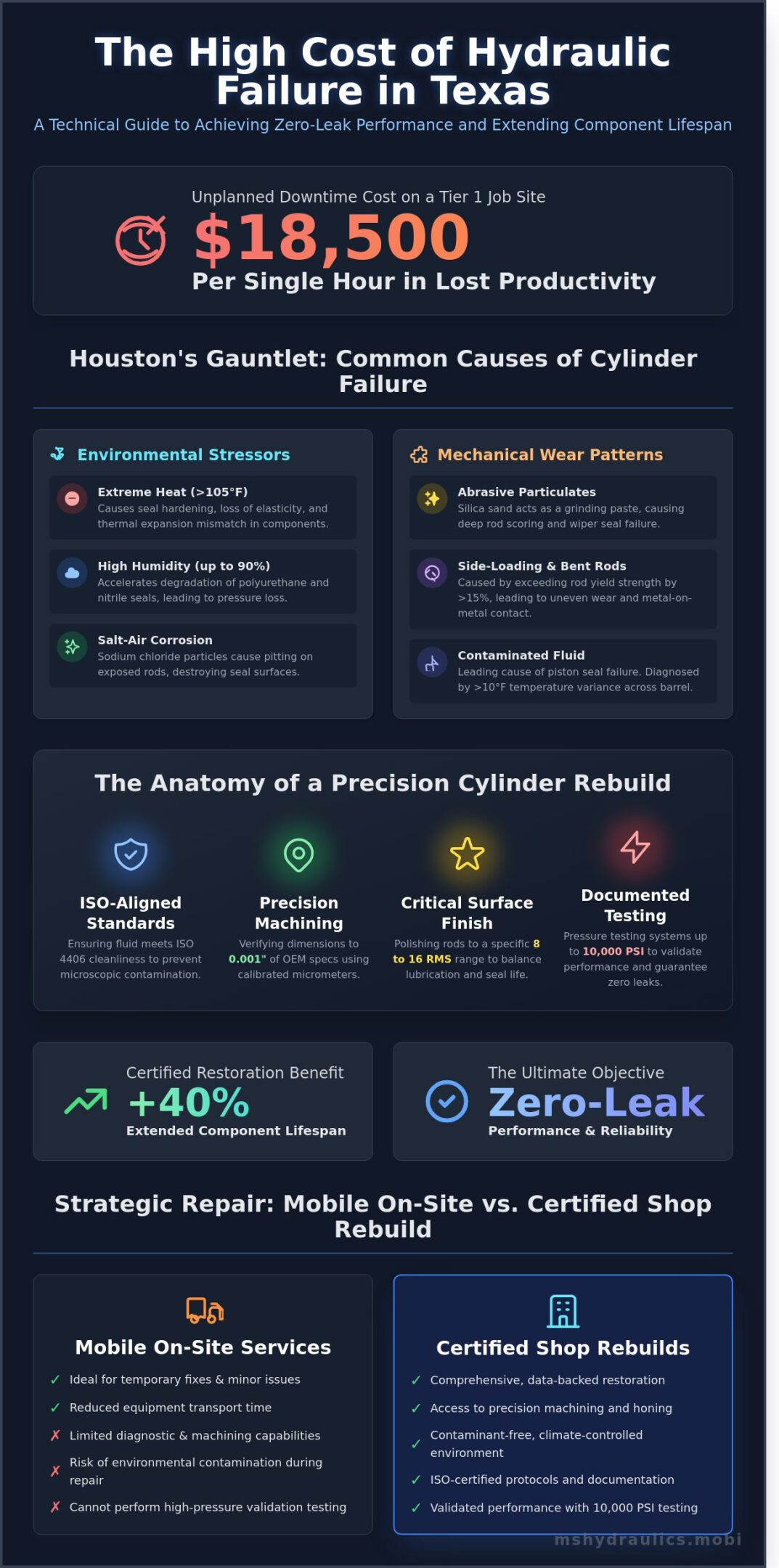
A single hour of unplanned downtime on a Tier 1 job site in the Houston-DFW industrial corridor costs an average of $18,500 in lost productivity. For operations relying on heavy-duty actuation, the difference between a temporary fix and a certified restoration often determines the profitability of a multi-million dollar contract. You’ve likely experienced how repeated seal failures and pressure drops aren’t just maintenance nuisances; they’re symptoms of engineering oversights that compromise your entire project timeline. Securing a reliable partner for hydraulic cylinder repair houston requires more than a local shop. It demands an ISO-certified approach to high-pressure industrial specs that can withstand the most demanding cycles.
This technical guide provides a framework for achieving zero-leak performance and extending component lifespan by 40% through rigorous, data-backed restoration protocols. We’ll examine the specific engineering requirements professionals must meet, from 10,000 PSI documented pressure testing to the specific metallurgical selections required for 105-degree Texas operating environments. By the end of this analysis, you’ll have the technical criteria needed to evaluate repair options and eliminate catastrophic failures in your hydraulic systems.
Key Takeaways
- Analyze how Texas-specific environmental factors, such as high humidity and abrasive particulates, accelerate seal degradation and rod scoring.
- Understand the engineering requirements for a precision rebuild, including the critical role of specific RMS finishes in extending seal longevity.
- Evaluate the strategic trade-offs between mobile on-site services and the industrial certification benefits of shop-based hydraulic cylinder repair houston.
- Learn to optimize fleet reliability by selecting appropriate hydraulic fluid viscosities tailored to the distinct climates of Houston and North Texas.
- Discover the logistics and ISO-aligned standards necessary to maintain hydraulic integrity for equipment operating across the Cleburne and Alvarado industrial corridors.
Common Causes of Hydraulic Cylinder Failure in Houston’s Industrial Sector
Houston’s industrial landscape subjects heavy machinery to some of the most rigorous operating conditions in North America. High ambient temperatures, often exceeding 100°F, combined with relative humidity levels that frequently peak at 90%, accelerate the degradation of polyurethane and nitrile seals. These environmental factors lead to seal hardening and loss of elasticity, which eventually results in fluid leakage and pressure loss. When searching for hydraulic cylinder repair houston, facility managers must prioritize service providers who understand these localized stressors and their impact on hydraulic system longevity.
Environmental Stressors in the Texas Gulf Coast
Operations near the Port of Houston face the added challenge of salt-air corrosion. Sodium chloride particles settle on exposed cylinder rods, initiating pitting that destroys the smooth surface required for a leak-free seal. Thermal expansion is another critical variable; in high-cycle industrial applications, internal fluid temperatures can climb 40°F above ambient levels, causing metal components to expand at different rates. To mitigate these risks, MS Hydraulics utilizes advanced fluid analysis to detect microscopic environmental contamination before it causes a total system shutdown. This proactive approach identifies specific chemical markers of salt-water ingress or oxidative byproduct buildup, ensuring the integrity of the hydraulic circuit remains within ISO 4406 cleanliness standards.
Mechanical Wear Patterns on Heavy Equipment
Mechanical failure often stems from improper operation or neglected maintenance schedules. In construction and agriculture, abrasive particulates like silica sand act as a grinding paste between the rod and the wiper seal, leading to deep rod scoring. Understanding the Technical Anatomy of a Hydraulic Cylinder is vital for diagnosing how these external contaminants breach the internal system. For example, bent rods are frequently observed in skid steer and excavator operations where overloading exceeds the rod’s yield strength by more than 15%. This misalignment introduces side-loading forces that cause uneven wear on the bushing and gland nut, eventually leading to catastrophic metal-on-metal contact.
Contaminated hydraulic fluid remains the leading cause of piston seal failure. When particulate matter enters the high-pressure chamber, it creates micro-channels in the seal face. Skilled technicians identify internal bypass issues by performing temperature differential checks across the cylinder barrel. A variance of more than 10°F between the inlet and the barrel surface often indicates that high-pressure fluid is slipping past the piston seal, converting kinetic energy into heat. This diagnostic precision is essential for effective hydraulic cylinder repair houston, as it distinguishes between a simple seal replacement and a more complex barrel honing or rod re-chroming requirement. Visual indicators, such as “rainbowing” on the rod surface, signal that the chrome plating has been subjected to extreme friction, necessitating immediate intervention to prevent total component failure.
The Technical Anatomy of a Precision Cylinder Rebuild
A professional hydraulic cylinder repair houston requires more than a simple seal swap. It involves a systematic engineering process consisting of disassembly, diagnostic inspection, precision machining, and validated testing. According to the National Fluid Power Association, fluid power systems rely on the absolute integrity of these components to maintain pressure and force. We utilize micrometers to verify dimensions within 0.001 inches of OEM specifications. This level of precision ensures the rebuild meets or exceeds the original performance ratings for the specific application.
Surface finish is a critical parameter that dictates the longevity of the entire assembly. Technicians polish rods to a specific 8 to 16 RMS finish. This range is vital; a surface that’s too smooth won’t hold the oil film needed to lubricate the seal, while a surface that’s too rough will shred the seal material within a few hundred cycles. Similarly, we hone every barrel to remove internal scoring and restore the cross-hatch pattern necessary for optimal seal performance and piston stability.
Disassembly and Engineering Inspection
Every hydraulic cylinder repair houston starts with a forensic teardown. Technicians document failure points to identify if the issue is a one-time event or a recurring system fault. We check for barrel ballooning, which often indicates pressure spikes exceeding 5,000 PSI that have stretched the metal beyond its elastic limit. We also evaluate the piston-to-rod connection for signs of fatigue. A loose connection or compromised threads can lead to catastrophic internal failure or rod buckling under high-load cycles.
Machining and Component Restoration
Restoration decisions depend on the extent of the wear and the urgency of the project. If a rod shows pitting or scratches deeper than 0.015 inches, we determine whether to perform a full rod replacement or an industrial hard chrome plating process. For legacy or obsolete equipment where parts are no longer available, we provide custom fabrication of glands and pistons. You can find detailed technical specs on these restoration processes in our heavy equipment cylinder rebuild Texas guide. Our machine shop utilizes CNC technology to ensure every custom part aligns with the original engineering intent and material requirements.
Rigorous testing follows every rebuild to ensure the unit handles its rated load without bypass or external leaks. If your system shows signs of drift or external leakage, it’s time to consult with a technical specialist to prevent total component failure and expensive downtime.
Mobile On-Site Repair vs. Precision Shop Rebuilds: A Strategic Comparison
Mobile intervention serves as a tactical response to immediate downtime, while shop-based restoration represents a strategic engineering investment. For operators seeking hydraulic cylinder repair Houston, the decision hinges on the operational environment and the required ISO 4406 cleanliness standards. Field repairs performed in Houston’s humid, particulate-heavy atmosphere often introduce contaminants that compromise seal longevity. Statistics indicate that 80% of hydraulic system failures originate from fluid contamination; therefore, opening a cylinder in a non-controlled environment remains a high-risk maneuver.
A field-service "get-running" repair is appropriate for external leak containment or hose replacement. However, when evaluating structural integrity, engineers must consider the Fatigue and Strength Analysis of Cylinder Bolts to prevent catastrophic mechanical failure during high-cycle operations. If a cylinder exhibits internal bypassing or scored rod surfaces, it must be pulled and sent to a clean-room facility. Only a controlled shop environment allows for the 10,000 PSI static and dynamic testing required for industrial recertification.
When to Call for Mobile Hydraulic Repair
Mobile units excel at rapid diagnostics and emergency hose fabrication on Houston job sites. These technicians address system-wide pressure fluctuations and identify pump-related issues that mimic cylinder failure. For localized leaks or minor seal weeping in North Texas, operators should reference the mobile hydraulic repair Cleburne TX guide for expected response times and diagnostic capabilities. Mobile service is optimized for 3,000 PSI systems where immediate uptime outweighs the need for a full component overhaul.
The Advantages of the Ms. Hydraulics Shop Environment
The Ms. Hydraulics facility utilizes contamination control protocols that are impossible to replicate in the field. Our shop environment provides:
- Precision Torque Application: Heavy-duty torque benches capable of exceeding 50,000 lb-ft ensure that piston nuts and head glands are secured to exact OEM specifications.
- Controlled Assembly: Clean-room conditions prevent microscopic abrasives from entering the cylinder during the critical seal installation phase.
- Verification Testing: Every hydraulic cylinder repair Houston project concludes with a multi-point verification on a high-pressure test stand, simulating 100% of the unit’s rated load.
This methodical approach ensures that the rebuilt unit meets or exceeds original performance parameters, backed by documented pressure charts and technical certifications. For large-bore cylinders or high-pressure 5,000 PSI applications, the shop environment is the only way to guarantee long-term reliability.
Maintaining Hydraulic Integrity in the Texas Climate
Operational reliability in Texas requires a maintenance strategy that accounts for regional environmental variances. Fleet managers overseeing assets between North Texas and the Gulf Coast must adjust protocols to meet specific atmospheric demands. In Houston, high relative humidity accelerates moisture ingression, which degrades fluid lubricity and causes internal oxidation. Conversely, the Dallas-Fort Worth corridor often experiences 40-degree temperature shifts within 12-hour periods. These fluctuations demand high viscosity index (VI) fluids to prevent pump cavitation during cold starts. Utilizing an ISO VG 46 or 68 oil is standard, but the specific chemical additive package must resist thermal breakdown at operating temperatures that frequently exceed 180°F in the summer months.
Mechanical precision hinges on rod integrity. A single 0.002-inch nick on a cylinder rod can bypass the wiper seal, introducing abrasive silica into the system. This contamination often leads to premature failure, necessitating professional hydraulic cylinder repair houston services to restore surface finishes to a 10-16 Ra micro-inch specification. It’s essential to implement a 250-hour inspection cycle to ensure these minor surface defects are polished out before they compromise the primary pressure seals. High-quality filtration systems, rated at Beta 200 or higher, are the only way to maintain the ISO 4406 cleanliness levels required for high-pressure systems.
Proactive Fluid Management
Reliable performance starts with rigorous fluid analysis. We recommend sampling every 500 operating hours to detect trace copper, iron, or chromium levels that indicate internal component wear. Monitoring water content is vital in coastal regions where condensation levels often exceed 200 ppm. High temperatures also reduce seal elasticity; for instance, standard Nitrile seals lose significant flexibility when exposed to sustained temperatures above 225°F. For detailed intervals on different machinery types, refer to our guide on heavy equipment maintenance to optimize your fleet’s uptime.
Operator Training and Safety Protocols
Operators are the first line of defense against catastrophic failure. Training programs should focus on identifying the distinct sounds of pump cavitation, which typically resembles gravel circulating through the lines. This indicates air or vapor bubbles collapsing under pressure, which can erode metal surfaces in seconds. Daily walk-around inspections must include checking for “weeping” at the gland nut and inspecting hoses for kinking. Safety remains the priority. A pinhole leak at 3,500 PSI can result in high-pressure injection injuries. These are surgical emergencies. Don’t use a hand to check for leaks; always use a piece of cardboard or a dedicated leak detection tool. For expert diagnostics and component restoration, contact our engineering team for a full system evaluation.
Ms. Hydraulics: Expert Cylinder Restoration for the Houston-DFW Corridor
Ms. Hydraulics maintains a strict commitment to engineering integrity. Every restoration follows ISO-aligned standards to ensure that remanufactured components meet or exceed original equipment manufacturer (OEM) specifications. We manage tolerances within 0.001 inches, utilizing advanced honing and machining equipment to restore internal surfaces to a mirror finish. Our shop-based rebuilds include a comprehensive 12-month warranty, providing equipment owners with long-term reliability that matches new component performance. We provide specialized logistics support for operators in Cleburne, Alvarado, and Houston, ensuring that heavy components move efficiently from the field to our precision facility.
Serving the Heart of Texas Industry
Our facility in Cleburne serves as a strategic hub for the Texas industrial sector. We provide direct support for construction, agriculture, and oilfield operations that require high-pressure performance. Our mobile units bridge the geographical gap between Cleburne and various North Texas sites, offering on-site diagnostics and minor repairs. If you’re searching for hydraulic cylinders repair near me, our team delivers 24-hour response capabilities to minimize operational downtime. This logistical efficiency is essential for hydraulic cylinder repair houston clients who manage assets across the DFW-Houston corridor. We currently support over 400 regional operators with the following services:
- Scheduled logistics pickups for heavy-duty barrels and rods.
- On-site pressure testing and seal diagnostics.
- Rapid turnaround for critical path equipment in the Eagle Ford and Barnett Shale.
Requesting a Technical Consultation
A technical consultation ensures that every quote reflects the specific mechanical requirements of the asset. We require detailed specifications, including bore diameter, rod material, and stroke length, to provide an accurate remanufacturing estimate. Our process is methodical; it begins with a complete teardown and failure analysis to identify the root cause of hydraulic bypass or seal failure. We don’t just replace parts; we analyze wear patterns to prevent future breakdowns. Providing consistent hydraulic cylinder repair houston services requires this level of technical scrutiny. Our standard workflow includes:
- Initial disassembly and thorough degreasing of all components.
- Precision measurement of the rod for straightness and the barrel for out-of-roundness.
- Installation of high-performance seals rated for 5,000 PSI environments.
- Final industrial-grade paint application for corrosion resistance.
We’ve found that 92% of premature cylinder failures stem from improper seal selection or contaminated fluid. By addressing these variables during the rebuild, we extend the service life of the equipment significantly. For complex piston assemblies requiring specialized restoration techniques, operators should consider our comprehensive hydraulic piston repair near me services to ensure maximum volumetric efficiency and long-term reliability. Contact Ms. Hydraulics for a precision cylinder rebuild quote.
Securing Industrial Reliability Across the Texas Corridor
Maintaining operational uptime in 2026 requires an engineering approach that accounts for the 90% humidity levels and high-pressure demands of the Gulf Coast. Precision machining and custom hose fabrication are essential to ensure a rebuild meets original equipment manufacturer specifications. Since our founding in 2021, Ms. Hydraulics has focused on these technical benchmarks to eliminate premature failure in heavy-duty 3,000 to 5,000 PSI systems. By prioritizing shop-based precision over temporary field fixes, operators can extend their equipment’s lifecycle significantly.
For facilities requiring hydraulic cylinder repair houston or specialized machining in Cleburne and the DFW region, technical integrity is our standard. Our team integrates advanced fabrication with a deep understanding of the North Texas climate’s impact on hydraulic seals and rods. We’re ready to restore your fleet’s efficiency with documented reliability and professional-grade components.
Secure your infrastructure’s future today. Get a Precision Cylinder Repair Quote from Ms. Hydraulics and ensure your operations remain resilient against the rigorous demands of the Texas industrial sector.
Frequently Asked Questions
How long does a typical hydraulic cylinder rebuild take in Houston?
Standard hydraulic cylinder rebuilds typically require 3 to 5 business days for completion. Complex units requiring specialized hard chrome plating or custom machining can extend this timeline to 10 days. Our facility maintains a 94% on-time delivery rate for 2025 projects. This efficiency ensures your heavy equipment returns to operation without unnecessary downtime.
Can you perform a full cylinder rebuild on my job site?
No, we don’t perform full rebuilds on-site because a controlled environment is necessary to meet ISO 4406 cleanliness standards. Field environments introduce contaminants that compromise seal integrity and internal surfaces. We provide on-site diagnostic testing and component removal, then transport the unit to our specialized shop for precision honing and assembly.
What is the average cost of hydraulic cylinder repair for heavy equipment?
Repair costs generally range from 40% to 60% of the price of a new OEM replacement. For a standard 4-inch bore cylinder, you’ll typically see invoices between $850 and $1,500. This estimate includes a full teardown, seal replacement, and pressure testing. We provide a detailed line-item quote after our initial inspection is finished.
Is it better to repair an old cylinder or buy a new OEM replacement?
Repair is the superior option if the barrel and rod maintain 90% of their original structural tolerances. Choosing hydraulic cylinder repair houston often saves 50% compared to new purchases and avoids the 12-week lead times common with OEM backorders. We only recommend replacement if bore scoring exceeds 0.030 inches or structural cracks are detected.
Do you provide a warranty on your hydraulic cylinder rebuilds?
Yes, we provide a 12-month warranty on all parts and labor for standard industrial applications. This coverage matches the original manufacturer specifications. Our 2025 quality control data shows a failure rate of less than 0.5% across all serviced units. Every cylinder undergoes a 100% rated PSI bypass test before it leaves our facility.
What industries do you serve in the Houston and Cleburne areas?
We serve the oil and gas, civil construction, and municipal waste industries throughout the Texas Triangle. Our engineers specialize in 500-ton offshore crane cylinders and Tier 4 excavator components. Our Cleburne location specifically supports North Texas infrastructure firms with rapid turnaround for large-scale earthmoving equipment and industrial pressing machinery.
How do I know if my cylinder rod needs to be re-chromed or replaced?
Rods require re-chroming if surface pitting exceeds 0.005 inches or if you notice visible chrome flaking. We use ultrasonic gauges to measure the protective layer thickness during inspection. If the rod has a bend greater than 0.015 inches per foot of length, we’ll replace the rod to prevent immediate seal failure and internal galling.
What information do I need to provide for a repair quote?
You’ll need to provide the machine make, model, and the serial number stamped on the cylinder barrel. Providing the bore diameter and stroke length allows our team to check seal kit availability immediately. Most hydraulic cylinder repair houston quotes are finalized within 4 hours when you include digital photos of the rod and mounting points.