The Definitive Guide to Hydraulic Hose Repair in Cleburne (2026)
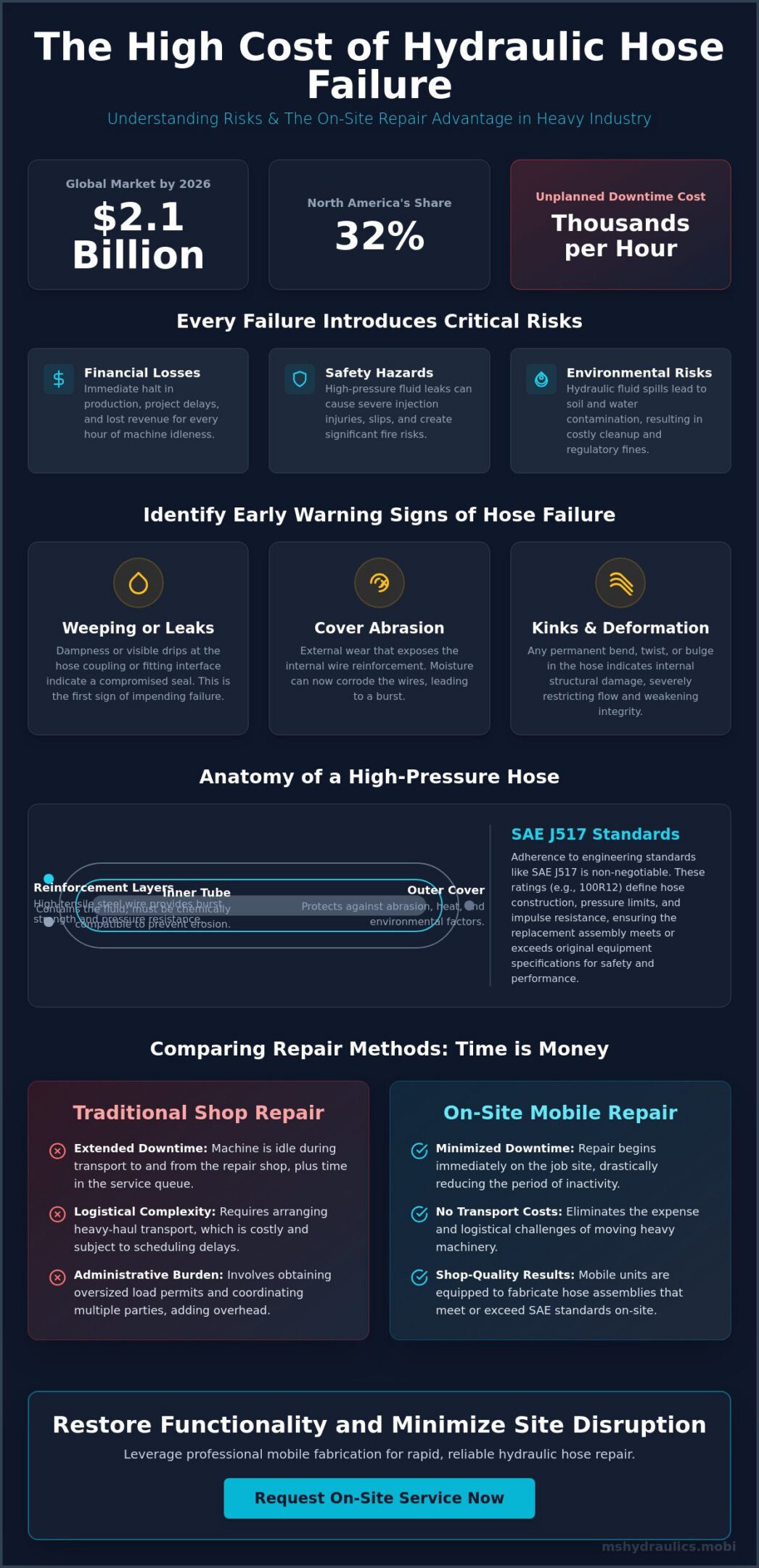
North America is projected to command a 32% share of the $2.1 billion global hydraulic hose market in 2026, yet many operators still struggle with the high cost of unplanned machine downtime. A failed assembly on a job site represents a critical breach in operational efficiency, often resulting in lost revenue and environmental hazards. You understand that every hour a machine sits idle is an hour of diminished profitability. Finding an immediate solution for hydraulic hose repair Cleburne is essential, but the repair must be as rigorous as the original engineering to prevent future failures.
We agree that a temporary patch is insufficient for modern high-pressure systems. This guide will help you master the technical requirements of hydraulic maintenance and show how professional mobile repair minimizes site disruptions. You’ll learn to identify fittings with precision and ensure every assembly meets updated SAE J517 and ISO 18752 performance standards. We will detail the diagnostic steps needed to restore functionality and provide a technical overview of the latest advancements in hose durability and material science.
Key Takeaways
- Master the technical distinctions of SAE J517 ratings to ensure every hose assembly maintains its structural integrity under peak operational pressures.
- Calculate the true impact of machine downtime by comparing the efficiency of on-site hydraulic hose repair Cleburne against the logistical delays of traditional shop transport.
- Follow a rigorous, multi-step fabrication protocol that includes precise system diagnostics and the selection of high-performance materials tailored for heavy-duty applications.
- Mitigate significant environmental and safety hazards by recognizing early indicators of hydraulic failure within North Texas construction and oilfield sectors.
- Leverage professional mobile fabrication capabilities to achieve shop-quality results that comply with the latest 2026 industrial engineering standards.
Why Hydraulic Hose Integrity is Critical for Cleburne’s Heavy Industries
The industrial landscape of North Texas relies on the consistent performance of Hydraulic machinery to drive output across construction, agriculture, and oilfield operations. In these sectors, a hydraulic hose isn’t merely a conduit; it’s a critical pressure vessel. When a failure occurs, the immediate need for hydraulic hose repair Cleburne becomes a priority to mitigate both mechanical and financial risks. High-pressure fluid leaks present severe safety hazards, including injection injuries and fire risks, alongside significant environmental liabilities that can lead to regulatory scrutiny. In the Barnett Shale and surrounding drilling areas, a single hose rupture can lead to an immediate cessation of work, triggering cascading delays across the entire project timeline.
Cleburne’s specific environmental conditions accelerate the degradation of elastomer components. The combination of ambient temperatures often exceeding 100°F and the presence of abrasive limestone dust creates a hostile environment for external hose covers. Excessive heat causes rubber compounds to harden and crack, while dust acts as an abrasive agent that wears down reinforcement layers during normal vibration. This environmental stress makes proactive monitoring essential for excavators, skid steers, and drill rigs where downtime costs thousands of dollars per hour in lost productivity. It’s a reality that operators must manage through rigorous preventative measures and rapid-response capabilities.
Local Industrial Context: From grandbury to Alvarado
Identifying Early Warning Signs of Hose Failure
Effective Heavy Equipment Maintenance requires a disciplined inspection protocol. Operators should look for “weeping” or dampness at the coupling interface, which typically indicates a compromised seal or fitting. Visual checks must also identify cover abrasion that exposes the wire reinforcement. Once the wire is visible, moisture penetration leads to corrosion and eventual bursting. Kinking or permanent deformation of the hose suggests internal structural damage. Recognizing these precursors allows for scheduled intervention before a catastrophic failure occurs on the job site, preserving both the equipment and the safety of the surrounding personnel.
Technical Specifications: Understanding Hose Ratings and SAE Standards
Precision in hydraulic hose repair Cleburne requires a deep understanding of hose anatomy and performance thresholds. A high-pressure hydraulic hose is a complex assembly consisting of an inner tube, reinforcement layers, and a protective outer cover. The inner tube must maintain chemical stability when in contact with specific hydraulic fluids to prevent internal erosion. The reinforcement layers, typically constructed from high-tensile steel, provide the necessary burst strength. Finally, the outer cover acts as a critical barrier against Cleburne’s abrasive limestone dust and intense UV exposure.
Adherence to SAE J517 hydraulic hose standards ensures that replacement components meet specific engineering benchmarks. These ‘100R’ ratings define the construction and pressure limits of the hose. For instance, a 100R12 hose is designed for high-pressure, high-impulse applications, whereas a 100R1 hose is suited for lower pressure return lines. Selecting the wrong rating during hydraulic hose repair Cleburne can compromise the safety of the entire hydraulic circuit and lead to premature component failure.
Sizing the inner diameter (I.D.) correctly is a fundamental requirement of fluid power engineering. If the I.D. is too small, fluid velocity increases, causing turbulence, pressure drops, and excessive heat. This thermal stress is exacerbated by Texas summer temperatures, which often push hydraulic systems toward their maximum operating limits. Ensuring your hose fabrication matches the original equipment manufacturer (OEM) specifications is essential for maintaining system efficiency and preventing pump cavitation.
Reinforcement Types: Braided vs. Spiral Wire
Wire-braided hoses are the industry standard for applications requiring flexibility and medium pressure. They utilize a crisscross pattern of steel wire to balance strength with a tighter bend radius. Spiral-wire reinforcement is the necessary choice for heavy-duty machinery facing high-impulse loads. These hoses feature steel wires wrapped in parallel layers, providing superior resistance to the pressure surges typical of heavy excavation equipment. Ensuring the elastomeric inner tube matches your specific hydraulic fluid is also vital to prevent material degradation.
Fittings and Connections: The Engineering of the Seal
The integrity of a hydraulic system depends on its connections. Common fittings found on North Texas job sites include JIC, ORFS, NPT, and BSPP. The O-Ring Face Seal (ORFS) is highly regarded for its ability to eliminate leaks caused by the heavy vibrations of diesel engines and hydraulic pumps. The dash size system identifies the size of hydraulic lines and fittings in increments of 1/16th of an inch. Using the correct fitting type and size ensures a leak-free interface that meets or exceeds the original system specifications.
Comparing Mobile Hose Repair vs. Traditional Shop Services in Johnson County
Determining whether to transport equipment to a brick-and-mortar facility or request on-site hydraulic hose repair Cleburne is a critical financial and logistical calculation. While shop-based repairs may initially appear cost-effective due to lower unit pricing for components, the true cost includes several hidden variables. You must account for the replacement part, technical labor, heavy-haul transportation fees, and the substantial revenue lost while the machine remains idle. In high-output sectors like drilling or heavy construction, the hourly loss from a non-operational rig often exceeds the cost of the repair itself.
Logistical hurdles frequently make shop-based services impractical for large-scale machinery. Moving a disabled excavator or skid steer from a remote site in Johnson County requires specialized trailers and, depending on the machine’s dimensions, oversized load permits. These requirements introduce administrative delays that extend downtime. Precision isn’t sacrificed during field fabrication; modern mobile units utilize high-performance crimping technology and clean-cut saws that mirror the technical standards of a stationary facility. Integrating On-Site Diagnostic Services ensures that the intervention addresses the root cause of the failure, such as system over-pressurization or pump wear, rather than simply replacing a symptomatic hose.
The Logistical Advantage of Mobile Service
Mobile intervention eliminates the need for heavy-haul logistics and the inherent risks of loading compromised machinery onto trailers. A primary engineering benefit of on-site fabrication is the capacity for real-time testing. Once the new assembly is installed, the technician can verify the integrity of the seal under actual operating conditions and peak pressures. This immediate verification is vital for emergency failures in Cleburne and Crowley, where restoring machine functionality is the primary objective. It’s a structured approach that prioritizes operational continuity.
Shop Services: When Does a Bench-Build Make Sense?
Stationary shop services are better suited for specific high-volume requirements or planned maintenance cycles. If you’re conducting a full fleet overhaul or need multiple OEM replacements for your internal inventory, bench-building provides a controlled environment for bulk fabrication. Complex manifold assemblies or specialized rigid tubing often require high-capacity shop machinery that isn’t easily transportable. However, for the majority of field failures, mobile hydraulic repair Cleburne TX offers the most efficient path to eliminating downtime. It’s the preferred choice for maintaining technical reliability on active job sites.
The Professional Fabrication Process: From Diagnostic to Installation
Executing a hydraulic hose repair Cleburne follows a methodical five-stage protocol to ensure mechanical integrity. The process begins with system depressurization. Neglecting this step risks fluid injection injuries and component damage. Once the system is safe, the technician removes the failed assembly and performs an immediate diagnostic to determine if the failure resulted from external abrasion or internal pressure spikes. Precision measurement follows; the new hose length must account for the 2% to 4% shrinkage that occurs when a hose is pressurized.
Selecting the appropriate SAE-rated hose and matching high-performance fittings is the third critical stage. Technical accuracy is paramount here. The technician identifies the thread type and seat angle before proceeding to mechanical crimping. This stage utilizes calibrated equipment to compress the fitting onto the hose to exact manufacturer specifications. A final system pressure test verifies the seal’s integrity under load. For precision engineering on your job site, contact us for professional Hydraulic Hose Fabrication.
The Critical Role of Cleanliness in Fabrication
Internal contamination is a primary cause of premature pump and valve failure. When a hose is cut, rubber particles and metal filings often enter the tube. Professional field repair utilizes projectile cleaning, where a foam pellet is launched through the hose to strip away debris before installation. This step is especially vital in North Texas, where ambient dust can easily infiltrate an open hydraulic circuit. Maintaining a closed, clean system during the repair preserves the longevity of the entire machine.
Proper Hose Routing and Installation Techniques
Longevity depends on more than just a quality crimp; it requires correct routing. A hose must never be installed with a “twist,” as this structural stress significantly reduces its pressure-bearing capacity. Technicians ensure there’s enough slack to accommodate machine movement and use protective sleeves or guards in high-abrasion areas. Proper clamping is also implemented to prevent vibration fatigue, which can lead to fitting separation over time. These technical details distinguish a professional installation from a temporary fix.
Engineering Reliability: Ms. Hydraulics LLC’s Mobile Fabrication Capabilities
Ms. Hydraulics LLC provides authorized mobile fabrication services tailored specifically for the construction, agriculture, and drilling sectors. Our operations are governed by a commitment to technical precision and a zero-compromise approach to quality. We ensure that every high-pressure assembly fabricated in the field adheres to the rigorous 2026 industry standards. This level of engineering reliability is essential for operators in Cleburne, Mansfield, Arlington, and the broader North Texas region who cannot afford the risks associated with substandard components. The Ms. Hydraulics LLC team views each repair as a precision engineering task rather than a simple parts replacement.
Integrity and technical accuracy form the foundation of our service delivery. By maintaining a disciplined focus on physical and mechanical parameters, we ensure that every hose assembly meets or exceeds the original equipment manufacturer specifications. This methodical approach builds trust with major industrial players who require dependable partners for their heavy equipment fleets. We understand that in high-stakes environments, the verification of every crimp and fitting is the only way to guarantee performance under peak load conditions.
Our Mobile Service Fleet and Equipment
The Ms. Hydraulics LLC mobile fleet is outfitted with professional-grade crimping systems and a comprehensive inventory of fittings and hose stock. This mobile infrastructure allows our technicians to fabricate hoses for a diverse range of machinery, including excavators, skid steers, and complex industrial drilling rigs. Our on-site technicians possess deep experience in heavy equipment diagnostics, ensuring that the replacement assembly matches the specific flow and pressure requirements of the host machine. We prioritize mechanical accuracy to restore machine functionality to its full capacity immediately without the need for shop-based intervention.
Partnering for Long-Term Fleet Health
Our service model extends beyond reactive repairs to address the underlying health of your hydraulic systems. During a field intervention, we analyze the failed component to identify system-wide stressors such as excessive heat, fluid cavitation, or aeration. These factors often signal deeper issues within the hydraulic pump or cooling system that could lead to subsequent failures. By implementing custom maintenance routines, we help fleet managers prevent future hose blowouts and extend the service life of their equipment. Contact Ms. Hydraulics LLC for rapid-response hydraulic hose repair Cleburne to secure the operational integrity of your heavy machinery.
Advancing Operational Efficiency through Precision Hydraulics
Maintaining the structural integrity of your fleet requires more than reactive maintenance; it demands a disciplined adherence to engineering standards. By prioritizing precise measurement, material compatibility, and specialized routing, operators can significantly reduce the risk of catastrophic failure. The transition to on-site fabrication eliminates the logistical complexities of transporting heavy equipment while ensuring every assembly meets modern performance benchmarks. This structured approach to maintenance preserves the longevity of high-value assets and minimizes the environmental risks associated with high-pressure leaks.
This commitment to maintenance often extends beyond the industrial sector to personal property; for those who value technical precision in their home systems, Pioneer Plumbing CDA offers specialized expertise, and you can explore Residential Plumbing Repair and Installation to ensure your water heaters and plumbing lines are handled by professionals.
Reliability on the job site is established through technical verification and rapid response. Our specialized mobile fabrication units are designed to deliver shop-quality results directly to your location, supporting excavators, skid steers, and drill rigs across Cleburne, DFW, and Johnson County. When you require expert hydraulic hose repair Cleburne, our technicians provide the diagnostic expertise needed to restore functionality and prevent recurring issues. It’s the most effective strategy for eliminating unplanned downtime in North Texas industries.
Request Mobile Hydraulic Hose Repair in Cleburne to secure your machinery’s performance. We look forward to supporting your operational goals with technical excellence.
Frequently Asked Questions
How long does a mobile hydraulic hose repair typically take?
Most standard on-site repairs are completed within one to two hours once the technician arrives at the job site. This timeframe includes system depressurization, removal of the failed assembly, precision fabrication of the new hose, and final pressure testing. Complex routing or multiple failures on a single machine may extend this duration. The primary goal of hydraulic hose repair Cleburne is to restore machine functionality with minimal interruption to the project’s critical path.
Can you repair a hydraulic hose, or does it always need to be replaced?
High-pressure hydraulic hoses must always be replaced as complete assemblies rather than patched or spliced. Industry safety standards, including SAE J1273, prohibit the reuse of old fittings on new hose stock or the use of field-attachable couplings on damaged sections. A full replacement ensures the structural integrity of the pressure vessel and prevents catastrophic system failure. This approach maintains the technical reliability required for heavy industrial applications and ensures operator safety.
What information do I need to provide when calling for a mobile hose repair?
You should provide the machine type, the hose’s approximate location on the equipment, and any visible pressure ratings or SAE dash sizes. Providing the fitting types, such as JIC or ORFS, helps the technician prepare the necessary inventory before dispatch. If the hose is inaccessible, describe the machine’s function that has failed. Accurate data allows the technician to expedite the diagnostic phase and ensures the mobile unit is stocked with the correct technical specifications.
Is mobile hose fabrication as reliable as a factory-made hose?
Professional mobile fabrication utilizes the same high-tier crimping technology and SAE-rated components found in factory environments. When executed by an experienced technician, these assemblies meet or exceed OEM performance parameters. The process involves precise calibration of the crimp diameter to match manufacturer specifications. This ensures the resulting assembly handles impulse loads and thermal expansion with the same durability as a factory-installed component. Quality control is maintained through rigorous on-site verification protocols.
Do you offer 24/7 emergency hydraulic repair in Cleburne?
You should verify specific availability directly, as service hours can vary based on technical staffing and regional demand. Many professional providers in Johnson County prioritize emergency response for critical failures that halt production. While standard operations typically occur during business hours, rapid-response hydraulic hose repair Cleburne is often available to address oilfield or construction emergencies. Always confirm the current dispatch protocol and any associated emergency call-in fees before scheduling an urgent technician visit.
What causes a hydraulic hose to burst unexpectedly?
Unexpected bursts are usually the result of external abrasion, internal fatigue from pressure spikes, or extreme thermal degradation. In North Texas, limestone dust often penetrates the outer cover, leading to wire reinforcement corrosion and structural weakening. Additionally, exceeding the hose’s minimum bend radius creates localized stress points that compromise the tube’s integrity. Regular inspections are essential to identify these mechanical vulnerabilities before they lead to a high-pressure fluid release and subsequent machine downtime.
How much does mobile hydraulic hose repair cost compared to a shop?
Mobile repair involves a service dispatch fee but often results in lower total project costs by eliminating machine transport and reducing downtime. While a shop-based repair might have a lower unit price for the hose itself, you must factor in the expense of heavy-haul trailers and lost hourly revenue. For most active job sites, the efficiency of on-site fabrication provides a superior financial outcome compared to the logistical burden and administrative delays of shop transport.
Can you identify my hose fittings if the labels are missing?
Technicians use specialized calipers and thread gauges to identify fittings based on physical dimensions and seat angles. Even if the original labels or part numbers are absent, we can determine if a fitting is JIC, NPT, ORFS, or a metric standard like BSPP. This technical identification is a standard part of our diagnostic process. It ensures the new assembly integrates seamlessly with the existing hydraulic circuit without risking leaks or fitting separation under high-pressure conditions.