Mansfield Excavator Repair Service: Expert Mobile Hydraulic Solutions (2026)
A single day of mechanical failure on a Mansfield job site can compromise project timelines and erase profit margins faster than almost any other operational variable. Most site managers recognize that the logistical burden of transporting a 30 ton machine to a fixed facility is often as prohibitive as the mechanical failure itself. When high pressure hydraulic systems lose integrity, relying on generalist mechanics often leads to symptomatic fixes rather than root cause resolution. Securing a specialized Mansfield excavator repair service is essential for maintaining the tight tolerances and pressure parameters required by modern earthmoving equipment.
You understand that technical precision is the only way to prevent recurring leaks and catastrophic pump failure. This article outlines how expert mobile hydraulic diagnostics and on-site repair protocols minimize downtime by addressing the specific mechanical requirements of your excavator. We’ll detail the technical advantages of mobile hydraulic hose fabrication, cylinder rebuilds, and valve diagnostics conducted directly in the field. This overview provides the technical insight needed to return your machinery to service with verified reliability and peak hydraulic performance.
Key Takeaways
- Analyze the economic impact of hydraulic failures and why they represent the leading cause of unplanned equipment downtime on Mansfield job sites.
- Identify the primary failure points within the hydraulic circuit, including pumps, valves, and cylinders, to facilitate more accurate troubleshooting.
- Utilize a specialized Mansfield excavator repair service to eliminate the logistical costs and delays associated with transporting heavy machinery to a repair facility.
- Establish a rigorous daily inspection protocol focused on weeping fittings and bucket cycle times to detect hydraulic degradation before catastrophic failure occurs.
- Discover how on-site diagnostic services and custom hose fabrication restore system integrity to precise engineering parameters without leaving the field.
The High Stakes of Excavator Downtime in Mansfield, TX
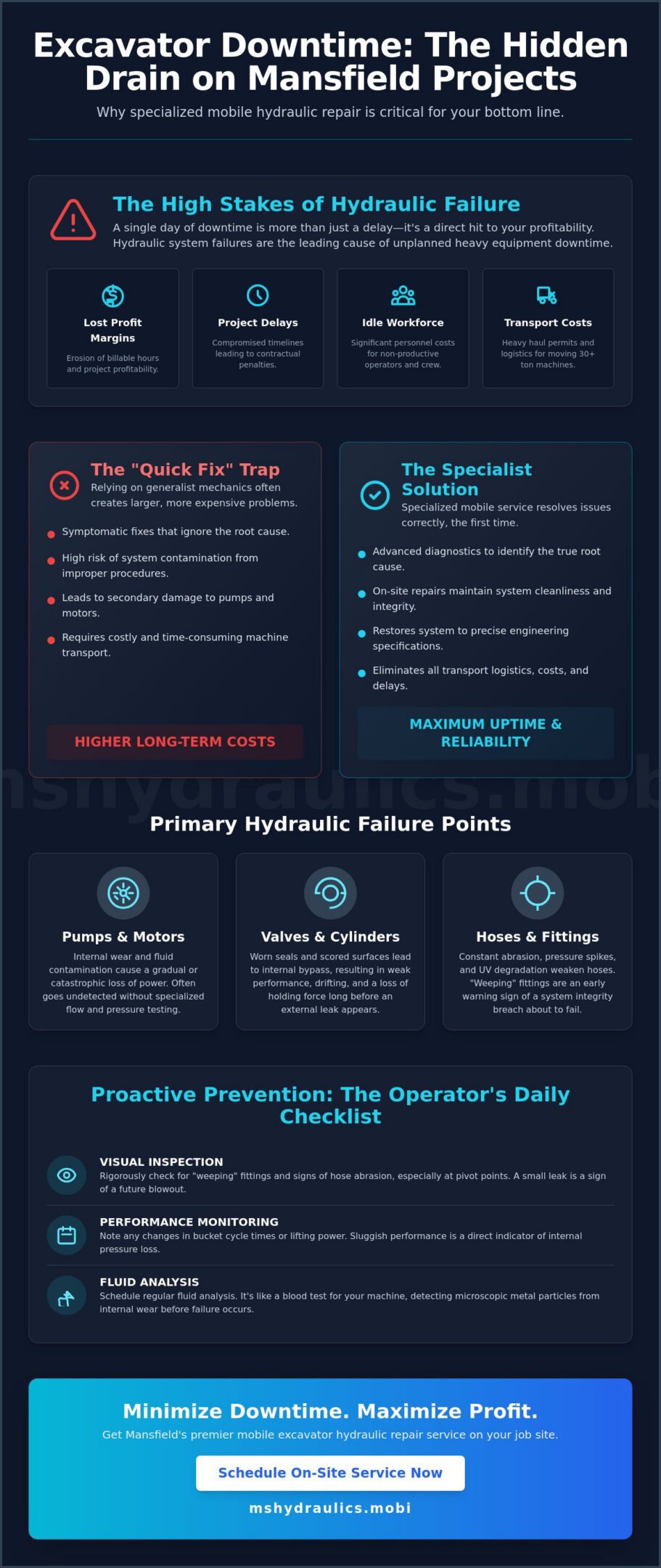
The financial burden of a non-functional excavator on a Mansfield residential site extends far beyond a delayed schedule. For contractors managing large scale developments near Matlock Road or Heritage Parkway, a single machine failure can halt an entire earthmoving crew. Industry data consistently indicates that hydraulic system failures account for the majority of unplanned heavy equipment downtime. This frequency is directly tied to the extreme pressures and tight tolerances essential for how hydraulic systems work within modern excavators. Moving a 60,000 pound machine to a repair shop in Tarrant County requires specialized hauling permits and significant logistical coordination. These hurdles often lead project managers to settle for generalist mechanics who lack the technical expertise to diagnose high pressure hydraulic circuits effectively.
The operational frustration is compounded when a generalist misses the nuances of a failing pump or a compromised control valve. These specialists often address the symptom while the root cause remains unaddressed. A specialized Mansfield excavator repair service is required to bridge the gap between basic mechanical fixes and precision hydraulic engineering. Without this expertise, a simple leak often evolves into a catastrophic system failure that can sideline a machine for weeks.
- Loss of billable machine hours.
- Logistical costs of heavy haul transport.
- Secondary damage to pumps and motors from fluid contamination.
- Personnel costs for idle operators.
Mansfield’s Growing Infrastructure and Equipment Demands
The expansive clay soils typical of North Texas place unique stress on excavator undercarriages and hydraulic seals. As Mansfield continues its rapid commercial expansion through 2026, the pressure to maintain strict project timelines has reached a critical point. Localized service is no longer a convenience; it’s a structural necessity for operational efficiency. Excavators operating in these conditions require routine maintenance and rapid response to maintain the integrity of their hydraulic circuits. A dedicated Mansfield excavator repair service provides the technical depth required to maintain equipment reliability in these taxing environmental conditions.
The Hidden Costs of ‘Quick Fix’ Hydraulic Repairs
Relying on temporary patches for hydraulic leaks frequently results in system wide contamination. When a hose is fabricated without proper cleaning or when a valve is incorrectly calibrated, particulate matter enters the fluid stream. This debris accelerates the wear of expensive components like the main pump and final drive motors. Precision hydraulic rebuilds prevent these secondary failures by restoring the system to original engineering specifications. While a “quick fix” may appear cost effective initially, the eventual replacement of a contaminated pump or a failed motor represents a far greater capital expenditure. True reliability depends on identifying the root cause of pressure drops or fluid loss before they propagate through the entire hydraulic circuit.
Diagnosing Common Excavator Hydraulic Failures
The hydraulic circuit of a modern excavator is a complex integration of physical parameters designed to convert engine power into mechanical force. This system begins at the main variable displacement pump, traverses the primary control valve bank, and terminates at the cylinders or final drive motors. While external leaks are obvious indicators of failure, a professional Mansfield excavator repair service often identifies internal bypass as the primary cause of performance degradation. Internal bypass occurs when pressurized fluid escapes across worn seals or spool clearances; it results in a loss of breakout force without any visible fluid loss on the ground.
Predicting catastrophic component failure requires more than visual inspection. Regular hydraulic fluid analysis serves as a critical diagnostic tool. By identifying microscopic metallic particles or changes in fluid viscosity, technicians can detect early stages of pump cavitation or motor wear before the system reaches a point of total failure.
Failure points typically cluster in three specific areas:
- High pressure hydraulic hoses subjected to constant abrasion and pressure spikes.
- Cylinder seals that have reached their duty cycle limit or been compromised by environmental contaminants.
- Control valve spools where precision tolerances have been eroded by fluid contamination.
Excavator Cylinder Seal Failures and Rod Damage
In the dusty environments typical of North Texas construction sites, hydraulic cylinders are prone to rod scoring. Even minor abrasions on the chrome surface can shred new seals within a few hours of operation. Operators should monitor for “drift,” where the boom or bucket slowly loses position under load. When drift exceeds manufacturer specifications, it indicates that fluid is bypassing the piston seal inside the barrel. While a simple seal kit may suffice for minor wear, deep scoring or barrel egging requires a full hydraulic cylinder rebuild involving precision honing to restore the internal diameter to a true cylindrical state.
Main Pump and Control Valve Troubleshooting
The main pump is the most technically sensitive component in the circuit. Variable displacement pumps from manufacturers like Cat, Deere, and Komatsu utilize complex swashplate mechanisms that are highly sensitive to heat and contamination. Unusual whining noises or an increase in hydraulic oil temperature often signal that the pump is struggling to maintain flow. Similarly, wear within the control valve bank leads to attachment drifting or erratic movement. Precision pressure testing protocols are necessary to differentiate between a failing pump and a worn relief valve. Identifying these issues early prevents the total system contamination that follows a catastrophic pump explosion.
Mobile vs. Shop Repair: Mansfield Service Models Compared
Selecting the appropriate service model for a downed excavator requires a technical assessment of the failure’s scope and the logistical constraints of the Mansfield job site. Mobile hydraulic repair focuses on minimizing the mean time to repair (MTTR) by addressing high-frequency failure points like ruptured hoses or leaking fittings directly in the field. This model eliminates the significant logistical burden of securing heavy-haul permits and coordinating transport for a 30 ton machine through Tarrant County traffic. While regional dealer service centers often operate with significant backlogs, a localized Mansfield excavator repair service provides a faster response, often arriving before the logistical costs of machine transport are even finalized.
The decision to move a machine to a controlled shop environment depends on the precision required for the repair. While on-site diagnostic services accurately identify circuit pressures and flow rates, certain mechanical restorations demand a contaminant-free setting. Shop based repairs are necessary for deep engineering tasks that involve internal component machining or large scale overhauls. The following criteria help determine the optimal service route:
- Mobile Intervention: Ideal for hydraulic hose fabrication, valve adjustments, and primary pump diagnostics.
- Shop Restoration: Necessary for complex hydraulic pump repair or when a cylinder barrel requires precision honing.
- Load Testing: Mobile service allows for testing under actual site conditions, whereas shop repair utilizes controlled test stands.
The Advantages of On-Site Mobile Repair
Immediate on-site repair offers the distinct advantage of real-time testing under actual load conditions. Technicians can observe the hydraulic system’s behavior while the excavator performs its standard duty cycle on Mansfield’s specific soil types. This ensures that the repair holds up against the unique breakout forces required on-site. Mobile units equipped for hydraulic hose fabrication produce custom replacements that match OEM specifications instantly. This capability removes the delay of ordering pre-fabricated parts, allowing the machine to return to operation within hours rather than days.
When to Opt for a Full Hydraulic Cylinder Rebuild
Field repairs have limits. This is especially true when physical damage to the cylinder rod or barrel is identified. Terminal wear, such as deep vertical scoring or a bent piston rod, cannot be adequately addressed in a mobile capacity. These conditions require the engineering precision of a shop environment. Technicians utilize specialized lathes and polishing equipment to restore surfaces to a sub-micron finish. For a detailed technical breakdown of these processes, consult our Heavy Equipment Cylinder Rebuild in Texas engineering guide. Shop based cylinder rebuilds ensure that the internal tolerances meet the strict parameters required for long-term seal integrity and high-pressure performance.
The Operator’s Checklist for Hydraulic System Health
Maintaining peak operational status requires a disciplined approach to daily inspections. The operator serves as the primary sensor for detecting early stage hydraulic degradation. While a professional Mansfield excavator repair service is essential for technical restoration, daily oversight prevents minor issues from escalating into system wide failures. Visual cues like “weeping” fittings or localized damp spots in the dust are early indicators of seal fatigue. These signs often precede the internal bypass issues where pressure is lost without catastrophic fluid discharge.
Monitoring cycle times provides a quantitative proxy for pump health. If the boom or bucket speed deviates from manufacturer specifications under standard load, it suggests a drop in volumetric efficiency. Similarly, hydraulic oil clarity and temperature must be verified. Milky or aerated oil indicates water ingress or air suction, both of which cause cavitation and rapid pump wear. When performing field level top offs, maintaining a sterile environment is critical. A single grain of North Texas grit can compromise the tight tolerances of a control valve spool, leading to the “jerkiness” often mistaken for mechanical linkage wear.
Pre-Shift Hydraulic Inspection Routine
A structured pre-shift routine identifies vulnerabilities before they cause downtime. Operators should follow these four technical checkpoints:
- Step 1: Inspect hose routing for signs of abrasion against the chassis or heat stress from proximity to the exhaust manifold.
- Step 2: Examine cylinder rods for nicks, burrs, or excessive oil film, which indicate that the wiper seal is no longer excluding contaminants.
- Step 3: Verify fluid levels and check the sight glass for aeration or a “milky” appearance.
- Step 4: Cycle the machine to ensure controls are responsive and that there’s no lag in the pilot system.
Implementing a Preventative Maintenance Schedule
Establishing rigid filter change intervals is the most effective way to prevent the “domino effect” of hydraulic failure. In the high demand environments of Mansfield, filters often reach their bypass state earlier than in less taxing climates. Utilizing professional On-Site Diagnostic Services allows for a data driven approach to maintenance. These services identify pressure drops and flow restrictions that are invisible to the naked eye. By addressing a failing relief valve or a clogged suction strainer early, you protect the high value main pump and final drive motors from premature wear. If your daily inspections reveal persistent pressure drops or fluid contamination, schedule on-site hydraulic repair to secure your machinery’s performance.
Ms. Hydraulics LLC: Mansfield’s Specialist for Mobile Excavator Repair
Ms. Hydraulics LLC operates with a specific focus on the mechanical and physical parameters of high pressure fluid power. While general mechanics provide broad support, our team functions as a dedicated engineering partner for heavy equipment operators. This specialization ensures that every Mansfield excavator repair service we perform is grounded in technical accuracy and systemic integrity. We understand that a project’s profitability depends on the reliability of its primary movers. From our operational base in Cleburne, Ms. Hydraulics LLC deploys specialized units to Mansfield job sites, bringing shop level precision directly to the field. Our technicians prioritize the identification of root causes, ensuring that repairs address the underlying hydraulic imbalance rather than just the visible symptoms.
Our presence in the North Texas industrial sector is characterized by a disciplined approach to machinery health. We don’t rely on guesswork or trial and error part replacement. Instead, Ms. Hydraulics LLC uses data driven diagnostics to verify the health of every pump, motor, and valve in the circuit. This methodical process builds trust with major international players and local contractors alike. By maintaining high standards of professional decorum and technical verification, we’ve positioned ourselves as a serious partner for those who value reliability and performance above all else.
Advanced Mobile Diagnostic Technology
Accurate diagnosis is the prerequisite for effective repair. Ms. Hydraulics LLC utilizes industrial flow meters and digital pressure gauges to monitor the performance of the hydraulic circuit in real time. This methodical approach allows us to pinpoint internal component wear, such as pump slippage or valve spool leakage, without unnecessary teardowns. By identifying the exact failure point, we reduce diagnostic time and return machinery to operation with verified performance data. Our expertise in Mobile Hydraulic Repair in Cleburne and the surrounding North Texas region is built on this commitment to quantitative verification. We provide the technical evidence needed to make informed maintenance decisions, whether it’s a simple adjustment or a complete hydraulic pump repair.
Custom Hose Fabrication and Component Rebuilds
System integrity often depends on the quality of individual components. Our mobile units are equipped for on site hydraulic hose fabrication, ensuring that replacements meet or exceed OEM standards for pressure rating and abrasion resistance. Beyond hoses, Ms. Hydraulics LLC provides comprehensive support for complex assemblies. This includes hydraulic motor repair, valve restoration, and precision cylinder rebuilds for all major industrial brands such as Komatsu, Caterpillar, and John Deere. We don’t just replace parts; we restore the engineering tolerances necessary for long term reliability. Our commitment to technical excellence ensures that your equipment maintains its breakout force and cycle times throughout its service life. Contact Ms. Hydraulics LLC for a Mansfield excavator repair service that values precision over temporary fixes.
Securing Long-Term Hydraulic Reliability for Mansfield Operations
Maintaining the operational integrity of heavy machinery in North Texas requires a transition from reactive patching to proactive engineering. Precision diagnostics identify internal wear before it manifests as catastrophic failure. By addressing root causes through specialized hydraulic engineering, contractors ensure their machinery consistently meets the breakout force and cycle times required for Mansfield’s infrastructure demands. Since 2021, we’ve provided the technical oversight necessary to maintain these complex systems across Mansfield, Cleburne, and the broader North Texas region.
Our mobile units deliver shop-level accuracy directly to the job site; this includes on-site hose fabrication and precision component diagnostics. Utilizing a specialized Mansfield excavator repair service eliminates the logistical burdens of equipment transport while restoring system performance to original engineering parameters. Technical excellence remains the most effective strategy for minimizing downtime and protecting high-value capital investments. Schedule Your Mansfield Excavator Diagnostic Call to verify your equipment’s hydraulic health and secure your project timelines today.
Frequently Asked Questions
How quickly can you respond to an excavator repair call in Mansfield?
Response times for a Mansfield excavator repair service depend on current technician dispatch schedules and the specific location of the job site. We prioritize logistical efficiency to ensure that diagnostic units arrive as quickly as possible to mitigate the costs of machine downtime. Each service call is evaluated based on the technical requirements of the failure and the availability of our mobile diagnostic equipment.
Do you carry common excavator hydraulic hoses and fittings on your service trucks?
Yes, our mobile units are equipped for on-site hydraulic hose fabrication. We maintain an inventory of high pressure hoses and diverse fittings that meet or exceed OEM specifications for major equipment brands. This capability allows technicians to manufacture custom replacements immediately, which eliminates the delay of ordering pre-fabricated components and ensures a precise fit for your specific machinery.
Can you perform hydraulic pressure testing on-site for a Cat or John Deere excavator?
Precision hydraulic pressure testing is a core component of our on-site diagnostic services. We utilize calibrated digital gauges and flow meters to monitor the performance of Cat, John Deere, and Komatsu hydraulic circuits under actual load conditions. This data driven approach allows us to identify internal bypass or pump inefficiency without requiring the machine to be transported to a fixed facility.
Is it better to repair a leaking hydraulic cylinder or replace it entirely?
Repairing a hydraulic cylinder through a professional rebuild is typically more cost effective than a full replacement. If the cylinder barrel and rod are within engineering tolerances, we can restore the unit to peak performance by replacing seals and polishing the rod. However, if the rod is bent or the barrel is deeply scored, replacement may be necessary to maintain system integrity.
What are the most common signs of hydraulic pump failure on an excavator?
The primary indicators of pump degradation include unusual whining noises and a significant increase in hydraulic oil temperature. Operators may also notice a decrease in breakout force or slower cycle times for the boom and bucket. These symptoms often suggest that the pump’s volumetric efficiency has dropped, which requires immediate technical intervention to prevent a catastrophic system failure.
Do you offer emergency 24/7 hydraulic repair for Mansfield construction sites?
Project managers should contact our Cleburne office directly to verify current availability for urgent service requests. While the Mansfield market shows a trend toward 24/7 availability, we operate based on the current capacity of our technical staff. We focus on providing a reliable Mansfield excavator repair service that prioritizes technical accuracy and long term machinery performance over temporary, after hours patches.
How do you ensure hydraulic system cleanliness during a field repair?
Technicians utilize specialized caps and plugs to seal all open hydraulic ports immediately during a repair. This protocol prevents North Texas dust and grit from entering the sensitive hydraulic circuit. We also follow strict contamination control standards during fluid top offs and component installations to ensure that the internal tolerances of pumps and valves remain compromised by particulate matter.
What areas around Mansfield do you cover with your mobile service?
Our mobile hydraulic repair units provide comprehensive coverage for Mansfield, Cleburne, and the broader North Texas region. We deploy specialized technicians from our Cleburne base to support residential developments and commercial infrastructure projects throughout the area. This regional focus ensures that we can provide expert on-site diagnostic services and heavy equipment maintenance wherever your machinery is currently operating.