Hydraulic Quick Disconnect Guide for Heavy Equipment
A single failed quick disconnect is rarely just a minor leak. It represents a critical breach in your machinery’s primary defense against hydraulic contamination and unplanned downtime. In the high-pressure environments of North Texas construction and agriculture, even a microscopic amount of grit introduced during an attachment swap can lead to catastrophic valve or pump failure. You’ve likely experienced the frustration of connections that refuse to seat under residual pressure or the persistent moisture that signals a failing seal. These aren’t just operational inconveniences; they’re indicators of a system operating below its engineered capacity.
We understand that maintaining a fleet requires precise technical knowledge and adherence to rigorous international standards. This guide enables you to master the selection, maintenance, and troubleshooting of hydraulic couplings to maximize machinery uptime and efficiency. We’ll examine the latest updates to ISO 16028:2023 for flat-face couplers and ISO 7241:2023 for poppet styles. This technical overview provides the data necessary to identify the correct ISO standard for your specific equipment, implement rigorous contamination controls, and ensure operator safety under high PSI conditions. Understanding these mechanical parameters is essential for any professional managing high-value industrial assets.
Key Takeaways
- Learn to identify the specific ISO 16028 and 7241 standards required for your machinery to ensure mechanical compatibility and operator safety.
- Understand how to match quick disconnect pressure and flow ratings to your system’s peak performance requirements to avoid restricted orifices and excessive heat.
- Identify early indicators of component failure, such as brinelling or seal degradation, through structured daily inspection protocols.
- Discover how ‘dry-break’ valving mechanisms enhance environmental compliance and prevent hydraulic fluid loss during high-frequency attachment changes.
- Access professional guidance on custom hose fabrication and mobile repair services to minimize critical downtime for heavy equipment in Cleburne and the DFW area.
The Fundamentals of Hydraulic Quick Disconnect Fittings
A Quick connect fitting is a precision-engineered mechanical coupling designed for the rapid, tool-free connection and disconnection of fluid lines. In heavy equipment operations, the quick disconnect serves as the primary interface for attachment versatility. It allows operators to transition between hydraulic hammers, buckets, and augers with minimal mechanical intervention. While permanent threaded fittings provide high-integrity connections for fixed plumbing, they’re impractical for modular systems. Quick disconnects differ from these permanent alternatives by utilizing internal locking mechanisms that maintain seal integrity even in high-vibration environments that would otherwise loosen traditional threaded joints.
The implementation of high-quality couplings provides three primary operational advantages: leak prevention, air inclusion reduction, and enhanced system serviceability. Modern designs incorporate dry-break technology to ensure that fluid loss remains within strict environmental and safety parameters during swaps. By reducing air inclusion, these fittings protect hydraulic pumps from cavitation, a common cause of premature component failure. They also allow technicians to isolate specific circuits for maintenance without draining the entire hydraulic reservoir, which significantly reduces labor requirements during routine service.
Anatomy of a Quick Disconnect Coupling
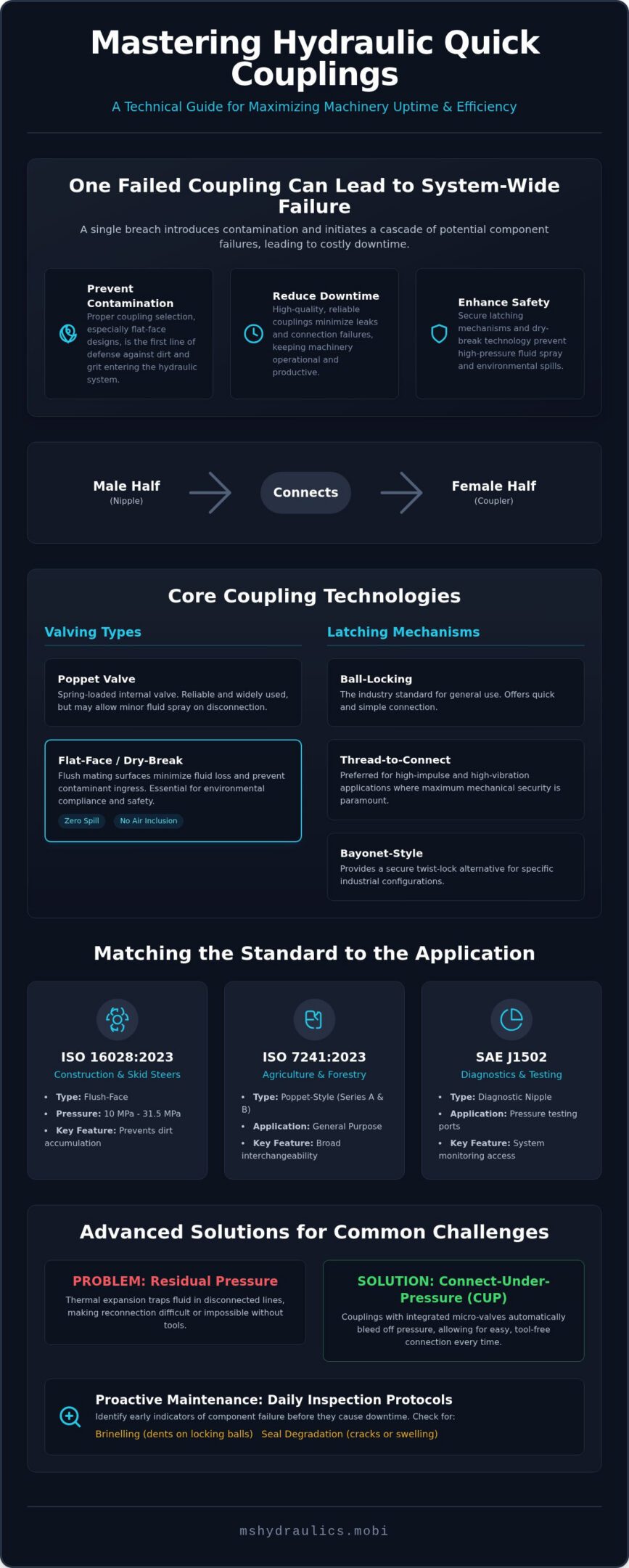
Every coupling set consists of a male half, often referred to as the nipple, and a female half, known as the coupler. The internal valving determines how the fluid behaves during connection. Poppet designs utilize a spring-loaded valve that opens upon engagement; they’re reliable but can allow small amounts of fluid spray. Conversely, flat-face designs feature a flush surface that minimizes spill and prevents external contaminants from entering the system. The latching mechanism is equally critical for safety. While ball-locking styles are the industry standard for general use, thread-to-connect mechanisms are preferred for high-impulse applications where mechanical security is paramount. Bayonet styles offer a secure twist-lock alternative for specific industrial configurations.
Common Industrial Standards (ISO and SAE)
Adherence to international standards ensures component interchangeability and system safety across global equipment fleets. The ISO 16028:2023 standard, which was updated in March 2023, governs flush-face type couplings used at pressures between 10 MPa and 31.5 MPa. This is the dominant standard for skid steers and construction machinery because it prevents dirt from accumulating in the coupling interface. For agricultural and forestry applications, the ISO 7241:2023 standard is the benchmark. This second edition, released in July 2023, covers both Series A and Series B poppet-style couplings. Additionally, SAE J1502 provides the technical specifications for diagnostic couplings used in pressure testing and system monitoring. Utilizing fittings that meet these verified certifications is essential for maintaining the mechanical legacy and reliability of high-pressure hydraulic systems.
Technical Categorization: Valving and Latching Mechanisms
Selection of a quick disconnect depends heavily on the valving configuration required for specific system parameters. Single shut-off couplings only contain a valve in the female half, meaning the male side remains open. This is rarely suitable for high-pressure hydraulics. Double shut-off couplings, the industrial standard for heavy equipment, feature valves in both halves to ensure fluid retention upon disconnection. For operations prioritizing environmental compliance and operator safety, ‘Dry Break’ technology is essential. These couplings utilize flush mating surfaces to eliminate fluid spill and air inclusion, meeting rigorous safety protocols during attachment changes.
Thermal expansion of trapped fluid often creates residual pressure in disconnected lines, a major operational pain point. Connect-Under-Pressure (CUP) technology addresses this by incorporating internal micro-valves that bleed off small amounts of pressure. This allows the operator to seat the coupling without specialized tools. It’s a critical feature for North Texas operators dealing with high ambient temperatures that accelerate pressure buildup in static lines. Material selection further dictates performance; while carbon steel with zinc-nickel plating is standard, stainless steel is preferred for corrosive environments, and brass remains relevant for specific low-pressure applications.
Poppet vs. Flat Face Couplers
Poppet valves are characterized by a cone-shaped valve that moves off a seat to allow flow. They offer excellent flow characteristics but are prone to ‘spill’ during disconnection. Flat face couplers, governed by ISO 16028, have become the requirement for modern excavators and skid steers. Their flush design is easy to clean, preventing dirt from entering the system. While poppet designs often exhibit lower pressure drops at high flow rates, the contamination prevention of flat face designs usually outweighs these minor efficiency gains in construction environments. Maintaining these surfaces is vital for system longevity.
Latching Styles for Heavy Equipment
The latching mechanism must withstand significant mechanical stress. Snap-type ball latching is the industry standard for speed and ease of use. However, for high-impulse loads and extreme vibration, screw-to-connect couplings are superior. These utilize a threaded sleeve to mechanically lock the halves together, preventing the ‘brinelling’ or indentation of locking balls often seen in standard couplings under heavy vibration. When components fail due to these mechanical stresses, on-site diagnostic services can identify whether a standard or heavy-duty latching mechanism is required. Adhering to the guidelines for Safe Installation of Quick Couplings ensures these mechanisms are seated correctly to prevent premature wear. Non-latching options are typically reserved for manifold blocks where the machinery’s structure provides the necessary clamping force.
Selection Parameters for Industrial Hydraulic Applications
Selection of a quick disconnect requires more than a simple check for physical compatibility. It demands a precise alignment with the mechanical parameters of the specific hydraulic circuit. For industrial systems in North Texas, where heavy equipment often operates between 3,000 and 6,000 PSI, matching the coupler’s rated working pressure to system peaks is mandatory for safety. The ASTM F1122-22 Standard provides the technical manufacturing and safety requirements that ensure these components can withstand such rigorous demands. Using a component with an insufficient pressure rating isn’t just an efficiency risk; it’s a potential point of catastrophic mechanical failure.
Flow rate, measured in gallons per minute (GPM), is another critical variable. If the internal orifice of a coupling is too restrictive for the system’s output, it creates a significant pressure drop. This restriction converts hydraulic energy into heat, which degrades fluid quality and reduces the operational speed of attachments. Furthermore, seal integrity must be maintained across a wide temperature range. North Texas summers can push ambient temperatures above 100°F, and when combined with internal friction, standard seals can become brittle. Selecting the correct elastomer is vital: Nitrile is standard for most petroleum-based fluids, while Viton is preferred for high-temperature applications or specific synthetic oils. EPDM is reserved for phosphate ester fluids but will fail rapidly if exposed to petroleum products.
Calculating Pressure and Flow Requirements
Under-sizing a coupling leads to hydraulic inefficiency and increased fuel consumption. When evaluating specifications, it’s essential to distinguish between working pressure and burst pressure. Design engineers typically utilize a 4:1 safety factor, but the burst pressure should never be considered an operational limit. Surge pressure is a critical failure point in heavy machinery characterized by a momentary, high-velocity pressure spike that can exceed the rated working limit of the coupling. These spikes often occur during the rapid actuation of control valves or when an attachment encounters a sudden mechanical resistance.
Environmental and Mechanical Considerations
Dust caps and plugs serve as the primary defense against hydraulic pump failure. In construction and agricultural environments, even microscopic grit can enter an open coupler and cause internal scoring in valves and cylinders. Corrosion resistance is equally important for equipment stored outdoors. Zinc-nickel or stainless steel finishes provide the necessary protection against oxidation in humid or chemically active environments. Integrating these components into a program of Heavy Equipment Maintenance ensures that seals and locking mechanisms are inspected for wear before they lead to unplanned downtime. Consistent verification of these selection parameters maintains the reliability and legacy of your fleet’s hydraulic systems.
Maintaining Quick Disconnect Integrity: Preventing System Downtime
Daily inspection protocols are the foundation of hydraulic system reliability. For mobile operators in Cleburne and the DFW area, checking the quick disconnect interface before every attachment change is a mandatory technical procedure. You should look for physical deformation of the sleeve, fluid weeping around the seals, and any accumulation of grit. These inspections prevent minor wear from escalating into a catastrophic breach that could sideline a machine for days.
Brinelling occurs when high-impulse loads cause the internal locking balls to indent the nipple groove. This mechanical wear prevents smooth rotation of the coupling and leads to premature seal failure. If you experience persistent resistance during engagement or observe visible “dimples” in the locking groove, the component has reached its fatigue limit. Continuing to use a brinelled coupling increases the risk of a high-pressure decoupling event, which poses a significant safety hazard to the operator.
Leaking couplings represent a hidden cost that extends beyond fluid replacement. High-pressure leaks can rapidly deplete a hydraulic reservoir, leading to pump cavitation and overheating. In the North Texas industrial sector, environmental regulations regarding hydraulic spills are strictly enforced. Proactive replacement of worn hardware is a necessary investment to avoid substantial environmental fines and the high cost of site remediation following a major fluid release.
Contamination Control Procedures
Wiping the face of a flat-face coupler is the single most effective way to prevent pump and valve failure. Even a single grain of silica introduced during a swap can score cylinder walls or foul precision valve spools. Operators must also inspect internal seals for nicks, hardening, or swelling. When multiple units across a fleet show similar patterns of seal degradation, On-Site Diagnostic Services can determine if system-wide contamination or extreme thermal cycles are the root cause.
Troubleshooting Connection Failures
When a coupler won’t engage, the first step is to verify that residual pressure has been properly bled from the circuit. If the connection still won’t seat after pressure relief, you must inspect for internal valve damage or external debris lodged within the locking sleeve. High-cycle applications, such as those involving hydraulic hammers or shears, require significantly shorter replacement intervals than standard loaders. You should never force a connection with a pry bar or hammer. This often damages the mating half and can cause internal mechanical failures that are difficult to diagnose in the field.
For immediate assistance with failed components or burst lines, our technicians provide mobile hydraulic repair to restore your machinery’s uptime and hydraulic efficiency.
Professional Support and Quick Disconnect Replacement in Cleburne
Professional field support is the final link in maintaining hydraulic system integrity. While understanding ISO 16028 or ISO 7241 specifications is essential for procurement, the actual installation and maintenance of a quick disconnect require specialized fabrication capabilities. Off-the-shelf hardware often lacks the precise tolerances required for high-vibration heavy equipment. Custom hose fabrication ensures that the assembly is matched to the specific flow and pressure requirements of your excavator or skid steer, preventing premature failure at the crimp point or the coupling interface. This precision is vital for maintaining the 4:1 safety factor necessary in high-pressure industrial environments.
Relying on generic components can lead to mismatched thread profiles or insufficient flow ratings, which eventually cause excessive heat and system inefficiency. Ms. Hydraulics focuses on integrity-driven component selection, ensuring that every replacement fitting meets or exceeds the original equipment manufacturer’s specifications. For operators in the North Texas industrial sector, this commitment to engineering excellence translates into higher machinery uptime and reduced long-term repair costs. We prioritize technical accuracy over convenience, providing components that are verified for the specific mechanical parameters of your fleet.
On-Site Hose and Fitting Solutions
Field failures rarely occur at convenient times or locations. Our mobile diagnostic services identify the root cause of fitting failure, whether it stems from hydraulic surges, environmental corrosion, or mechanical wear like brinelling. Once the issue is diagnosed, we provide custom hose fabrication on-site, utilizing high-performance ISO-standard couplers to restore system functionality. This approach eliminates the need for equipment transport and minimizes the window of non-productivity. For emergency support on the job site, our technicians provide Expert Mobile Hydraulic Repair to ensure your high-pressure systems remain operational.
Serving Cleburne and the DFW Metroplex
Our operational footprint covers Cleburne and the broader DFW area, with a focus on Alvarado, Burleson, and Mansfield job sites. We understand the specific demands of North Texas construction, agriculture, and drill rig operations. By maintaining a mobile presence, we reduce the critical downtime that occurs when a quick disconnect fails during high-intensity shifts. Our technicians are equipped to handle the rigorous standards required for modern industrial machinery, providing a reliable partnership for fleet managers and independent operators alike. If you are facing a system breach or require a technical consultation for your hydraulic interfaces, you can Contact Ms. Hydraulics for 24/7 Mobile Service to secure expert assistance.
Optimizing Hydraulic Reliability and Fleet Performance
Mastery of the quick disconnect interface is a fundamental requirement for maintaining the operational integrity of high-pressure hydraulic systems. By adhering to the latest ISO 16028:2023 standards and implementing rigorous daily contamination controls, fleet managers can significantly mitigate the risks of pump cavitation and unplanned downtime. Precision in component selection, particularly regarding flow rates and surge pressure tolerances, ensures that your heavy equipment operates at its engineered capacity even under the extreme thermal conditions common in North Texas. It’s essential to recognize that a single mismatched fitting can compromise an entire circuit’s performance and safety profile.
When mechanical failures occur or system upgrades are required, professional technical support is essential for maintaining mechanical excellence. Ms. Hydraulics has served Cleburne and North Texas since 2021, providing specialized heavy equipment technicians for critical repairs and component integration. We offer 24/7 Emergency Mobile Service and Expert Fitting Replacement to restore your machinery’s efficiency on-site. Maintaining these rigorous standards preserves the mechanical legacy of your fleet while ensuring long-term operational success. Your commitment to technical precision today prevents the catastrophic failures of tomorrow.
Frequently Asked Questions
What is the difference between ISO A and ISO B quick disconnects?
ISO 7241 Series A is the primary standard for agricultural and forestry machinery, whereas Series B is utilized in general industrial and chemical applications. These standards are not interchangeable because they possess different physical dimensions and poppet valve geometries. Series A is frequently found on equipment manufactured in Europe, while Series B is more prevalent in North American industrial settings. Both utilize a poppet-style valve but require specific mating halves to maintain a secure seal.
Can I connect a flat-face coupler under full system pressure?
Standard ISO 16028 flat-face couplers are not designed for connection under full system pressure. Attempting to force a connection while the hydraulic circuit is fully pressurized can damage internal seals and the locking mechanism. If your application requires handling residual pressure, you must utilize specialized Connect-Under-Pressure (CUP) technology. These fittings feature micro-valves to bleed off trapped pressure, allowing for a manual connection without the risk of mechanical failure or operator injury.
Why is my hydraulic quick disconnect leaking from the interface?
Interface leaks usually stem from degraded O-rings or the presence of particulate contamination on the mating surfaces. In high-vibration heavy equipment, brinelling, which is the indentation of locking balls into the nipple groove, can also prevent a flush seat. If the leak persists after you’ve thoroughly cleaned the quick disconnect and inspected the seals for nicks or hardening, the internal valving may be compromised. Replacing the entire coupling set is often necessary to ensure a high-pressure, zero-leak connection.
How do I identify the thread type on my existing disconnect fitting?
Identifying the thread type requires a thread pitch gauge and a set of precision calipers. You must measure the outside diameter of the threads and determine the number of threads per inch or the metric pitch. Common hydraulic thread standards in North Texas include NPT, JIC 37-degree flares, and ORB. Matching these specifications accurately is vital to prevent cross-threading and ensure the mechanical legacy of the hydraulic assembly during repair or replacement.
Is it safe to mix different brands of hydraulic quick disconnects?
Mixing different brands is technically permissible provided both halves adhere to the same international standard, such as ISO 16028 or ISO 7241. However, it’s not a recommended practice for high-performance industrial applications. Subtle variations in manufacturing tolerances between different providers can lead to increased seal wear or restricted flow rates. For critical machinery, utilizing a matched set from a single manufacturer ensures optimal mechanical alignment and maintains the system’s rated burst pressure and safety factors.
What are the signs that a quick disconnect needs to be replaced?
Visible signs that a coupling requires immediate replacement include fluid weeping at the interface, physical deformation of the locking sleeve, or visible dimples in the nipple groove. If you find it increasingly difficult to engage or disengage the fitting despite a lack of residual pressure, internal valve damage is likely. Ignoring these indicators can lead to a catastrophic high-pressure decoupling event, which compromises operator safety and leads to significant hydraulic fluid loss on the job site.
How do dust caps prevent hydraulic pump failure?
Dust caps serve as the primary barrier against environmental contamination entering the hydraulic circuit. In construction and agricultural environments, even microscopic silica particles can enter an open coupler and travel to the hydraulic pump. This grit causes internal scoring of precision components, leading to pump cavitation and eventual mechanical failure. Utilizing caps and plugs whenever the quick disconnect is disengaged is a simple yet critical preventative maintenance step for protecting high-value industrial assets.
Do you offer mobile quick disconnect replacement in Fort Worth?
Ms. Hydraulics provides comprehensive mobile hydraulic repair and on-site hose fabrication throughout the Dallas-Fort Worth metroplex. Our service area includes Fort Worth, Arlington, Mansfield, and surrounding communities like Alvarado and Cleburne. Our technicians are equipped to perform on-site diagnostics and replace failed fittings directly at your job site to minimize operational downtime. We specialize in high-pressure systems for excavators and skid steers, ensuring your machinery returns to service with ISO-compliant components.