Emergency Mobile Hydraulic Repair in Fort Worth: Minimizing Industrial Downtime
Every minute a Tier 4 final engine sits idle on a North Texas construction site, the operational deficit compounds through lost productivity and missed contractual deadlines. You understand that transporting a 20 ton excavator to a central facility for a blown seal isn’t just a logistical hurdle; it’s a critical failure in project management. When hydraulic systems fail, the immediate requirement is more than just a quick fix. It’s the necessity for emergency mobile hydraulic repair Fort Worth providers who bring shop-level engineering precision directly to the field.
We recognize that technical precision cannot be sacrificed for speed. This guide explains how professional mobile intervention restores operational efficiency by applying ISO-standard repair protocols directly on-site. You’ll learn about the specific methodologies used to repair hoses and cylinders to OEM standards and how clear communication on repair timelines prevents further scheduling disruptions. By prioritizing displacement accuracy and pressure integrity, we ensure your machinery returns to service with the reliability your operations demand.
Key Takeaways
- Quantify the operational impact of downtime and understand why on-site diagnostics significantly reduce the mean time to repair compared to traditional shop transport.
- Learn the technical requirements for field hose fabrication, including adherence to SAE J517 standards to ensure replacement components meet or exceed OEM specifications.
- Identify the critical safety and assessment protocols required immediately following a hydraulic failure to protect personnel and prevent environmental contamination.
- Discover how professional emergency mobile hydraulic repair Fort Worth services provide the specialized tooling and engineering expertise necessary for immediate component restoration.
- Evaluate the long-term ROI of field-based engineering partnerships that prioritize technical integrity and system longevity across the DFW Metroplex.
The Critical Impact of Hydraulic Failure on Fort Worth Job Sites
The DFW Metroplex maintains one of the highest concentrations of heavy machinery in the United States, with Fort Worth serving as a critical node for logistics and civil engineering. According to the U.S. Bureau of Labor Statistics, the Dallas-Fort Worth area added over 80,000 construction and extraction jobs in recent years to support massive growth. When a hydraulic system fails on a site like the Panther Island project or a major I-35W expansion, the consequences extend beyond a single machine. High-pressure leaks in excavators and drill rigs often stem from seal degradation or hose fatigue. Without emergency mobile hydraulic repair Fort Worth services, a minor leak can escalate into total system contamination, requiring a full fluid flush and pump replacement.
Industrial Dynamics in the Fort Worth-Dallas Region
Infrastructure projects in North Texas require 100% equipment availability to meet aggressive 2024 completion targets. The regional climate introduces specific technical challenges. Ambient temperatures exceeding 100 degrees Fahrenheit directly impact hydraulic fluid viscosity, often pushing ISO VG 46 or 68 oils past their thermal stability limits. When fluid thins, lubrication efficiency drops, and heat-induced expansion causes seal failure in skid steers and loaders. In surrounding areas like Cleburne and Alvarado, agricultural machinery faces similar stress from high-torque operations in abrasive soil conditions, leading to accelerated wear on cylinder rods and valve banks.
The Financial Reality of Machinery Stoppage
For Tier 1 construction contractors, the financial impact of a stopped machine is immediate. Industry data from the Association of Equipment Management Professionals (AEMP) suggests that heavy equipment downtime can cost a project thousands of dollars per hour in labor idle time and liquidated damages. Beyond direct costs, a burst hose releases pressurized hydraulic oil at velocities exceeding 600 feet per second. This creates environmental hazards that attract Texas Commission on Environmental Quality (TCEQ) scrutiny and potential fines. Site managers face immense pressure as they balance project timelines against these safety risks. Utilizing an emergency mobile hydraulic repair Fort Worth provider ensures that technical precision is maintained under pressure, preventing the catastrophic failure of auxiliary components like pumps and motors.
Immediate intervention is the only way to protect the integrity of the hydraulic circuit. When a hose fails, the drop in pressure can introduce air and particulates into the system, leading to cavitation. This phenomenon causes microscopic implosions that pit metal surfaces within pumps and valves. By addressing the failure on-site with engineering-grade precision, operators can avoid the secondary costs associated with total system overhauls.
Technical Standards for Emergency Field Repairs
Engineering precision is the differentiator between a temporary patch and a permanent restoration. Effective emergency mobile hydraulic repair Fort Worth requires more than a service truck; it demands a mobile laboratory capable of maintaining strict technical standards under field conditions. Every repair must begin with advanced on-site diagnostic services to pinpoint the root cause of pressure loss or component failure. Utilizing digital flow meters and pressure transducers allows technicians to evaluate system performance against original equipment manufacturer (OEM) benchmarks before any hardware is replaced.
Adherence to SAE J517 standards serves as the foundation for all field-based hose fabrication. This standard dictates the construction, dimensional, and performance requirements for hydraulic hoses. In high-pressure applications, such as the 6,000 PSI circuits found in modern excavators, precise crimping and fitting selection are non-negotiable. A failure to match the hose reinforcement to the system’s peak surge pressure often leads to premature burst cycles and increased safety risks.
Mobile Hose Fabrication and Fitting Standards
Matching OEM specifications requires an exhaustive inventory of fitting geometries. Technicians must accurately identify thread types, including Joint Industry Council (JIC), National Pipe Taper (NPT), and O-Ring Face Seal (ORFS), to ensure leak-free connections. A common failure point in field repairs is the incorrect application of torque. Over-tightening an ORFS fitting can crush the elastomeric seal, while under-tightening a JIC fitting leads to vibration-induced leaks. “Crimping it right” involves using calibrated equipment that maintains specific compression ratios, ensuring the hose remains secured under peak surge pressures and mechanical vibration.
Hydraulic Fluid and System Cleanliness
Contamination is the primary cause of hydraulic component wear. During emergency field teardowns, the risk of introducing silica or metallic particulates is high. Technicians must follow ISO 4406 cleanliness codes, which quantify the number of particles per milliliter of fluid. Maintaining a target cleanliness level, such as 18/16/13, is essential for protecting sensitive proportional valves and piston pumps from internal erosion. Selecting the correct fluid for the North Texas environment is equally critical. Given the extreme thermal cycles in Fort Worth, using a high viscosity index (HVI) fluid ensures the oil maintains its protective film at 105 degrees Fahrenheit while remaining pumpable during winter cold starts. For those seeking long-term system stability, consulting with a certified hydraulic specialist ensures all field interventions align with global engineering best practices.
On-Site vs. Shop Repair: Evaluating the Most Efficient Path
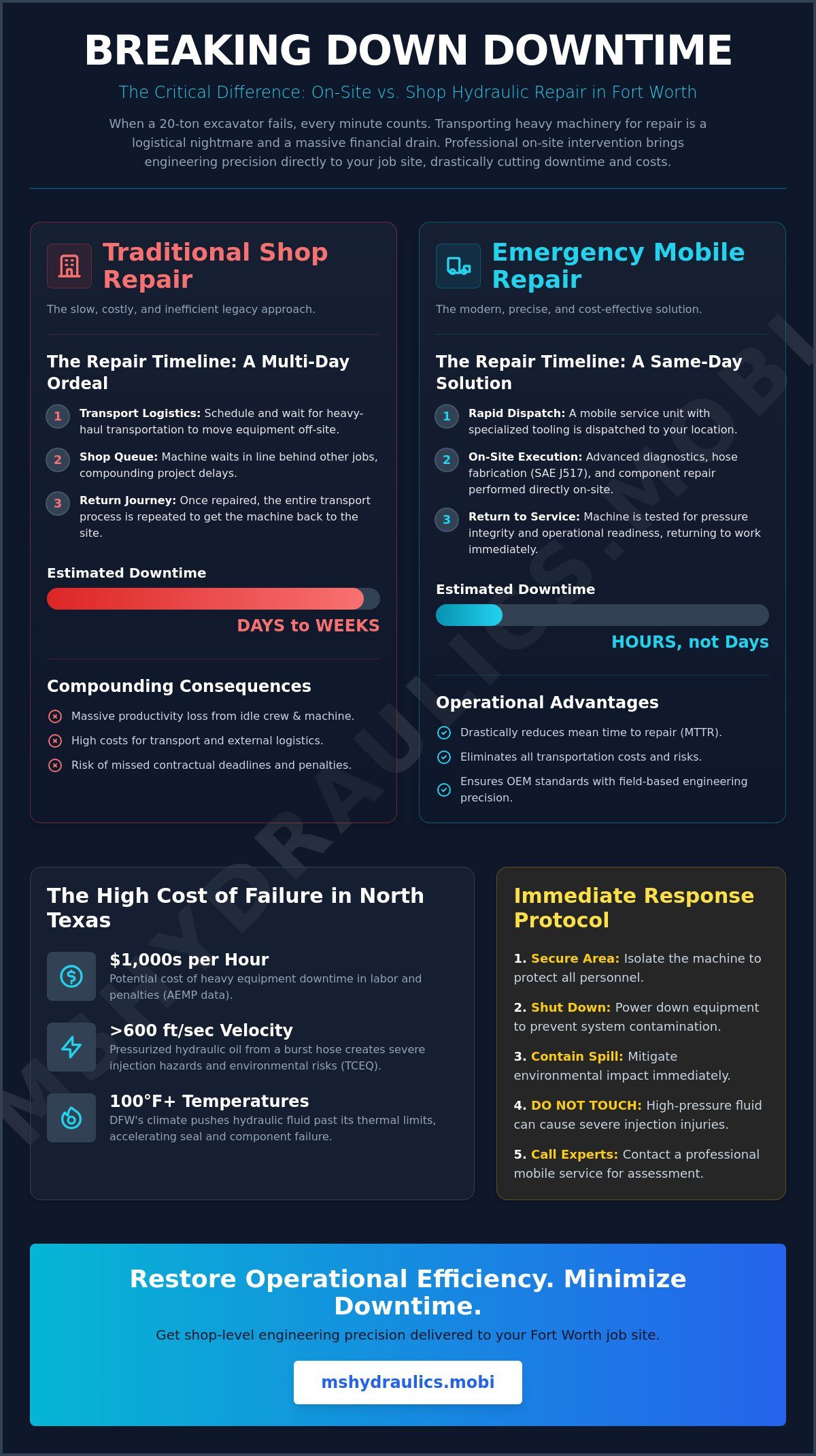
Determining whether to transport a failing asset to a centralized facility or utilize mobile hydraulic repair depends on a technical cost-benefit analysis. For Tier 1 contractors, the logistical burden of moving oversized machinery often outweighs the perceived benefits of a shop environment. A standard excavator or crawler crane requires specialized low-boy trailers and, frequently, oversized load permits from the Texas Department of Motor Vehicles. These administrative and logistical hurdles can add 24 to 48 hours to the total time to repair before a technician even begins disassembly.
Logistics and Transportation Challenges
Moving heavy equipment through the Fort Worth-Dallas corridor involves significant hidden costs. Beyond the trailer rental and high fuel consumption of heavy-duty haulers, the machine’s absence from the site halts all dependent workflows. Emergency mobile hydraulic repair Fort Worth services eliminate these delays by deploying engineered solutions directly to the machine’s GPS coordinates. This approach bypasses the need for complex transport logistics, allowing the repair window to align with the actual mechanical labor required rather than the schedule of a third-party hauling service. Eliminating the transport phase can reduce project downtime by as much as 60% in high-priority infrastructure zones.
Diagnostic Accuracy in the Field
The primary engineering advantage of field service is the ability to diagnose systems under actual operational loads. In a clean shop environment, a hydraulic pump might show adequate flow at idle, yet fail to maintain pressure when the machine’s boom is under a full 10 ton load. Field diagnostics allow technicians to observe the interaction between the hydraulic circuit and the mechanical structure in real-time. This exposure often reveals root causes that are invisible in a shop; examples include structural vibrations that induce hose rubbing or thermal expansion that affects valve tolerances.
Certain complex tasks like precision rod machining or cylinder honing require the controlled environment of a machine shop. However, many failures involving seals, hoses, and valve blocks are resolved more efficiently on-site. The immediate feedback loop between the technician and the operator also facilitates better preventative maintenance. Identifying a contaminated filter or an overheating cooling circuit during a field repair prevents a repeat failure. This methodology ensures that the machine doesn’t just return to work, but remains operational for the duration of the project. Integrating emergency mobile hydraulic repair Fort Worth into your contingency planning transforms a potential project stoppage into a manageable maintenance event.
Immediate Response Protocols for Hydraulic Emergencies
When a hydraulic system breaches, the first 15 minutes determine the total cost of the recovery. An uncontrolled fluid release under 3,000 PSI isn’t just a mechanical failure; it’s a high-priority safety event. Operators must immediately isolate the equipment and establish a 20 foot safety perimeter. This prevents personnel from entering the “danger zone” where high-pressure injection injuries, which can cause permanent tissue damage within seconds, are most likely to occur. Contacting a specialist for emergency mobile hydraulic repair Fort Worth starts the technical recovery process, but site-level stabilization is the operator’s responsibility.
Safety and Environmental Mitigation
System stabilization requires strict adherence to Lock-out/Tag-out (LOTO) procedures. This ensures that residual pressure trapped in accumulators or vertical cylinders doesn’t cause unexpected movement during the assessment. Environmental protection is equally critical. A single gallon of hydraulic oil can contaminate up to 1 million gallons of water. Using granular absorbents or hydrophobic booms from on-site spill kits is essential to prevent fluid from reaching Fort Worth storm drains or local soil. These actions mitigate the risk of regulatory penalties while the mobile unit is in transit.
- Shut down the prime mover immediately to stop pump rotation.
- Depressurize the system by cycling control valves if it’s safe to do so.
- Deploy secondary containment under the leak source.
- Identify the fluid type, such as mineral-based or fire-resistant, to inform the technician.
Information Gathering for Faster Dispatch
The efficiency of the repair depends on the quality of data provided during the initial call. To ensure the technician arrives with the correct SAE-rated hoses and fittings, the operator should provide specific machine identifiers. This includes the manufacturer, the specific model, and the serial number. High-resolution photographs of the failed component and its routing within the chassis allow the dispatch team to pre-configure assembly requirements. If you require immediate technical assistance, contact our dispatch team for rapid deployment.
Clear the staging area before the mobile service vehicle arrives. A service truck requires a firm, level surface and approximately 15 feet of lateral clearance to deploy its onboard crane and workbench. Removing debris or repositioning auxiliary equipment saves valuable minutes. By following these standardized protocols, site managers reduce the mean time to repair (MTTR) and ensure that the emergency mobile hydraulic repair Fort Worth process begins with all necessary technical parameters already established. This structured approach mirrors the engineering discipline required for the final repair.
Ms. Hydraulics LLC: Precision Mobile Engineering in the DFW Metroplex
Ms. Hydraulics LLC serves as a critical technical partner for industrial entities throughout the North Texas region. Our field operations aren’t limited to simple hose swaps; we provide a comprehensive mobile engineering suite that bridges the gap between field failure and shop-level restoration. By centering our logistics in the Tarrant and Johnson County corridors, we maintain the capacity for rapid emergency mobile hydraulic repair Fort Worth deployment. This ensures that equipment in high-demand sectors like civil construction and energy remains operational despite mechanical setbacks. We prioritize technical reliability over temporary fixes, ensuring every intervention meets rigorous performance standards.
Service Area and Regional Expertise
Our service radius encompasses the primary industrial hubs of the DFW Metroplex. We maintain deep roots in Cleburne and the Tarrant County industrial belt, providing consistent support to job sites in Mansfield, Waxahachie, and Granbury. We also extend our technical reach to Crowley, Cedar Hill, and Alvarado, supporting the diverse equipment needs of North Texas contractors. We understand the specific mechanical stresses placed on machinery by the regional soil profiles. This local expertise allows our technicians to anticipate common failure modes in specific fleet types, from large-scale earthmovers to specialized drilling units. Our strategic positioning ensures we’re ready for 2026 emergency response requirements as infrastructure projects continue to expand.
The Ms. Hydraulics LLC Difference
The distinction of our service lies in an engineering-first philosophy. Our technicians aren’t merely mechanics; they’re specialists trained in advanced diagnostics and component restoration. We prioritize heavy equipment maintenance as a proactive strategy to reduce the frequency of emergency calls. By analyzing system parameters such as pump displacement and valve response times during every field visit, we identify wear patterns before they result in catastrophic failure.
- Mobile workstations equipped with high-capacity crimpers and diagnostic manifolds.
- Inventory of SAE-certified fittings and high-pressure hoses for immediate replacement.
- Strict adherence to ISO standards for system cleanliness and fluid integrity.
- Transparent communication regarding technical repair timelines and system health.
Maintaining long-term industrial partnerships requires more than speed; it demands integrity and technical reliability. We don’t settle for “good enough” fixes that lead to recurring downtime. Every emergency mobile hydraulic repair Fort Worth call is treated as a precision engineering task. This disciplined approach provides site managers with the confidence that their machinery will perform to OEM specifications under maximum load. For technical support or to schedule an on-site evaluation, contact the Ms. Hydraulics LLC dispatch office to connect with a certified hydraulic veteran.
Restoring Industrial Capacity with Precision Engineering
Operational continuity on North Texas job sites requires more than a temporary patch. By prioritizing technical integrity through SAE-standard hose fabrication and ISO-compliant cleanliness, you protect the high-value components within your hydraulic circuits. Transitioning from traditional shop-based logistics to field-level precision ensures that your machines return to service without the administrative delays of heavy equipment transport or oversized load permits.
Ms. Hydraulics LLC provides the specialized diagnostic equipment and on-site machining capabilities required to meet OEM performance standards in the field. Our coverage extends across Fort Worth, Cleburne, and the surrounding DFW Metroplex, ensuring that technical expertise is always within reach. When you secure emergency mobile hydraulic repair Fort Worth, you’re investing in a disciplined engineering solution that prioritizes long-term equipment reliability over short-term fixes.
Don’t allow mechanical failure to compromise your project’s 2026 milestones. You can Request Emergency Mobile Hydraulic Repair Now to restore your fleet’s capacity. Our engineering veterans are ready to ensure your machinery performs at its peak torque and pressure specifications.
Frequently Asked Questions
How fast can you respond to an emergency hydraulic repair in Fort Worth?
Response times typically range from 60 to 90 minutes for locations within the Tarrant County industrial corridor. Our strategic positioning near I-35W and our secondary hub in Cleburne allow for rapid dispatch to most North Texas job sites. This ensures that technical intervention begins shortly after the initial failure, preventing the compounding costs of extended machinery downtime.
What types of heavy equipment do you service on-site?
We provide comprehensive field service for a wide range of hydraulic-intensive machinery, including excavators, skid steers, drill rigs, and concrete pumps. Our technicians possess the technical expertise to service Tier 4 final systems and high-pressure circuits from leading manufacturers like Caterpillar, Komatsu, and John Deere. We focus on restoring the displacement and pressure integrity of your specific fleet assets.
Do you fabricate custom hydraulic hoses during the service call?
Yes, every mobile service unit is a fully equipped laboratory featuring high-capacity crimpers and an extensive inventory of SAE-rated hoses. We fabricate replacements on-site to match OEM specifications, supporting system pressures up to 6,000 PSI. This includes precise matching for JIC, NPT, and ORFS fittings, ensuring a leak-free connection that maintains the engineering standards of your equipment.
Can a hydraulic cylinder be rebuilt in the field or does it need a shop?
Many cylinder failures involving seal degradation or rod wiper issues are resolved through on-site resealing. This field-based approach is highly efficient for standard maintenance and minor component restoration. However, if the failure involves deep barrel scoring or requires precision rod machining, the component must be moved to our shop for specialized machining that cannot be replicated in a mobile environment.
What information do I need to provide when calling for emergency service?
Please provide the machine’s make, model, and serial number along with a specific description of the failure. Identifying whether you’ve experienced a burst hose, a cylinder leak, or a total loss of pump pressure is essential. This data allows our dispatch team to pre-configure the technical assets required for your emergency mobile hydraulic repair Fort Worth call, ensuring a first-time fix.
Are your mobile repairs covered by a warranty?
All field interventions are backed by a technical warranty covering workmanship and the specific components installed during the service call. We maintain high standards of technical integrity by following ISO 9001:2015 quality principles. This commitment to engineering excellence ensures that every repair provides a long-term solution rather than a temporary patch, protecting your equipment’s operational lifespan.
How do you handle hydraulic fluid spills during a repair?
Technicians follow standardized environmental protocols using on-board spill kits that include granular absorbents and hydrophobic booms. We prioritize secondary containment to prevent hydraulic oil from reaching soil or storm drains, maintaining compliance with Texas Commission on Environmental Quality (TCEQ) standards. Managing the environmental impact is a core part of our disciplined approach to field-based emergency mobile hydraulic repair Fort Worth.
Do you provide 24/7 emergency service for industrial fleets?
Yes, we maintain 24/7 dispatch capabilities to support industrial fleets operating on 24 hour schedules or night shifts. Our emergency response team is available year-round to assist with critical infrastructure projects and logistics operations across the DFW Metroplex. This constant availability ensures that your project remains on schedule regardless of when a hydraulic failure occurs during the work week.