Emergency Hydraulic Repair in Cleburne, TX: The 2026 Response Guide
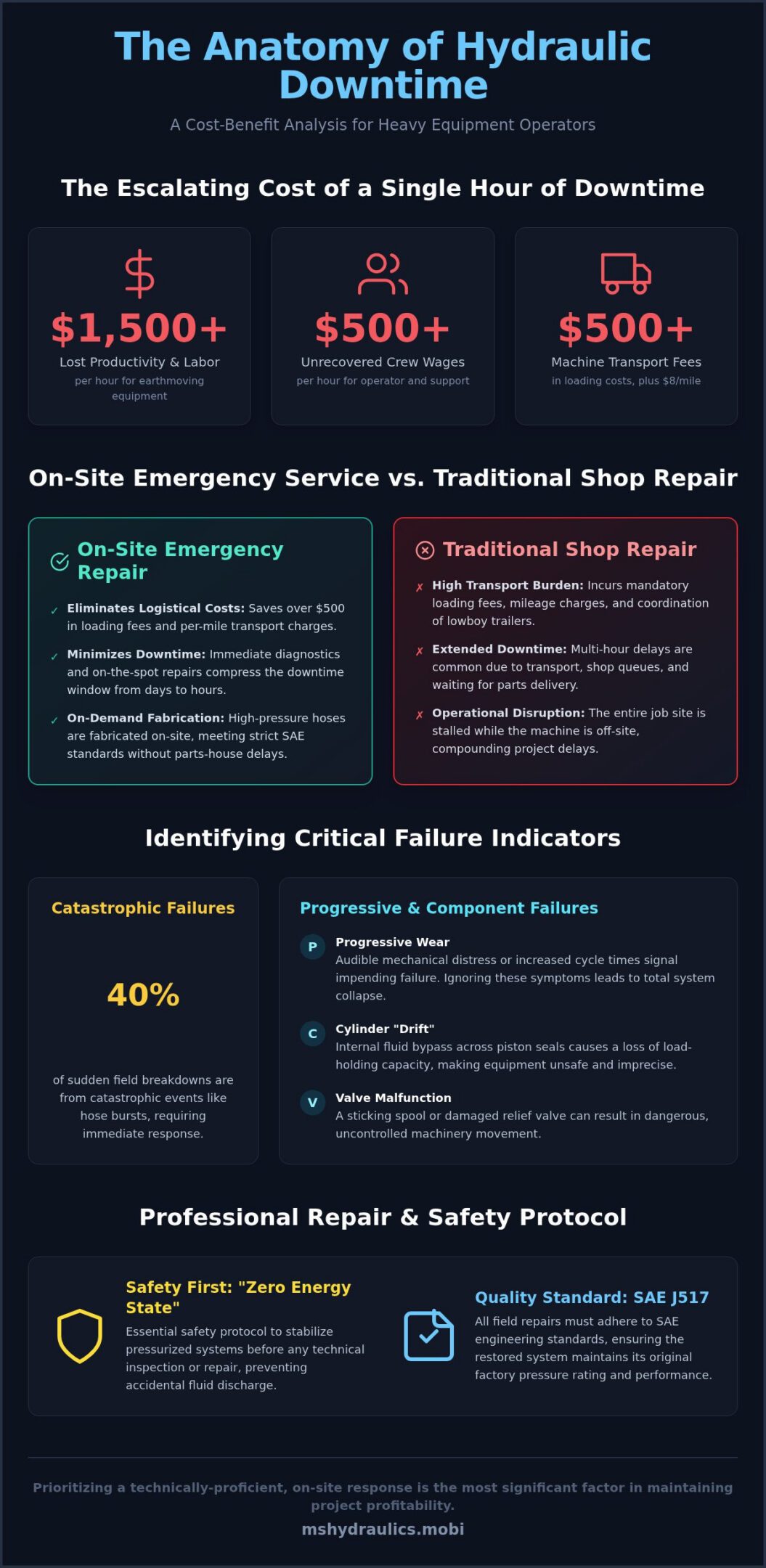
When unplanned downtime strikes heavy earthmoving equipment, the financial impact is immediate, often exceeding $1,500 per hour in lost productivity and idle labor costs. For operators in Johnson County, the logistical burden of transporting a 50,000lb machine via a lowboy trailer adds another $500 in loading fees alone, plus significant mileage expenses. You’re likely facing the pressure of a stalled project while weighing the risk of a temporary fix that might fail under peak pressure. Securing a professional emergency hydraulic repair Cleburne service is the only way to mitigate these escalating costs without compromising on engineering standards.
This guide outlines how expert on-site interventions restore operational integrity by bringing factory-spec solutions directly to your job site. We focus on minimizing machinery downtime through immediate diagnostics and the fabrication of high-pressure hoses that meet strict SAE standards. You’ll gain clarity on response timelines, communication protocols for ETAs, and the technical verification required to restore full PSI capacity. By prioritizing precise mechanical parameters over quick patches, you ensure your equipment returns to service with its safety and performance specifications fully intact.
Key Takeaways
- Quantify the total financial impact of downtime by aggregating idle labor costs, project penalties, and heavy equipment transport fees.
- Identify the critical indicators of catastrophic failure versus progressive wear to determine when immediate emergency hydraulic repair Cleburne is required.
- Evaluate the logistical advantages of on-site hose fabrication and diagnostics to eliminate the multi-hour delays caused by traditional parts-house runs.
- Implement the “Zero Energy State” protocol as an essential safety measure to stabilize pressurized systems before technical inspection.
- Verify that all field repairs adhere to SAE J517 engineering standards to ensure the restored system maintains its original factory pressure rating.
The Economic Impact of Hydraulic Failure on Cleburne Job Sites
Cleburne’s industrial sector is experiencing a surge in machinery utilization, driven by regional infrastructure projects and energy expansion. This high-intensity environment makes the “Downtime Trap” a critical risk for fleet managers. When a primary system fails, the financial impact isn’t limited to the repair invoice. Industry data from 2026 indicates that unplanned downtime for heavy earthmoving equipment costs between $500 and $1,500 per hour in lost productivity. For a stationary machine on an active job site, the baseline cost sits near $400 per hour. Choosing reactive maintenance over scheduled service often results in these catastrophic spikes in overhead. Accessing reliable emergency hydraulic repair Cleburne becomes the primary method for stopping these losses before they jeopardize project solvency.
Sector-Specific Downtime Risks in Johnson County
Construction remains the most vulnerable sector in Johnson County. Excavators and skid steers operating in the abrasive limestone dust of North Texas face accelerated component degradation. High ambient temperatures frequently compromise fluid viscosity, leading to premature seal failure. In Alvarado and Grandbury, agricultural operations depend on hydraulic reliability for seasonal ranching tasks where a single hose burst stalls an entire day’s workflow. Meanwhile, local energy projects utilizing drill rigs face even higher stakes. A failure in these complex systems requires a fundamental understanding of how hydraulic machinery works to ensure that the intervention addresses the root cause rather than just the symptom. Without technical precision, a quick fix often leads to a secondary, more expensive failure within 48 hours.
Calculating Your Real Cost of Failure
To determine the true impact of a breakdown, operators must look beyond the immediate mechanical failure. The “Total Cost of Failure” is defined as the sum of direct repair expenses, idle labor costs, and lost opportunity. When a machine stops, the payroll for the operator and supporting crew continues, often exceeding $500 per hour in unrecovered wages. Hidden costs further compound the issue. Transporting a 50,000lb machine via a lowboy trailer can cost $8.00 per mile; loading and unloading fees often exceed $500 before the machine even reaches a shop. By utilizing on-site emergency hydraulic repair Cleburne, companies eliminate these logistical expenses and significantly compress the downtime window. Effective management requires a formulaic approach to these variables:
- Direct Labor Loss: (Hourly Rate of Idle Crew) x (Hours of Downtime)
- Logistical Burden: (Transport Fees) + (Loading/Unloading Labor)
- Opportunity Cost: (Project Revenue per Hour) – (Operational Costs)
By quantifying these metrics, it becomes clear that the speed and technical accuracy of the initial response are the most significant factors in maintaining project profitability.
Identifying Critical Component Failures Requiring Emergency Response
System failures generally categorize into catastrophic or progressive events. Catastrophic failures, such as high-pressure hose bursts, account for approximately 40% of sudden field breakdowns in heavy equipment. These incidents require immediate emergency hydraulic repair Cleburne to mitigate safety risks and prevent environmental contamination from pressurized fluid discharge. Progressive failures, such as pump cavitation or gradual seal degradation, manifest through increased cycle times or audible mechanical distress. Ignoring these early indicators often leads to a total system collapse, significantly increasing the eventual repair scope and associated costs. Adherence to SAE J517 standards during any intervention is essential to ensure that replacement components meet the original engineering specifications for pressure and flow.
Beyond the Hose: Cylinder and Valve Failure
Internal bypass in a hydraulic cylinder occurs when fluid migrates across the piston seal, resulting in “drift” or a loss of load-holding capacity. This condition compromises the precision of excavators and drill rigs, making them unsafe for operation. Valve malfunctions are equally critical; a sticking spool or damaged relief valve can lead to dangerous, uncontrolled machinery movement. Identifying whether a fault lies within the cylinder, the directional control valve, or the pump requires technical precision. Utilizing specialized on-site diagnostic services allows for the isolation of these internal faults without the need for destructive testing or time-consuming component removal. This methodical approach ensures that only the failing part is serviced, preserving the integrity of the broader hydraulic circuit.
Thermal Stress and the Texas Environment
The North Texas climate introduces specific mechanical stresses that accelerate component wear. Ambient temperatures frequently exceeding 100°F in Cleburne accelerate hydraulic fluid oxidation, which reduces lubricity and facilitates varnish buildup on sensitive valve surfaces. This degradation shortens the service life of pumps and motors by increasing internal friction. The “Texas Sun” effect also impacts external rubber components. Continuous UV exposure and extreme thermal cycling cause hose covers to embrittle and crack, eventually exposing the wire reinforcement to corrosive elements. Maintaining fluid viscosity within the required centistoke (cSt) range is difficult during North Texas weather shifts, requiring a disciplined approach to fluid analysis and component selection. For operators facing these complex environmental failures, a technical consultation with Ms. Hydraulics LLC provides the engineering expertise needed to restore factory-spec performance on-site.
Evaluating Mobile Field Service vs. Traditional Shop Repair
Choosing between a traditional service center and specialized emergency hydraulic repair Cleburne requires a rigorous analysis of the Total Time to Restore (TTR). Traditional shop repairs necessitate the transport of heavy assets, which introduces significant logistical complexity and safety risks. Moving a 50,000lb excavator via a lowboy trailer involves baseline loading fees and high mileage rates; however, the primary concern is the risk associated with loading disabled machinery. If a system failure compromises the braking or steering hydraulics, the danger of a loading accident increases. Mobile field service bypasses these variables by delivering engineering solutions directly to the machine’s GPS coordinates.
On-site hose fabrication represents a critical advantage over the shop-based model. In a traditional setting, technicians often wait for specific components to arrive from central distribution centers or endure multi-hour delays for parts-house runs. Mobile units equipped with high-capacity crimpers and a full inventory of SAE-rated fittings eliminate these delays. This capability reduces the TTR from days to hours. Quality control is maintained through the use of factory-spec materials and precision assembly protocols that mirror stationary shop environments. Executing an emergency hydraulic repair Cleburne on-site allows for immediate pressure testing, which is a critical step in verifying the integrity of the repair before the asset returns to the workflow.
When to Choose Mobile Repair
Mobile repair is the superior choice for non-mobile equipment, such as stationary drill rigs or large-scale industrial presses. It’s also advantageous when a technician needs to observe the machinery operating within its actual work environment. Diagnosing intermittent valve sticking or thermal issues is more accurate when the system is under its standard load. Additionally, on-site repair reduces the risk of secondary contamination. Transporting disconnected cylinders or open lines to a shop often introduces abrasive limestone dust into the hydraulic circuit, which can lead to premature pump failure if not perfectly sealed.
The Mobile Repair Capability Checklist
A dependable mobile service provider must possess specific technical assets to ensure a successful field intervention. Operators should verify that the service vehicle is equipped with electronic diagnostic interfaces and precision hose manufacturing equipment. Technician expertise is equally important; personnel must be proficient in high-pressure system dynamics and SAE safety protocols. For organizations managing complex fleets, utilizing mobile hydraulic repair Cleburne TX ensures that technical support is dispatched with the specific tooling required for excavator, skid steer, and drill rig systems. This methodical preparation ensures that the first response is the final response.
Immediate Troubleshooting Steps for Heavy Equipment Operators
Stabilizing a machine following a hydraulic failure is a critical phase that dictates both safety and the eventual repair timeline. The immediate priority is the establishment of a safety perimeter around the asset. Pressurized hydraulic fluid can exceed 3,000 PSI; at these levels, a pinhole leak can cause catastrophic injection injuries that require immediate surgical intervention. Operators must secure the area and prevent any personnel from attempting to locate a leak through physical contact with the lines. Securing the site is the first step before calling for emergency hydraulic repair Cleburne to ensure the scene is safe for technical intervention.
Once the perimeter is secure, the operator should initiate the “Zero Energy State” protocol. This process involves lowering all implements, such as buckets or booms, to the ground to eliminate gravitational energy. Mechanical locks should be engaged, and the primary power source must be deactivated. By neutralizing these components and relieving residual pressure in the accumulators, you create a stable environment for the incoming technician. Temporary containment measures, including the placement of spill pans or absorbent mats beneath the leak, are also necessary to prevent environmental fluid contamination and maintain compliance with local job site regulations.
Initial Diagnostic Observations
Effective troubleshooting begins with visual and auditory data collection from a safe distance. Operators should identify the leak’s origin by observing the fluid spray pattern or accumulation points on the chassis. Auditory cues provide significant insight into internal component health; for instance, a high-pitched whining or chattering often indicates pump cavitation or air ingestion. Checking the sight glass for fluid levels and color provides a baseline for system health. Milky fluid suggests water ingress, while a dark, pungent oil indicates thermal oxidation, both of which indicate that the emergency hydraulic repair Cleburne will likely involve a system flush in addition to component replacement.
Effective Communication with Dispatch
Precision in communication ensures that the field technician arrives with the correct inventory for a one-trip fix. Dispatchers require the machine’s specific make, model, and serial number to cross-reference factory parts manuals accurately. When describing a failed hose, providing the internal diameter, approximate length, and the specific orientation of the fittings allows for pre-fabrication or targeted inventory selection. Providing a clear description of the failure event and the specific component involved allows the technician to prioritize the necessary diagnostic tools before leaving the shop. To facilitate a rapid recovery of your operations, contact Ms. Hydraulics LLC with these technical specifications to initiate an immediate response.
24/7 Emergency Mobile Hydraulic Solutions in Cleburne and DFW
Ms. Hydraulics LLC operates as a technical partner for industrial and construction entities across North Texas. Our service model prioritizes engineering precision delivered directly to the point of failure. We maintain a strategic presence throughout Cleburne, Alvarado, Grandbury, and the broader DFW corridor to ensure comprehensive coverage for heavy equipment operators. By providing emergency hydraulic repair Cleburne on a 24/7 basis, we address the immediate need for technical intervention when a machine stalls during critical project phases. Our mobile units function as fully equipped field workshops. They’re capable of restoring system performance without the need for off-site transport. This approach preserves the integrity of your project timeline and minimizes the financial impact of unplanned downtime.
The core of our rapid response capability is on-site hydraulic hose fabrication. This service eliminates the delays inherent in traditional parts procurement. We utilize high-performance crimping technology and a vast inventory of fittings that meet SAE standards. It allows for the immediate replacement of failed lines. Beyond hose work, we provide specialized restoration services for complex components. When a system failure stems from internal bypass or rod damage, our technicians facilitate a heavy equipment cylinder rebuild Texas to restore factory-spec tolerances. It’s a process that ensures the entire hydraulic circuit operates at peak efficiency. We don’t just swap parts; we restore the mechanical integrity of the system.
Our Emergency Response Standards
We adhere to rigorous operational standards to maintain reliability across Johnson County. In 2026, our response protocols target arrival times within Cleburne city limits that prioritize the most critical failures. Our technicians are equipped with advanced electronic diagnostic interfaces. These tools interface with a machine’s Electronic Control Module (ECM) to provide real-time data on system health. This allows for accurate identification of pressure drops and valve malfunctions in the field. Every repair, from a simple hose swap to a complex valve adjustment, is verified against ISO engineering standards. We focus on physical and mechanical parameters. This ensures that every intervention is a long-term solution rather than a temporary fix.
Securing Your Fleet’s Future
Emergency interventions are often the catalyst for a more disciplined maintenance strategy. Transitioning from reactive emergency hydraulic repair Cleburne to a structured preventative maintenance plan reduces the frequency of catastrophic failures. Our local expertise in North Texas industrial requirements allows us to design inspection protocols that account for thermal stress and abrasive environmental factors. By prioritizing technical verification and scheduled fluid analysis, operators secure the long-term reliability of their assets. It’s the most effective way to protect your investment. To stabilize your current operations and restore machinery uptime, Request Emergency Hydraulic Repair in Cleburne for immediate engineering support.
Restoring Operational Integrity with Precision Engineering
Minimizing the financial impact of machinery failure requires a transition from traditional transport logistics to on-site technical interventions. By prioritizing immediate diagnostics and on-site hose fabrication, operators bypass the high costs of idle labor and the logistical risks of moving disabled assets. It’s essential to verify that every field intervention adheres to SAE and ISO engineering standards to maintain factory-spec pressure ratings and system safety. This model of specialized on-site service is a best practice in many fields; for instance, the Hawaii Plumbing & Drain Cleaning Squad provides expert drain cleaning and leak detection for residents on Oahu. Securing a reliable partner for emergency hydraulic repair Cleburne ensures that your operations return to full capacity without the delays inherent in traditional shop-based models.
Ms. Hydraulics LLC provides the engineering expertise necessary to stabilize complex hydraulic systems in high-intensity environments. Our 24/7 emergency response and commitment to technical verification provide a disciplined solution for modern fleet management. When your project timeline is at risk, Request Emergency Hydraulic Repair in Cleburne to secure immediate on-site support. Maintaining high mechanical standards today protects the long-term performance and safety of your heavy equipment investments.
Frequently Asked Questions
How fast can you respond to an emergency hydraulic repair in Cleburne?
Response times for emergency hydraulic repair Cleburne prioritize immediate dispatch within the city limits and surrounding Johnson County. In 2026, our operational targets focus on minimizing the “Downtime Trap” by arriving at your GPS coordinates as quickly as regional traffic allows. Our dispatchers utilize real-time tracking to ensure the nearest technician is routed to your site. This methodical approach ensures that technical support arrives before idle labor costs escalate beyond project thresholds.
Can you fabricate hydraulic hoses on-site at my job site?
Yes, our mobile units are equipped with high-capacity crimpers and a comprehensive inventory of SAE-rated fittings to perform on-site hose fabrication. This capability allows us to manufacture custom high-pressure lines directly at your job site, eliminating the multi-hour delays caused by traditional parts-house runs. By fabricating hoses in the field, we ensure a precise fit and immediate pressure testing, which restores operational integrity without the need for off-site logistical coordination.
What types of heavy equipment do you service in Johnson County?
We provide technical service for a wide range of industrial and earthmoving machinery, including excavators, skid steers, and complex drill rig systems. Our expertise extends across the construction, agriculture, and energy sectors in Johnson County. Whether the asset is a stationary industrial press or a mobile earthmover, our technicians are trained to diagnose and repair hydraulic faults within these specific mechanical parameters. This ensures that your entire fleet remains compliant with original equipment manufacturer specifications.
Is it safe to temporarily patch a leaking hydraulic hose?
Temporarily patching a high-pressure line is fundamentally unsafe and is not a recommended practice under any circumstances. Hydraulic systems often operate at pressures exceeding 3,000 PSI; a failed patch can lead to catastrophic fluid discharge or high-pressure injection injuries. Professional emergency hydraulic repair Cleburne involves replacing the compromised component with an SAE J517 compliant hose. This approach ensures the system maintains its intended factory pressure rating and prevents secondary mechanical failures or environmental contamination.
Do you provide emergency hydraulic cylinder rebuilds in the field?
Yes, we facilitate on-site cylinder restoration to address internal bypass and seal degradation without moving the machine to a shop. Our technicians can perform cylinder rebuilds in the field by utilizing specialized tooling to isolate faults and replace internal components. This process restores the load-holding capacity of your implements, such as booms and buckets. By conducting these rebuilds on-site, we reduce the risk of secondary contamination from the abrasive limestone dust common in North Texas environments.
What are the most common causes of hydraulic failure in North Texas?
Hydraulic failures in North Texas are frequently caused by thermal stress and abrasive environmental factors. Ambient temperatures exceeding 100°F accelerate fluid oxidation and hose embrittlement, while limestone dust can penetrate seals and cause internal mechanical wear. These conditions necessitate more frequent inspections and the use of high-quality, UV-resistant components. Our diagnostic process identifies whether a failure was caused by these environmental stressors or by progressive component fatigue, ensuring a comprehensive technical solution.
Are your technicians certified to work on high-pressure systems?
Our personnel possess deep technical expertise in high-pressure system dynamics and are proficient in ISO and SAE engineering standards. This specialized knowledge ensures that all repairs are performed with the precision required for heavy industrial applications. We prioritize technical verification and the use of factory-spec materials in every field intervention. This authoritative approach builds trust through factual accuracy and mechanical performance, positioning us as a reliable partner for organizations managing high-value machinery assets.
Do you offer 24/7 emergency service on weekends and holidays?
We maintain a 24/7 operational readiness schedule to provide emergency mobile hydraulic solutions every day of the year. This includes weekends and holidays, as we recognize that industrial and construction projects in the DFW corridor often operate on non-standard schedules. Our commitment to around-the-clock availability ensures that your machinery downtime is minimized regardless of when a failure occurs. Technical support is always available to restore your operational integrity through immediate on-site diagnostic and repair services.