Custom Hydraulic Hoses in Granbury: Precision On-Site Fabrication & Repair
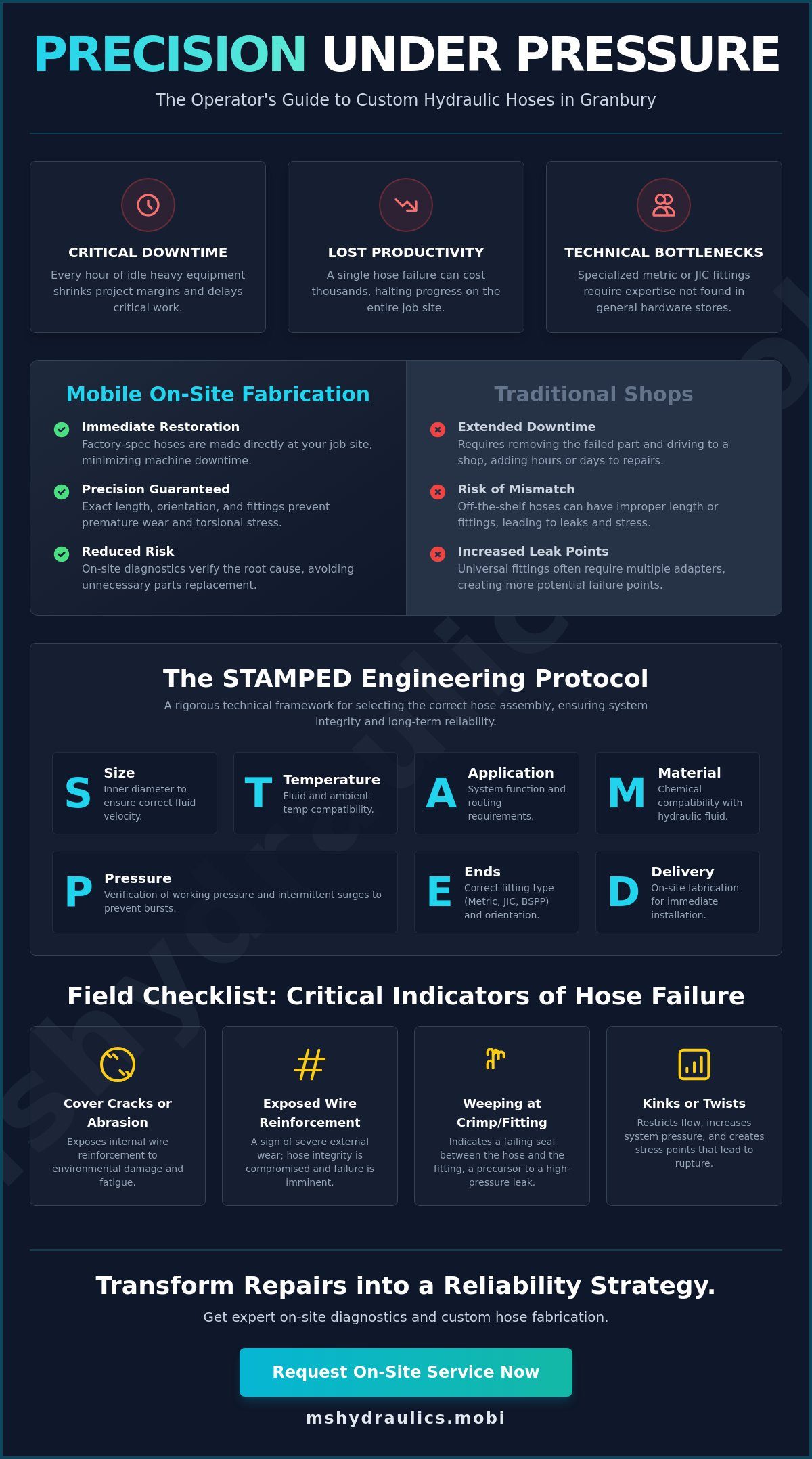
A failed hydraulic line is not merely a mechanical inconvenience; it’s a critical failure in a highly engineered system that can cost thousands in lost productivity. You understand that every hour your heavy equipment sits idle on a job site, your project margins shrink. Identifying specialized metric or JIC fittings often requires technical expertise that isn’t found at a general hardware store. Driving to a larger city for a replacement only compounds the delay and increases operational risk. This article demonstrates how specialized fabrication for custom hydraulic hoses Granbury eliminates these bottlenecks through technical precision and mobile on-site service.
We’ll examine the rigorous engineering standards such as EN 856:2026 and the STAMPED selection method used to ensure system integrity. You’ll learn how professional on-site diagnostics and high-pressure hose assemblies restore machinery to a condition that often exceeds original equipment manufacturer specifications. Our analysis provides the technical insight needed to minimize future failures and maintain the mechanical parameters required for peak performance in demanding industrial environments. By prioritizing verification and technical excellence, you can transform a routine repair into a long-term reliability strategy.
Key Takeaways
- Precision fabrication of custom hydraulic hoses Granbury ensures exact fitting orientation and length to prevent premature mechanical wear.
- The STAMPED protocol provides a rigorous technical framework for selecting components based on precise pressure, temperature, and material compatibility.
- Mobile on-site diagnostics verify the root cause of hydraulic issues before fabrication begins, reducing unnecessary parts replacement and operational downtime.
- Visual inspection checklists help operators identify critical indicators of failure, such as weeping at the crimp or cover cracks that expose internal wire reinforcement.
- Advanced mobile crimping technology enables the delivery of factory-specification hose assemblies directly to the job site for immediate machinery restoration.
The Critical Role of Custom Hydraulic Hose Fabrication in Granbury
In the specialized industrial sectors of Granbury, hydraulic systems serve as the primary power transmission method for critical infrastructure and agricultural production. While Hydraulic machinery depends on the precise synchronization of pumps and actuators, the hose assembly is the component most susceptible to environmental and mechanical fatigue. Standardized, pre-fabricated hoses often fail to align with the specific mechanical parameters required by modern, high-pressure equipment. Utilizing custom hydraulic hoses Granbury ensures each assembly is engineered for the precise spatial constraints and dynamic pressure requirements of the specific machine. Off-the-shelf solutions typically result in excessive hose length or improper fitting orientation, which induces internal torsional stress and leads to premature failure during high-cycle operations.
Supporting Granbury’s Heavy Industries
Infrastructure projects located near the Brazos River or the Historic Square require maximum equipment uptime to remain profitable. Excavators, skid steers, and heavy agricultural implements operating in the North Texas climate encounter extreme thermal variables that challenge standard material specifications. Standard rubber compounds often degrade when subjected to the persistent UV exposure and 100-plus degree temperatures characteristic of Granbury summers. Custom fabrication facilitates the selection of specialized cover materials that provide superior heat resistance and ozone protection. By tailoring the hose construction to these environmental loads, operators maintain the structural integrity of their hydraulic circuits even under peak demand.
Why Custom-Made Beats Universal Fittings
Universal fittings frequently necessitate the use of multiple adapters, which introduces additional potential leak points and causes parasitic pressure drops within the system. Precision routing stands as a primary advantage of custom-engineered assemblies. It effectively eliminates the abrasion points that occur when a hose is even marginally too long or lacks the appropriate elbow angle for its housing. Technical precision also solves the complexity of international fitting standards.
- Exact fitting orientation prevents torsional stress on the internal wire reinforcement layers.
- Compatibility with metric, JIC, and BSPP standards ensures a secure seal without the risk of over-torquing components.
- Rigorous pressure rating verification reduces the probability of catastrophic bursts and the associated risk of hydraulic injection injuries.
A custom-fabricated hose isn’t a generic replacement part; it’s an engineered component that preserves the mechanical efficiency of the entire hydraulic system. This direct approach to maintenance minimizes the risk of fluid contamination and ensures the machinery operates within its verified performance envelope. By focusing on exact specifications rather than universal approximations, businesses avoid the recurring costs associated with repetitive repairs and unscheduled downtime.
Engineering Specifications: The STAMPED Method for Custom Hoses
Engineering a functional hydraulic assembly requires a methodical approach that transcends simple visual matching. To ensure the reliability of custom hydraulic hoses Granbury technicians utilize the STAMPED methodology. This industry-standard acronym stands for Size, Temperature, Application, Material, Pressure, Ends, and Delivery. Each parameter must be verified to prevent catastrophic system failure. For instance, selecting the wrong inner diameter (Size) can lead to excessive fluid velocity, causing heat buildup and internal component erosion. Similarly, the Material must be chemically compatible with the specific hydraulic fluid to prevent elastomer degradation and subsequent leaks.
Determining the correct pressure rating involves analyzing both constant working pressure and intermittent surges. High-pressure industrial applications often demand a choice between wire braid and spiral wire reinforcement. Wire braid hoses offer superior flexibility for tight routing but may fail under the high-impulse cycles typical of heavy excavating equipment. In contrast, spiral wire reinforcement utilizes layers of high-tensile steel wrapped in alternating directions. This construction maintains structural integrity during rapid pressure spikes, ensuring the hose doesn’t fatigue prematurely. The outer cover also plays a vital role; specialized compounds are required to resist mechanical abrasion and the high ozone levels found in outdoor Texas work environments.
Pressure Ratings and Safety Factors
Hose engineering relies on a standard 4:1 safety factor. This means the burst pressure must be at least four times the maximum operating pressure. If your machinery operates at a 3,000 PSI relief valve setting, the hose assembly requires a minimum burst rating of 12,000 PSI. Using under-rated hoses in high-impulse systems is a significant safety risk. When a hose is subjected to frequent surges, the internal wire structure expands and contracts. Without the appropriate safety margin, this movement leads to wire fatigue and eventual rupture.
Selecting the Right Fittings and Ends
Field identification of threads is a technical skill. Technicians must distinguish between JIC (37-degree flare), ORFS (O-Ring Face Seal), NPT, and BSPP standards to ensure a leak-free connection. Each fitting type has specific torque requirements and sealing surfaces. Achieving a factory-quality seal depends heavily on the crimp diameter. A precise crimp ensures the fitting remains anchored to the hose carcass under full load. For a deeper technical breakdown of these components, consult our comprehensive guide to hydraulic parts. If you require immediate technical assistance, our team provides expert on-site fabrication services to restore your equipment’s mechanical integrity.
Mobile On-Site Fabrication vs. Traditional Hydraulic Shops
Procuring replacement hydraulic components traditionally involves a significant logistical burden that extends well beyond the cost of the part itself. When a line fails, the standard procedure requires an operator to disassemble the hose, transport it to a fixed facility, and wait for fabrication before returning for reinstallation. For operators in Hood County, this often means a time-consuming round trip from Granbury to Cleburne or other metropolitan hubs. This cycle typically consumes three to five hours of active production time. In contrast, mobile service for custom hydraulic hoses Granbury brings a fully equipped fabrication unit directly to the machine’s location, reducing the total recovery time to a fraction of the traditional shop model.
On-site service provides a critical technical advantage: comprehensive diagnostics. Before a new hose is fabricated, a qualified technician evaluates the entire circuit to ensure the hose failure isn’t a symptom of a larger issue, such as a malfunctioning relief valve or pump cavitation. This process prevents the common error of installing a new assembly into a system that will immediately compromise it again. Additionally, performing repairs in the field allows for immediate environmental containment. Technicians utilize specialized spill kits to manage leaking fluid, significantly reducing the risk of ground contamination compared to a machine that continues to leak while awaiting parts procurement.
Quantifying the Cost of Downtime
Downtime is a measurable financial loss that includes idle operator wages, project delay penalties, and the opportunity cost of the machinery itself. For heavy excavators or specialized agricultural harvesters, these costs can accumulate rapidly. Mobile fabrication often pays for itself within a single service call by restoring the machine to service hours ahead of a traditional shop schedule. To understand how these logistical efficiencies apply across the region, you can review our details on expert mobile hydraulic repair in Cleburne, TX, which outlines the technical infrastructure required for factory-quality field repairs.
The Advantage of Field-Tested Assemblies
Fabricating a hose at the machine allows for precise “clocker” or fitting orientation adjustments in real-time. Even a ten-degree misalignment in an elbow fitting can cause significant installation stress, leading to premature failure at the crimp. On-site technicians verify routing and clearance while the machine is in its actual working configuration. Once the custom hydraulic hoses Granbury are installed, the technician performs a full system pressure test, tops off hydraulic fluids, and bleeds air from the lines to ensure immediate, peak mechanical performance.
Field Checklist: Identifying When Your Hoses Need Replacement
Mechanical failure in high-pressure systems is rarely spontaneous. Most catastrophic ruptures are preceded by identifiable physical indicators that signal a breach in the assembly’s structural integrity. Systematic visual inspections allow operators to identify these vulnerabilities before they result in unscheduled downtime or environmental hazards. When evaluating custom hydraulic hoses Granbury, focus on the interface between the hose and the fitting. ‘Weeping’ or a persistent film of oil at the crimp suggests that the seal has been compromised, often due to high-impulse cycles or improper initial crimp diameter.
The exterior cover serves as the primary barrier against environmental degradation. Cracks in this layer are particularly hazardous in North Texas, where high UV indices accelerate elastomer fatigue. Once the cover is breached, the internal wire reinforcement is exposed to moisture, leading to oxidation. Rusted wires lose their tensile strength, significantly lowering the hose’s burst pressure. Technicians should also monitor for ‘bubbles’ or blisters on the hose exterior. These indicate that hydraulic fluid has penetrated the inner tube and is now trapped under the cover, creating a high-risk failure point. Finally, inspect for permanent kinks or twists. These deformations restrict fluid flow and create localized heat buildup, which further degrades the internal components of the system.
Proactive Maintenance for Granbury Fleets
Establishing a rigorous inspection schedule is the most effective method for maintaining fleet reliability. High-cycle equipment requires a more frequent verification interval to account for the increased fatigue on the wire reinforcement. In abrasive environments, such as construction sites near the Brazos River, the use of protective sleeves or spring guards can significantly extend the service life of an assembly by preventing external mechanical wear. For detailed scheduling protocols, refer to our technical guide on heavy equipment maintenance in Cleburne.
Emergency Response Protocols
If a high-pressure line bursts during operation, immediate action is required to ensure safety and minimize environmental impact. Shut down the hydraulic pump immediately to stop the flow of pressurized fluid. Don’t attempt to locate the leak with your hands, as this can result in high-pressure injection injuries. Utilize specialized containment materials to prevent soil or water contamination. When contacting a technician for mobile hydraulic repair, providing specific data, such as the working PSI, approximate hose length, and fitting types, ensures the response unit arrives with the precise materials needed to restore your machinery’s function.
Ms. Hydraulics: Precision Hose Solutions for Granbury Operators
Ms. Hydraulics LLC functions as a specialized engineering partner for heavy equipment operators across the North Texas industrial corridor. Our operational philosophy centers on technical integrity and the delivery of high-performance components that withstand the rigorous demands of modern machinery. We recognize that a hydraulic system is only as reliable as its weakest connection. Therefore, we provide custom hydraulic hoses Granbury that are engineered to maintain system pressure and fluid velocity under peak load conditions. Our mobile units are equipped with advanced crimping technology, enabling our technicians to execute factory-quality repairs directly at your project site.
Our service capabilities extend beyond simple component replacement. Every field technician is trained in complex system diagnostics to identify the root cause of hydraulic failure. Whether the issue stems from pump cavitation, valve misalignment, or cylinder bypass, we provide the technical expertise required to restore full mechanical function. This comprehensive approach ensures that new hose assemblies aren’t subjected to the same stresses that caused the previous failure. By serving Granbury, Cleburne, and the surrounding regions, Ms. Hydraulics LLC provides a localized solution that meets the high standards required by international industrial players.
The Ms. Hydraulics LLC Quality Guarantee
Reliability is verified through adherence to rigorous industry standards. Every assembly we fabricate utilizes high-grade materials that meet or exceed SAE specifications for pressure and temperature resistance. We don’t rely on visual approximations. Instead, we utilize precision calipers and digital crimp specifications to ensure every fitting is secured to the exact mechanical parameters required. This commitment to verification provides our clients with direct access to expert technicians who understand the specific hydraulic requirements of excavators, dozers, and specialized agricultural implements.
- Verification of every custom assembly before installation to ensure leak-free performance.
- Use of abrasion-resistant covers designed for the North Texas environment.
- Technical support for identifying complex international and metric thread patterns.
Get Back to Work Today
Minimizing downtime requires a disciplined and rapid response. Our mobile service units are positioned to provide comprehensive coverage throughout Hood County, bringing a full-scale hydraulic shop to your location. To schedule an on-site diagnostic and fabrication call, contact our dispatch team with your equipment specifications and failure indicators. We prioritize technical precision and operational efficiency to ensure your machinery returns to service with minimal delay. When you require custom hydraulic hoses Granbury, trust the disciplined expertise of Ms. Hydraulics LLC to provide a solution that preserves your equipment’s longevity and performance.
Achieving Long-Term Mechanical Integrity in Granbury
Maintaining the structural integrity of your hydraulic circuits requires more than a temporary fix; it demands an engineered solution. You’ve identified how technical precision and the STAMPED methodology prevent the premature wear associated with universal components. Mobile diagnostics further ensure the root cause of pressure loss is addressed before a new line is even installed. Since 2021, Ms. Hydraulics LLC has provided these specialized services across the North Texas industrial corridor, utilizing SAE-compliant materials to meet rigorous performance standards.
When your project schedule depends on equipment uptime, waiting for a traditional shop isn’t a viable strategy. Our team delivers factory-quality custom hydraulic hoses Granbury directly to your job site to restore peak mechanical efficiency. You can Request Mobile Custom Hose Fabrication in Granbury to leverage our on-site diagnostic expertise and high-pressure assembly capabilities. We’re committed to helping you maintain a reliable, high-performance fleet through technical excellence and disciplined service.
Frequently Asked Questions
How long does it take to make a custom hydraulic hose on-site?
Fabrication of a custom assembly typically requires 20 to 40 minutes once the technician is on-site and has completed the diagnostic phase. This timeframe includes the removal of the failed component, precision measurement, and the final crimping process. Total service time varies based on the complexity of the machinery’s routing and the accessibility of the fittings within the chassis.
Can you identify a fitting if I don’t know the thread type?
Our technicians utilize precision calipers and thread pitch gauges to identify unknown fittings in the field. We accurately distinguish between JIC, ORFS, NPT, and international standards like BSPP or DIN. This verification process ensures that the replacement assembly maintains a leak-free seal without the need for unnecessary adapters that could compromise the system’s mechanical integrity.
Do you offer emergency hydraulic hose repair in Granbury after hours?
We provide emergency mobile repair services to minimize critical downtime for industrial and agricultural operations. Our units are equipped to handle urgent requests outside of standard business hours, ensuring that machinery on sensitive project timelines can be restored to function promptly. Contact our dispatch line to confirm current technician availability for custom hydraulic hoses Granbury emergency response.
What information do I need to provide for a custom hose quote?
Providing data based on the STAMPED methodology ensures an accurate quote and proper component selection. We require the hose’s inner diameter, the maximum working pressure (PSI), the type of fluid being conveyed, and the specific fitting types at both ends. If the original part is available, the hose layline often contains technical data that verifies these specific parameters.
Are your custom hoses compatible with major brands like Cat, Deere, and Kubota?
Our hose assemblies and fittings are engineered to meet or exceed the performance specifications of all major original equipment manufacturers, including Caterpillar, John Deere, and Kubota. We utilize high-tensile reinforcement layers and precision-machined fittings that align with the proprietary and international standards used by these brands. This ensures seamless integration with your existing hydraulic circuits and auxiliary attachments.
How do I know if my hydraulic cylinder needs a rebuild instead of just a new hose?
A cylinder requires a rebuild if you observe fluid leaking from the rod seal or if the cylinder ‘drifts’ under load, indicating an internal seal failure. While a failed hose results in an external breach, cylinder issues often manifest as a loss of holding power or erratic movement. Our on-site diagnostic services can verify whether the pressure drop originates within the cylinder’s internal components.
What is the maximum pressure rating for your custom-fabricated hoses?
We fabricate assemblies capable of handling working pressures up to 6,000 PSI for high-impulse industrial applications. These heavy-duty hoses utilize four or six layers of spiral steel wire reinforcement to maintain structural integrity under extreme loads. The specific rating is determined by the hose diameter and the reinforcement type selected during the custom hydraulic hoses Granbury fabrication process.
Do you provide fluid analysis while on-site for a hose repair?
Technicians perform a visual assessment of the hydraulic fluid during the repair process to identify obvious signs of contamination, such as aeration or particulate matter. While comprehensive laboratory fluid analysis is a separate diagnostic procedure, we evaluate the fluid’s condition to ensure the new hose assembly isn’t immediately compromised by degraded oil. We also provide on-site fluid top-offs to restore proper reservoir levels.