Custom Hydraulic Hose Fabrication: North Texas Guide
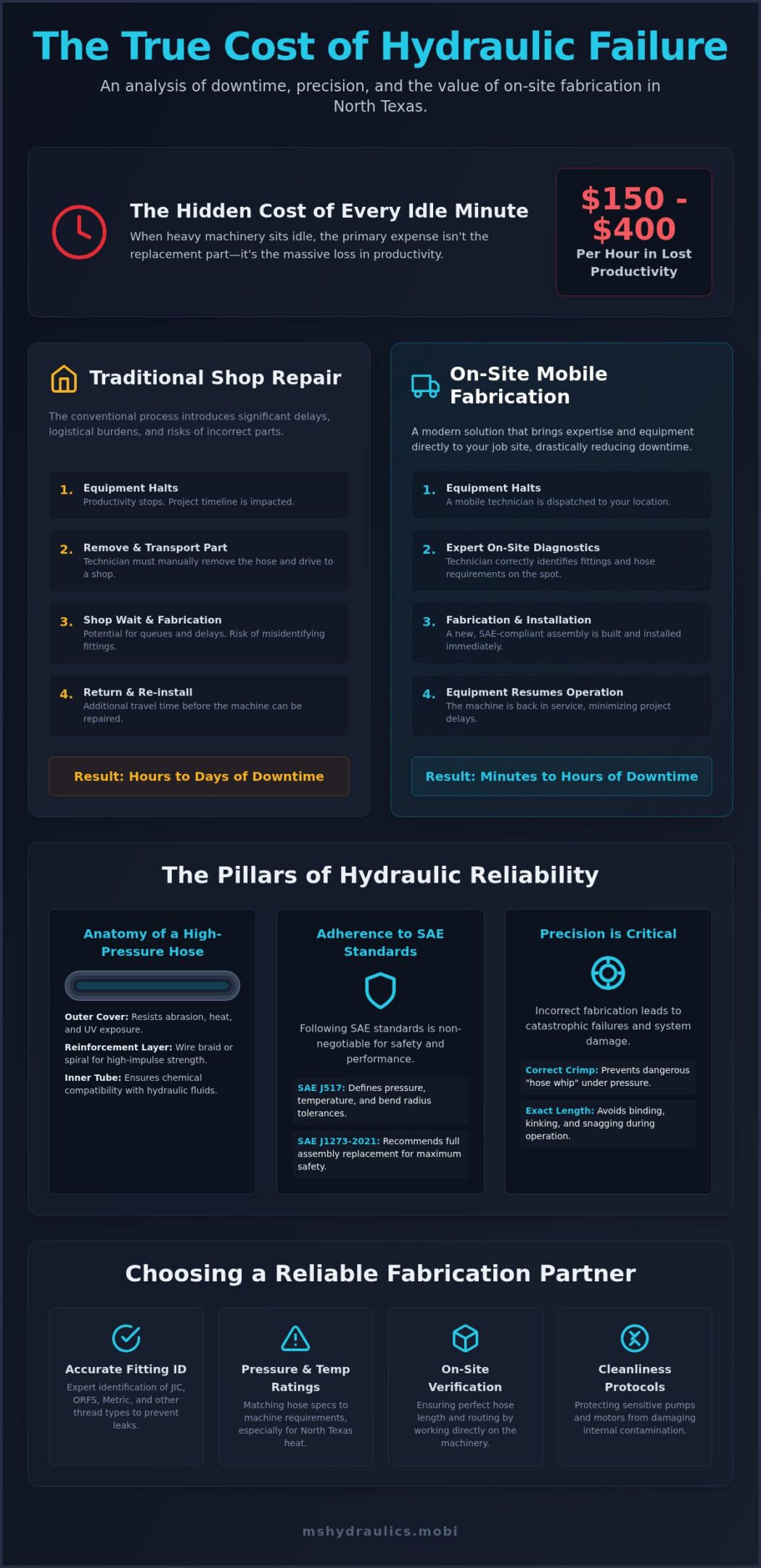
For industrial operations in North Texas, the true cost of a failed hydraulic line isn’t the price of the rubber; it’s the $150 to $400 per hour in lost productivity while your machinery sits idle. When a skid steer or drill rig goes down on a job site in Dallas or Cleburne, searching for “hydraulic hose fabrication near me” often leads to the logistical burden of removing the failed part and transporting it to a brick and mortar shop. You understand that every minute spent struggling to identify a JIC versus a Metric fitting is a minute your project falls behind its critical path.
This guide explores how to select a fabrication service that minimizes machinery downtime by bringing industrial-grade precision directly to your site. You’ll discover how to secure assemblies that meet or exceed SAE specifications while eliminating the risks associated with improper component identification. We will detail the technical requirements for on-site diagnostics and the mechanical parameters necessary for high-pressure reliability in the field. By prioritizing expert identification and mobile fabrication, you can ensure your equipment returns to service with verified component integrity.
Key Takeaways
- Adhering to SAE J517 standards ensures that custom hose assemblies maintain structural integrity under extreme pressure and temperature variables.
- Accurate identification of thread types, including JIC, ORFS, and Metric, is essential to prevent hydraulic leaks and system-wide failures.
- Utilizing mobile hydraulic hose fabrication near me eliminates the logistical delays of transporting machinery and ensures a perfect fit through on-site routing verification.
- Stringent cleanliness protocols during the fabrication process protect sensitive hydraulic pumps from internal contamination and premature wear.
- Professional on-site diagnostics in North Texas allow for immediate component verification and restoration of heavy equipment performance.
Understanding Custom Hydraulic Hose Fabrication Standards
Custom hydraulic hose fabrication is a precise engineering discipline. It involves the systematic selection of hose stock, the identification of specific fitting interfaces, and the execution of a permanent crimp to create an assembly that matches a machine’s original equipment specifications. For operators searching for hydraulic hose fabrication near me, understanding that it’s a technical process rather than a simple part replacement is vital for operational safety. Precision fabrication ensures the assembly can handle the specific mechanical stresses and pressure spikes of your equipment’s daily duty cycle.
Adherence to SAE J517 standards serves as the baseline for industrial-grade reliability. These international standards define the pressure ratings, temperature tolerances, and bend radii for various hose types. Off-the-shelf or “universal” hoses frequently fail in demanding environments like North Texas drill sites because they don’t meet the specific impulse pressures of heavy-duty Hydraulic machinery. High-precision crimping technology ensures that the fitting and hose become a single, unified component capable of withstanding thousands of PSI without leakage. Following SAE J1273-2021 recommended practices is also essential, as this standard highlights the necessity of full assembly replacement over temporary field fixes to maintain operational safety.
The Anatomy of a High-Pressure Assembly
A reliable hydraulic assembly consists of three critical layers, each serving a distinct mechanical purpose. The inner tube must maintain chemical compatibility with hydraulic fluids to prevent internal erosion or degradation. The reinforcement layer utilizes wire braid for flexibility or spiral wire for high-impulse applications where pressure spikes are frequent, such as in large excavators. Finally, the outer cover is engineered to resist mechanical abrasion and the intense North Texas heat, which prevents the rubber compound from cracking prematurely under UV exposure.
Why Precision Fabrication Matters for Heavy Equipment
When seeking hydraulic hose fabrication near me, the technical accuracy of the crimp diameter is the most critical factor. An incorrect crimp leads to “hose whip,” which is a catastrophic failure where the hose detaches under full system pressure. Ensuring the exact hose length is also necessary to prevent binding during machine articulation or excessive slack that might catch on external debris. Proper fabrication directly impacts the overall health of the system. It maintains consistent flow rates and prevents the introduction of air or contaminants, which significantly extends the operational lifespan of hydraulic pumps and motors. These precise measurements are especially critical for complex systems in excavators and skid steers where space is limited and movement is constant.
Technical Specifications: Identifying Fittings and Hose Ratings
Technical accuracy in component identification is the primary safeguard against system failure. When searching for hydraulic hose fabrication near me, operators must ensure that the technician understands the “DASH” size system. This industry-standard nomenclature measures the hose’s inside diameter (ID) in sixteenths of an inch. For example, a -08 hose has a 1/2-inch ID. Matching this dimension precisely is vital to maintaining the flow velocity and pressure designed by the equipment manufacturer. Even a minor deviation in diameter can cause excessive heat buildup or restricted performance in sensitive hydraulic circuits.
Selecting a hose rating requires aligning the assembly’s maximum working pressure with the machine’s relief valve settings. Using a hose with an insufficient PSI rating invites catastrophic bursts. Conversely, ignoring temperature parameters leads to premature hardening of the rubber. In North Texas, where ambient temperatures frequently exceed 100 degrees Fahrenheit, selecting materials that exceed standard thermal ratings is a necessary precaution for long-term reliability. Adhering to these safety measures for hydraulic assemblies ensures the system remains stable under peak thermal and mechanical loads.
Common Fitting Types in North Texas Machinery
Identification of thread types is a critical step in fabrication. JIC (Joint Industry Council) 37-degree flare fittings remain the standard for American-made machinery due to their reliable metal-to-metal seal. However, for high-vibration applications like skid steers, O-Ring Face Seal (ORFS) fittings are often superior because the elastomeric seal absorbs mechanical shock and prevents leaks. While NPT (National Pipe Thread) is common, its reliance on thread deformation for sealing makes it less ideal for high-pressure systems where repeated assembly is required. Expert identification of these fittings on-site prevents the common error of cross-threading mismatched Metric or BSP components.
Hose Reinforcement: 2-Wire vs. 4-Wire Spiraled
The internal reinforcement structure dictates the hose’s pressure capacity and flexibility. Standard construction equipment typically utilizes 2-wire braided hoses, which offer a balance of durability and ease of routing for most general-purpose applications. In contrast, high-pressure excavators and drill rigs require 4-wire spiral hoses to manage the extreme surge pressures encountered during heavy operation. Impulse life refers to the total number of high-pressure cycles a hose can endure before the reinforcement layers suffer fatigue-related failure. Ensuring that these technical variables are correctly identified requires specialized tooling and field experience. For those requiring expert verification on-site, mobile hydraulic repair services provide the necessary technical oversight to prevent mismatched components.
Mobile vs. Shop-Based Fabrication: Cost and Downtime Analysis
The financial impact of a hydraulic failure is rarely limited to the invoice for the new assembly. When operators search for hydraulic hose fabrication near me, they often overlook the “hidden costs” associated with traditional shop-based repairs. A standard shop repair requires the operator to shut down the machine, remove the failed component, and drive to a physical location. This process includes transit time and the high probability of waiting in a queue while other assemblies are processed. In contrast, mobile fabrication eliminates the transit phase. It allows the technician to observe the hose in its original routing, ensuring the new assembly matches the exact bend radius and orientation required for that specific machine configuration.
Environmental stewardship is a secondary but critical advantage of on-site service. Mobile units are equipped to assist with fluid containment during the swap, preventing hydraulic oil from contaminating the job site. This proactive approach aligns with OSHA Hydraulic System Safety guidelines, which emphasize the importance of maintaining clean and secure fluid power systems. By performing the fabrication at the machine, the technician can also verify that no secondary damage occurred to adjacent fittings or cylinders during the initial failure, providing a more comprehensive repair than a simple hose swap.
The Logistics of On-Site Service
Mobile fabrication units function as self-contained industrial workshops. These vehicles carry a comprehensive inventory of multi-spiral hoses, high-pressure fittings, and precision crimping equipment. When operators require hydraulic hose fabrication near me for urgent repairs, the inventory carried on the vehicle is the deciding factor in speed of service. This capability is essential for managing equipment failures where a stalled excavator in Granbury or Crowley could halt an entire construction crew. Before the new hose is even cut, the technician performs a diagnostic assessment to identify the root cause of the failure, such as excessive vibration or abrasion against a frame rail. This ensures the replacement is an engineered solution rather than a temporary fix.
Downtime Calculation: A Real-World Example
Consider the economic difference between a four-hour shop-related delay and a one-hour mobile intervention. In the shop scenario, you lose the operator’s labor for the removal and travel time, plus the machine’s billable hours. If the machine generates $300 per hour, a four-hour delay costs $1,200 in lost revenue alone. Mobile service reduces this window significantly. By opting for mobile hydraulic repair Cleburne TX services, the machine is typically back in operation within sixty minutes of the technician’s arrival. This efficiency preserves the project schedule and maximizes the return on investment for high-value heavy equipment.
Selection Criteria for a Reliable Fabrication Partner
Selecting a partner for hydraulic hose fabrication near me requires evaluating more than just proximity. A reliable provider must demonstrate rigorous cleanliness protocols and testing procedures to ensure industrial-grade reliability. Internal contamination remains the primary catalyst for premature hydraulic pump failure. During the cutting and crimping process, rubber particulate and metallic shavings are generated within the hose bore. If these contaminants aren’t removed, they migrate to the valve bank and pump internals; this causes scoring on precision-machined surfaces and eventual system bypass.
Technician expertise is equally vital. A qualified professional doesn’t simply replicate a failed part. They analyze the failure mode to determine if it was caused by external abrasion, excessive thermal exposure, or internal pressure spikes. For operators of international equipment brands, a partner must also stock specialized fittings to avoid the delays associated with backordered components. Verification of the final assembly through pressure testing ensures that the crimp will hold under the machine’s peak operational loads without compromise.
The Importance of Hose Cleaning Systems
Fabrication debris like rubber dust and metal shavings can destroy sensitive valve banks in a matter of hours. High-tier fabrication involves the use of pneumatic projectile cleaning systems. This process fires a high-density foam pellet through the hose to scrub the inner tube of all fabrication debris. Following cleaning, the assembly must be capped immediately to prevent environmental contamination during transport or installation. ISO Cleanliness Levels represent the standardized coding system used to quantify the amount of particulate contamination present in a hydraulic system’s fluid. Adhering to these levels is essential for maintaining the operational life of high-performance components.
Preventative Maintenance and System Diagnostics
A replacement hose acts only as a temporary solution if the technician fails to identify why the original component failed. Professional fabrication partners integrate On-Site Diagnostic Services to evaluate system pressure and temperature variables during the swap. For example, excessive pressure spikes may indicate a failing relief valve, while localized abrasion suggests a routing error. Correcting these mechanical parameters prevents the new assembly from suffering the same fate as its predecessor. Identifying routing errors, such as improper bend radii or contact with moving parts, is a standard part of a comprehensive repair. To ensure your machinery meets these technical standards, contact us for professional custom hydraulic hose fabrication.
Mobile Hydraulic Hose Fabrication in Cleburne and North Texas
Ms. Hydraulics LLC serves as a specialized partner for industrial and agricultural operations requiring precise field service. For those searching for hydraulic hose fabrication near me in the North Texas region, we provide a disciplined approach to on-site assembly that prioritizes mechanical reliability. Our mobile service units are configured to support the specific demands of excavators, skid steers, and drill rigs. By performing fabrication at the job site, we eliminate the logistical variables that typically extend machinery downtime. This commitment to efficiency is supported by a technical expertise that encompasses all major heavy equipment brands and high-pressure system requirements.
Our focus on integrity and long-term relationships means that every assembly is treated as a critical engineering component. We don’t just replace a part; we ensure the new hose meets the exact physical and mechanical parameters of your machine’s hydraulic circuit. This methodical flow of service, from on-site diagnostics to final verification, provides the order and predictability necessary for large-scale construction and drilling projects. Our status as a top-tier provider is rooted in our ability to deliver industrial excellence directly to the point of failure.
Our North Texas Service Area
Reliability in the field depends on rapid response and localized expertise. We maintain a consistent presence across Johnson County and the broader DFW area, providing field service to job sites in Cleburne, Alvarado, and Granbury. Our reach extends to the industrial and commercial hubs of Mansfield, Arlington, Waxahachie, and Cedar Hill. Whether the equipment is located on a high-traffic construction site or a remote agricultural property in rural Johnson County, our technicians arrive with the inventory required for immediate restoration. For a broader understanding of our technical capabilities, see our full guide to Heavy Equipment Maintenance in North Texas.
Request On-Site Fabrication Today
To facilitate an efficient service call, operators should provide specific technical data regarding the failed component. Identifying the machine type, the specific hose location, and any visible fitting characteristics allows the technician to prepare the mobile unit’s inventory before arrival. This structured communication ensures that the right multi-spiral hose stock and fittings are ready for immediate deployment. Our organizational model utilizes transparent labor rates and project-based fees to provide predictability for maintenance budgets. This objective approach to pricing, combined with our focus on engineering excellence, establishes Ms. Hydraulics LLC as a dependable partner for major industrial players. If your operation faces a critical failure, Contact Ms. Hydraulics LLC for Emergency Hose Fabrication to restore your equipment’s performance with minimal delay.
Securing Industrial Reliability in North Texas
Maintaining high-pressure hydraulic integrity requires a methodical combination of technical precision and rapid field deployment. By prioritizing on-site diagnostics and strict adherence to international SAE standards, operators effectively eliminate the structural risks associated with generic, off-the-shelf assemblies. When searching for hydraulic hose fabrication near me, selecting a partner equipped with mobile service units is the most efficient strategy to prevent the high costs of machine transport and extended downtime. This approach ensures that every fitting is verified for compatibility within the specific mechanical parameters of your equipment’s hydraulic circuit.
Ms. Hydraulics LLC provides specialized support for heavy equipment across Cleburne, Granbury, and the DFW area. Our mobile units are engineered to deliver industrial-grade fabrication and comprehensive diagnostics directly to your job site. This ensures your excavators and drill rigs return to service with verified component integrity. Get On-Site Hydraulic Hose Fabrication Now to restore your operational efficiency with professional precision. We look forward to supporting your continued success in the field.
Frequently Asked Questions
How long does it take to fabricate a custom hydraulic hose on-site?
Fabrication of a standard custom assembly typically requires 20 to 40 minutes once the technician is on-site. This duration includes the time needed for precise measurement, cutting, and industrial crimping of the fittings. Complex configurations or large-diameter hoses may extend this window. By performing the work at your location in Cleburne or the DFW area, we eliminate the transit time associated with traditional shop-based repairs. This ensures your equipment returns to operation with minimal disruption.
Can you make hydraulic hoses for any brand of heavy equipment?
We provide fabrication services for all major heavy equipment brands, including excavators, skid steers, and drill rigs from manufacturers like Caterpillar, Komatsu, and John Deere. Our mobile units carry a wide range of fittings that accommodate the specific thread patterns used by international and domestic OEMs. This technical versatility allows us to support construction and industrial sectors across North Texas regardless of the machine’s origin or specialized hydraulic requirements. We maintain a steady inventory to ensure broad compatibility.
What information do I need to provide when calling for a mobile hose repair?
To ensure a rapid response, please provide the machine’s make and model along with the specific location of the failed hose. Information regarding the fitting type, such as JIC or ORFS, and the approximate hose length helps our technicians prepare the necessary inventory. If the system operates under extreme pressure, identifying the PSI requirements is also beneficial. This data allows our mobile units to arrive fully equipped for your specific hydraulic hose fabrication near me needs.
Do you carry metric hydraulic fittings on your mobile service units?
Our mobile service units maintain a comprehensive inventory of metric and BSP fittings. These components are essential for the maintenance of international equipment brands frequently used in North Texas construction and drilling projects. Carrying these specialized fittings on-site prevents the delays often caused by backordered parts. Our technicians possess the technical expertise to accurately identify metric thread pitches and seat angles to ensure a leak-free connection. This capability is vital for maintaining the integrity of modern hydraulic systems.
Is it cheaper to repair a hydraulic hose or replace it with a new assembly?
Replacing the entire hose assembly is the standard recommended practice for ensuring industrial safety and reliability. While minor fitting adjustments are sometimes possible, repairing a compromised hose is often prohibited by SAE J1273-2021 standards due to the risk of catastrophic failure. A new custom assembly provides a verified service life and prevents the recurring costs of secondary leaks. Investing in a new assembly is more cost-effective than risking the downtime associated with a failed temporary fix.
What is the maximum pressure rating for the hoses you fabricate?
We fabricate assemblies capable of handling peak system pressures up to 6,000 PSI or higher, depending on the reinforcement structure. For high-impulse applications like drill rigs and large excavators, we utilize 4-wire spiral hoses that meet or exceed SAE specifications. The exact pressure rating is determined by the hose diameter and the specific reinforcement layers used. Every assembly is engineered to maintain structural integrity under the most demanding mechanical loads found on job sites in Mansfield and Waxahachie.
Do you offer 24/7 emergency hydraulic hose fabrication near Cleburne?
Ms. Hydraulics LLC provides mobile hydraulic hose fabrication near me across Cleburne, Alvarado, and the DFW area. We focus on rapid emergency response to minimize downtime on industrial and construction job sites. While we prioritize urgent field service calls, operators should contact us directly to confirm current availability for specific after-hours or weekend requirements. Our mobile units are strategically positioned to serve Johnson County and surrounding areas with professional technical support and on-site diagnostics during critical equipment failures.
Can you fabricate hoses for hydraulic cylinders during a rebuild?
We frequently fabricate new hose assemblies as part of a comprehensive hydraulic cylinder rebuild. During the disassembly and resealing process, our technicians inspect all associated lines for signs of thermal degradation or mechanical wear. Replacing these hoses while the cylinder is already being serviced is a proactive maintenance strategy that prevents future failures. This integrated approach ensures that the entire hydraulic circuit operates at peak efficiency. It’s a methodical way to maintain equipment performance across Granbury and Crowley.