Hydraulic Component Failure Analysis in Cedar Hill, TX
What if the component that failed isn’t the component that caused the failure? A damaged pump, valve, or cylinder may be the visible problem, while the underlying cause lies elsewhere in the hydraulic system. Hydraulic component failure analysis Cedar Hill operators can use starts by separating symptoms from root causes, so the repair addresses more than the part that stopped working.
Unplanned downtime disrupts schedules, and similar symptoms can point to different faults. Replacing a component without identifying the cause may leave the equipment vulnerable to another failure. This article explains how technicians investigate hydraulic problems, which equipment details and operating history can guide the analysis, and how findings inform a practical repair response. Ms. Hydraulics provides on-site diagnostic services in Cedar Hill and the Dallas-Fort Worth region, drawing on over 22 years of experience servicing heavy equipment and tractors. The aim is to move from equipment symptoms to informed repair decisions.
Key Takeaways
- Hydraulic component failure analysis Cedar Hill technicians perform traces symptoms toward possible system or component causes, rather than treating one clue as proof.
- Record the equipment complaint, operating conditions, affected functions, and diagnostic information to help build a clearer picture of the fault.
- Leaks, unusual movement, or performance changes can point to different issues in pumps, motors, valves, or cylinders. Each clue needs further investigation.
- Use diagnostic findings to decide whether continued operation could worsen the fault and what repair response is appropriate.
- On-site diagnostics and hydraulic repair can help investigate equipment where it operates in Cedar Hill and across the Dallas-Fort Worth region.
Hydraulic Component Failure Analysis in Cedar Hill: What It Reveals
Hydraulic component failure analysis Cedar Hill equipment owners can use is a methodical investigation, not simply a decision about which part to replace. It traces an observed fault through the component and wider hydraulic system to identify the most likely underlying cause. Hydraulic component failure analysis is the structured examination of equipment symptoms and evidence to determine how and why a hydraulic fault occurred.
A visible symptom is evidence, but it does not confirm a failure mechanism. For example, oil around a cylinder may indicate a leak, but that observation alone does not establish whether a seal failed, a connection is loose, or another condition contributed. Failure analysis generally involves gathering and evaluating evidence to determine the cause; Failure analysis is the process of collecting and analyzing data to determine the cause of a failure. For hydraulic equipment, the investigation also needs to account for how the machine was operating and how its components work together.
That distinction affects the repair decision. Replacing a damaged part may restore function temporarily, but if a contributing system condition remains, the replacement could be exposed to the same problem. A useful analysis asks not only what failed, but what evidence supports that conclusion and whether another factor may have contributed. The findings give owners a more informed basis for repair and maintenance decisions.
Which hydraulic components may need investigation?
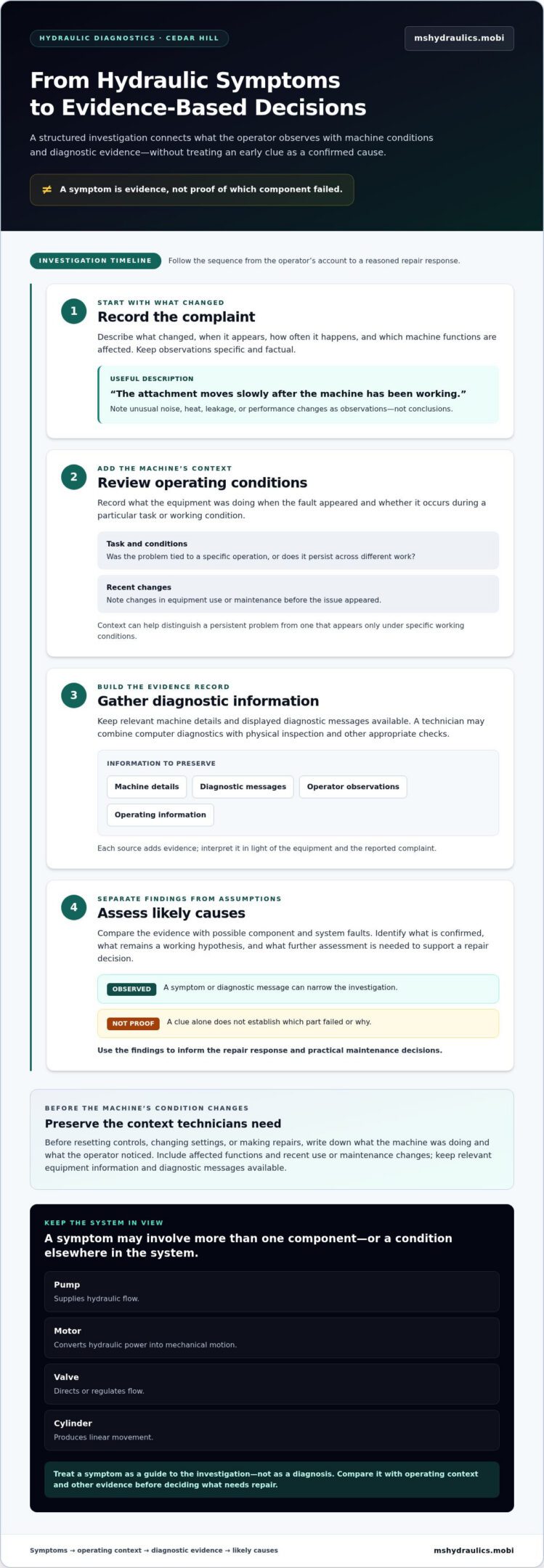
Pumps supply hydraulic flow, motors convert hydraulic power into mechanical motion, valves direct or regulate flow, and cylinders produce linear movement. These components have different roles, but a change in machine performance can involve more than one part or a condition elsewhere in the system. Treat a symptom as a guide to the investigation, not as a diagnosis. Compare it with operating context and other evidence before deciding what needs repair.
Why root-cause analysis matters in Cedar Hill
On farms, construction sites, and industrial operations, equipment downtime can interrupt planned work. A sound diagnosis helps operators make repair decisions based on the likely cause rather than replacing parts by assumption. The findings can also inform practical maintenance advice after the immediate issue is addressed.
Cedar Hill identifies where local operators need service; it does not change how a hydraulic fault is diagnosed. The same disciplined process applies whether a machine is working on a farm, at a construction site, or in an industrial plant. On-site investigation gives technicians the opportunity to assess equipment where it operates and relate reported symptoms to actual working conditions.
For an equipment owner, the goal is a reasoned explanation that connects the observed problem to supporting evidence and a practical response. This helps distinguish a component that needs repair from a system condition that may also need attention, reducing the risk of treating only the most visible part of the fault.
How Hydraulic Failure Analysis Moves from Symptoms to Evidence
A useful investigation follows a sequence. It starts with the operator’s account, then adds information about machine operation and diagnostic evidence before weighing possible causes. For hydraulic component failure analysis Cedar Hill equipment owners can prepare for, the goal is to record what the machine is showing without turning an early clue into a conclusion.
A reliable diagnosis combines equipment symptoms with relevant operating information because the same symptom can have different causes under different conditions.
- Record the complaint. Describe what changed, when the issue appears, how often it occurs, and which machine functions are affected. “The attachment moves slowly after the machine has been working” is more useful than “the pump is bad.” Record unusual noise, heat, leakage, or performance changes as observations.
- Review operating conditions. Note what the equipment was doing when the fault appeared, whether it occurs during a particular task, and whether operation or maintenance changed beforehand. This context can help distinguish a persistent problem from one that appears only under specific working conditions.
- Gather diagnostic evidence. Keep machine details, displayed diagnostic messages, and relevant operating information available. A technician may combine computer diagnostics with physical inspection and other appropriate checks. Each source adds evidence, but it needs to be interpreted in light of the equipment and complaint.
- Assess likely causes. Compare the evidence with possible component and system faults. Separate confirmed observations from working hypotheses, then identify what additional assessment is needed to support a repair decision. A message or symptom can narrow the investigation without proving which part failed.
Record the fault before changing conditions
Before resetting controls, changing settings, or making repairs, write down what the machine was doing and what the operator noticed. Include affected functions and any recent changes in use or maintenance. Keep relevant equipment information and diagnostic messages available for the technician. These details preserve context that may be harder to reconstruct after the machine’s condition changes.
Use diagnostics to narrow the investigation
Computer diagnostics can provide useful information about heavy equipment and help inform repair decisions. They do not replace interpretation of physical symptoms: a code or message needs to be considered alongside the reported problem and operating conditions. Inspection and testing can help evaluate possible causes, with the approach guided by the machine and fault. Ms. Hydraulics provides on-site diagnostic services for heavy equipment, bringing investigation to where machinery operates.
For equipment in Cedar Hill and the surrounding Dallas-Fort Worth area, a clear record of the fault can make on-site diagnostics more productive. When symptoms disrupt equipment operation, on-site hydraulic diagnostic support can help connect the reported issue with practical next steps.
Pump, Motor, Valve, or Cylinder? Compare Failure Clues Carefully
A machine’s performance can point toward a hydraulic problem without identifying the failed component. A pump, motor, valve, or cylinder may produce overlapping clues, and a wider system condition can affect more than one part. In hydraulic component failure analysis Cedar Hill operators should treat each clue as a starting point for investigation, not a verdict. A technician interprets symptoms in the context of the specific machine, its operating conditions, and the available evidence.
| Component | Possible observable clue | Why further investigation is needed |
|---|---|---|
| Pump | Unusual noise or a change in hydraulic performance | Other components or system conditions may affect performance, so the clue alone does not confirm pump failure. |
| Motor | Changed movement or reduced performance in a driven function | The cause may relate to the motor, its control, or another part of the hydraulic circuit. |
| Valve | Inconsistent response or unexpected movement of a function | The observed behavior needs to be considered alongside the affected circuit and machine operation. |
| Cylinder | Visible leakage or a change in movement | The observation does not establish the failure mechanism or rule out contributing system conditions. |
These clues are prompts for diagnosis, not a component-by-component pass or fail test. If several functions change at once, consider whether a shared system condition could be involved. A fault in one component may also affect how another part behaves, so replacing the component nearest the symptom can miss the broader cause.
What pump and motor symptoms can suggest
Noise, leakage, or a change in output can direct attention toward a pump or motor, but none proves that the component has failed. The technician weighs the clue against machine behavior and other evidence. For example, contamination and wear may be factors in a pump problem, but those possibilities are not universal explanations. The evidence from the specific machine should guide the diagnosis.
How valve and cylinder concerns differ
Valves and cylinders follow distinct diagnostic paths because they perform different functions: valves control or direct hydraulic flow, while cylinders create linear movement. A change in how an attachment responds may warrant evaluation of its control path as well as the cylinder. For rebuild-specific detail, review this heavy equipment cylinder rebuild guidance. Hydraulic parts guidance for North Texas can provide broader component context.
Accurate interpretation depends on the whole picture: which function is affected, how the machine behaves, and what inspection or diagnostic evidence supports a likely cause. A technician can use those details to distinguish a component concern from a condition that may involve the wider hydraulic system, then guide the repair decision accordingly.
Prepare for Hydraulic Diagnostics in Cedar Hill and Choose the Next Step
A prepared service call starts with a clear account of the machine and the change that prompted concern. For hydraulic component failure analysis Cedar Hill equipment owners can support, useful information helps the technician relate symptoms to operating context. It can also help distinguish a focused repair need from a condition that calls for broader assessment or maintenance.
- Equipment details: Make, model, and the machine’s identifying information.
- Symptoms: What changed, when it occurs, and whether it is getting worse or appearing intermittently.
- Affected functions: Which movements or operations are not responding as expected.
- Diagnostic information: Any available computer messages or other records related to the fault.
Information that helps an on-site assessment
Describe the conditions surrounding the issue, such as the task underway and whether the symptom occurs consistently or only during certain operations. Share unusual sounds, heat, leakage, or performance changes as observations rather than diagnoses. Make, model, affected functions, and available computer-diagnostic information give the technician a useful starting point. An accurate assessment still depends on the specific equipment and evidence gathered during the investigation.
Before the assessment, avoid changing machine settings or clearing diagnostic information if doing so could remove useful context. If a fault comes with worsening performance, new leakage, or unusual noise, continued operation may increase damage or complicate the repair. The effect depends on the machine and fault, so no single threshold applies to every piece of equipment. Consider the symptoms and operational demands together rather than assuming the equipment can continue unchanged.
Once the evidence is reviewed, the practical next step may be component repair, a broader hydraulic assessment, or maintenance work tied to the findings. Diagnosis helps clarify what needs attention and why; maintenance advice can help operators plan for the equipment’s condition. Heavy equipment maintenance guidance for North Texas offers additional context for planning upkeep around working equipment.
When mobile service is the practical next step
Heavy equipment may be located in a field, at a construction site, or within an industrial operation. An on-site assessment lets technicians investigate the fault where the machine operates. Ms. Hydraulics provides mobile hydraulic repair and on-site diagnostics in Cedar Hill and across the Dallas-Fort Worth region and surrounding areas. The technician can consider the machine’s actual setting alongside its symptoms and diagnostic information.
For equipment that needs an on-site assessment or hydraulic repair, mobile hydraulic repair is a practical service option. Bringing together the equipment details, observed symptoms, and available diagnostic information gives the investigation a useful starting point.
Hydraulic Component Diagnostics and Repair Support Near Cedar Hill
For equipment owners who need to turn diagnostic findings into a practical next step, Ms. Hydraulics LLC provides on-site hydraulic and diesel repair across the Dallas-Fort Worth region and surrounding areas, including Cedar Hill. The company provides computer diagnostics for all heavy equipment, along with hydraulic equipment and cylinder repair. Its experience servicing heavy equipment and tractors spans over 22 years.
This connects equipment assessment with repair support. Findings from an investigation can guide decisions about hydraulic component repair and maintenance, rather than treating a symptom without considering what it means for the machine. The appropriate response depends on the equipment, the evidence, and the operating context.
Connect diagnostic findings with a repair plan
Once likely causes have been assessed, the next step is to identify the component or system condition requiring attention. A repair plan may address a hydraulic component, while maintenance advice can help operators consider equipment care beyond the immediate fault. Ms. Hydraulics also provides expert equipment-maintenance advice, including guidance aimed at reducing oil costs. Recommendations should be grounded in the machine’s needs, without assuming a particular saving or outcome.
This is a practical process: identify the issue, explain how the evidence informs the repair decision, and keep equipment operation and customer overhead in view. Integrity and service matter in that work. Clear communication about findings helps an owner understand why a repair or maintenance step is being considered and how it relates to the reported problem.
Request hydraulic diagnostic support for Cedar Hill equipment
When describing a fault, include the machine’s make and model, what changed, when the symptom occurs, and which functions are affected. Share relevant computer-diagnostic information and explain what the equipment was doing when the issue appeared. These details help place the concern in context; the assessment still depends on the machine and evidence available during inspection.
On-site support is relevant when heavy equipment is in a field, at a construction site, or within an industrial operation. Ms. Hydraulics serves Cedar Hill as part of the Dallas-Fort Worth region and surrounding areas, including Cleburne, Alvarado, Granbury, Crowley, Arlington, Mansfield, and Waxahachie. The company brings hydraulic and diesel repair and diagnostic services to equipment where it operates. For operators considering hydraulic component failure analysis Cedar Hill, sharing the fault and operating context is a useful first step toward an informed repair discussion.
Describe the equipment and its symptoms to contact Ms. Hydraulics for on-site service and discuss diagnostic and repair support for your Cedar Hill machine.
Put Your Equipment Back on a Clearer Path
The next repair decision can also inform how you manage the machine going forward. Keep a record of the reported fault, diagnostic findings, work completed, and maintenance recommendations. That history gives operators a practical reference if performance changes again and helps future assessments start with more context.
For Cedar Hill equipment owners, hydraulic component failure analysis Cedar Hill offers a way to move from uncertainty toward an evidence-based service decision. A clear description of the machine’s symptoms and operating conditions can frame the next discussion around the equipment’s actual needs.
Ms. Hydraulics brings over 22 years of experience servicing heavy equipment and tractors, with computer diagnostics for heavy equipment and on-site hydraulic and diesel repair across the Dallas-Fort Worth region and surrounding areas. On-site hydraulic diagnostic support can help you discuss the fault affecting your equipment and consider a practical next step. A well-informed repair plan starts with clear observations.
Frequently Asked Questions
How do you analyze a hydraulic component failure?
Technicians compare the reported fault with machine operation, service history, and inspection findings to determine what the evidence supports. For hydraulic component failure analysis Cedar Hill equipment owners can prepare for, note whether the issue began after maintenance, a change in task, or a period of heavy use. That history can help explain when the symptom occurs and guide which conditions or components need closer assessment.
Can symptoms identify which hydraulic component has failed?
Symptoms can narrow the investigation, but they rarely identify a failed component on their own. Slow movement, for example, could involve a pump, motor, valve, cylinder, or another system condition. Record which functions are affected and whether they change together or separately. That distinction gives a technician useful context, but the diagnosis still depends on machine-specific evidence rather than the symptom alone.
What are common signs of hydraulic pump failure?
Possible clues include a change in operating noise, reduced performance, leakage, or inconsistent operation. These observations can point toward a pump concern, but they can also have other causes. Note whether the change happens across several functions or only during one operation, and whether it is consistent. This comparison helps technicians interpret the complaint without treating any single sign as proof that the pump has failed.
How can you tell whether a hydraulic motor or pump is failing?
A pump supplies hydraulic flow, while a motor uses hydraulic power to produce mechanical movement. If a machine’s driven movement changes, the motor may be one area to assess; if broader hydraulic performance changes, the pump may also warrant investigation. These patterns are clues, not a definitive distinction. A technician considers the machine’s design, affected functions, and diagnostic evidence to identify the more likely source.
What happens if hydraulic oil contamination is suspected?
Tell the technician what was observed and whether fluid was added or changed recently. Avoid adding fluid unless its suitability for the equipment is known, and keep relevant maintenance information available. Oil appearance alone may not establish the type or extent of contamination, so treat it as an observation, not a confirmed diagnosis. An assessment can help determine whether the fluid or another part of the system needs attention.
Can computer diagnostics identify hydraulic system problems?
Computer diagnostics can provide useful messages or equipment information that supports an investigation, particularly on electronically controlled heavy equipment. They may help identify a reported system issue, but they do not necessarily confirm a mechanical failure or explain its cause. Technicians interpret diagnostic information alongside machine behavior and physical evidence. Sharing displayed messages and describing operating conditions can make those results more useful.
Does Ms. Hydraulics provide on-site hydraulic diagnostics near Cedar Hill?
Yes. Ms. Hydraulics LLC provides on-site hydraulic and diesel repair and computer diagnostics for heavy equipment in the Dallas-Fort Worth region and surrounding areas. Service coverage includes Cedar Hill and nearby communities such as Cleburne, Alvarado, Granbury, Crowley, Arlington, Mansfield, and Waxahachie. Contact Ms. Hydraulics to discuss on-site diagnostic and repair support for your machine.