ANSI A92.2 Section 5: DFW Hydraulic Maintenance Guide
For fleet managers in the North Texas industrial corridor, a sudden hydraulic failure is rarely a matter of bad luck; it’s typically the result of a documented oversight in regulatory adherence. Maintaining a fleet of vehicle-mounted aerial devices requires more than just mechanical intuition. It demands a precise, technical alignment with the latest safety mandates. While many operators have historically looked to Section 5 of ANSI A92.2 to guide their service protocols, the 2021 revision has shifted the landscape of owner responsibilities and inspection intervals significantly.
You recognize that the complexity of these industrial regulations often leads to the risk of costly OSHA fines and equipment downtime during peak operations. This guide will help you master the rigorous maintenance and inspection requirements necessary to ensure fleet safety and total regulatory compliance. We’ll provide a clear breakdown of current mandates, including the transition of maintenance duties to Section 8 within the ANSI/SAIA A92.2-2021 standard. By following this technical overview, you’ll gain a structured maintenance schedule and the professional confidence required to maximize your equipment’s mechanical integrity and operational longevity.
Key Takeaways
- Clarify the distinct legal obligations of equipment owners versus manufacturers to ensure all vehicle-mounted aerial devices meet modern safety parameters.
- Learn the specific 90-day and 1,000-hour inspection thresholds required to satisfy the rigorous safety mandates of Section 5 of ANSI A92.2.
- Standardize preventative maintenance protocols using components that meet original engineering specifications to mitigate the risk of structural failure and mechanical downtime.
- Adopt a structured compliance checklist to audit maintenance logs and verify that all hydraulic service intervals align with rigorous industry best practices.
- Leverage on-site diagnostics and mobile repair solutions to fulfill mandatory inspection obligations without the logistical burden of transporting heavy machinery.
Understanding ANSI A92.2 Section 5: The Owner’s Legal Mandate
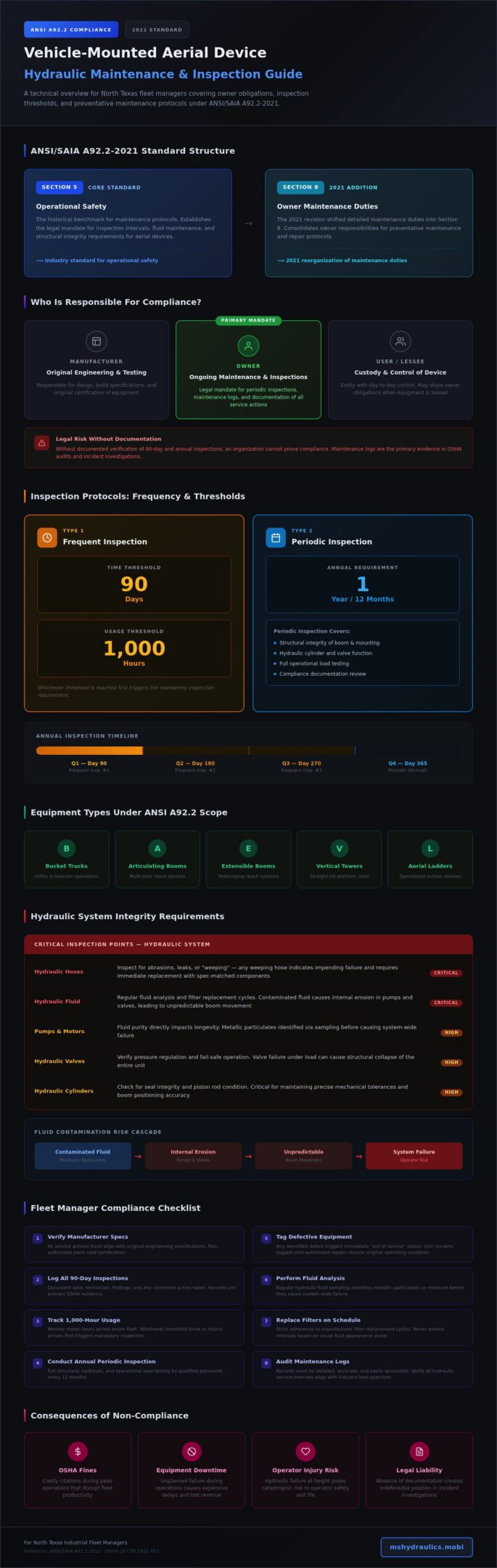
The ANSI/SAIA A92.2-2021 standard establishes the definitive framework for the design, maintenance, and safe operation of vehicle-mounted elevating and rotating aerial devices. Historically, Section 5 of ANSI A92.2 has served as the critical benchmark for owners seeking to align their maintenance protocols with industry safety requirements. These regulations apply to a wide range of machinery, including bucket trucks, articulating booms, and specialized utility units. By adhering to these parameters, fleet managers mitigate the risk of catastrophic hydraulic failure and ensure the physical safety of operators working at height. An Aerial Work Platform relies on precise mechanical tolerances; even a minor deviation in fluid pressure or structural integrity can lead to severe incidents. While the 2021 revision has reorganized some maintenance requirements into Section 8, the core principles of Section 5 of ANSI A92.2 remain the industry standard for operational safety.
Who is Responsible for Compliance?
The standard differentiates clearly between the manufacturer, the owner, and the user. While the manufacturer is responsible for the original engineering and testing, the owner carries the legal mandate for ongoing maintenance and periodic inspections. The standard defines the “User” as the entity that has custody and control of the device, which may be the owner or a lessee. Failing to maintain equipment to these standards creates significant legal liability and increases the likelihood of OSHA citations. In the event of an audit or incident investigation, your maintenance logs and inspection records serve as the primary evidence of compliance. Without documented verification of 90-day and annual inspections, an organization can’t prove its adherence to the safety protocols outlined in the standard. This documentation must be detailed, accurate, and easily accessible for regulatory review.
Scope of Equipment Under A92.2
The scope of A92.2 is broad, encompassing various vehicle-mounted systems used across the utility, telecommunications, and construction sectors. This includes extensible and articulating boom aerial devices, vertical towers, and aerial ladders. These units depend on complex hydraulic circuits to provide stability and reach. Because these systems operate under high pressure and support human life, they require specialized oversight that exceeds standard heavy equipment maintenance. Standard hydraulic systems often lack the fail-safe mechanisms found in A92.2-compliant units, making specialized oversight essential. Proper oversight ensures that critical components, like hydraulic valves and cylinders, don’t fail under load. This maintains the structural integrity of the entire unit and protects the operator from mechanical collapse.
Maintenance and Repair Requirements Under Section 5
Compliance with Section 5 of ANSI A92.2 necessitates a proactive preventative maintenance program. This isn’t a suggestion; it’s a mandate derived directly from the manufacturer’s operational manuals. Owners must ensure every service action aligns with original engineering specifications. Using non-authorized parts or unverified components compromises the machine’s safety factors and potentially voids its certification. If a technician identifies a defect during maintenance, the unit must be immediately withdrawn from service and tagged. This “out of service” status remains until authorized repairs restore the device to its original operating condition. This process is codified by OSHA Aerial Lift Regulations, which incorporate ANSI standards by reference to define legal safety benchmarks.
Hydraulic fluid serves as the primary medium for power transmission in aerial devices. Section 5 protocols emphasize regular fluid analysis and strict adherence to filter replacement cycles. Contaminated fluid causes internal erosion in pumps and valves, often leading to unpredictable boom movement. Regular sampling identifies metallic particulates or moisture before they cause a system-wide failure. Maintaining fluid purity is a mechanical necessity that directly impacts the longevity of high-value components like pumps and motors.
Hydraulic System Integrity
Inspectors must examine all hydraulic hoses for abrasions, leaks, or “weeping.” A weeping hose is a clear indicator of impending failure. When replacements are necessary, custom hydraulic hose fabrication must meet or exceed the manufacturer’s burst pressure requirements. Technicians also need to test hydraulic valves to ensure they center correctly. This prevents inadvertent movement, which is critical for operators working near energized lines or structural obstacles. If your fleet requires technical verification, utilizing professional on-site diagnostic services ensures these inspections are performed to exacting standards.
Structural and Mechanical Maintenance
Structural integrity is as vital as hydraulic performance. Maintenance teams must inspect the boom structure for hairline cracks, corrosion, or signs of material fatigue. Pivot points and rotation bearings require specific lubrication schedules to prevent mechanical binding and premature wear. The platform leveling system must also be maintained within a 5-degree tolerance mandate. Any drift beyond this parameter creates an unstable work environment and violates the safety requirements of Section 5 of ANSI A92.2. Rigorous attention to these mechanical parameters ensures the equipment remains a reliable asset throughout its service life.
Inspection Protocols: Frequent vs. Periodic
The ANSI/SAIA standard mandates a rigorous two-tiered inspection strategy to ensure equipment reliability. Specifically, Section 5 of ANSI A92.2 outlines the requirements for frequent and periodic evaluations. These inspections must be conducted by a “qualified person.” The standard defines this as an individual who, through a recognized degree or professional standing, has demonstrated the ability to resolve technical issues related to the equipment. Documentation for every inspection must be retained for at least five years. This historical data provides a verifiable audit trail for regulatory compliance. Detailed records are essential for understanding the ANSI A92 Aerial Work Platform Standards and their impact on long-term fleet safety.
Frequent inspections occur at intervals of 90 days or 150 operating hours, whichever comes first. This technical deep dive is far more comprehensive than the daily pre-start checks performed by operators. Daily checks focus on basic fluid levels and obvious damage. In contrast, the 90-day inspection requires a systematic evaluation of all critical components. Technicians must verify all control functions and emergency stop mechanisms for immediate response. They also perform a visual inspection of hydraulic cylinders to detect rod scoring or seal leaks. Identifying minor weeping early prevents catastrophic failure. It’s a critical step in maintaining mechanical integrity.
Periodic inspections are required annually or every 1,000 operating hours. These evaluations are significantly more intrusive. For older units, structural Non-Destructive Testing (NDT), such as ultrasonic or magnetic particle testing, is often necessary. This detects internal material fatigue not visible to the naked eye. The 2021 revision of the standard also introduced a Major Structural Inspection that must be performed 15 years after the unit is placed in service. Insulated booms require dielectric testing to verify their non-conductive properties. This is a life-saving requirement for utility crews working near energized lines. Utilizing professional on-site diagnostic services allows fleet managers to verify system pressures and flow rates against factory specifications. This ensures the unit operates within its original design limits and remains safe for the operator.
Ensuring Compliance: A Checklist for North Texas Fleet Managers
Operational compliance in the Dallas-Fort Worth region requires a methodical approach to record-keeping and mechanical oversight. Fleet managers should begin by auditing all current maintenance logs to identify any gaps in the 90-day “Frequent” inspection intervals. While the 2021 update relocated many maintenance specifics to Section 8, the industry still recognizes Section 5 of ANSI A92.2 as the foundational standard for owner-led safety programs. If a unit’s history shows missed intervals, it’s technically non-compliant and poses a liability risk. Every hydraulic repair must be performed by technicians who demonstrate a specific familiarity with A92.2 parameters rather than general mechanical knowledge.
Beyond the mechanical systems, every mobile unit must carry up-to-date operator manuals and legible safety decals. These items are often overlooked but are mandatory for passing roadside OSHA inspections. Establishing a relationship with a localized repair partner is essential for managing units that are tagged “out of service.” Prompt resolution of these defects minimizes the logistical burden on North Texas operations. If you discover a hydraulic leak or structural defect, securing mobile hydraulic repair services immediately prevents extended downtime.
Managing Documentation and Records
Both OSHA and ANSI accept digital and physical logbooks, provided the data is readily retrievable. Each entry must record the exact date of inspection and the signature of the qualified person who performed the evaluation. A critical part of this process is tracking the resolution of “deficient” items. If an inspector identifies scored cylinder rods or weeping hoses, the log must document the specific corrective action taken. This closed-loop reporting system proves that the owner has fulfilled the safety mandates of Section 5 of ANSI A92.2 during a regulatory audit.
Training Requirements for Maintenance Personnel
Technical proficiency extends beyond basic wrenching. Maintenance personnel must understand the structural effects of operating aerial devices on slopes, as this significantly alters hydraulic load pressures. Training should also cover the precise installation of synthetic ropes and high-pressure hydraulic fittings. For teams in Cleburne and the wider DFW area, utilizing a heavy equipment maintenance guide helps bridge the gap between general repair and standard-specific compliance. Proper training ensures that every rebuild or hose fabrication meets the rigorous safety factors required for aerial work.
Professional Hydraulic Support for ANSI A92.2 Compliance
Ms. Hydraulics LLC serves as the primary technical partner for fleet managers tasked with fulfilling the rigorous safety mandates of Section 5 of ANSI A92.2. While national service networks often lack the responsiveness required for regional operations, localized expertise ensures that every mechanical intervention aligns with specific manufacturer parameters. Our team provides the specialized labor and fabrication services necessary to transform complex regulatory requirements into a documented maintenance legacy. By focusing on physical and mechanical parameters, we ensure that every vehicle-mounted aerial device in your fleet remains a reliable asset rather than a liability risk. We bridge the gap between regulatory theory and mechanical reality through disciplined engineering and verified repair protocols that meet the industry’s highest standards.
Mobile Repair Solutions in Johnson County
For units tagged “out of service” on Cleburne job sites, rapid response is the only way to mitigate the high cost of equipment downtime. Ms. Hydraulics LLC offers mobile repair solutions that eliminate the logistical burden of transporting heavy machinery for inspection. Our technicians conduct on-site pressure testing and valve adjustments to verify that system performance meets A92.2 performance standards. This local North Texas proximity allows for immediate intervention, ensuring it’s a priority to reduce emergency fees and travel time. On-site diagnostics provide real-time verification of hydraulic integrity, ensuring that repairs are based on quantitative data. We focus on the precision required for aerial devices, ensuring that emergency fixes restore the unit to full operational compliance without compromising safety factors.
Restoring Hydraulic Integrity
The engineering precision of heavy equipment cylinder rebuilds is a cornerstone of fleet longevity and operator safety. When internal seals fail or rod scoring occurs, the structural safety of the aerial device is fundamentally compromised. We restore these components to original manufacturer safety specifications using high-grade materials and verified assembly techniques. Our custom hose fabrication processes utilize components that meet or exceed ANSI safety factors, providing the burst pressure margins required for high-risk aerial work. This disciplined approach to technical maintenance ensures that every rebuild passes the rigorous verification steps required by Section 5 of ANSI A92.2. By replacing worn components with verified parts, we help you maintain the mechanical legacy of your equipment. This technical restoration process ensures your fleet remains compliant with both manufacturer guidelines and international safety standards.
Securing Your Fleet’s Operational Future
Adhering to the mandates of Section 5 of ANSI A92.2 is a strategic necessity for industrial operations in North Texas. By mastering the 90-day frequent inspection cycle and the annual periodic deep dive, you transform mechanical safety from a variable into a constant. Documented compliance isn’t just about avoiding fines; it’s about protecting your personnel and the structural integrity of your high-value assets. Transitioning to a disciplined maintenance schedule ensures that every hydraulic component, from the pump to the platform leveling system, operates within original engineering tolerances.
Maintaining this level of technical precision requires a partner who understands the specific mechanical parameters of aerial devices. Ms. Hydraulics LLC provides the specialized expertise needed to keep your fleet in peak condition. We offer on-site diagnostics for immediate compliance verification and specialized custom hose fabrication tailored to your machine’s pressure requirements. Serving Cleburne, Dallas, and Fort Worth, our mobile teams are ready to support your regulatory goals. Ensure Your Fleet is ANSI Compliant with Expert Mobile Repair to maintain your commitment to industrial excellence. We look forward to helping you achieve a safer, more efficient job site.
Frequently Asked Questions
What is the primary focus of ANSI A92.2 Section 5?
The primary focus of Section 5 of ANSI A92.2 is the owner’s legal obligation to maintain and inspect vehicle-mounted aerial devices. This standard establishes the baseline for preventative maintenance programs, requiring that all repairs utilize authorized parts that meet original engineering specifications. It ensures that machines like bucket trucks and articulating booms remain structurally sound and mechanically safe for operators working at height in the North Texas industrial sector.
How often must a “Frequent Inspection” be performed under Section 5?
A “Frequent Inspection” must be performed every 90 days or after 150 hours of operation, whichever comes first. This technical evaluation is significantly more rigorous than a daily pre-start check. It requires a qualified technician to verify all control functions, emergency stop mechanisms, and structural components for signs of fatigue. Units that haven’t been used for three months must also undergo this inspection before returning to active service.
Can my own staff perform ANSI A92.2 inspections?
Your own staff can perform these inspections provided they meet the definition of a “qualified person” under the standard. This means the individual must possess a recognized degree, certificate, or professional standing that demonstrates their ability to solve problems related to the specific equipment. Many fleet managers in DFW partner with specialized technical providers like Ms. Hydraulics LLC to ensure these evaluations meet the precision required by Section 5 of ANSI A92.2.
What happens if I fail to document a required periodic inspection?
Failing to document a required periodic inspection creates significant legal and operational liability for your organization. In the event of an equipment failure or an OSHA audit, the lack of a signed inspection record serves as evidence of non-compliance. This can result in heavy fines and may void insurance coverage. Documentation is the primary proof that an owner has fulfilled their safety mandate to maintain the equipment’s mechanical integrity.
Does ANSI A92.2 Section 5 apply to used or rented aerial devices?
This standard applies to all vehicle-mounted aerial devices currently in service, regardless of whether they are new, used, or rented. The current owner or user is responsible for ensuring that the unit has received its frequent and periodic inspections. If you rent a unit for a job in Cleburne or Fort Worth, you should verify that the rental company provides current inspection records that align with the 90-day requirements.
What hydraulic components are most likely to fail an A92.2 inspection?
Hydraulic hoses and cylinders are the components most frequently identified as deficient during inspections. Inspectors look for weeping seals, rod scoring, and abrasions on hose jackets that compromise burst pressure safety factors. Hydraulic valves that fail to center correctly or show signs of internal leakage also trigger a failure. Addressing these issues through professional cylinder rebuilds or custom hose fabrication is essential for maintaining the unit’s “in-service” status.
Are there specific training requirements for operators under this standard?
Operators must receive training on the specific model of the aerial device they intend to use. This training covers the manufacturer’s operating instructions, safety features, and the mechanical limitations of the unit. Operators need to understand the structural effects of working on slopes and how to perform daily pre-start checks. While maintenance personnel focus on Section 5 of ANSI A92.2 requirements, operator proficiency is equally vital for overall job site safety.
How long must I keep maintenance and inspection records for my fleet?
You must retain maintenance and inspection records for at least five years. These records provide a historical audit trail that demonstrates a consistent commitment to safety and regulatory adherence. Keeping detailed logs of repairs, including the signature of the qualified inspector and the date of service, protects your organization during regulatory reviews. Digital and physical logbooks are both acceptable forms of documentation for fleet compliance in Texas.