M+S Hydraulic Motor Repair in Texas: Precision Rebuilds for Heavy Equipment
Why would a North Texas operation wait weeks for a replacement orbital motor from overseas when the technical failure likely requires only a precision seal restoration or internal component realignment? For many industrial operators in Cleburne and the DFW metroplex, the assumption that a drop in torque or a visible fluid leak signals the end of a unit’s service life leads to unnecessary capital expenditure. Utilizing professional M+S hydraulic motor repair Texas services offers a more efficient alternative, focusing on the mechanical integrity of high-torque, low-speed components to restore original efficiency levels.
We recognize that downtime is the most significant threat to your project timelines and operational margins. This guide provides the technical framework to diagnose, repair, and maintain M+S orbital motors, allowing you to minimize equipment standing time and verify the root cause of mechanical failure. You’ll learn about the specific requirements for rebuilding these precision components, the benefits of local technical expertise, and the maintenance strategies that extend the lifecycle of your heavy machinery. Our objective is to provide the engineering clarity needed to restore your equipment to peak performance with minimal delay.
Key Takeaways
- Identify the critical mechanical differences between Gerotor and Geroller designs to accurately diagnose volumetric efficiency drops in M+S orbital motors.
- Utilize on-site pressure and flow testing to precisely differentiate between internal motor wear and external hydraulic system failures.
- Securing expert M+S hydraulic motor repair Texas offers a high-precision, cost-effective alternative to the long lead times of importing new European components.
- Implement rigorous fluid contamination controls and axial load monitoring to prevent premature failure of the motor’s output shaft and internal seals.
- Leverage local mobile diagnostic capabilities in Cleburne and the DFW area to minimize downtime and verify the specific root cause of equipment failure.
Technical Overview of M+S Hydraulic Motors and Failure Modes
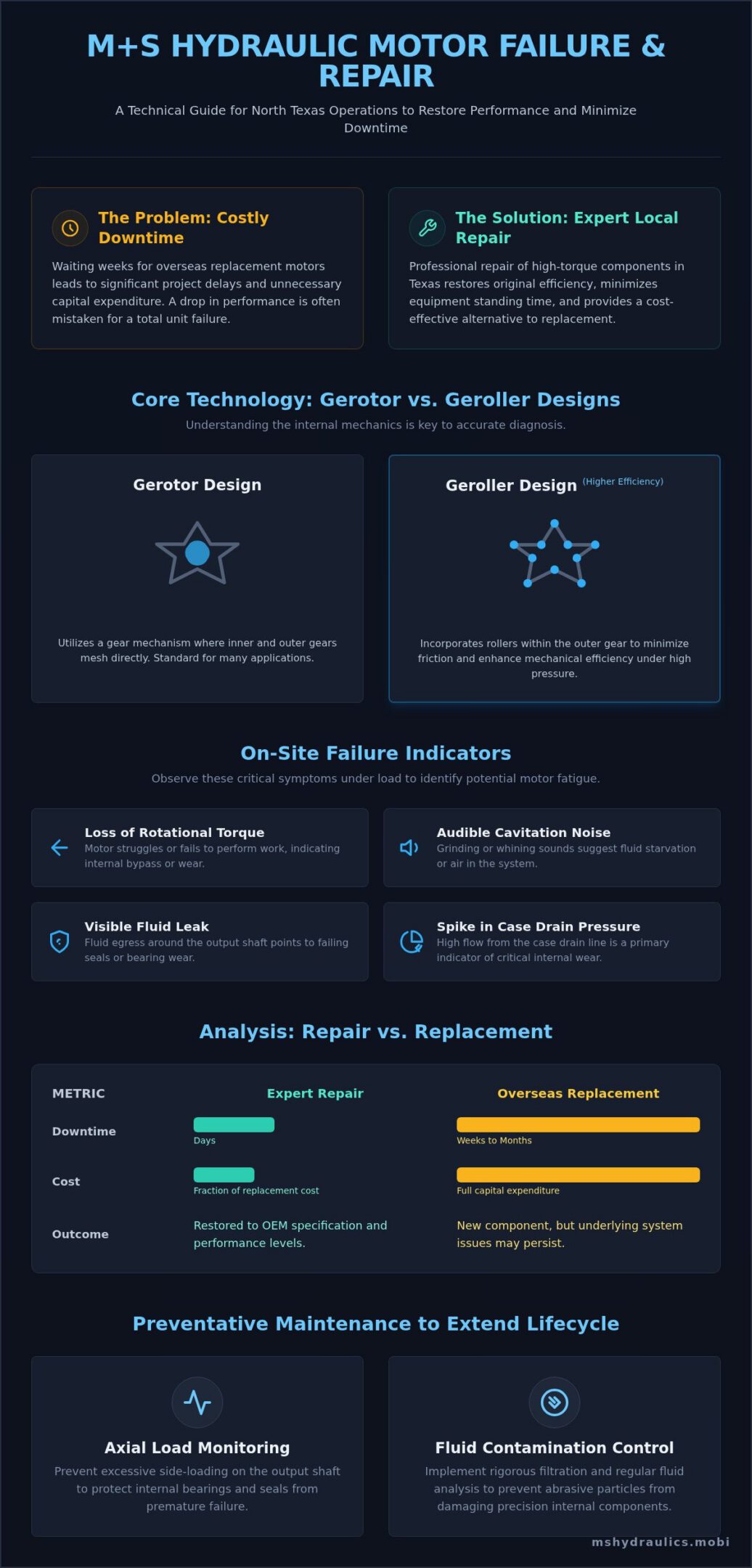
M+S Hydraulic produces a range of high-performance orbital motors designed for demanding industrial environments. These units operate as a Hydraulic motor using either Gerotor or Geroller technology. Gerotor sets utilize a gear mechanism where the inner and outer gears mesh directly, while Geroller designs incorporate rollers within the outer gear ring to minimize friction and enhance mechanical efficiency under high-pressure conditions. This design choice makes M+S units a standard for North Texas construction and agricultural machinery, where consistent torque is vital for operation.
The distributor valve acts as the internal timing mechanism, synchronizing fluid delivery to the gear set chambers. When tolerances within this valve or the shaft seals degrade, the motor experiences a measurable drop in volumetric efficiency. For operators seeking M+S hydraulic motor repair Texas, understanding these internal dynamics is the first step toward effective troubleshooting. Common failure indicators include a distinct loss of rotational torque, audible cavitation noise, or visible fluid egress around the output shaft.
The Orbital Principle: High Torque at Low Speeds
The orbital principle allows these motors to generate significant mechanical force without the need for external gear reduction. By utilizing an internal gear set that orbits around a central axis, M+S motors maintain high efficiency even at low RPMs. This capability is essential for equipment such as skid steer augers, industrial conveyors, and mobile drive systems common across Fort Worth and Dallas. Precision engineering ensures that clearances between moving parts remain within microns; this standard must be maintained during any professional rebuild to ensure long-term reliability.
Identifying Symptoms of Motor Fatigue on the Job Site
Field diagnostics often begin with observing the motor’s behavior under load. Internal bypass occurs when hydraulic fluid slips past worn internal components, causing the motor to rotate without the necessary force to perform work. Operators should monitor case drain lines since a spike in case drain pressure often indicates that internal wear’s reached a critical threshold. Visual inspections of the shaft seal are equally important. Even a minor weep can escalate into a catastrophic failure if the underlying bearing wear isn’t addressed. Reliable M+S hydraulic motor repair Texas depends on verifying these specific failure modes before a full teardown begins.
Precision Diagnostics for M+S Hydraulic Motors in North Texas
Precision diagnostics serve as the foundation for any successful restoration of heavy equipment. Without a rigorous testing protocol, operators risk replacing functional components while leaving the underlying fault unaddressed. In the context of M+S hydraulic motor repair Texas, the diagnostic sequence begins with a clear differentiation between motor failure and upstream pump degradation. This requires isolating the motor from the rest of the hydraulic circuit to ensure that performance data reflects the unit’s actual condition.
On-Site Diagnostic Procedures
The initial phase of troubleshooting involves deploying mobile flow meters to capture real-time performance metrics. This step is particularly critical in high-heat Texas environments, where thermal expansion can alter fluid viscosity and exacerbate existing internal leaks. Technicians monitor the relationship between input flow and output speed to calculate the motor’s volumetric efficiency. Case drain flow serves as the primary health indicator for M+S motors. When this flow exceeds the manufacturer’s specified parameters, it confirms that internal clearances have widened beyond acceptable tolerances. If you’re experiencing inconsistent performance, scheduling on-site diagnostic services can pinpoint whether a full rebuild is necessary before the unit’s removed from the chassis.
Internal Component Inspection and Verification
Once a motor’s identified for repair, it must be moved to a controlled environment for clean-room disassembly. This prevents environmental contaminants from entering the precision gear sets during inspection. Our technical team evaluates several critical areas:
- Geroller Set Evaluation: We inspect the rollers and gear lobes for scoring, pitting, or cavitation damage that disrupts the fluid seal.
- Drive Link and Shaft Integrity: The drive link and output shaft are checked for mechanical wear, torsional fatigue, and spline deformation.
- Valve Plate Verification: The distributor valve plate is measured for flatness and surface integrity; even minor warping can cause significant pressure drops.
This methodical approach ensures that every M+S hydraulic motor repair Texas project is backed by verified data. By identifying the specific failure mode, we can provide an accurate cause-of-failure report, helping operators adjust their maintenance protocols to prevent recurrence. This engineering-first mindset distinguishes a professional rebuild from a simple parts replacement.
M+S Motor Repair vs. Replacement: A Cost-Benefit Analysis
Deciding between a full replacement and a precision rebuild requires a thorough analysis of the total cost of ownership. While purchasing a new unit might seem like a straightforward solution, the financial and operational benefits of M+S hydraulic motor repair Texas often provide a superior return on investment. Industry data indicates that remanufactured hydraulic motors can cost as little as 50% of the price of a new replacement. This cost differential allows operators to allocate resources toward other critical maintenance needs while achieving mechanical performance that mirrors a factory-new component.
Lead times are another critical factor in this analysis. M+S Hydraulic is a European manufacturer; sourcing new orbital motors frequently involves significant international shipping delays and exposure to global supply chain volatility. A local Texas repair facility bypasses these logistical hurdles, providing a turnaround in a fraction of the time. Beyond the financial and time savings, component restoration supports industrial sustainability. Rebuilding a motor housing instead of discarding it reduces the demand for raw material extraction and the energy-intensive casting processes required for new production.
When Rebuilding is the Optimal Engineering Choice
Rebuilding is the preferred engineering path when the motor’s housing and primary internal gear sets remain within salvageable tolerances. During a professional rebuild, technicians don’t just replace parts; they optimize the unit for local conditions. For example, upgrading standard seals to high-temperature fluorocarbon variants is a standard practice for equipment operating in the extreme heat of Texas summers. This modification ensures the motor maintains its seal integrity even when hydraulic fluid temperatures peak during prolonged duty cycles. Precision machining of the valve plate and internal wear surfaces ensures the unit returns to factory-spec volumetric efficiency and torque output.
Logistical Advantages for DFW Area Businesses
For operations based in the Dallas-Fort Worth metroplex, the proximity of Cleburne-based technicians offers a distinct competitive advantage. Utilizing a local provider for M+S hydraulic motor repair Texas minimizes the logistical complexity of transporting heavy components. This localized support allows for a more integrated approach to heavy equipment maintenance, where motor health is monitored as part of a comprehensive fleet strategy. By avoiding the uncertainty of global shipping, Texas businesses maintain tighter control over their project timelines and operational uptime. Reliability is further reinforced through rigorous bench testing, ensuring the motor is ready for immediate deployment upon return to the job site.
Maintenance Protocols to Prevent M+S Motor Failure
Implementing regular on-site diagnostic services allows for early detection of wear patterns. By monitoring case drain pressure and flow rates, technicians can identify internal degradation before it results in a total system shutdown. If you’re noticing a drop in equipment speed, contact our mobile repair team to verify the motor’s health before a catastrophic failure occurs.
Fluid Integrity and Filtration Standards
In the North Texas climate, selecting the correct ISO viscosity grade is essential. Significant temperature swings between seasons require a fluid that maintains its protective film strength at 100°F+ while flowing freely during winter cold starts. Monitoring operating temperatures is equally vital; excessive heat leads to fluid oxidation and varnish formation, which causes internal valves to stick and seals to harden. High-cycle industrial motors benefit from 10-micron filtration to protect the internal distributor valve and gear set clearances. We recommend a professional fluid analysis every 500 to 1,000 operating hours to detect metal particulate or water ingress. This data-driven approach prevents the need for premature M+S hydraulic motor repair Texas by addressing contamination at the source.
Correct Installation and Alignment
Mechanical failure often stems from improper installation rather than internal defects. Managing radial and axial loads on the output shaft prevents side-loading. Side-loading causes bearing fatigue and shaft seal failure. Proper coupling and precise alignment ensure the load is distributed according to the motor’s design specifications. Additionally, the case drain line must be routed directly to the reservoir with minimal backpressure. High case pressure is a common cause of blown shaft seals. Before full operation, the system must be properly bled to remove trapped air. This prevents cavitation during the initial start-up, which can pit internal components within seconds of activation.
Expert Hydraulic Motor Repair Services in Cleburne and DFW
Ms. Hydraulics LLC functions as the primary technical authority for M+S hydraulic motor repair Texas, providing specialized services for the intricate orbital designs used in heavy machinery. Our Cleburne facility is specifically configured to manage the high-precision requirements of M+S components. We focus on restoring the mechanical integrity of excavators, skid steers, and industrial drive systems. This regional expertise eliminates the logistical delays associated with importing replacement units from overseas. Every shop-based rebuild concludes with rigorous performance testing. This verification process ensures that the motor’s rotational torque and volumetric efficiency align with original engineering specifications before the unit returns to service.
Our Mobile Diagnostic and Repair Fleet
Our mobile diagnostic and repair fleet provides immediate support across Cleburne, Dallas, and Fort Worth. These service units are equipped with advanced flow meters and pressure gauges for on-site motor removal and comprehensive system troubleshooting. This capability is essential for minimizing transport costs for heavy equipment owners throughout Johnson County and the broader DFW area. We recognize that an idle machine on a construction site represents a significant financial loss. Our rapid response protocols focus on identifying the root cause of hydraulic failure at the point of operation. This allows for immediate intervention, preventing the collateral damage that often occurs when a failing motor remains in a pressurized circuit.
Commitment to Industrial Excellence and Integrity
Our organizational framework prioritizes industrial excellence and technical integrity. We maintain rigorous adherence to international hydraulic standards and formal certifications. This ensures that every repair meets the high-value performance descriptors expected by major industrial players. We provide transparent reporting on failure causes, documenting specific wear patterns and required component replacements. This methodical approach allows operators to evaluate the lifecycle of their equipment with factual accuracy. Our goal is to serve as a disciplined partner for Texas industries, providing the engineering data necessary for long-term reliability. Contact Ms. Hydraulics for M+S motor diagnostics in North Texas to restore your machinery to peak operational efficiency.
Optimizing Operational Reliability for M+S Hydraulic Systems
Maintaining the technical integrity of M+S orbital motors is essential for the sustained performance of heavy equipment in North Texas. Professional diagnostics allow operators to move beyond reactive repairs, focusing instead on verified failure causes and precision component restoration. Choosing specialized M+S hydraulic motor repair Texas lets you bypass the logistical hurdles of international shipping while securing a rebuild that meets rigorous engineering standards.
Ms. Hydraulics LLC remains focused on providing the technical precision required for modern industrial machinery. We operate locally from Cleburne, delivering specialized expertise in heavy equipment hydraulic systems directly to your job site. Our mobile on-site diagnostics are available across the DFW metroplex, ensuring that downtime remains a manageable variable rather than a project-ending disruption. Restoring your motor’s torque and volumetric efficiency isn’t just about immediate fixes; it’s a cost-effective strategy that reinforces your fleet’s long-term reliability.
Request an M+S Motor Diagnostic Call in North Texas to verify your equipment’s health and restore peak performance. Your machinery’s next phase of high-efficiency operation starts with an expert technical assessment.
Frequently Asked Questions
What are the first signs of M+S hydraulic motor failure?
Loss of rotational torque and increased case drain flow are the primary indicators of internal motor degradation. Operators often notice the machinery slowing down under heavy loads or failing to maintain position when the control valve is centered. Auditory cues like high-pitched whining or metallic grinding also signal that the internal gear set clearances have expanded. If you observe fluid weeping from the output shaft, it confirms a seal failure that requires immediate technical attention.
How much does it cost to repair an M+S motor compared to buying new?
Remanufacturing an existing unit typically costs significantly less than purchasing a new replacement, often saving up to 50% of the capital expenditure. While the exact investment depends on the internal damage, rebuilding allows you to salvage the heavy iron housing and main shaft components. This approach provides a high return on investment by restoring factory performance levels without the high cost and volatility associated with importing new European orbital motors.
Can Ms. Hydraulics perform M+S motor diagnostics on my job site?
Yes, our technicians provide mobile on-site diagnostic services across Cleburne and the DFW metroplex to minimize equipment downtime. We utilize portable flow meters and pressure gauges to isolate the motor from the rest of the hydraulic circuit. This process verifies whether the performance drop is internal to the motor or stems from a failing pump or valve. Identifying the fault at the source prevents the unnecessary removal of functional components from your machinery.
How long does a typical hydraulic motor rebuild take in Cleburne?
A standard M+S hydraulic motor repair Texas project typically takes between three to five business days depending on the specific series and part availability. We maintain an inventory of common seal kits and internal components to ensure a rapid turnaround for our North Texas clients. This localized service is significantly more efficient than the weeks often required for international shipping and customs clearance of new replacement units from overseas.
What causes M+S motor seals to leak prematurely in Texas?
Extreme thermal cycles in North Texas cause standard seal materials to harden and lose their necessary elasticity over time. High ambient temperatures combined with heavy duty cycles lead to fluid oxidation, which creates an abrasive varnish on internal surfaces. This varnish scores the shaft surface and allows fluid to bypass the seal under pressure. Upgrading to high-temperature fluorocarbon seals is a standard preventative measure we implement during our professional rebuild process.
Are M+S motors compatible with standard hydraulic fluids used in DFW?
M+S motors are compatible with the standard mineral-based hydraulic oils commonly used in DFW industrial and construction applications. However, it’s essential to maintain the correct ISO viscosity grade to handle the intense Texas temperature swings. Using fluid that becomes too thin at high temperatures leads to inadequate lubrication of the Geroller set and premature wear of the distributor valve. We recommend regular fluid analysis to monitor for contamination and additive depletion.
Does Ms. Hydraulics offer a warranty on hydraulic motor repairs?
We provide technical verification on all motor repairs to ensure they meet the specific performance parameters required for your heavy equipment. While you should contact our Cleburne office for specific terms and coverage details, our rebuilds focus on restoring the unit to factory-spec reliability. Every motor undergoes rigorous bench testing under load to confirm its mechanical integrity and torque output before it’s released for installation on your job site.
What is the difference between a Gerotor and a Geroller motor in M+S designs?
The primary difference lies in the friction-reducing rollers found in the Geroller design compared to the direct gear contact of a Gerotor set. Geroller motors incorporate rollers in the outer ring to enhance mechanical efficiency and durability under high-pressure conditions. These designs are generally preferred for continuous-duty applications where torque consistency is a critical requirement. Our technicians are experienced in the specific timing and tolerance requirements for both internal gear set configurations.