Custom Hydraulic Hose Fabrication in Cleburne: The Technical Guide to High-Pressure Assemblies
The global hydraulic hose market is projected to reach $6.8 billion in 2026, yet a single assembly failure can halt a multi-million dollar construction project in minutes. Operators in North Texas recognize that downtime isn’t merely an inconvenience; it’s a direct financial liability that compounds with every hour a machine sits idle. You’ve likely experienced the frustration of waiting for a critical part while your excavator or drill rig remains non-operational due to a ruptured line.
Securing professional custom hydraulic hose fabrication Cleburne allows you to bypass these logistical bottlenecks through precision-engineered, on-site solutions. This technical guide explains how high-pressure assemblies that adhere to SAE J1273-2021 and SAE J517 standards ensure the long-term integrity of your fleet. We’ll examine the specific fabrication parameters required to withstand harsh Texas environments and the diagnostic protocols that prevent premature component failure. By focusing on engineering accuracy and material verification, you can maintain operational continuity even under the most demanding industrial conditions.
Key Takeaways
- Identify the critical role of SAE J517 standards and specialized inner tube materials like Nitrile or EPDM in maintaining high-pressure assembly integrity.
- Discover why precision custom hydraulic hose fabrication Cleburne outperforms standard retail components in the demanding environments of the North Texas construction sector.
- Examine how mobile on-site fabrication facilitates perfect hose routing directly on the machine, bypassing the costs and delays of heavy equipment transport.
- Learn the technical fabrication protocols, including precision skiving and cleaning, required to achieve a permanent metal-to-metal bond for high-integrity fittings.
- Leverage specialized on-site diagnostics to move beyond simple hose replacement and address the underlying mechanical issues affecting hydraulic system performance.
The Critical Role of Custom Hydraulic Hose Fabrication in Cleburne
In the industrial corridors of Johnson County, the reliability of Hydraulic machinery depends entirely on the integrity of its fluid conveyance systems. Custom hydraulic hose fabrication Cleburne involves the precise assembly of hoses tailored to specific lengths, pressure ratings, and fitting configurations. While retail, off-the-shelf hoses might provide a temporary fix, they frequently fail in the demanding environments of North Texas. These failures stem from a lack of consideration for the specific mechanical stresses and environmental factors unique to heavy equipment operation in this region. Technicians don’t just replace parts; they engineer solutions that account for the machine’s specific duty cycle.
Custom vs. Pre-fabricated: A Technical Comparison
Standardized hoses are designed for a broad range of applications, which often results in a “good enough” fit that compromises long-term performance. Precision fitment is essential because it significantly reduces vibration-induced wear on hydraulic lines, a primary cause of pinhole leaks and catastrophic bursts. Custom fabrication allows for the selection of specific inner tube compounds, such as Nitrile or specialty polymers, that are fully compatible with the hydraulic fluids being used. This prevents the inner wall degradation that occurs when incompatible materials are exposed to high-temperature oils. Additionally, custom solutions provide the opportunity to upgrade specifications, such as incorporating high-abrasion covers, based on field data from previous component failures.
Addressing the Cost of Downtime in North Texas
The financial impact of a ruptured hose extends far beyond the price of the replacement part. For an idle excavator or drill rig in Cleburne, the hourly loss in productivity can reach hundreds of dollars, disrupting project timelines and labor schedules across the entire job site. Local custom hydraulic hose fabrication Cleburne eliminates the extensive lead times associated with shipping OEM parts from distant distribution centers. By fabricating a replacement assembly on-site or in a local facility, operators can resume work in a fraction of the time required for traditional procurement.
Beyond the mechanical systems, the digital infrastructure used to manage fleet logistics and project scheduling is equally critical; for professional technical support, We Fix PC Laptop provides expert computer and laptop repair services to ensure your administrative tools remain functional.
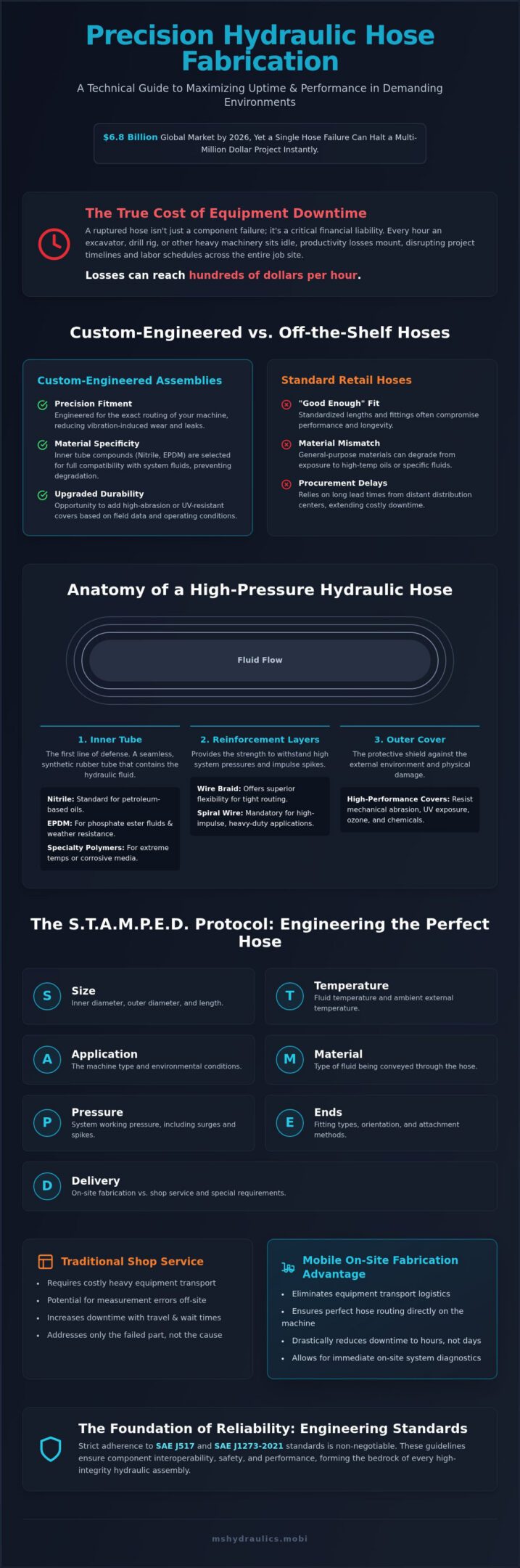
To ensure the selected hose meets the rigorous demands of the application, industry professionals follow the STAMPED protocol, which defines the critical parameters of Size, Temperature, Application, Material, Pressure, Ends, and Delivery. This methodical approach ensures that every assembly supports the operational longevity of the machine. In sectors like construction, agriculture, and oil and gas, where equipment operates under extreme loads, this level of engineering precision is a necessity for maintaining a competitive edge in the regional market.
Just as fluid conveyance systems require precision, industrial process equipment in the energy sector demands expert care; for those in the oil and gas industry, TEG Reclamation Services offers professional glycol reclamation and dehydration to maintain system efficiency.
Just as heavy equipment requires precision maintenance to avoid downtime, industrial facilities depend on robust infrastructure; for those overseeing site safety and property maintenance, you can visit Cleroux & Sons Roofing to learn about professional roof repair and restoration services.
Technical Specifications: Understanding SAE Standards and Hose Anatomy
Engineering a high-pressure assembly requires strict adherence to SAE J517 standards. These guidelines, supported by the National Fluid Power Association, ensure that components from different manufacturers maintain interoperability and safety. In the context of custom hydraulic hose fabrication Cleburne, selecting the correct inner tube material is the first line of defense against chemical degradation. Nitrile is the industry standard for petroleum-based oils, while EPDM is utilized for phosphate ester fluids or applications requiring high weather resistance. Specialty polymers are reserved for extreme temperature ranges or highly corrosive media, ensuring the hose wall doesn’t soften or become brittle during operation.
The structural integrity of the hose is defined by its reinforcement layers. Wire braid reinforcement offers superior flexibility for tight routing, whereas spiral wire construction is mandatory for high-impulse applications where pressure spikes are frequent. When performing custom hydraulic hose fabrication Cleburne, technicians must evaluate whether the application requires the flexibility of a wire braid or the impulse resistance of a spiral wire layout. For heavy machinery operating in the North Texas sun, outer cover durability is a non-negotiable specification. High-performance covers must resist both mechanical abrasion from moving parts and the intense UV exposure that leads to cover cracking and subsequent reinforcement corrosion.
Pressure Ratings and Safety Factors
Every professional hydraulic assembly operates under a 4:1 safety factor, meaning the burst pressure is four times the rated working pressure. This margin is critical when considering surge pressures, which often exceed nominal system limits during heavy lifting or sudden valve closures. In Cleburne, ambient temperatures can exceed 100°F, causing hydraulic fluid to thin and increasing the risk of seal failure or hose expansion. For equipment like skid steers, which typically operate between 3,000 and 4,000 PSI, ensuring the assembly can handle these thermal and mechanical surges is vital for operator safety.
Just as extreme heat necessitates specialized hydraulic components, it also demands robust climate control for residential and commercial buildings; you can discover Christensen Heating and Cooling for professional HVAC services that maintain system reliability regardless of external temperatures.
Fitting Geometry and Thread Identification
The interface between the hose and the machine is where most leaks occur. Technicians must accurately distinguish between JIC (Joint Industry Council) 37-degree flares, NPT (National Pipe Thread), and ORFS (O-Ring Face Seal) configurations. ORFS fittings have become the preferred choice for modern high-pressure systems because the elastomeric seal prevents the “weeping” common in metal-to-metal connections. For a detailed breakdown of these components, refer to our resource on Identifying Hydraulic Hose Fittings: A Cleburne Field Guide. Utilizing the correct geometry is the only way to ensure a leak-free system. If you’re unsure of your current specifications, our team provides on-site diagnostic services to verify your assembly requirements before fabrication begins.
Mobile On-Site Fabrication vs. Traditional Shop Services
Heavy equipment logistics are inherently complex; moving a non-functional machine to a physical shop involves significant secondary costs. When a high-pressure line fails on a drill rig or excavator, the primary objective is to restore the fluid conveyance system with minimal disruption. Traditional shop services require the operator to either transport the entire machine or remove the damaged assembly and deliver it to a brick-and-mortar facility. This process introduces multiple points of failure and extended downtime. In contrast, custom hydraulic hose fabrication Cleburne is most effective when performed directly at the machine’s location. This allows for precise measurement of hose length and orientation, ensuring that the final assembly follows the intended routing paths without unnecessary stress or abrasion.
Mobile units equipped with industrial-grade crimpers and high-speed saws replicate the precision of a controlled shop environment. These units are engineered to handle the mechanical parameters required for high-impulse lines, ensuring that every crimp meets the manufacturer’s specification for diameter and compression. Adhering to SAE J 1273-2021 recommended practices during field assembly ensures that factors like hose bend radius and clearance are verified in real-time. This immediate verification eliminates the risk of “re-work” that often occurs when a hose fabricated off-site doesn’t fit the machine’s specific geometry.
The Convenience of Field Service
Field service eliminates the “two-trip” problem, where a technician must remove a hose, drive to a shop, and then return for installation. By integrating custom hydraulic hose fabrication Cleburne into a mobile service model, we address the primary cause of industrial delays. This approach also allows for on-site diagnostics. Technicians can identify the root cause of a hose burst, such as pump cavitation or valve malfunction, before installing the new assembly. Our service coverage area includes Cleburne, Granbury, and Mansfield, providing localized support for critical infrastructure projects across North Texas.
Consistency and Quality Control in the Field
Technician expertise is as critical as the machinery used for the repair. Maintaining cleanliness during on-site assembly is a priority to prevent system contamination, which can lead to catastrophic pump or valve failure. Mobile technicians utilize specialized caps and plugs to seal open ports during the fabrication process, maintaining the integrity of the hydraulic circuit. For operators requiring immediate assistance, our Expert Mobile Hydraulic Repair in Cleburne, TX provides a direct alternative to the logistical delays of traditional shops, ensuring that your equipment returns to its duty cycle without unnecessary transport costs.
The Fabrication Process: Engineering Precision for 2026
The initial phase of custom hydraulic hose fabrication Cleburne requires more than a simple linear measurement. Technicians must perform precise “cut-to-length” calculations that account for hose “grow” or “shrink” once the system is pressurized. Depending on the reinforcement type, a hose can change in length by as much as +2% to -4% under peak load. Failing to account for this variation leads to excessive tension on fittings or dangerous slack that causes abrasion against the machine’s chassis. Every cut is executed with high-speed, diamond-tipped saws to ensure a clean, square edge, which is foundational for a secure fitting attachment.
High-pressure assemblies often require skiving, a technical process where the outer cover or inner tube is removed to facilitate a direct metal-to-metal bond between the fitting and the reinforcement layer. This step ensures that the crimp force is applied directly to the wire braid or spiral, preventing the “cold flow” of rubber that can lead to fitting blow-offs. Once skived, the assembly undergoes crimp diameter verification. Technicians use digital calipers to measure the finished crimp against the manufacturer’s specification table, typically requiring accuracy within thousandths of an inch. Finally, internal cleaning and capping are mandatory to prevent hydraulic system contamination, as even microscopic debris can cause catastrophic pump failure.
Advanced Crimping Technology
The industry has transitioned toward programmable, digital crimpers to achieve 100% repeatability across multiple assemblies. These machines store specific crimp settings, eliminating the human error associated with manual adjustments. Precision is paramount because over-crimping can crush the internal reinforcement, while under-crimping fails to provide the necessary retention force for high-pressure surges. To maintain assembly integrity and safety ratings, it’s essential to use hoses and fittings from the same manufacturer to ensure engineered compatibility. This holistic approach to component matching is what differentiates professional fabrication from generic retail repairs.
Final Testing and Documentation
Quality assurance concludes with a rigorous pressure testing protocol where the assembly is subjected to 1.5 times its rated working pressure to verify the integrity of the crimp and the absence of pinhole leaks. A visual inspection follows, focusing on fitting alignment and the integrity of the outer cover. Every custom build is then tagged and tracked. This documentation allows for rapid replacement in the future, as the specific technical parameters are already on file. Our technicians follow these rigorous protocols for every custom hydraulic hose fabrication project to ensure your machinery operates safely under peak load.
Ms. Hydraulics LLC: Your Cleburne Partner for Reliable Hose Fabrication
Ms. Hydraulics LLC functions as a disciplined technical partner for the industrial and construction sectors throughout Johnson County. While general suppliers offer broad product catalogs, our organization focuses on high-precision mobile solutions tailored to the mechanical parameters of heavy machinery. Providing custom hydraulic hose fabrication Cleburne directly at the job site eliminates the logistical complexities and costs associated with equipment transport. This specialized approach ensures that drill rigs, excavators, and skid steers are equipped with fluid conveyance systems that maintain operational integrity under peak loads.
While local maintenance is vital, specialized construction sectors like concrete placement also require dedicated machinery expertise; for those seeking professional sales and support for concrete pumping machinery, equipcon.com.au provides a specialized resource for high-pressure industrial applications.
Lawn mowers often utilize complex hydraulic drive systems; for landscaping professionals looking to augment their fleet with well-maintained gear, you can visit Mowing Route Density to explore specialized equipment rental services.
Reliability is rooted in an engineering-first philosophy. Technicians don’t simply replace failed components; they conduct on-site diagnostics to verify the health of the entire hydraulic circuit. By identifying underlying issues such as valve malfunctions or pump cavitation, we prevent the premature failure of new assemblies. Utilizing 2026 mobile fabrication technology allows for shop-quality precision in the field, ensuring every crimp and fitting meets rigorous industry standards for safety and performance. This methodical approach builds trust with operators who require predictable performance in the demanding North Texas environment.
Beyond the Hose: Comprehensive Hydraulic Support
Our capabilities extend across the entire hydraulic system, allowing for the integration of custom hydraulic hose fabrication Cleburne with complex Cylinder Rebuilds. We provide a holistic service model that addresses the mechanical fatigue of the machine rather than just the symptoms of a leak. To support long-term equipment efficiency, we offer the following services across North Texas:
- Mobile repair and diagnostics in Alvarado, Granbury, Crowley, and Arlington.
- Preventative maintenance plans designed to identify hose cover degradation and fitting corrosion before they lead to catastrophic failure.
- On-site pressure testing and system flushing to maintain fluid cleanliness.
- Specialized component repair for hydraulic pumps, motors, and valves.
Get Back to Work Faster
The primary objective of our mobile units is the immediate reduction of downtime. When requesting service, providing technical details such as the machine’s make, model, and the specific location of the failure allows our technicians to arrive with the necessary materials for a one-trip solution. We prioritize long-term reliability over temporary fixes, ensuring that every assembly we fabricate contributes to the overall efficiency of your heavy equipment fleet. Our commitment to factual accuracy and engineering expertise positions us as a serious partner for industrial players in the DFW region. For immediate technical assistance, Contact Ms. Hydraulics LLC for On-Site Hose Fabrication and restore your machinery’s operational capacity today.
Maximizing Fleet Efficiency Through Technical Precision
The operational integrity of heavy machinery in North Texas depends on the technical accuracy of its hydraulic components. Adhering to SAE J517 standards and utilizing precise “cut-to-length” calculations prevents the mechanical failures that lead to expensive project delays. By prioritizing custom hydraulic hose fabrication Cleburne, fleet managers ensure that every assembly is engineered for the specific pressures and environmental stresses of the job site. Beyond industrial equipment, for those managing residential or commercial properties, you can discover Your Home Electrical and Handyman Services LLC for professional electrical and handyman solutions throughout the Texas area.
Since 2021, Ms. Hydraulics LLC has provided specialized on-site diagnostics and mobile repair for excavators and drill rigs across the DFW region. This mobile-first approach bypasses the inefficiencies of traditional brick-and-mortar shops by delivering shop-quality results directly to the field. Request Mobile Hose Fabrication in Cleburne to secure high-integrity assemblies that minimize downtime and maximize your equipment’s duty cycle. Maintaining a high standard of fluid conveyance remains the most effective strategy for ensuring the longevity of your industrial assets.
Frequently Asked Questions
How long does it take to fabricate a custom hydraulic hose on-site?
On-site fabrication typically requires 30 to 60 minutes per assembly once the technician arrives at the machine. This duration includes the time necessary for precise measurement, cutting, skiving, and final crimping. Complex routings or multiple assemblies may extend this timeframe. The primary goal is to restore the machine to its duty cycle within a single service call, eliminating the need for multiple trips to a physical shop.
Can you make a hydraulic hose for any brand of heavy equipment?
Custom hydraulic hose fabrication Cleburne is brand-agnostic and supports all major heavy equipment manufacturers including Caterpillar, Komatsu, and John Deere. Because assemblies are built to SAE J517 specifications, the focus remains on matching thread geometry and pressure ratings rather than OEM branding. This ensures that replacement hoses meet or exceed the performance of original factory components across all industrial sectors.
What information do I need to provide for a custom hose quote?
Providing the STAMPED parameters is the most effective way to secure an accurate quote. This includes the hose’s inside diameter (Size), operating Temperature, the specific Application, the fluid Material, peak operating Pressure, and the required fitting Ends. If these details are unknown, on-site diagnostic services can verify the specifications through physical inspection of the failed assembly to ensure a perfect match.
Is mobile hose fabrication more expensive than going to a shop in Cleburne?
Mobile fabrication involves a service fee for the technician’s travel and on-site labor, but it often results in a lower total cost of ownership. Eliminating the logistics of transporting heavy equipment to a shop in Cleburne significantly reduces secondary expenses. When you factor in the reduction of machine downtime, the on-site model provides a more efficient financial outcome for industrial and construction operations.
Do you offer 24/7 emergency hydraulic hose repair in Johnson County?
Operators in Johnson County should verify current service hours and availability directly with the provider to confirm emergency response windows. While mobile units are designed for rapid deployment, specific availability for after-hours service depends on current scheduling and technician status. It’s recommended to establish a service relationship early to ensure a faster response during critical infrastructure failures or machine breakdowns.
How do I know if my hydraulic hose needs to be replaced or just repaired?
Hydraulic hoses generally require full replacement rather than localized repair once the structural integrity of the reinforcement layer is compromised. Safety standards prohibit patching high-pressure lines because a temporary fix won’t withstand the 4:1 burst pressure ratio required for industrial safety. You should replace a hose if you observe exposed wire reinforcement, deep cover abrasions, or fluid weeping at the crimp fitting interface.
What is the difference between a 2-wire and 4-wire hydraulic hose?
The primary difference lies in the reinforcement structure and its ability to handle pressure impulses. A 2-wire hose utilizes braided steel for flexibility in lower-pressure systems, while a 4-wire hose uses spiral-wound steel to resist the high-frequency pressure spikes common in heavy lifting. Selecting the 4-wire configuration is essential for modern excavators and drill rigs that operate under extreme mechanical loads in North Texas.
Can you fabricate hoses for high-temperature or high-abrasion environments?
Yes, specialized assemblies can be engineered to withstand temperatures exceeding 212°F or environments with high mechanical abrasion. Technicians select inner tubes made from EPDM or other specialty polymers and apply high-abrasion outer covers to prevent premature degradation. These custom solutions ensure the fluid conveyance system remains reliable even when exposed to the intense heat and friction typical of heavy industrial sites.