Expert Mobile Hydraulic Valve Repair in Cleburne: Minimizing Industrial Downtime
Transporting a 50-ton excavator or a specialized drill rig just to diagnose a malfunctioning control valve is an inefficient use of capital that stalls project momentum. For industrial operations in North Texas, the logistical cost of moving heavy machinery often rivals the actual repair bill. Our specialized mobile hydraulic valve repair Cleburne service addresses this inefficiency by bringing precision engineering directly to your job site. You likely understand the frustration of losing thousands in daily revenue while a machine sits idle in a transport queue. It’s a common industry pain point that many fleet managers assume is an unavoidable cost of doing business.
This article demonstrates how professional on-site valve restoration eliminates the need for expensive transport while returning your equipment to its original OEM specifications. We’ll examine the technical requirements for maintaining precise hydraulic tolerances and explain how immediate, on-site diagnostics prevent minor pressure drops from becoming catastrophic system failures. By focusing on mechanical accuracy and local availability, you can bypass the logistical headaches of the dealership and restore full control to your heavy equipment without the high overhead of traditional shop repairs.
Key Takeaways
- Learn how hydraulic valves function as the central control mechanism of your machinery and why precise calibration is essential for system performance.
- Discover how professional mobile hydraulic valve repair Cleburne eliminates the logistical burden and significant costs of transporting heavy equipment to a fixed facility.
- Understand the technical protocols used for on-site diagnostics, including the use of high-precision pressure gauges and field-based cleanliness standards.
- Identify early indicators of valve failure, such as cylinder drift or spool seal degradation, to prevent minor issues from causing total machinery downtime.
- Evaluate the economic advantages of local, on-site service compared to the high overhead and lost revenue associated with traditional shop repairs.
The Critical Role of Mobile Hydraulic Valve Repair in Cleburne
Mobile hydraulic valve repair Cleburne represents a specialized technical service focused on the on-site restoration of fluid power control mechanisms. In industrial and agricultural sectors, hydraulic valves function as the primary logic centers of a machine. They regulate pressure, direction, and flow rate to ensure precise actuator movement. Understanding how hydraulic control valves work is fundamental to maintaining the operational integrity of complex systems. When these components fail, the entire machine loses its ability to perform coordinated tasks, effectively rendering it useless until the valve’s internal tolerances are restored to OEM specifications.
Cleburne has seen a 5.74% growth in employment between 2023 and 2024, driven largely by its robust manufacturing and industrial base. This expansion places immense pressure on heavy equipment fleets. Local operators utilize high-capacity machinery like excavators, skid steers, and drill rigs to meet strict project deadlines. These machines rely on intricate valve banks to manage high-pressure fluid. Our mobile hydraulic valve repair Cleburne service ensures that these critical assets remain in the field rather than sitting in a transport queue. It’s a modern approach to maintenance that prioritizes technical accuracy without the logistical burden of traditional shop visits.
As the local manufacturing sector continues to expand, many businesses are exploring ways to increase efficiency through automation; for a look at how collaborative robotics are revolutionizing fabrication on a global scale, you can visit TME Systems Pty Ltd to learn more about their welding solutions.
Why Control Valves Fail on North Texas Job Sites
Control valves are precision-engineered components with extremely tight tolerances. In North Texas, extreme seasonal heat significantly impacts hydraulic fluid viscosity, which can lead to premature seal degradation and heat-related hardening. Contamination remains the most common cause of failure; even microscopic particulates can score a valve spool, causing internal bypass and a resulting loss of pressure. High-cycle environments common in Cleburne’s construction and utility sectors accelerate mechanical wear on centering springs and pilot controls, eventually leading to erratic machine behavior.
The True Cost of Hydraulic Downtime
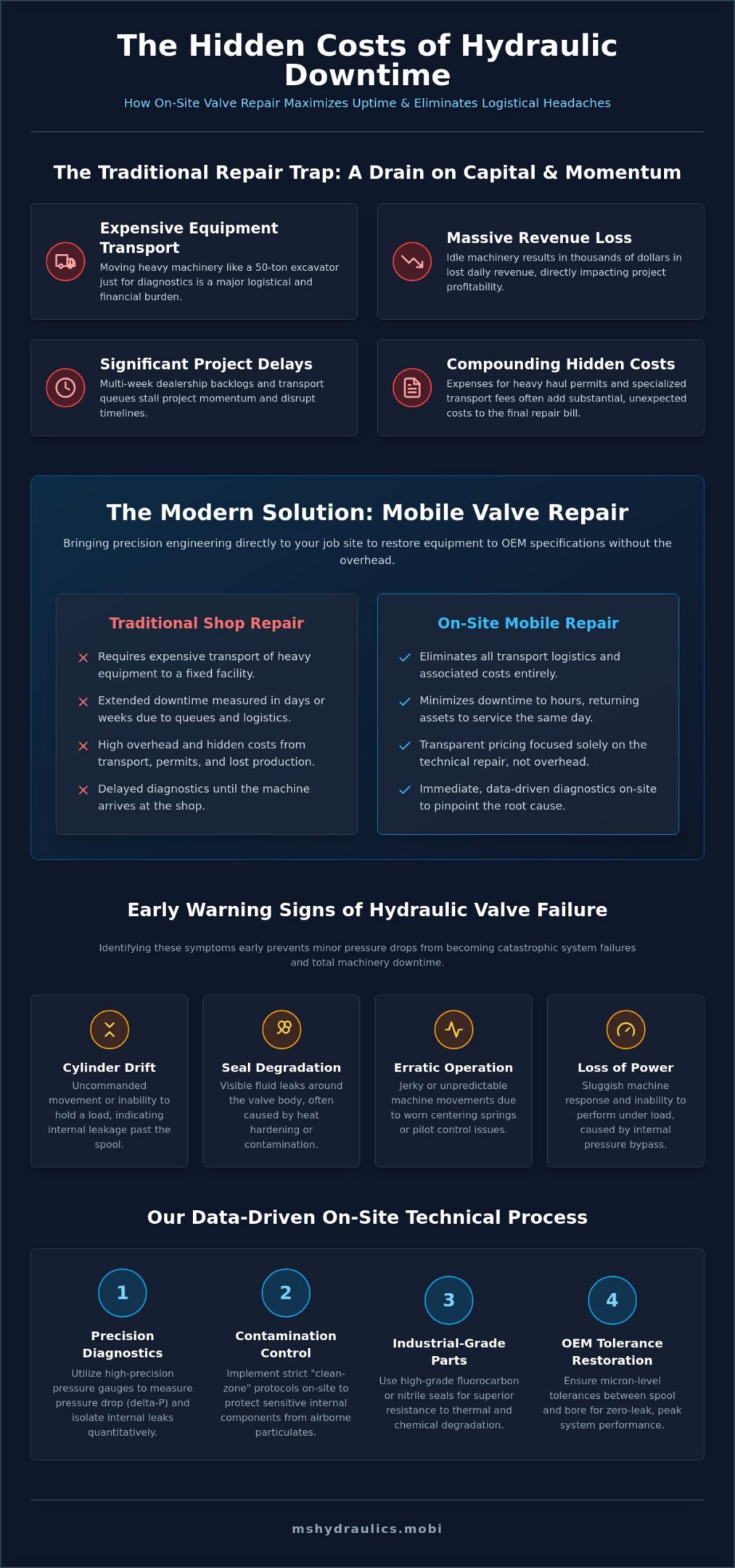
Downtime is more than a scheduling inconvenience. It’s a direct drain on capital. When a primary machine is sidelined, the lost hourly revenue can escalate quickly, impacting the profitability of the entire project. Beyond the lack of production, the hidden costs of traditional shop repair are substantial. Heavy haul permits and specialized transport fees for large equipment add significant expenses to the total repair bill. Mobile service bypasses these logistical hurdles and avoids the multi-week dealership backlogs often found in the Dallas-Fort Worth metroplex. By choosing on-site diagnostics and repair, fleet managers maintain better control over their operational timelines and maintenance budgets.
Technical Anatomy: How We Restore Hydraulic Valves On-Site
Restoring a control valve to peak performance in a field environment requires a disciplined approach to technical diagnostics. Our mobile hydraulic valve repair Cleburne process begins with a comprehensive system analysis using high-precision pressure gauges. These instruments allow technicians to measure delta-P (pressure drop) across specific valve segments, isolating internal leaks that cause sluggish machine response. Unlike general mechanics who might rely on visual inspection alone, we utilize quantitative data to verify the integrity of the hydraulic circuit before any component disassembly occurs. This data-driven phase ensures that we address the root cause of the pressure loss rather than merely treating the symptoms.
Field environments are inherently hostile to precision hydraulics. By executing mobile hydraulic valve repair Cleburne at the machine’s location, we implement strict “clean-zone” practices to protect internal components. This involves clearing the immediate area of debris and using specialized containment to prevent airborne particulates from entering the open valve bank. Once disassembled, we prioritize the use of high-grade fluorocarbon or nitrile seals. These materials offer superior resistance to the thermal cycling and chemical degradation common in North Texas industrial operations. We don’t settle for standard-grade kits when the application demands industrial-strength durability.
Spool and Bore Precision Requirements
Zero-leak performance in a hydraulic system depends on micron-level tolerances between the valve spool and the housing bore. During an on-site evaluation, we inspect the spool for scoring, pitting, and erosion caused by fluid cavitation or contamination. If the clearances exceed manufacturer specifications, an internal bypass occurs, leading to heat generation and lost actuator force. While many valves can be successfully resealed, a severely scored bore typically dictates a full component replacement to ensure safety. Our technicians possess the specialized expertise to determine if a valve can be salvaged or if a new unit is required to meet OEM standards.
Pressure Testing and Calibration Protocols
The final phase of a repair involves precise calibration. We set relief valve pressures to exact manufacturer specifications on-site, ensuring the system doesn’t exceed safe operating limits. For modern machinery, load-sensing valve adjustments are critical for maintaining machine responsiveness and fuel efficiency. We verify flow rates across all functions to ensure that multi-function hydraulic performance remains balanced. If your equipment shows signs of erratic movement or pressure loss, our on-site diagnostic services can identify the exact pressure deviations requiring correction.
Mobile Service vs. Shop Repair: A Cost-Benefit Analysis
The decision between field restoration and shop-based repair often hinges on a misunderstood calculation of labor rates. While shop hourly fees may appear competitive, they represent only a fraction of the total project expenditure. Utilizing mobile hydraulic valve repair Cleburne eliminates the primary cost driver of heavy equipment maintenance: the logistical overhead. When a control valve fails, the machine becomes a “dead” asset, requiring specialized recovery that quickly inflates the final bill. By performing the repair on-site, we remove the need for external recovery services and keep the equipment within the production cycle.
Comparing time-to-operation reveals a stark disparity. A traditional shop repair involves scheduling transport, waiting for an open bay, and navigating a dealership backlog that can last weeks. In contrast, mobile service restores machinery in hours. We maintain shop-quality results by deploying specialized field units equipped with the same diagnostic and clean-zone tools found in a fixed facility. This ensures that micron-level tolerances are met without the machine ever leaving the job site. The technical accuracy of a field repair is verified through the same pressure-testing protocols used in a laboratory setting, ensuring that the machine returns to service at OEM specifications.
Eliminating the Logistical Nightmare
Moving a 50,000-pound excavator with a seized hydraulic system is a complex engineering challenge. It requires low-boy trailers and expensive over-size load permits that vary based on regional regulations. Loading a non-functional machine also introduces the risk of secondary damage to the undercarriage or hydraulic cylinders during the winching process. For instance, a project at a Cleburne construction site avoided over $2,000 in transport fees alone by choosing on-site valve service. By repairing the unit where it sat, the contractor maintained their project timeline and avoided the risks associated with heavy haulage and potential loading accidents.
Long-Term Value of On-Site Maintenance
On-site repair provides an opportunity for direct technical observation that shop environments lack. Technicians can observe the machine’s behavior under actual load conditions, allowing for more accurate calibration of relief valves and load-sensing circuits. This setting also facilitates real-time feedback with the operator, which helps identify systemic issues like pump cavitation or hose degradation that might otherwise go unnoticed in a sterile shop environment. For a deeper look at preventing these failures, see our Heavy Equipment Maintenance guide. This holistic approach ensures that the valve repair isn’t just a temporary fix but part of a broader strategy for machine reliability and performance verification.
Field Troubleshooting: Identifying Valve Issues Early
Effective field troubleshooting requires a methodical evaluation of machine behavior before a total failure occurs. Operators should first observe for “cylinder drift,” where an actuator moves under load without control input. This movement typically signals that fluid is bypassing the valve spool through worn internal clearances. Next, inspect the valve bank for external fluid migration. Wetness at the spool ends or around the solenoid housings often indicates seal degradation. Monitoring thermal signatures is equally critical; if a valve body feels excessively hot compared to the hydraulic reservoir, it’s likely acting as a heat sink due to internal friction or restricted flow passages. For machines with integrated telemetry, documenting error codes from electronically controlled valves is essential. These quantitative data points facilitate a more efficient mobile hydraulic valve repair Cleburne process by narrowing the diagnostic focus before the technician arrives.
A basic pressure check can be performed if the equipment is outfitted with diagnostic ports. By monitoring the pressure at high idle during a stalled function, you can determine if the relief valve is opening prematurely. This step helps distinguish between a mechanical failure in the actuator and a hydraulic logic failure within the control block. Identifying these deviations early prevents the cumulative damage associated with operating a compromised system. Consistent monitoring of these parameters ensures that you don’t overlook the subtle signs of hydraulic degradation.
Symptoms of a Failing Control Valve
Erratic movement or “jerking” during multi-function operations often suggests a failure in the load-sensing circuit or a sticking spool. When a machine lacks “holding power” under load, the internal bypass within the valve block is the primary technical suspect. These symptoms often escalate during high-cycle work, where thermal expansion further loosens tolerances. If the valve body becomes a heat sink, it indicates that the energy of the pressurized fluid is being converted into heat rather than mechanical work, a clear sign of system inefficiency.
When to Stop Operating and Call a Professional
Operating a machine with a compromised valve introduces the risk of “thermal runaway.” This condition occurs when internal leakage generates heat that thins the hydraulic fluid, leading to even more leakage and potential catastrophic failure of the main pump. Avoiding these blockages is critical for the longevity of the entire hydraulic circuit. If you observe persistent pressure drops or erratic actuator response, our On-Site Diagnostic Services provide the technical verification needed to prevent collateral damage. Securing a professional assessment early prevents minor spool wear from becoming a total system overhaul. If your machinery displays these technical red flags, request a mobile hydraulic valve repair Cleburne to restore precision control and safeguard your equipment’s main hydraulic components.
Why Ms. Hydraulics LLC is Cleburne’s Choice for Valve Repair
Ms. Hydraulics LLC has established itself as a technical leader in the North Texas industrial sector by providing high-precision mobile hydraulic valve repair Cleburne. Since our founding in 2021, we’ve focused on delivering modern, efficient solutions that address the specific engineering challenges of regional machinery. Our technicians possess deep expertise in the diverse equipment types found in Cleburne, from high-pressure industrial drill rigs to agricultural skid steers. This specialized knowledge allows us to maintain the rigorous standards required by major international players while remaining accessible to local fleet operators.
Integrity is the foundational principle of our service model. We prioritize factual accuracy in our diagnostics; we fix what’s broken and provide objective advice on components that remain within operational tolerances. This direct approach builds trust and ensures that your maintenance budget is allocated effectively. Our service footprint extends beyond Cleburne to include Alvarado, Granbury, and Mansfield, providing a reliable alternative to expensive dealership transport. We offer holistic hydraulic support that integrates valve restoration with complementary services like hydraulic hose fabrication and cylinder rebuilds, ensuring your entire fluid power system operates at peak performance.
Our Mobile Service Capabilities
Our service trucks are mobile engineering hubs designed for complex on-site diagnostics. We utilize specialized tooling to service both legacy mechanical valves and modern electronically controlled units. This versatility is critical for North Texas fleets that often operate a mix of equipment generations. Our technicians are trained to handle a variety of valve architectures, ensuring that regardless of your machine’s age, its hydraulic logic can be restored to factory specifications. For more information on our field capabilities, explore our Mobile Hydraulic Repair services.
Partnering for Long-Term Reliability
We believe that industrial excellence is achieved through consistent, predictable maintenance. We work closely with local Cleburne operators to develop custom maintenance plans that identify potential valve failures before they cause project delays. This proactive stance transforms the traditional repair-on-failure model into a structured strategy for long-term machine reliability. By building lasting relationships with North Texas fleets, we provide the specialized mobile hydraulic valve repair Cleburne needs to maintain high-pressure performance. If your equipment is experiencing pressure deviations or erratic control, contact Ms. Hydraulics LLC for On-Site Valve Repair to secure a professional, engineering-focused solution.
Restoring Operational Precision to Your Heavy Equipment Fleet
Maintaining the mechanical integrity of a hydraulic system requires more than reactive maintenance; it demands a technical partner capable of executing precision repairs in the field. By prioritizing on-site diagnostics, you eliminate the substantial logistical costs and equipment downtime associated with traditional shop transport. Professional mobile hydraulic valve repair Cleburne ensures that your control systems are restored to exact OEM specifications while your machinery remains on the job site. This methodology transforms a complex component failure into a manageable, data-driven restoration process that respects your project timelines.
Ms. Hydraulics LLC provides the specialized expertise necessary to manage complex valve logic alongside broader system needs like cylinder rebuilds and custom hose fabrication. Our technicians serve Cleburne, Alvarado, and Mansfield with a focus on engineering accuracy and operational integrity. This holistic approach prevents minor pressure deviations from escalating into catastrophic component failures. We provide the technical verification needed to keep your projects on schedule and your equipment in top condition. Request Mobile Hydraulic Valve Repair in Cleburne to secure your fleet’s performance today. We’re ready to help you maintain peak industrial efficiency and long-term machine reliability.
Frequently Asked Questions
Can you repair a hydraulic valve on-site, or does it have to go to a shop?
On-site repair is possible for the majority of control valve failures. Technicians use mobile service units to perform field disassembly, cleaning, and seal replacement under strict contamination protocols. While catastrophic housing damage might require a shop-based replacement, most pressure-loss issues are resolved without transporting the machinery. This on-site approach maintains project momentum and avoids the logistical costs of heavy haulage.
How do I know if my hydraulic problem is the valve or the pump?
Function-specific failure usually indicates a valve issue, whereas total system pressure loss often points to the pump. A technician performs a delta-P check to measure pressure drops across the valve bank. If one function is sluggish but others operate at full capacity, the logic center is the likely culprit. Conversely, if no actuators reach relief pressure, the pump’s volumetric efficiency has likely degraded.
What are the most common signs of a failing hydraulic control valve?
Cylinder drift and erratic actuator response are the primary indicators of internal valve leakage. You may also observe external fluid migration around the spool seals or excessive heat localized at the valve block. These symptoms suggest that the internal tolerances have widened, allowing fluid to bypass the intended circuit. Addressing these signs early prevents secondary damage to the main hydraulic pump and actuators.
Does Ms. Hydraulics LLC serve areas outside of Cleburne?
Ms. Hydraulics LLC provides mobile hydraulic valve repair Cleburne and extends its technical services to surrounding North Texas regions. Our coverage area includes Alvarado, Granbury, and Mansfield, ensuring local operators have access to professional on-site diagnostics. This regional presence allows us to serve as a high-efficiency alternative to distant dealerships, reducing the total duration of equipment downtime for regional industrial fleets.
How long does a typical mobile hydraulic valve repair take?
A typical on-site valve restoration is completed within two to six hours. This timeframe includes the initial diagnostic pressure check, component disassembly, seal replacement, and final system calibration. Mobile service is significantly faster than the multi-day or multi-week turnaround times common at fixed facilities. By performing the work at your location, we restore your machine to OEM specifications during a single service call.
Is it cheaper to repair or replace a hydraulic control valve?
Repair is generally the more cost-effective option for addressing seal degradation or centering spring failures. Replacing a complete multi-spool valve bank is a significant capital expenditure that’s often unnecessary if the bore and spool remain within micron-level tolerances. Our technicians provide an objective assessment of the component’s condition to ensure you only invest in a replacement when the mechanical integrity of the housing is compromised.
Can you handle electronically controlled hydraulic valves on modern excavators?
Yes, we possess the technical capabilities to service both mechanical and electronically controlled hydraulic valves. Modern excavators utilize solenoid-actuated valves that require specific electrical diagnostics alongside traditional pressure testing. Our mobile units are equipped to handle these complex systems, ensuring that pilot-operated controls and electronic logic centers are calibrated for precise machine response. This expertise is vital for maintaining the performance of late-model industrial equipment.
What information should I have ready when I call for a mobile service request?
You should provide the machine’s make, model, and serial number, along with a description of the specific hydraulic symptoms. Identifying the valve manufacturer, such as Parker, Husco, or Rexroth, also facilitates a faster mobile hydraulic valve repair Cleburne. This information allows our technicians to arrive with the correct technical documentation and specialized seal kits required for your specific equipment architecture, ensuring a more efficient on-site restoration.