Excavator Cylinder Rebuild in Texas: A Technical Guide to Restoring OEM Performance
Texas has officially emerged as the largest construction equipment market in North America, fueled by a 4 percent increase in new residential permits and massive infrastructure expansion. For fleet managers and owner-operators, maintaining peak machine availability often depends on a high-quality excavator cylinder rebuild Texas technicians perform to rigorous mechanical standards. You’re likely familiar with the operational bottlenecks caused by leaking seals and the prohibitive costs associated with purchasing new OEM components.
Restoring hydraulic integrity doesn’t require a total replacement when technical precision is applied to the rebuild process. This guide explores the engineering requirements for restoring OEM performance, from barrel honing to rod re-chroming. You’ll learn how specialized mobile diagnostics and project-based testing can eliminate site downtime and extend the service life of your heavy machinery. We’ll provide a clear overview of the technical milestones necessary to ensure your equipment operates with its original digging and lifting power.
Key Takeaways
- Identify critical mechanical failure symptoms, such as cylinder drifting and external leaks, to prevent catastrophic hydraulic pressure loss.
- Understand the technical precision involved in a professional excavator cylinder rebuild Texas to restore hydraulic actuators to original performance levels.
- Compare the financial benefits of component restoration, which typically yields 40-60% savings over the procurement of new OEM replacement parts.
- Implement preventative maintenance protocols, including hydraulic fluid analysis, to mitigate internal contamination and extend equipment service life.
- Leverage mobile diagnostic services in Cleburne and the DFW Metroplex to facilitate rapid on-site repairs and minimize operational downtime.
Understanding Excavator Hydraulic Cylinder Failure in North Texas
An excavator hydraulic cylinder functions as the primary linear mechanical actuator, converting hydraulic fluid energy into the mechanical force required for high-tonnage digging and lifting. These components are the muscle of the machine. Understanding Hydraulic cylinder components and operation is essential for identifying early warning signs before a total system failure occurs. In the demanding environments of Cleburne and the DFW Metroplex, these actuators face extreme physical stress that necessitates a proactive approach to maintenance.
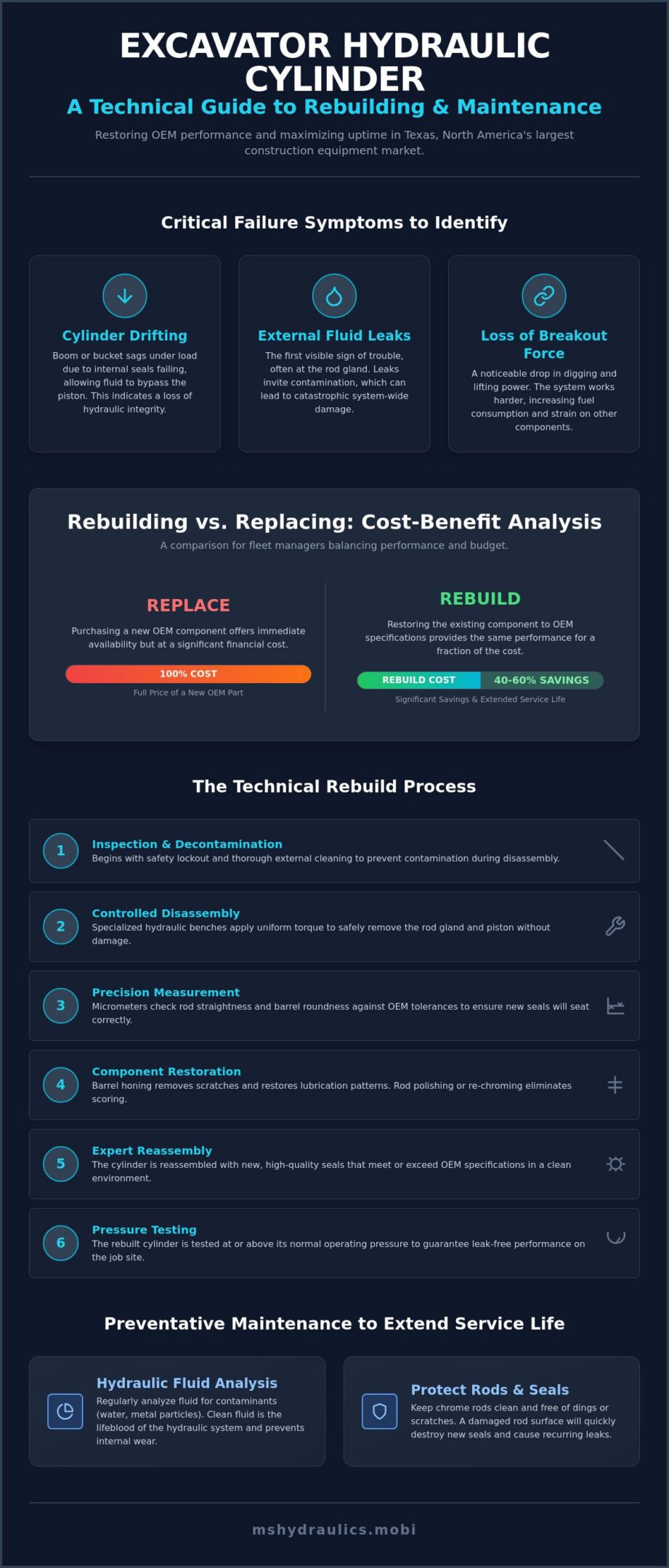
Failure typically manifests through three primary symptoms: cylinder drifting, external fluid leaks, and a noticeable loss of breakout force. Drifting occurs when internal seals fail, allowing fluid to bypass the piston and causing the boom or bucket to sag under load. External leaks at the rod gland are often the first visible sign of trouble. If left unaddressed, these issues lead to a significant drop in system pressure, eventually requiring a comprehensive excavator cylinder rebuild Texas technicians perform to restore original equipment manufacturer (OEM) specifications.
The North Texas climate introduces specific environmental stressors that accelerate component degradation. Intense summer heat leads to rapid thermal cycling, which hardens synthetic seals and reduces their elasticity. Furthermore, the fine dust and abrasive soil common to local job sites act as a grinding compound. When the wiper seal fails to deflect these particles, they become embedded in the rod, leading to longitudinal scoring that destroys the integrity of the entire seal package. Ignoring these minor leaks is a high-risk strategy; a compromised seal is the primary gateway for hydraulic contamination, which can quickly migrate to the hydraulic pump and cause catastrophic internal damage.
Common Failure Modes for Heavy Equipment
Seal hardening and cracking are the most frequent issues, often caused by hydraulic fluid reaching temperatures beyond the seal’s design parameters. On Texas job sites, rod scoring is equally prevalent due to airborne contaminants. Once the chrome plating on a rod is scratched, it acts like a file against the seals during every stroke. Finally, internal bypass caused by piston seal degradation allows high-pressure fluid to leak into the low-pressure side of the cylinder, neutralizing the machine’s lifting power and reducing overall cycle times.
The High Cost of Excavator Downtime
The financial impact of a non-operational excavator extends far beyond the repair bill. Indirect costs include the expense of renting a replacement machine, idle labor on the job site, and potential liquidated damages for project delays. When a cylinder loses efficiency, the entire hydraulic system must work harder to compensate, which increases fuel consumption and places unnecessary strain on the engine. It’s a technical reality that seal failure is the leading cause of hydraulic contamination, often necessitating expensive fluid flushes and filter replacements if the rebuild is delayed.
The Technical Rebuild Process: From Inspection to Pressure Testing
Executing a professional excavator cylinder rebuild Texas requires a methodical engineering approach to ensure the component returns to its original performance parameters. The process begins with safety and decontamination. Technicians must first follow OSHA guidelines on hydraulic system lockout to neutralize stored energy before removing the actuator from the machine. Once in a controlled environment, a thorough external cleaning removes abrasive Texas soil and dust. This prevents external particulates from entering the hydraulic circuit during the teardown phase. Controlled disassembly follows, utilizing specialized hydraulic benches to apply uniform torque when removing the rod gland and piston.
Precision measurement is the next critical phase. Technicians use micrometers to evaluate rod straightness and barrel roundness against specific OEM tolerances. If a barrel is “out of round” or a rod is slightly bent, the new seals won’t seat correctly, leading to immediate failure. Barrel honing is performed to remove minor internal scratches and restore the cross-hatch pattern required for proper seal lubrication. Meanwhile, the chrome rod undergoes a polishing process to eliminate micro-burrs. If your machine is struggling with heavy loads, our mobile hydraulic repair experts can perform an initial assessment to determine the extent of the damage.
The final assembly involves the installation of high-performance seal kits designed for the thermal stressors of the North Texas environment. Every component, including internal bushings and wear rings, is inspected for signs of uneven wear. A rebuild is only as good as its final verification, which is why we never bypass the load-testing stage. A comprehensive excavator cylinder rebuild Texas service provides the technical verification necessary for high-stakes industrial projects.
Component Restoration vs. Replacement
Deciding between restoration and replacement depends on the depth of the damage. Rod polishing is sufficient for minor surface oxidation; however, if rod scoring exceeds 0.005 inches, industrial re-chroming is necessary to restore surface hardness and diameter. We replace internal bushings and wear rings whenever they show clearance beyond OEM specifications. This ensures the rod remains centered, preventing side-loading that would otherwise compromise the new seals.
Final Verification and Testing
Reliability is verified through a rigorous testing protocol. This includes both static and dynamic pressure testing to ensure zero bypass at peak operating PSI. We document these results to provide fleet managers with a verifiable record of performance. This methodical testing confirms that the rebuilt cylinder can withstand the maximum breakout forces required on a heavy-duty job site, ensuring a long-term repair partner relationship.
Rebuilding vs. Replacing: A Cost-Benefit Analysis for Fleet Managers
Fleet managers must evaluate component failure through a rigorous financial lens. A primary benchmark for this assessment is the 50 percent rule. If the estimated cost of restoration exceeds half the price of a new aftermarket unit, replacement becomes the logical choice. However, a precision excavator cylinder rebuild Texas technicians perform typically costs between 40 and 60 percent of a new OEM replacement. This price differential represents a significant opportunity for capital preservation across large equipment fleets. When you factor in the high cost of new heavy-duty actuators, the ROI on a professional rebuild is often undeniable.
Lead times present another critical variable. Supply chain volatility often extends the delivery window for new OEM cylinders to several weeks or even months. Local restoration services provide a decisive advantage by reducing this window. A rebuilt unit often returns to service in a fraction of the time required for international shipping and customs clearance. For a project in Cleburne or the DFW Metroplex, every day a machine sits idle results in lost revenue and potential project penalties. Rapid turnaround through local expertise keeps your operations on schedule.
Quality concerns regarding aftermarket cylinders also influence the decision. Many low-cost aftermarket options use inferior alloys or thinner barrel walls to reach their price points. These components may not withstand the peak operating pressures of heavy digging. In contrast, a professional rebuild retains the high-integrity OEM housing while replacing the internal wear components with premium materials. This technical approach ensures the structural core of the machine remains within original design specifications while restoring the hydraulic seal to peak efficiency.
Environmental factors are increasingly relevant in the industrial sector. Component restoration aligns with modern sustainability goals by reducing the demand for raw steel production. It minimizes the carbon footprint associated with manufacturing and transporting heavy iron across global trade routes. Rebuilding is a disciplined choice that supports both fiscal responsibility and resource conservation.
When a Rebuild is the Best Option
Restoration is the optimal path when the cylinder barrel and rod are structurally sound. Cylinders exhibiting standard seal wear or minor surface scoring are prime candidates for a rebuild. This is also the most viable strategy for older excavator models where OEM parts are obsolete or difficult to source. Integrating rebuilds into your preventative maintenance cycles ensures long-term reliability without the expense of total component replacement.
Signs a Replacement is Necessary
There are instances where a rebuild is no longer technically or economically feasible. Severe barrel bulging, often caused by extreme pressure spikes, indicates a compromise in structural integrity that cannot be honed away. Deeply pitted rods or those with structural cracks are generally unsafe for continued use. If the internal damage is so extensive that the cost of machining and re-chroming exceeds the 50 percent threshold, we recommend a full component replacement to ensure operator safety.
Preventative Maintenance Protocols to Extend Cylinder Service Life
Establishing a methodical inspection schedule is the primary mechanism for preventing premature component failure. For heavy machinery operating in the abrasive soil conditions of Cleburne and the DFW Metroplex, visual inspections should occur every 50 to 100 operating hours. Technicians must examine the rod surface for signs of longitudinal scoring and check the gland nut for hydraulic weeping. If a component has already reached the point of mechanical bypass, an excavator cylinder rebuild Texas experts provide is the most reliable way to restore system pressure and prevent secondary damage to the hydraulic pump.
Hydraulic fluid analysis serves as a diagnostic window into the internal state of the actuator. By measuring particulate counts and checking for the presence of metallic shavings, fleet managers can identify internal wear before it results in a total system shutdown. Maintaining fluid cleanliness according to ISO 4406 standards is essential. Contaminated fluid acts as a liquid sandpaper, rapidly eroding piston seals and barrel walls. We recommend scheduled sampling every 500 hours to track wear trends and ensure the additive package in your hydraulic oil remains effective against thermal degradation.
Mechanical protection during transport and storage is often overlooked. When moving excavators between job sites, rods should be fully retracted to prevent impact damage or exposure to corrosive elements. If a machine must remain idle for extended periods, applying a specialized protective coating to any exposed rod surfaces prevents oxidation. Training operators to recognize the early signs of hydraulic bypass—such as a “spongy” feel in the controls or a bucket that won’t hold its position—allows for intervention before a minor seal leak necessitates a full component replacement. Contact our team for on-site diagnostic services to evaluate your fleet’s hydraulic integrity.
Environmental Protection Strategies
Daily cleaning of the cylinder rods is a simple yet effective way to prevent dust ingress. Abrasive Texas dust that accumulates on the rod is often pulled past the wiper seal, where it destroys the primary high-pressure seals. Furthermore, selecting the correct hydraulic fluid viscosity is critical for North Texas temperature swings. Using a high-viscosity index oil ensures the fluid remains thick enough to lubricate during 100-degree summers while maintaining flow during winter freezes. In high-debris environments, such as demolition or land clearing, installing protective bellows or boots can significantly extend seal life.
In addition to on-machine protection, housing your fleet in a durable steel structure can significantly reduce environmental wear; click here to explore steel building solutions designed for secure equipment storage.
Internal System Health
Internal health depends on rigid adherence to filter change intervals. A clogged filter allows unfiltered oil to bypass the system, introducing contaminants directly into the cylinder’s precision-honed barrel. Monitoring system temperature is equally vital; hydraulic oil that exceeds 180 degrees Fahrenheit will “cook” synthetic seals, causing them to lose elasticity and crack. For comprehensive fleet management strategies, refer to our Heavy Equipment Maintenance guide for full fleet protocols.
Expert Excavator Cylinder Services in Cleburne and the DFW Metroplex
Ms. Hydraulics LLC operates as a specialized provider of hydraulic solutions, focusing on the rigorous requirements of the Texas construction and agricultural sectors. Our capabilities extend beyond standard shop repairs to include comprehensive field support. By facilitating an excavator cylinder rebuild Texas operators can rely on, we ensure that heavy machinery, from standard excavators to complex drill rigs, maintains the high-pressure performance necessary for industrial output. Our service footprint covers Cleburne, Burleson, Mansfield, and the broader Fort Worth region, positioning us as a localized partner for large-scale fleet operations.
The core of our service model is built on technical integrity and engineering precision. We recognize that transporting a 50-ton excavator for a single cylinder issue is often logistically impractical and financially draining. Our approach centers on mobile diagnostic capabilities that bring expert analysis directly to the job site. This proactive model allows for rapid identification of seal failure or rod damage before the component is even removed, streamlining the entire restoration workflow and ensuring that repairs are grounded in verified data.
On-Site Support for Johnson County
Our mobile technicians utilize specialized diagnostic equipment to evaluate hydraulic actuators in their operating environment. This field-based approach significantly reduces the logistical burden of heavy equipment maintenance. By identifying the specific failure mode on-site, we can determine the most efficient path toward restoration. For many operators in Cleburne, this means minimizing the time a machine spends out of the production cycle. Accessing On-Site Diagnostic Services provides an immediate technical baseline for your equipment’s hydraulic health.
Why Choose Local Expertise?
Choosing a local repair partner ensures a deep understanding of the environmental stressors unique to North Texas. We account for the abrasive soil compositions and extreme thermal cycling that define local job sites. Our commitment to excellence is reflected in our project-based fees for disassembly and testing, providing a transparent and methodical repair process. A precision excavator cylinder rebuild Texas technicians deliver is vital because the earthmoving segment holds nearly 50 percent of the construction equipment market, and uptime remains the primary driver of profitability. Requesting a technical assessment for your excavator fleet is the first step in establishing a reliable, long-term maintenance partnership that values mechanical performance and operational efficiency above all else.
Optimizing Hydraulic Performance and Equipment Longevity
Maintaining the hydraulic integrity of your fleet is a technical requirement for sustained operational efficiency in the North Texas market. A professional excavator cylinder rebuild Texas technicians perform provides a cost-effective alternative to OEM replacement, often reducing component expenses by 40 to 60 percent. By prioritizing precision honing, rod polishing, and rigorous pressure testing, you ensure your actuators return to their original performance parameters. It’s essential to implement structured maintenance protocols, such as routine fluid analysis, to extend the service life of your heavy industrial machinery.
Ms. Hydraulics LLC combines on-site diagnostic expertise with deep technical knowledge to support construction and agricultural projects across Cleburne and the entire DFW Metroplex. We focus on minimizing your downtime through methodical disassembly and verified testing procedures. Our technicians specialize in the complex requirements of heavy equipment actuators and don’t compromise on mechanical accuracy. We’re ready to serve as your dependable repair partner for all high-tonnage industrial needs.
When your equipment is ready for rural development tasks, you can discover Best Cistern Septic Solutions for expert septic field installation and repair services.
Request a Technical Quote for Excavator Cylinder Rebuilds today to ensure your fleet operates with peak mechanical reliability.
Frequently Asked Questions
How much does it cost to rebuild an excavator cylinder in Texas?
The cost for an excavator cylinder rebuild Texas depends on the component’s size and the specific failure mode identified during disassembly. Factors such as rod re-chroming or barrel honing will influence the final project fee. We provide transparent, project-based pricing after a full technical assessment, ensuring the restoration remains more cost-effective than procurement of a new OEM actuator.
How long does a typical cylinder rebuild take?
Turnaround times are contingent upon the extent of mechanical damage and the availability of specific seal kits. Most standard rebuilds are completed within a few business days. Our goal is to minimize your operational downtime through an excavator cylinder rebuild Texas fleet managers trust, which is significantly faster than the lead times for new international equipment shipments.
Can you rebuild a hydraulic cylinder on-site at my construction project?
We perform on-site diagnostic services to identify the root cause of hydraulic failure directly at your job site. While minor mobile hydraulic repairs are possible in the field, a full technical rebuild requires a controlled environment to prevent internal contamination. Heavy machining processes, such as precision honing and load testing, must be conducted in our specialized facility to ensure OEM performance.
What is the difference between resealing and a full cylinder rebuild?
Resealing involves the replacement of soft components like O-rings and wipers, whereas a full rebuild includes the restoration of metal surfaces. A full rebuild involves measuring tolerances with micrometers, honing the barrel, and polishing the rod to ensure the new seals don’t fail prematurely. This comprehensive approach is necessary if the cylinder exhibits internal bypass or rod scoring.
How do I know if my excavator cylinder rod needs re-chroming?
A rod requires re-chroming when surface scoring or pitting is deep enough to be felt with a fingernail or exceeds 0.005 inches. Polishing can resolve minor oxidation, but structural scoring will rapidly destroy new seals. Our technicians evaluate the rod’s surface finish and diameter against original specifications to determine if industrial re-chroming is the only viable path for restoration.
Do you provide warranties on excavator cylinder rebuild services?
Reliability is ensured through rigorous static and dynamic pressure testing before any component leaves our facility. We verify that each rebuilt actuator meets peak operating PSI requirements and maintains zero bypass under load. Our focus is on providing a dependable repair that restores the machine’s original digging and lifting power through disciplined quality control.
What are the most common causes of hydraulic cylinder failure in excavators?
The most frequent causes of failure include hydraulic fluid contamination, excessive thermal cycling, and physical rod damage. In the North Texas climate, fine dust can bypass worn wiper seals and act as an abrasive, leading to rod scoring. Additionally, operating with degraded fluid causes internal seals to harden and crack, resulting in pressure loss and cylinder drifting.
Is it worth rebuilding an older excavator cylinder or should I buy new?
Rebuilding is typically the superior option for older cylinders, provided the barrel and rod are structurally sound. It allows you to retain high-quality OEM housings while replacing worn internal components with modern, high-performance materials. This is especially valuable for obsolete models where new parts are no longer manufactured or have prohibitive lead times.