Expert On-Site Cylinder Repair in Fort Worth: Minimizing Heavy Equipment Downtime
Every hour a heavy machine sits idle due to a compromised hydraulic seal represents a direct loss of project momentum and revenue. For contractors in North Texas, the standard response of dismantling and transporting components to a service center often costs more in logistical delays than the actual technical restoration. Professional on-site cylinder repair Fort Worth services are redefining this recovery timeline by bringing engineering precision directly to the job site. You likely already know that the physical burden of moving a large-scale cylinder isn’t just a labor issue; it’s a safety risk and an environmental liability if fluid leaks occur during transit.
This article demonstrates how expert field intervention eliminates these logistical hurdles, returning your equipment to full operational capacity without the need for off-site transport. We’ll examine the technical advantages of immediate diagnostic clarity, the significant reduction in total labor hours required for removal and reinstallation, and the rigorous engineering standards that ensure long-term component reliability. By shifting the focus from transport to technical execution, you can maintain project schedules while upholding strict OSHA safety standards and environmental compliance.
Key Takeaways
- Evaluate the true economic impact of mobile diagnostics by accounting for the hidden labor and transport costs associated with traditional off-site repairs.
- Identify critical indicators of hydraulic failure, such as cylinder drifting or creeping, and understand how North Texas thermal conditions accelerate seal degradation.
- Learn the technical parameters for deciding between a field-based reseal and a comprehensive engineering rebuild based on barrel and rod conditions.
- Streamline your recovery timeline with professional on-site cylinder repair Fort Worth services that eliminate the logistical risks of transporting large-scale components.
- Establish a secure environment for mobile technicians by following standard protocols for load stabilization and residual pressure relief before service begins.
The Economics of On-Site Cylinder Repair in Fort Worth
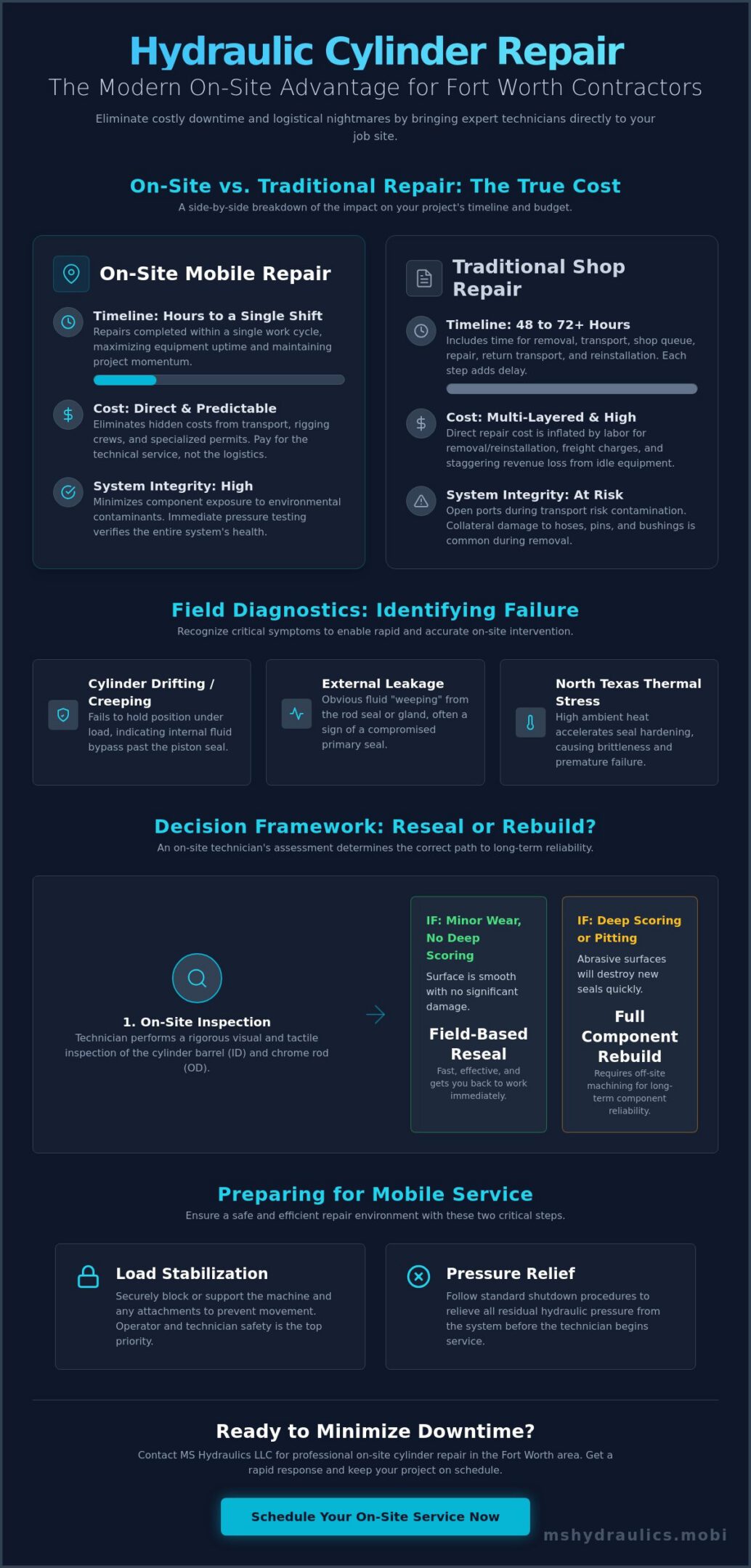
On-site cylinder repair Fort Worth services represent a specialized mobile diagnostic and restoration discipline focused on hydraulic actuators. Unlike traditional shop-based models, this approach brings technical expertise directly to the machine’s location. A hydraulic cylinder is a complex mechanical assembly; its failure often stems from internal seal degradation or external rod damage. When a unit fails, the immediate instinct is often to extract the component for transport. However, this triggers a series of hidden costs that frequently exceed the price of the repair itself. Ms. Hydraulics LLC provides these mobile services to mitigate the expenses of removal labor, specialized transport logistics, and the eventual reinstallation phase. Mobile repair preserves hydraulic system integrity by limiting the duration of internal component exposure to environmental contaminants during the resealing process.
Why Mobile Service is the Standard for North Texas Construction
The rapid infrastructure expansion across North Texas demands high equipment availability. Fort Worth construction schedules are tight. Moving heavy components often requires specialized transport permits or dedicated rigging crews, adding layers of bureaucratic and logistical delay. On-site service bypasses these requirements. Technicians from Ms. Hydraulics LLC perform the work in situ, which also reduces the risk of secondary system damage. Inexperienced crews often cause collateral damage to pins, bushings, or hydraulic lines during a forceful manual removal process. A mobile specialist uses dedicated field tools designed for precision extraction without compromising surrounding structures.
Calculating the ROI of Field Response
Calculating the true value of a field response requires a shift from viewing repair as an isolated expense to viewing it as a productivity strategy. If a machine generates significant hourly revenue, a 48 to 72 hour shop turnaround represents a staggering loss. Mobile service premiums are negligible when contrasted with three days of zero production. Field technicians provide immediate, on-site pressure testing. This allows for system-wide diagnostics that ensure the cylinder failure wasn’t merely a symptom of a failing pump or a restricted valve. It’s a comprehensive approach that prioritizes uptime. Field service ROI is the delta between immediate restoration and multi-day transport cycles.
- Direct Labor Savings: Eliminates the man-hours required for component extraction and hauling.
- Logistical Efficiency: Removes the need for heavy-duty freight or specialized transport permits.
- Operational Continuity: Reduces the typical repair window from days to a single work shift.
Technical Diagnostics: Identifying Cylinder Failure in the Field
Accurate diagnosis in the field requires a systematic approach to distinguish between localized component failure and broader systemic issues. Technicians performing on-site cylinder repair Fort Worth operations begin by identifying the specific nature of the malfunction, typically categorized as either internal or external leakage. External leakage is often obvious, manifesting as fluid “weeping” from the rod seal or gland nut. Internal leakage, however, presents as “drifting” or “creeping,” where the cylinder fails to hold its position under load. This occurs when fluid bypasses the piston seal internally, often due to seal wear or a scored barrel ID.
Environmental factors in North Texas play a critical role in premature component failure. High ambient temperatures accelerate the hardening of elastomeric seals, a process that robs the material of its required elasticity. Once a seal hardens, it can’t maintain a proper interface with the rod or barrel during standard thermal expansion cycles. This leads to brittle failure and sudden pressure loss. Additionally, technicians must execute rigorous visual inspection protocols to identify chrome rod scoring or pitting. Even minor surface irregularities can act as abrasive files, destroying new seals within hours of installation if they aren’t addressed during the diagnostic phase.
Common Failure Modes in Heavy Equipment Actuators
Hydraulic actuators in heavy machinery face specific mechanical stresses that lead to predictable failure patterns. Piston seal bypass is a primary reason an excavator arm or loader bucket won’t hold its load, as high-pressure fluid migrates to the low-pressure side of the piston. Rod seal degradation is another common issue; it starts as a minor film of oil on the rod but quickly escalates into a blowout. In the Fort Worth area, heavy dust and grit are constant threats. These particulates accumulate on the rod and, if the wiper seal is compromised, they’re pulled directly into the gland nut, accelerating wear on internal bearing surfaces.
On-Site Diagnostic Tools and Procedures
Field technicians utilize specialized pressure gauges and flow testing equipment to isolate the cylinder from the control valve or pump. By “dead-heading” the cylinder and monitoring pressure drop, a technician can confirm internal bypass without dismantling the unit. Rod alignment checks are also essential during a field inspection. A bent rod or misaligned mounting pin creates side-loading, which causes uneven wear on the wear bands and seals. If your initial inspection reveals significant rod scoring or erratic movement, professional on-site diagnostic services provide the data necessary to decide if a field reseal is viable or if the unit requires a full shop rebuild.
- Pressure Testing: Verifies piston seal integrity by monitoring pressure retention under static load.
- Rod Inspection: Utilizes precision straight-edges and visual checks for pitting or chrome delamination.
- Thermal Analysis: Identifying localized “hot spots” on the cylinder barrel that indicate internal fluid bypass.
The Decision Framework: On-Site Reseal vs. Full Component Rebuild
Determining the appropriate level of intervention requires a rigorous assessment of the cylinder’s internal and external physical parameters. Professional on-site cylinder repair Fort Worth services are most effective when the failure is isolated to elastomeric components. If the technical evaluation confirms that the barrel ID remains honed and the rod’s hard-chrome plating is free of significant scoring, a field-based restoration is the primary recommendation. This data-driven approach ensures that technicians don’t perform superficial repairs on components that require structural machining. When structural integrity is compromised, the unit must be transitioned to a controlled environment for a comprehensive heavy equipment cylinder rebuild Texas facility where precision lathes and honing equipment are available. Ms. Hydraulics LLC manages these transitions based on engineering data to ensure long-term reliability.
When an On-Site Reseal is Sufficient
A field reseal is the standard recovery protocol for utility equipment and primary actuators that exhibit standard wear patterns. The speed of this process is its greatest advantage. Technicians can often complete the disassembly, cleaning, and seal installation within a single work shift. Success in the field depends on seal kit compatibility with OEM specifications. High-tier providers ensure that replacement seals meet or exceed original pressure ratings and material hardness. If the rod surface is smooth and the gland nut threads are intact, an on-site restoration provides a reliable, long-term solution without the logistical burden of off-site transport.
Red Flags Requiring a Full Rebuild
Certain mechanical failures cannot be rectified in the field. “Mushroomed” rod ends, cracked piston heads, or deep longitudinal grooves in the barrel ID are clear indicators that the component requires shop-based machining. Utilizing professional On-Site Diagnostic Services prevents the mistake of installing new seals into a damaged barrel, which would lead to immediate failure. Ms. Hydraulics LLC manages this transition by providing clear diagnostic reports. If a field repair isn’t viable, the technician coordinates the extraction and transport of the cylinder to the specialized shop. This integrated workflow ensures that the decision to move off-site is based on engineering necessity rather than logistical convenience.
- Surface Integrity: Rod chrome must be free of pitting, flaking, or abrasive scoring.
- Dimensional Accuracy: The cylinder rod must be straight; any deviation requires hydraulic press intervention.
- Structural Soundness: Piston and gland nut threads must be free of galling or cross-threading.
Preparing Your Job Site for a Mobile Hydraulic Technician
Effective execution of on-site cylinder repair Fort Worth depends on rigorous job site preparation. A technician’s efficiency is directly linked to the accessibility and safety of the environment they enter. Before the mobile unit arrives, the primary objective is the stabilization of the equipment. This involves more than just turning off the engine. It requires the active neutralization of stored energy within the hydraulic circuits. Relieving residual pressure prevents the hazardous release of fluid during the initial stages of disassembly. Providing clear documentation, such as machine serial numbers and hydraulic schematics, allows the technician to verify seal kit compatibility before the first bolt is turned.
Environmental containment is equally critical. Given the increasing industry focus on sustainability and the potential for environmental fines, preparing for fluid loss is a technical necessity. While mobile technicians bring containment tools, having a designated area free of debris helps prevent the ingress of contaminants into the open hydraulic system. This proactive approach minimizes the risk of secondary component failure caused by grit or dust entering the pump or valve circuits during the repair process.
Safety Protocols for On-Site Hydraulic Work
All work must adhere to OSHA safety standards to protect both the technician and site personnel. Blocking and cribbing are mandatory for any machine with raised booms, blades, or buckets. Mechanical locks or heavy-duty stands must support the load to eliminate reliance on hydraulic pressure alone. Technicians also identify high-pressure zones and potential pinch points before beginning work. Establishing a clean “work zone” around the machine prevents unauthorized personnel from entering the area. This is essential when handling heavy actuators and high-pressure lines.
Essential Information for the Service Call
Accurate data transmission is the foundation of a successful field response. Providing the specific machine model, whether it’s a Cat, Deere, or Case unit, ensures the technician arrives with the correct OEM-spec seal kits. Describing the failure symptoms in detail, such as the exact speed of a “creeping” cylinder or the location of a visible leak, helps the technician prioritize specific diagnostic tools. Finally, ensure the mobile service truck has clear, unobstructed access to the Fort Worth site. If you’re facing a critical failure, you can schedule your mobile hydraulic repair now to restore your equipment’s operational capacity.
- Pressure Neutralization: Cycle all control valves to the neutral position after engine shutdown.
- Load Stabilization: Use certified cribbing materials to secure all elevated components.
- Site Access: Clear a path for the mobile service truck to park within 15 to 20 feet of the target machine.
Ms. Hydraulics LLC: Your Partner for Mobile Cylinder Repair in Fort Worth
Ms. Hydraulics LLC operates as a primary technical partner for the North Texas heavy equipment sector, providing engineering-led solutions directly to the job site. Our organization understands that mechanical availability is the cornerstone of project profitability, especially within the high-demand construction corridors of the DFW Metroplex. By deploying a specialized mobile diagnostic fleet for on-site cylinder repair Fort Worth, we provide a direct solution to the logistical constraints and hidden costs of traditional shop-based models. Our mobile hydraulic repair Cleburne TX service integrates seamlessly with your existing fleet management protocols, allowing for rapid restoration of hydraulic actuators without the need for off-site transport. Since 2021, we have focused on maintaining the technical integrity of complex hydraulic systems to ensure long-term machinery performance.
Our Mobile Capabilities and Technician Expertise
The technical capability of our mobile units is designed to mirror shop-level precision through the use of advanced field equipment. Our technicians possess specific expertise in the hydraulic systems of excavators, skid steers, and heavy-duty drill rigs, addressing the unique pressure requirements and mechanical tolerances of these machines. We maintain a comprehensive inventory of high-specification seal kits and hydraulic fittings to facilitate immediate field recovery. Ms. Hydraulics LLC utilizes precision pressure testing equipment to verify every on-site cylinder repair before the machine returns to service. This verification phase is critical; it confirms that the seal interface and piston integrity meet the required physical and mechanical parameters under load. By using data-driven diagnostics, we eliminate the secondary risks associated with unverified field repairs, providing a documented assurance of component reliability.
Service Area and Response Times
Our strategic positioning allows for comprehensive coverage across the DFW Metroplex, including Fort Worth, Arlington, and Mansfield. We recognize that hydraulic failure often occurs at critical project milestones, requiring immediate technical response to prevent cascading schedule delays. Our rapid response protocols are structured to address emergency cylinder failures, minimizing the window of machine downtime. Beyond emergency intervention, we provide scheduled on-site maintenance services to identify seal degradation and rod wear during planned outages. This methodical approach allows for the identification of potential failures before they result in unplanned blowouts. Our communication rhythm ensures that you receive granular technical updates from the initial diagnostic phase through to final testing. Contact Ms. Hydraulics LLC today for On-Site Diagnostic Services that keep your project on track.
- Regional Coverage: Serving industrial hubs across Fort Worth, Cleburne, and the wider North Texas region.
- Technical Verification: Every repair is validated through standardized pressure testing protocols to ensure system integrity.
- Operational Efficiency: Reducing the recovery timeline from several days to a single work shift through localized field intervention.
Optimizing Hydraulic Recovery and Project Timelines
Transitioning from traditional shop-based repair to a mobile recovery model is a strategic decision that prioritizes machine uptime and technical precision. By utilizing advanced diagnostics and on-site pressure testing, you eliminate the logistical burden of component transport while maintaining the highest engineering standards. This approach ensures that your actuators return to full capacity within a single shift, bypassing the multi-day delays of traditional hauling. Successful on-site cylinder repair Fort Worth operations depend on this integration of field expertise and rigorous verification protocols.
Ms. Hydraulics has served the DFW Metroplex since 2021, deploying a specialized mobile diagnostic fleet to resolve complex hydraulic failures. Our technical team maintains specific expertise in excavator and drill rig hydraulics, ensuring that even high-pressure actuators receive precise restoration. We invite you to Request On-Site Cylinder Repair in Fort Worth to see how our methodical approach can stabilize your project schedules. Maintaining the integrity of your hydraulic systems is essential for long-term machinery performance and job site safety.
Frequently Asked Questions
Can a hydraulic cylinder truly be repaired on-site without a clean room?
Yes, on-site cylinder repair Fort Worth is a standard industry practice for replacing seals and gland components. Technicians utilize portable containment systems and specialized cleaning protocols to protect the open hydraulic circuit from environmental contaminants. While a shop provides a more controlled environment, field repairs on actuators are highly effective when executed with proper contamination control measures.
How long does a typical on-site cylinder reseal take?
A standard on-site cylinder reseal typically requires two to six hours of technical labor. This duration depends on the machine’s configuration and the accessibility of the mounting pins. Most field interventions are completed within a single work shift, allowing the equipment to return to operation without the multi-day delays associated with off-site transport.
Is it cheaper to repair or replace a hydraulic cylinder?
Repair is almost always the more economical choice for large-scale industrial cylinders. The cost of a new OEM component often represents a significant capital expenditure. Unless the cylinder barrel has suffered structural deformation or deep internal scoring that exceeds machining limits, a professional reseal or rebuild provides a higher return on investment.
What brands of heavy equipment do you service in Fort Worth?
What happens if the cylinder rod is bent or badly scored?
If a rod is bent or badly scored, the component must be transitioned to a specialized shop for restoration. Rod straightening and re-chroming require heavy-duty hydraulic presses and precision grinding equipment that can’t be deployed in the field. Attempting to reseal a damaged rod on-site will result in immediate seal failure and fluid loss.
Do you provide a warranty for on-site hydraulic repairs?
Professional hydraulic services typically provide a limited service period to ensure the integrity of the seals and labor. You should verify specific terms during the initial diagnostic call. Reliability is maintained through the use of high-quality elastomeric components and rigorous pressure testing before the machine is cleared for service.
What information do I need to provide for a mobile service call?
You should provide the machine make, model, and serial number to ensure seal kit compatibility. It’s also helpful to describe the failure symptoms, such as the speed of cylinder drift or the location of external leaks. Clear instructions for site access and load stabilization status are also required for a safe technician arrival.
Can you handle large-scale industrial cylinders on-site?
Yes, our mobile fleet is equipped to handle large-scale actuators used in heavy construction and mining. We regularly perform on-site cylinder repair Fort Worth for excavators and drill rigs directly on the job site. If the physical dimensions of the cylinder allow for field disassembly, we can manage the technical restoration without removing the unit from the site.