Signs of Hydraulic Pump Failure: A Technical Diagnostic Guide for North Texas Operators
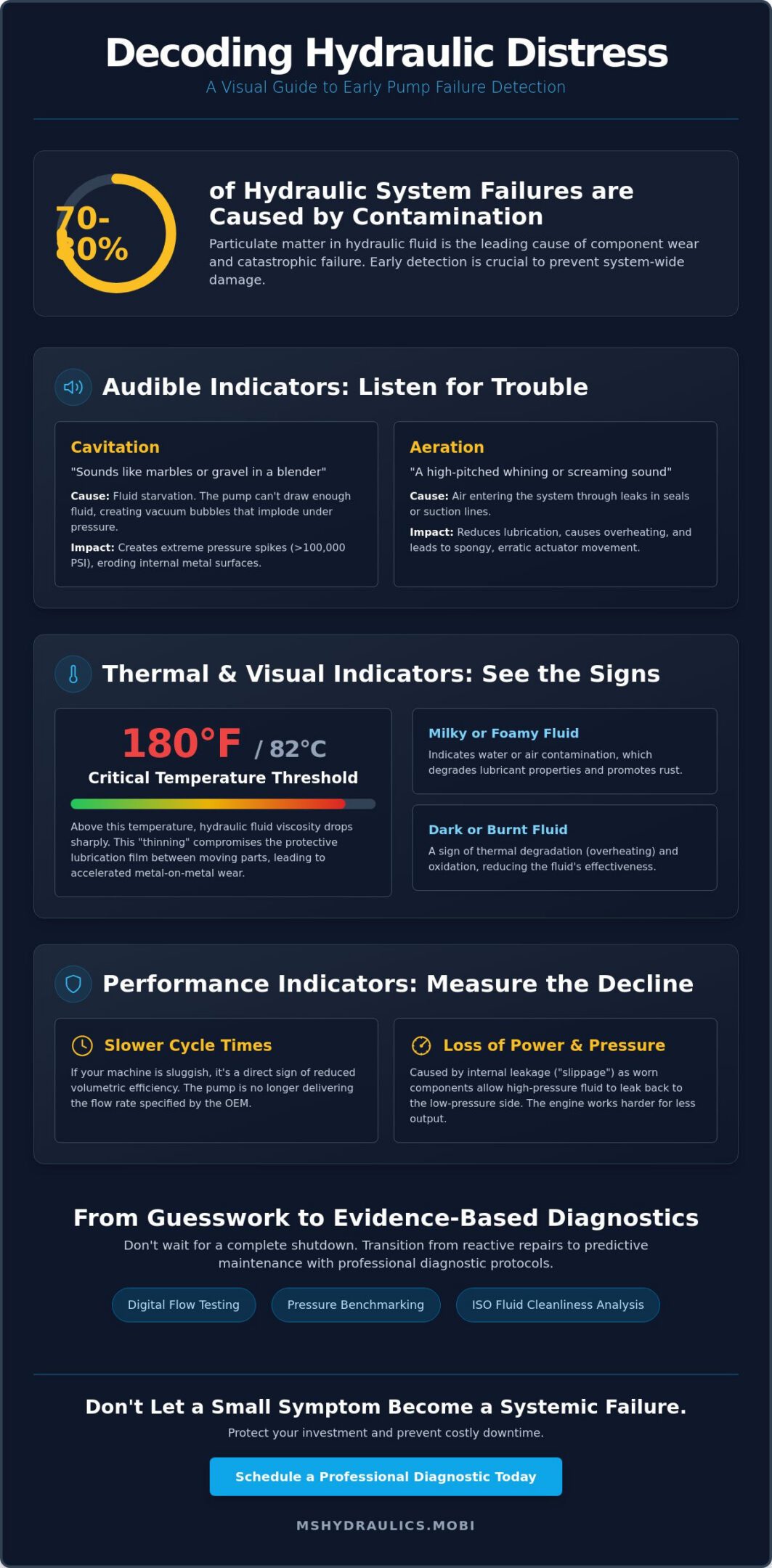
Did you know that particulate contamination accounts for approximately 70% to 80% of all hydraulic system failures? In the demanding environments of North Texas, where ambient heat and airborne dust are constant variables, these statistics translate into significant financial risks for heavy equipment operators. Identifying the early signs of hydraulic pump failure is the only way to prevent a minor component wear issue from escalating into a total system collapse. You’re likely already concerned about that unusual whining sound or a slight drop in cycle times. These aren’t just nuisances; they’re measurable indicators of mechanical decline.
We understand that the decision to pull a machine from service for a hydraulic cylinder rebuild or pump repair involves a difficult cost-benefit analysis. This guide provides the technical framework you need to move from guesswork to evidence-based diagnostics. You’ll learn to interpret specific audible, thermal, and performance-based indicators that signal internal component fatigue. We’ll also examine how the new ISO 18464 efficiency standards and 2026 Texas Railroad Commission regulations regarding fluid waste impact your maintenance protocols. By the end of this article, you’ll have clear criteria for calling a technician and a strategy for minimizing secondary damage to your valves and cylinders.
Key Takeaways
- Distinguish between the metallic grinding of cavitation and the high-pitched whining of aeration to pinpoint the specific root cause of component stress.
- Identify why 180°F represents a critical threshold for hydraulic fluid integrity and how heat-induced thinning accelerates internal mechanical wear.
- Master the technical signs of hydraulic pump failure by benchmarking current cycle times against OEM specifications to quantify internal leakage.
- Establish professional diagnostic protocols, including digital flow testing and pressure benchmarking, to transition from reactive maintenance to predictive repair.
- Apply a technical cost-benefit analysis to determine whether to proceed with a hydraulic pump repair or a full component replacement.
Understanding the Mechanics of Hydraulic Pump Failure in Heavy Equipment
A hydraulic pump is the primary power source for any heavy machinery circuit, converting mechanical energy from an engine or motor into fluid flow. While it’s often described as the heart of the system, its technical role is to generate flow against the resistance of the load. When an operator fails to recognize the early signs of hydraulic pump failure, the consequences extend far beyond a single component. A pump that begins to disintegrate internally acts as a source of particulate contamination, sending metal fragments through valves and actuators. This leads to a systemic failure that is significantly more expensive to remediate than a proactive pump repair.
Efficiency loss in a hydraulic circuit is rarely instantaneous. It manifests as a gradual decline in volumetric efficiency, where the pump can no longer maintain the required flow at high pressures. This decline directly impacts operational costs. As efficiency drops, the engine must work harder to achieve the same work output, leading to increased fuel consumption and sluggish cycle times. Monitoring these performance metrics is the first step in a professional diagnostic protocol.
The Transition from Mechanical to Fluid Energy
Pumps rely on extremely tight internal tolerances to move fluid effectively. As these clearances widen due to wear, a phenomenon known as “slippage” occurs. Slippage is the internal leakage of fluid from the high-pressure outlet back to the low-pressure inlet. This doesn’t just reduce flow; it generates heat. When slippage reaches a critical point, the pump can no longer meet the flow demands of the system, resulting in stalled actuators under heavy loads. Understanding this physics-based decline is vital for determining the exact point where a pump can no longer perform its primary function.
Root Causes of Premature Failure in North Texas
In North Texas, environmental factors accelerate mechanical decline. Cleburne and Fort Worth job sites often present high levels of airborne dust and silica. If filtration systems aren’t maintained to modern standards, such as an ISO 4406 cleanliness code of 18/16/13, these particulates enter the fluid and act as an abrasive, grinding down internal pump surfaces. Additionally, extreme Texas heat can cause fluid temperature to exceed 180°F, causing viscosity to drop below recommended levels. This thinning of the fluid compromises the lubrication film between moving parts, leading to metal-on-metal contact. Finally, improper relief valve settings can cause system over-pressurization, which stresses pump seals and bearings beyond their engineering limits.
Audible Indicators: Differentiating Between Cavitation and Aeration
Acoustic signatures provide the most immediate data for field diagnostics. While performance loss might be subtle, a change in the pump’s sonic profile is a clear warning. Operators must learn to distinguish between two distinct sounds that represent the primary signs of hydraulic pump failure: cavitation and aeration. Each has a unique mechanical cause and requires a specific corrective action. Using a technician’s stethoscope or even a simple metal rod against the pump housing can help isolate where these sounds originate. This ensures you address the root cause rather than just the symptoms.
Cavitation: The Silent Component Killer
Cavitation occurs when the pump cannot pull enough fluid from the reservoir to fill its internal chambers. This creates a vacuum that causes vapor bubbles to form within the oil. As these bubbles move into the high-pressure side of the pump, they implode with violent force. The sound is unmistakable; it resembles a handful of marbles being rattled in a heavy metal blender. These implosions generate localized pressure spikes that can exceed 100,000 PSI, literally sandblasting metal from the pump’s internal surfaces. To prevent this, check for restricted suction lines or inlet filters that have become clogged with debris.
Aeration: Air Contamination in the Circuit
Aeration is often confused with cavitation, but the root cause is air entering the system rather than a lack of fluid. This produces a steady, high-pitched whining or “screaming” sound that intensifies under load. Identifying these sounds is critical because they are the most reliable audible signs of hydraulic pump failure in high-pressure mobile systems. Air typically enters through damaged shaft seals, loose hose fittings on the suction side, or low reservoir levels that allow a vortex to form. Beyond the noise, aerated fluid becomes compressible. This leads to “spongy” control responses and erratic actuator movement. You can verify aeration by checking the reservoir; if the fluid appears foamy or milky, air is present in the circuit.
Scientific research into predictive maintenance for hydraulic pumps confirms that these acoustic anomalies precede total mechanical failure. If you detect these sounds on your job site, scheduling on-site diagnostic services can identify the air entry point or suction restriction before the pump sustains irreparable internal damage.
Thermal and Visual Signs: Fluid Degradation and Overheating
Excessive operating temperature is one of the most quantifiable signs of hydraulic pump failure. While hydraulic systems naturally generate heat during energy conversion, a sudden or sustained spike in fluid temperature indicates a loss of volumetric efficiency. Technical specifications generally identify 180°F as the critical threshold for most standard hydraulic fluids. Beyond this temperature, the fluid’s chemical structure begins to degrade through oxidation, leading to the formation of sludge and varnish. This degradation doesn’t just damage the pump; it compromises the entire circuit’s reliability by coating valve spools and clogging fine-tolerance orifices.
High temperatures also cause fluid thinning, or a reduction in viscosity. When fluid becomes too thin, the lubricating film required to separate moving metal parts within the pump dissipates. This leads to increased friction, which generates even more heat in a destructive feedback loop. Operators should perform regular visual checks of the fluid’s condition. Milky fluid typically indicates water contamination or severe aeration, while dark, opaque fluid with a distinct burnt odor suggests advanced thermal oxidation. Implementing rigorous condition monitoring of hydraulic pumps allows for the detection of these thermal anomalies before they result in a seized rotating group.
The Texas Heat Factor in Pump Failure
In North Texas, equipment cooling systems face unique challenges. During Cleburne’s summer months, ambient temperatures often exceed 100°F, significantly narrowing the temperature differential that hydraulic heat exchangers rely on to shed heat. If a machine’s cooling fins are clogged with local dust or the fan drive is underperforming, the pump will operate at a baseline temperature that is already near the danger zone. Selecting a high-viscosity index (VI) fluid is essential for these industrial operations, as it maintains a more stable lubricating film across the wide temperature swings typical of the region. Without adequate cooling and proper fluid selection, the pump’s internal seals will harden and fail prematurely.
Visual Inspection of Components
Physical evidence on the pump housing itself can confirm internal distress. Scorched or blistered paint on the pump’s exterior is a clear indicator that the unit has experienced a significant over-temperature event. Additionally, operators should monitor for “weeping” seals around the shaft or housing joints. While a small external leak might seem minor, it can lead to internal pump starvation or allow air to be drawn into the suction side, accelerating the failure modes discussed in previous sections. Identifying these external leaks often requires professional On-Site Diagnostic Services to determine if the leak is a simple seal failure or a symptom of excessive internal case pressure caused by pump wear.
Operational Performance Drops: Slow Cycles and Pressure Loss
Operational sluggishness is often the first quantifiable metric an operator observes when a system begins to degrade. While audible and thermal anomalies provide immediate warnings, a decline in cycle times offers a direct measurement of a pump’s volumetric efficiency. When a machine no longer meets its factory-rated performance, it’s essential to investigate the signs of hydraulic pump failure through standardized testing. If a boom lift or bucket curl that typically takes six seconds now requires nine, the system is experiencing a significant increase in cycle duration, which indicates internal bypass.
This loss of speed is directly related to internal leakage, or slippage. As the internal components of the pump wear down, the precision tolerances required to move fluid against high pressure are compromised. Instead of the fluid being directed to the actuators, a portion of the flow escapes through widened clearances and returns to the pump’s inlet or case drain. This doesn’t just slow down the machine; it creates a cascade of damage. Metal particulates shed during this wear process are carried downstream, often leading to the need for a Heavy Equipment Cylinder Rebuild Texas as the debris scores cylinder walls and destroys sensitive seals.
Pressure vs. Flow: Diagnosing the Decline
A common diagnostic error is assuming a pump is healthy simply because it can reach its maximum relief pressure. A worn pump may still achieve 3,000 PSI at a “dead head” position, but it’ll fail to maintain the necessary flow rate (GPM) while the actuators are in motion. This distinction between static pressure and dynamic flow is critical. Worn gears, vanes, or piston slippers allow fluid to take the path of least resistance internally. You might notice the machine “stuttering” or hesitating under heavy loads, which suggests the pump can no longer provide the steady, laminar flow required for precise control.
Total System Sluggishness
To isolate a failing pump from a faulty valve, technicians look for systemic performance drops. If every hydraulic function on the machine is slow, the issue is almost certainly the pump. Conversely, if only one circuit is sluggish, the problem likely lies within a specific control valve or actuator. Tracking these performance metrics in a daily log allows fleet managers to identify the “slow death” of a pump before it results in a catastrophic failure. If your equipment is struggling to maintain its rated cycle times, scheduling Mobile Hydraulic Repair can prevent the total contamination of your hydraulic circuit.
Professional Diagnostic Protocols and Mobile Repair Solutions
When the visual, thermal, and audible signs of hydraulic pump failure are present, the next stage of technical intervention involves quantitative verification. Guesswork in a high-pressure environment leads to unnecessary component replacement and extended downtime. Professional diagnostics rely on digital flow testing and pressure benchmarking to determine the exact state of the pump’s volumetric efficiency. By measuring the flow rate (GPM) at various pressure intervals, technicians can pinpoint the level of internal bypass. This data-driven approach ensures that the repair strategy addresses the root cause of the decline rather than just the symptoms observed during operation.
The technical cost-benefit analysis between repair and replacement depends on the extent of internal damage. If the pump housing remains within OEM tolerances and the rotating group sustains only minor wear, a professional rebuild is often the most efficient path. However, if the failure involves catastrophic metal shedding or significant scoring of the valve plate and housing, a full unit replacement is required to maintain system integrity. For those needing to source high-quality replacement components, you can check out GSM Internacional. Regardless of the chosen path, post-repair protocols must include a comprehensive system flush. Failure to remove the debris generated by the failing pump will lead to the premature failure of new components through particulate migration.
On-Site Diagnostic Testing Under Load
Bench testing a pump in a controlled shop environment doesn’t always reveal the failures that occur under the unique stresses of a job site. Environmental variables, such as the ambient heat in North Texas, can influence how a pump performs when it reaches its full operating temperature. On-site diagnostics allow for testing the pump while it’s integrated into the machine’s specific circuit, providing a more accurate assessment of how it handles dynamic loads. Using high-precision flow meters and pressure transducers, technicians can verify pump health without the need for extensive machine disassembly, preventing the “parts changing” mentality that inflates maintenance budgets.
Partnering with Ms. Hydraulics LLC for Fleet Reliability
Maintaining a fleet in Cleburne, Alvarado, or the broader DFW Metroplex requires a partner who understands the local environmental stressors. Developing a custom maintenance plan with Ms. Hydraulics LLC that includes regular fluid analysis and pressure benchmarking allows operators to catch the early signs of hydraulic pump failure before they result in a total system lockout. When a failure does occur, utilizing mobile hydraulic repair Cleburne TX provides the fastest route to recovery. This service brings expert diagnostic equipment and repair capabilities directly to the equipment, minimizing transport costs and getting your machinery back into the production cycle with verified performance and long-term reliability.
Securing System Integrity Through Technical Vigilance
Maintaining the operational reliability of heavy machinery requires a disciplined approach to diagnostic monitoring. Identifying the early signs of hydraulic pump failure, such as acoustic anomalies and thermal spikes, allows operators to mitigate the risk of systemic contamination. It’s no longer sufficient to rely on reactive maintenance. Modern industrial standards demand precise performance benchmarking and regular fluid analysis to ensure that internal slippage doesn’t compromise your machine’s volumetric efficiency under the extreme conditions of the North Texas climate.
Ms. Hydraulics LLC has provided the region with industrial-grade precision since 2021. Our expert technicians focus on rigorous root cause analysis to ensure that a single component failure doesn’t become a recurring operational deficit. We provide specialized on-site diagnostics for excavators, skid steers, and drill rigs to minimize downtime and verify system health under actual load conditions. Contact Ms. Hydraulics LLC for Expert Mobile Pump Diagnostics in Cleburne to secure your fleet’s performance. Proactive technical intervention is the most effective strategy for ensuring the longevity and efficiency of your hydraulic assets.
Frequently Asked Questions
What are the first audible signs of hydraulic pump failure?
The first audible indicators are typically cavitation and aeration. Cavitation produces a rattling sound similar to marbles in a blender, caused by vapor bubbles imploding at high pressure. Aeration results in a high-pitched, steady whining or screaming sound that intensifies under load. Both acoustic signatures indicate the pump’s internal tolerances are under severe mechanical stress, requiring immediate diagnostic attention to prevent a total system collapse.
Can a hydraulic pump fail without leaking oil externally?
Yes, a pump can suffer a complete mechanical failure without ever showing an external oil leak. This occurs through internal leakage, also known as slippage, where fluid bypasses internal seals and tolerances from the high-pressure side back to the low-pressure side. You’ll notice a drop in volumetric efficiency and increased fluid temperature rather than a visible puddle on the ground.
How does cavitation damage the internal components of a pump?
Cavitation causes damage through the rapid formation and violent implosion of vapor bubbles within the hydraulic fluid. These implosions generate localized pressure spikes that can exceed 100,000 PSI. This force is strong enough to blast small fragments of metal off the internal surfaces of the pump, leading to rapid erosion and systemic particulate contamination that destroys downstream valves and cylinders.
Why is my hydraulic system running slower as the day gets hotter?
Heat causes hydraulic fluid to lose its viscosity, leading to thinning that compromises the lubricating film. In North Texas, ambient temperatures often exceed 100°F, which makes it harder for heat exchangers to cool the system effectively. As the fluid thins, internal slippage increases, which are common signs of hydraulic pump failure. This results in slower cycle times and erratic actuator performance.
Is it better to rebuild or replace a failing hydraulic pump?
The decision depends on a technical cost-benefit analysis of the internal components. If the pump housing is within OEM specifications and only the rotating group is worn, a rebuild is a cost-effective solution. However, if there’s significant scoring or metal shedding, a full replacement is necessary. Rebuilding a catastrophically damaged pump often leads to repeat failures due to compromised housing integrity and internal clearances.
What should I do if I find metal shavings in my hydraulic filter?
Finding metal shavings in a filter requires an immediate system shutdown to prevent further contamination. These shavings are definitive signs of hydraulic pump failure or advanced cylinder wear. You must perform a full system flush and replace the damaged components. Continuing to operate the machine will allow metal particulates to migrate into sensitive valve spools, exponentially increasing the final repair cost.
How often should I perform a flow test on my heavy equipment?
You should perform a digital flow test every 1,000 operating hours or whenever you observe a 10% or greater increase in cycle times. Benchmarking current performance against OEM specifications allows you to track the gradual decline of volumetric efficiency. Regular testing is a core part of predictive maintenance, helping you schedule repairs before a catastrophic failure occurs on the job site.
Can air in the hydraulic lines cause the pump to fail?
Air in the hydraulic lines, or aeration, is a primary cause of pump failure because air is compressible and doesn’t provide adequate lubrication. When air bubbles pass through the pump, they cause localized overheating and metal-on-metal contact between internal components. This leads to the same type of surface erosion seen in cavitation, eventually destroying the pump’s ability to maintain pressure and flow.