Dump Truck Hydraulic Service in Mansfield: Technical Guide to Mobile Repair
In the high-velocity aggregate sectors of North Texas, the true cost of a hydraulic failure is measured in lost revenue cycles rather than simple repair invoices. You’re likely aware that towing a commercial vehicle with a Gross Vehicle Weight Rating over 10,001 pounds is a logistical burden that compounds your downtime. Securing a reliable dump truck hydraulic service Mansfield is essential for maintaining project timelines and avoiding the contamination risks inherent to dusty Texas job sites.
Our objective is to provide a professional engineering perspective on mobile hydraulic restoration to help you minimize idle equipment time. You’ll learn the technical requirements for certified on-site repairs, ranging from hose fabrication to complex valve diagnostics. This guide details the rigorous standards and mechanical parameters necessary to ensure your fleet achieves long-term system reliability without the need for costly off-site transport. By focusing on precision diagnostics and mobile intervention, you can maintain the operational efficiency required to meet strict industry standards and maximize your equipment’s service life.
Key Takeaways
- Understand how on-site diagnostic services eliminate the logistical overhead and revenue loss associated with towing heavy-duty equipment to a repair facility.
- Identify the critical mechanical differences between single-stage and telescopic hoist cylinders to ensure precise component restoration.
- Discover how professional dump truck hydraulic service Mansfield addresses the specific high-pressure demands placed on systems by the local construction boom.
- Learn to diagnose common hydraulic failures, such as pump wear and valve sticking, before they result in catastrophic equipment downtime.
- Evaluate the engineering advantages of mobile hydraulic repair units that utilize specialized technical expertise to restore system integrity on-site.
Critical Dump Truck Hydraulic Challenges in Mansfield, TX
Professional dump truck hydraulic service Mansfield entails the systematic diagnostic and mechanical restoration of high-pressure hoist systems. As Mansfield continues its trajectory of rapid infrastructure expansion, the operational demand on heavy equipment has reached unprecedented levels. This construction boom forces dump trucks into continuous duty cycles, where hydraulic components must perform under constant load without the benefit of cooling intervals. These rigorous conditions accelerate wear on pumps, valves, and seals, requiring a disciplined approach to maintenance and repair to prevent total system failure.
Environmental stressors in North Texas play a decisive role in component degradation. High ambient temperatures and pervasive particulates create a hostile environment for Hydraulic Machinery Principles to operate effectively. When the mechanical parameters of a system are pushed beyond their design limits by external factors, the risk of catastrophic failure increases. This is particularly evident in Mansfield, where the combination of heavy clay soils and limestone dust creates a unique profile of abrasive contaminants that challenge standard filtration systems. Understanding these challenges is the first step in implementing a robust mobile repair strategy.
Thermal Degradation in Texas Summer Operations
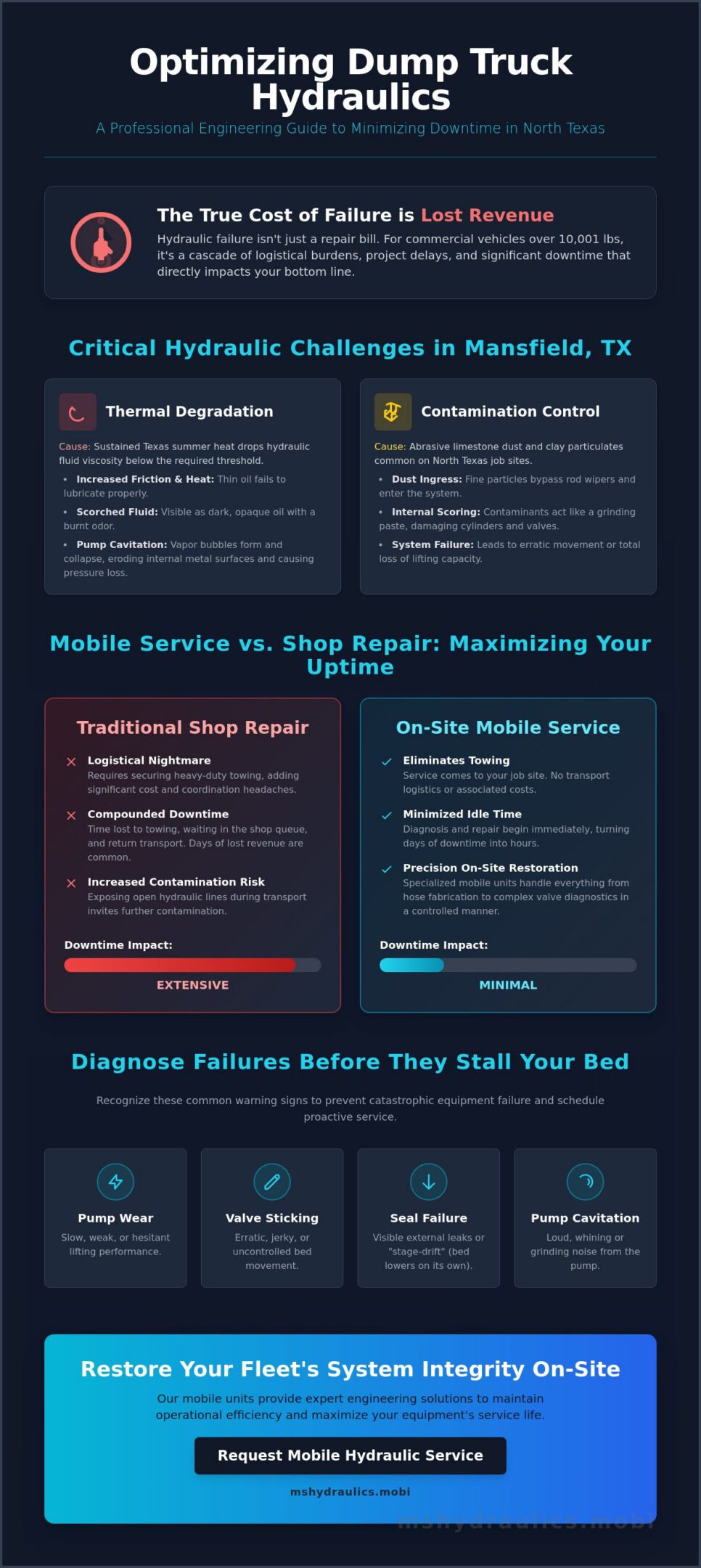
Standard hydraulic fluids are engineered to operate within specific temperature ranges. In the sustained heat of a Texas summer, fluid viscosity often drops below the minimum threshold required for adequate lubrication. This thinning of the oil leads to increased friction and heat generation, which can eventually cause scorched fluid. You’ll recognize this by a distinct burnt odor or a darkened, opaque appearance in the reservoir. Without functional oil coolers to dissipate this thermal energy, the system becomes susceptible to pump cavitation. This occurs when vapor bubbles form and collapse within the fluid, causing physical erosion of internal metal surfaces and significant loss of pressure.
Contamination Control on Mansfield Job Sites
Dust ingress remains the primary cause of seal failure across Johnson County aggregate sites. Fine particulates are abrasive and can bypass standard rod wipers during the retraction phase of the hoist cylinder. Once these contaminants enter the system, they act as a grinding paste, leading to internal cylinder scoring and valve spool wear. Maintaining micron-level filtration is the only effective defense against this mechanical degradation. A failure to manage contamination often results in erratic bed movement or a total loss of lifting capacity. Precise dump truck hydraulic service Mansfield focuses on restoring these seals and flushing the system to ensure long-term operational stability on the job site.
Technical Components of Dump Truck Hydraulic Systems
Every dump truck hydraulic system is a closed-loop circuit designed to convert mechanical energy into high-pressure fluid power. The core of this operation begins with the Power Take-Off (PTO) unit. This component serves as the critical interface between the truck’s transmission and the hydraulic pump. While gear pumps are frequently selected for their durability in heavy aggregate hauling, piston pumps are becoming more prevalent where variable flow and higher efficiency are required. Precision control valves then manage the fluid distribution, ensuring the bed’s descent is controlled and the hold position remains stable under heavy loads.
Technical dump truck hydraulic service Mansfield ensures these individual components operate in synchronization. When one parameter deviates, such as a pump losing volumetric efficiency, the entire hoist cycle is compromised. Regular assessment of these mechanical interfaces is essential for preventing the system-wide failures discussed in the previous section. Maintaining the integrity of the PTO and pump connection prevents mechanical stripping that can lead to total power loss during a critical lift.
Telescopic Cylinder Mechanics and Failure Points
Multi-stage telescopic cylinders provide the necessary stroke length within a compact retracted footprint. However, this complexity introduces specific failure modes, such as stage-drift. This occurs when internal seals fail or fluid bypasses the piston, causing the bed to lower unintentionally. Restoring these units requires more than just seal replacement. It demands the engineering necessity of proper rod polishing to remove microscopic abrasions that would otherwise compromise new seals. For a deeper look at these technical requirements, see our guide on heavy equipment cylinder rebuild Texas.
Wet Kit Integration and Hose Routing
Wet kits integrate the hydraulic tank, pump, and lines into the chassis. Hose routing is a critical engineering factor often overlooked during field repairs. Proper hose bend radii must be maintained to prevent internal wire reinforcement fatigue. We identify ‘burst-ready’ hoses by looking for cover abrasion, fitting corrosion, or localized swelling that indicates a breach in the inner liner. Selecting fittings that can withstand high-vibration dump operations is equally vital. If you suspect a hose or fitting is nearing its fatigue limit, our technicians provide mobile hydraulic repair to secure your system before a high-pressure failure occurs. Using heavy-duty fittings with high-pressure ratings ensures the system remains leak-free even during the extreme vibrations of off-road job sites.
Mobile Service vs. Shop Repair: Maximizing Uptime for Mansfield Fleets
Choosing between a mobile intervention and a traditional shop environment is a strategic decision that directly impacts fleet availability. For operators in North Texas, the logistical burden of transporting a non-functional dump truck is substantial. Given the 80,000-pound maximum weight limit for commercial vehicles on Texas interstate roadways, a specialized heavy-duty wrecker is required for transport. This adds an immediate financial layer to the repair before a single diagnostic is performed. In contrast, a mobile dump truck hydraulic service Mansfield eliminates these transit costs and the associated risk of secondary damage during the towing process.
Shop environments often suffer from scheduling backlogs that can keep equipment idle for days or weeks. Mobile units prioritize immediate response, bringing a fully equipped technical environment directly to the job site. This approach allows for simultaneous repair and operational oversight, ensuring the vehicle returns to service as soon as the mechanical parameters are restored. By bypassing the shop queue, fleet managers can significantly reduce revenue loss from idle equipment.
The Logistics of On-Site Hydraulic Hose Fabrication
Effective field repair requires the same precision as a controlled shop setting. Carrying a mobile crimper is essential for ensuring that new hose assemblies meet exact OEM specifications for pressure and flow. Technicians must match the wire reinforcement and fitting metallurgy to the specific demands of high-pressure hoist systems. Precise execution also involves strict contamination control; by fabricating and installing hoses on-site, we minimize the time the hydraulic circuit is exposed to the airborne particulates common in Mansfield aggregate sites. This immediate restoration prevents the system from remaining open to the environment, which is a critical factor in long-term reliability.
Reducing Downtime with On-Site Diagnostics
Pinpointing the root cause of an intermittent failure is often more effective when the system is observed under real-world load conditions. Mobile units utilize high-precision flow meters and pressure gauges to differentiate between pump wear and control valve bypass. For more complex issues, our On-Site Diagnostic Services provide a data-driven approach to troubleshooting. Testing a hoist cylinder while it is supporting a full load of aggregate provides insights that bench testing simply cannot replicate. This technical accuracy ensures the correct component is serviced the first time, preventing unnecessary expenditure and extended downtime.
Diagnosing Common Hydraulic Failures Before They Stall Your Bed
Early detection of mechanical deviations is the most effective method for preventing catastrophic system failure. When an operator notices a slow hoist response, it often indicates a loss in volumetric efficiency within the pump or a filter bypass condition where the system struggles to maintain flow. Professional dump truck hydraulic service Mansfield provides the technical oversight needed to distinguish between these two conditions through precise pressure testing. Identifying these issues before they result in a complete stall ensures that repairs remain targeted and cost-effective. Delaying intervention only increases the risk of damaging auxiliary components like the PTO or control valves.
Erratic bed movement or “shuddering” during the lift cycle typically points to air entrainment in the hydraulic circuit or a sticking control valve spool. While air in the system can sometimes be bled out, a sticking valve often suggests internal contamination or mechanical wear that requires professional intervention. It’s also vital to distinguish between minor weepage at a fitting and a critical hose failure. While weepage might seem negligible, it’s frequently the precursor to a high-pressure burst. Unusual noises, such as a high-pitched whine or metallic grinding, often signal cavitation or a mechanical failure within the PTO gear assembly that requires immediate attention.
Hydraulic Pump Cavitation: Causes and Prevention
Cavitation is the formation and collapse of vapor bubbles due to low pressure. This physical phenomenon is highly destructive to pump gears and internal housings, as the collapsing bubbles create localized shockwaves that erode metal surfaces over time. Low fluid levels in the reservoir or clogged intake screens are the primary culprits for this condition. If you detect a sharp, rattling noise during operation, it’s essential to verify fluid levels and screen integrity immediately to prevent total pump destruction. Maintaining a clean intake path is the simplest way to avoid this expensive repair.
Cylinder Stage Drift and Internal Bypassing
Cylinder stage drift occurs when the dump bed fails to hold its position, slowly descending even when the control valve is in the neutral or hold position. To test for internal bypassing, a technician can monitor the temperature of the cylinder barrel or utilize a flow meter to check for fluid movement across the piston seals. The holding valve also plays a critical role in maintaining bed position; if this valve is compromised, the bed will lose stability regardless of seal integrity. While a seal kit is often sufficient for minor leaks, a full rod rebuild is required if the rod surface is scored or out of round. For immediate technical assistance with these diagnostic challenges, you can request our mobile hydraulic repair services to restore your equipment’s performance on-site.
Professional Mobile Hydraulic Solutions by Ms. Hydraulics LLC
Ms. Hydraulics LLC operates a fleet of mobile repair units engineered to function as self-contained technical environments. These units are strategically deployed to provide dump truck hydraulic service Mansfield, ensuring that aggregate and construction fleets in Johnson County maintain peak operational status. Our methodology is rooted in engineering-led restoration, prioritizing the mechanical integrity of high-pressure systems over temporary fixes. This commitment to technical excellence allows us to serve as a reliable partner for industrial players who require predictable performance from their heavy equipment. We provide a full range of mobile hydraulic repair Cleburne TX and the surrounding areas, focusing on precision diagnostics and component longevity.
By integrating advanced diagnostic tools directly into our field service, we ensure that every mechanical intervention is backed by quantitative data rather than estimation. Our technicians are trained to evaluate the entire hydraulic circuit, from the PTO interface to the hoist cylinder, to identify the root cause of failure. This holistic approach prevents the recurring issues often associated with surface-level repairs. Our units are equipped to handle complex field restorations, allowing your fleet to return to service without the logistical delays of shop-based scheduling.
Specialized Hose Fabrication and Cylinder Expertise
On-site hose fabrication is performed using calibrated crimping equipment to match OEM pressure and flow parameters exactly. This technical precision is vital for dump truck hydraulic service Mansfield, where high-pressure hoist cycles test the limits of standard components. Our approach to cylinder restoration involves methodical disassembly and a thorough inspection of the barrel and rod surfaces. We apply high-grade sealing solutions and verify every repair against industrial performance parameters. This ensures the system remains leak-free and maintains full lifting capacity even under maximum load conditions in the field.
Partnering for Long-Term Fleet Reliability
Custom maintenance plans are developed to address the specific duty cycles of Mansfield-based fleets. While individual results vary based on equipment age and usage, industry data suggests that disciplined preventative maintenance can reduce emergency repair expenditures by up to 30%. Fluid analysis serves as a core part of this predictive strategy. By monitoring the presence of microscopic metal particulates, we detect pump or valve degradation before a catastrophic failure occurs. This data-driven oversight helps fleet managers extend the service life of their equipment and stabilize operational costs. Contact us today to schedule a technical consultation and optimize your dump truck fleet’s performance.
Securing Operational Continuity through Technical Precision
Maintaining the mechanical integrity of a heavy-duty hoist system requires a disciplined approach to both diagnostics and repair. We’ve established that on-site intervention effectively addresses the environmental stressors of North Texas while eliminating the logistical complexities of transporting heavy equipment. By utilizing expert on-site diagnostics and custom hose fabrication in the field, you can ensure your fleet adheres to the rigorous performance parameters required for aggregate hauling. These mobile strategies provide the accuracy needed to restore system pressure and flow without the revenue loss associated with traditional shop backlogs.
A specialized focus on cylinder rebuild expertise and system-wide contamination control allows for the restoration of hydraulic circuits directly at the job site. Implementing these technical solutions is the most efficient way to secure a professional dump truck hydraulic service Mansfield. We invite you to Request Mobile Dump Truck Hydraulic Service in Mansfield to optimize your equipment’s reliability and minimize operational downtime. Taking proactive steps today ensures your fleet remains productive and compliant with all industrial standards.
Frequently Asked Questions
How do I know if my dump truck’s hydraulic pump is failing?
A failing hydraulic pump typically manifests through a significant reduction in hoist speed and increased mechanical noise. High-pitched whining often indicates cavitation, while a metallic grinding sound suggests internal gear or bearing failure. If the pump housing becomes excessively hot to the touch, it indicates internal friction and a loss of volumetric efficiency that requires immediate technical attention.
Can you repair a leaking telescopic hoist cylinder on-site in Mansfield?
Yes, specialized mobile units perform on-site resealing and mechanical inspection of telescopic hoist cylinders. Technical teams utilize portable equipment to disassemble multi-stage cylinders directly on the chassis. This process includes rod inspection and seal replacement, allowing for a professional dump truck hydraulic service Mansfield without the need for off-site transport or expensive towing fees.
What is the most common cause of hydraulic hose failure on dump trucks?
External abrasion and mechanical fatigue are the primary causes of hose failure in dump applications. Constant vibration during off-road transport and improper bend radii lead to the degradation of the wire reinforcement. Over time, these stressors cause the hose to burst under high-pressure hoist cycles, necessitating immediate field replacement to prevent environmental contamination and fluid loss.
Is it possible to fabricate custom hydraulic hoses at my job site?
Custom hydraulic hose fabrication is a standard capability of our mobile repair units. We carry a comprehensive inventory of high-pressure hoses and fittings, along with calibrated field crimpers. This allows us to manufacture new assemblies to exact OEM specifications at your job site, ensuring a precise fit and immediate system restoration without the delay of visiting a shop.
Why is my dump truck bed lowering slowly or drifting down?
A drifting dump bed is usually caused by internal fluid bypassing the piston seals or a failure in the system’s holding valve. When seals are compromised, high-pressure fluid leaks into the low-pressure side of the cylinder, causing a gradual descent. A faulty control valve can also fail to maintain the “hold” position, resulting in unsafe bed movement during loading or unloading cycles.
Does the Texas heat affect my dump truck’s hydraulic system?
Sustained high temperatures in North Texas directly impact hydraulic fluid viscosity, causing it to thin and lose its lubricating properties. This thermal stress accelerates the wear of internal components and can cause rubber seals to become brittle. Maintaining proper oil cooling and monitoring fluid condition is essential for preventing heat-related system failure during the extreme summer months in Mansfield.
What are the signs of hydraulic fluid contamination?
Signs of contamination include a milky or cloudy appearance, which indicates water entrainment, or a darkened, gritty texture suggesting particulate ingress. You might also notice increased component wear or erratic valve operation. Regular fluid analysis is the most accurate method for detecting microscopic contaminants that aren’t visible to the naked eye before they cause internal scoring.
How often should I perform preventative maintenance on my truck’s wet kit?
Preventative maintenance for a truck’s wet kit should generally be performed every 500 operational hours or on a quarterly basis. This schedule should be adjusted based on the severity of the duty cycle and environmental conditions at the job site. Regular inspections of the PTO, pump, and filtration system are critical for ensuring long-term reliability and preventing unexpected downtime in your dump truck hydraulic service Mansfield.