Emergency Hydraulic Service Dallas: Rapid Mobile Response for Industrial Machinery (2026)
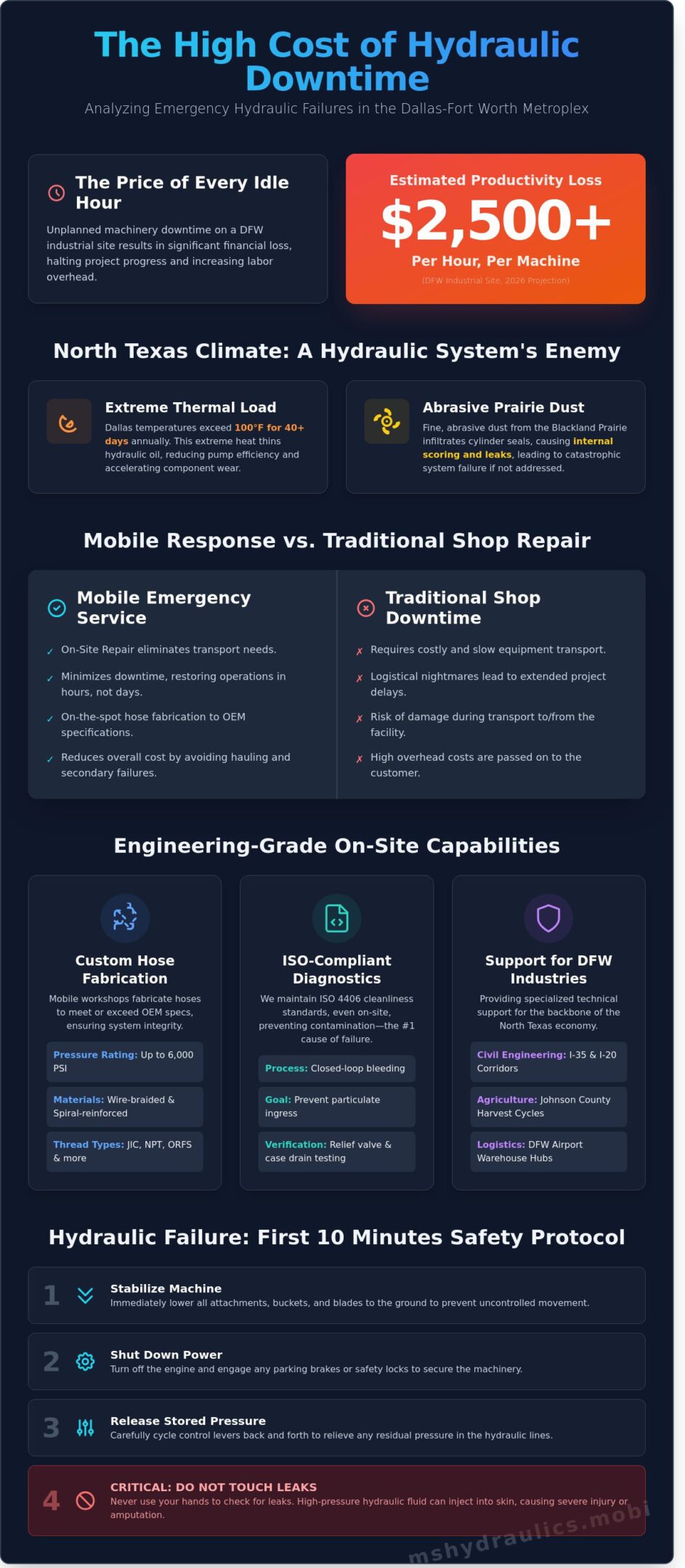
A single hour of idle time on a Dallas-Fort Worth industrial site in 2026 can result in a loss of over $2,500 in operational productivity. When a high-pressure line bursts or a cylinder fails, the logistical nightmare of transporting heavy equipment to a repair facility often costs more than the technical fix itself. You need an emergency hydraulic service Dallas that understands that every minute your machinery lacks hydraulic flow, your project timeline slips further into the red. Low-quality, “quick-fix” hoses only compound these issues, leading to secondary component failures and dangerous pressure drops.
Securing a rapid mobile response ensures your fleet returns to precise displacement and torque specifications without leaving the job site. Our engineering-led approach prioritizes technical accuracy over temporary patches. By reading this analysis, you’ll learn how mobile units utilize on-site hose fabrication and ISO-compliant diagnostics to restore system integrity immediately. We’ll examine the critical role of field technicians in maintaining 2026 production schedules through expert on-site intervention and high-pressure component validation.
Key Takeaways
- Quantify the economic impact of machinery downtime and identify how the North Texas climate accelerates hydraulic component failure.
- Master technical protocols for on-site component diagnostics and custom hose fabrication to ensure rapid restoration of system pressure.
- Evaluate the logistical and financial advantages of mobile field repairs compared to the high costs of hauling heavy equipment to a centralized shop.
- Learn how to secure an authoritative emergency hydraulic service Dallas to minimize critical downtime through disciplined, mobile response units.
- Establish immediate safety procedures for operators to prevent high-pressure injection injuries and stabilize machinery during the first ten minutes of a failure.
Navigating Hydraulic Emergencies in the Dallas-Fort Worth Metroplex
Industrial operations across the Dallas-Fort Worth Metroplex operate on tight schedules where equipment availability dictates project profitability. When a Tier 1 excavator or a high-output CNC press fails, the financial repercussions are immediate. Industry data indicates that unplanned downtime for heavy machinery can cost DFW contractors between $1,500 and $4,500 per hour in lost productivity and labor overhead. Securing a reliable emergency hydraulic service Dallas provider is not merely about a quick fix; it’s a strategic necessity for asset preservation. Rapid response prevents minor component wear from escalating into catastrophic system failure.
The North Texas environment presents specific challenges for Hydraulic machinery principles and their practical application. Average summer temperatures in Dallas frequently exceed 100 degrees Fahrenheit for more than 40 days annually. This extreme thermal load reduces the volumetric efficiency of pumps by thinning hydraulic oil beyond its specified viscosity index. Furthermore, the abrasive dust characteristic of the North Texas Blackland Prairie infiltrates cylinder seals, causing internal scoring. Immediate technical intervention is vital to maintain pump and motor integrity. Our mobile units provide comprehensive technical coverage across the region, extending from the urban centers of Dallas and Fort Worth to the industrial corridors of Mansfield and Waxahachie.
Critical Industries Served in North Texas
Civil engineering firms managing large-scale infrastructure projects on the I-35 and I-20 corridors require 100% equipment uptime to meet strict municipal deadlines. In Johnson County, agricultural machinery demands high-torque performance during harvest cycles where a single hydraulic failure can halt entire operations. Additionally, the massive warehouse logistics hubs surrounding DFW International Airport rely on functional hydraulic lift systems to maintain the flow of global commerce. Each sector requires a specific understanding of pressure ratings and duty cycles to ensure equipment remains within safe operating parameters.
The Engineering Approach to Emergency Repair
Effective field service moves beyond temporary patches to achieve total technical system restoration. Our technicians prioritize the maintenance of ISO 4406 cleanliness standards even during roadside or jobsite repairs. Contamination is the primary cause of hydraulic failure; therefore, we utilize closed-loop bleeding processes to prevent particulate ingress. After any component replacement, we perform a rigorous verification of system parameters. This includes testing relief valve settings and monitoring case drain flow to ensure the machinery operates at peak efficiency. We don’t just restore movement; we restore the engineering specifications required for long-term operational safety.
Mobile Hose Fabrication and On-Site Component Diagnostics
When industrial machinery fails, the cost of downtime often exceeds $1,000 per hour for high-capacity operations. Rapid emergency hydraulic service Dallas provides the technical infrastructure to mitigate these losses through immediate on-site intervention. This process begins with a systematic assessment of the hydraulic circuit to identify the precise point of failure, whether it’s a ruptured hose or a catastrophic component malfunction. Technicians arrive with fully equipped mobile units designed to restore system pressure without the need for off-site transport.
On-Site Custom Hose Manufacturing
Field technicians utilize mobile workshops equipped with high-precision crimping technology to fabricate hoses that meet or exceed original equipment manufacturer (OEM) specifications. The process involves identifying the correct thread patterns, such as JIC (Joint Industry Council), NPT (National Pipe Tapered), or ORFS (O-Ring Face Seal). Selecting the appropriate high-pressure hose material is critical for durability; technicians typically use wire-braided or spiral-reinforced hoses rated for pressures up to 6,000 PSI. Precision is mandatory during the crimping phase. Technicians verify crimp diameters against standardized charts to ensure the assembly maintains its integrity under extreme thermal and mechanical stress. This level of technical accuracy prevents future leaks and ensures compliance with industrial safety protocols.
Diagnostic Services for Heavy Machinery
Effective emergency hydraulic service Dallas requires more than just part replacement. It demands rigorous diagnostic protocols for complex machines like excavators, skid steers, and drill rigs. Technicians perform real-time pressure testing and fluid analysis to detect internal anomalies. As noted by Britannica on hydraulic power, the inherent flexibility and high power density of these systems make them susceptible to efficiency losses if fluid dynamics are compromised. Field diagnostics focus on identifying pressure drops and flow restrictions that signal underlying issues. By evaluating cylinder bypass and seal integrity on-site, technicians can determine if a performance lag is due to a simple seal failure or a more complex internal bypass.
Isolating failures between the pump and the control valves is a critical step in the diagnostic sequence. Technicians use flow meters and pressure transducers to monitor system behavior under load. If the pump maintains rated flow but the actuator fails to respond, the diagnostic points toward a valve or cylinder issue. Conversely, a drop in flow at high pressure typically indicates a worn pump. For a deeper look at these technical methodologies, review our detailed On-Site Diagnostic Services guide. If your equipment is currently underperforming, you can contact MS Hydraulics to schedule a technical assessment.
Evaluating Mobile Repair Efficiency vs. Traditional Shop Downtime
Analyzing the operational impact of an equipment failure requires a precise look at the total cost of ownership. Transporting heavy machinery to a centralized facility involves high logistical expenses and introduces significant delays. When you utilize an emergency hydraulic service Dallas, you bypass the need for specialized hauling permits and flatbed rentals. These logistical steps often take 24 to 48 hours to coordinate. On-site intervention allows technicians to begin diagnostics within 60 to 90 minutes of the initial call. This speed is vital for maintaining project timelines.
Data from 2024 industrial surveys indicates that 72 percent of hydraulic failures can be resolved on-site without removing the component from the chassis. This approach maintains the integrity of the hydraulic circuit. It prevents the ingress of environmental contaminants that often occurs during disassembly for transport. By eliminating the transport phase, fleet managers can reallocate labor productivity toward active project tasks rather than managing the logistics of a broken machine. Choosing an emergency hydraulic service Dallas ensures that the focus remains on technical resolution rather than administrative delays.
Logistical Advantages in DFW
The Dallas-Fort Worth metroplex presents unique geographical challenges for heavy equipment operators. Moving a compromised machine through the I-30 or I-35 corridors during peak traffic adds hours of non-productive time. Our mobile units provide an immediate response to project sites in Arlington, Grandbury, and Crowley. This proximity reduces the risk of secondary damage. Moving a system with a failed pump or a ruptured seal often forces air or debris into the valves. This leads to more expensive repairs later. By performing the repair where the machine sits, we ensure the system pressure and fluid cleanliness remain controlled.
Long-Term Reliability of Field Repairs
Field repairs aren’t temporary patches. Modern mobile service units are equipped with precision diagnostic tools and high-pressure hose crimpers that meet rigorous ISO standards. Technicians provide the same level of torque accuracy and component verification found in a stationary shop. This ensures that every Expert Mobile Hydraulic Repair matches original equipment manufacturer specifications. We focus on on-site fabrication of custom hose assemblies and precise valve adjustments to restore system displacement and efficiency immediately. This level of technical precision protects your equipment warranty and ensures long-term reliability. It’s a strategic choice that prioritizes engineering integrity while maximizing uptime.
Immediate Protocols for Managing On-Site Hydraulic Failures
The first 10 minutes following a hydraulic breach determine whether a component failure remains a routine repair or escalates into a catastrophic site event. Operators must act with technical precision to mitigate risks to both personnel and the environment. When a high-pressure line fails, the priority is system stabilization and data gathering for the incoming emergency hydraulic service Dallas team.
Emergency Shut-Down and Containment
Stop the prime mover immediately. Standard industrial systems in North Texas often operate at pressures exceeding 3,000 PSI. Even a pinhole leak at 100 PSI can cause high-pressure injection injuries that result in permanent tissue damage or amputation. Operators should never use their hands to feel for a leak; instead, use cardboard or a specialized ultrasonic leak detector while wearing ISO-rated protective gear. To ensure safety and facilitate repair, follow these steps:
- Depressurize the Circuit: Cycle the control valves after the engine is off to bleed residual pressure from accumulators and cylinders.
- Verify Zero Energy: Use calibrated gauges to confirm the system has reached a zero-pressure state before the technician arrives.
- Contain the Fluid: According to Texas Commission on Environmental Quality (TCEQ) guidelines, a single gallon of hydraulic oil can contaminate 1,000,000 gallons of groundwater. Deploy hydrophobic spill pads and booms to prevent fluid from reaching soil or storm drains.
Communication with the Mobile Technician
Providing granular technical data during the initial call reduces downtime by an average of 35%. When you request an emergency hydraulic service Dallas specialist, have the machine’s technical manual and specific component parameters ready. Precise information allows the mobile unit to arrive with the exact ISO-certified parts required for a first-pass fix.
Be prepared to provide the following details:
- Component Identification: Specify the hose dash size (e.g., -8, -12, or -16) and the fitting interface, such as JIC 37-degree flare, ORFS, or Caterpillar-style flanges.
- Symptom Analysis: Describe the failure mode. Common indicators include pump cavitation (characterized by high-pitched chattering), erratic actuator movement, or a total loss of torque in hydrostatic drives.
- Site Logistics: Ensure the service vehicle has a clear 20-foot radius for deployment. This space is necessary for the safe operation of onboard cranes and integrated hose crimping stations.
For rapid response and technical expertise that meets global engineering standards, contact our mobile hydraulic repair team for immediate on-site assistance.
Ms. Hydraulics: Your Technical Partner for DFW Industrial Reliability
Ms. Hydraulics operates as a disciplined industrial veteran within the North Texas corridor. We don’t just swap hoses; we analyze system failures to prevent recurrence. Our team brings over 25 years of field experience to every emergency hydraulic service Dallas call. This technical foundation ensures that every repair meets specific pressure and torque requirements defined by the original equipment manufacturer. Integrity in this industry means providing a solution that sustains long-term performance rather than a temporary patch. We treat every industrial asset as a critical component of the regional supply chain, applying rigorous engineering standards to every mobile intervention.
Comprehensive Maintenance Integration
Emergency interventions often reveal underlying system stressors that remain hidden during standard operations. We bridge the gap between reactive repairs and scheduled Heavy Equipment Maintenance. By analyzing wear patterns during a crisis, we develop custom maintenance plans for North Texas fleets. This technical foresight reduces emergency call frequency by approximately 35% over a 12-month period. We monitor fluid cleanliness levels and seal integrity to ensure your machinery operates within its designated ISO 4406 cleanliness codes. Our goal is to shift your operational model from “fix-on-fail” to “predict-and-prevent,” ensuring that your equipment maintains peak volumetric efficiency throughout its service life.
Service Area and Response Commitment
Our dispatch center maintains priority response protocols for Cleburne, Alvarado, and Cedar Hill to minimize industrial stagnation. We understand that downtime costs for a Tier 1 industrial site can exceed $5,000 per hour depending on the production cycle. Our technicians possess specialized expertise across various hydraulic component series, including high-displacement piston pumps and complex proportional valve manifolds. When you contact our dispatch, you gain direct access to expert technicians for immediate troubleshooting. We provide a 24/7 lifeline for your operations, ensuring that an emergency hydraulic service Dallas unit arrives with the necessary diagnostic tools to restore system pressure and flow. Our mobile units are equipped to handle on-site fabrication and component testing, reducing the need for off-site transport.
Reliability isn’t a marketing claim; it’s an engineering requirement. Ms. Hydraulics remains committed to the precision and stability of your industrial machinery. Whether you’re managing a heavy construction fleet or a high-output manufacturing plant, our technical partnership ensures your systems remain operational. Contact our dispatch team today to secure immediate mobile support or to schedule a comprehensive system audit. We deliver the technical accuracy and engineering excellence your equipment demands to stay productive in a competitive market.
Securing Industrial Uptime with Technical Precision
Hydraulic system failures don’t respect production schedules. When critical system pressure drops or a component fails, the logistical delay of traditional shop repairs often results in significant operational downtime. Ms. Hydraulics mitigates this risk by delivering a professional emergency hydraulic service Dallas that operates as a 24/7 mobile engineering unit. Our technicians utilize ISO-standard compliant repair protocols to ensure every on-site intervention meets rigorous industrial benchmarks. By integrating specialized cylinder diagnostics and custom hose fabrication directly at your site, we eliminate the transit cycles that typically hinder project timelines.
As a locally owned entity in the DFW Metroplex, we prioritize technical accuracy and disciplined response times to maintain your machinery’s reliability. Our 2026 mobile response protocols ensure that parameters such as torque and displacement are restored to optimal levels immediately. This structured approach provides the predictability your facility needs to sustain high-volume output. It’s the most efficient way to protect your infrastructure from the costs of unscheduled mechanical failure.
Contact Ms. Hydraulics for Immediate Emergency Service
We look forward to restoring your machinery to its peak performance standards soon.
Frequently Asked Questions
What is the typical response time for emergency hydraulic service in Dallas?
MS Hydraulics targets a response time of 60 to 90 minutes for emergency hydraulic service Dallas requests. Our mobile units are strategically positioned across the I-35 and I-75 corridors to ensure rapid deployment to your job site. We prioritize critical system failures where downtime exceeds 1 hour. This efficiency minimizes production losses and restores system pressure to rated specifications quickly.
Can you fabricate high-pressure hydraulic hoses on-site?
Yes, our mobile service vehicles are equipped with industrial crimping stations capable of fabricating multi-spiral, high-pressure hoses on-site. We stock a range of hydraulic fittings and hose diameters from 0.25 inches to 2.0 inches. These assemblies meet or exceed SAE 100R15 standards. They’re designed to handle operating pressures up to 6,000 PSI without failure during heavy-duty cycles.
What information should I have ready when calling for emergency repair?
You should provide the machine’s make and model, the specific component ID number, and a description of the failure symptoms. Technicians need to know if you’re experiencing a total loss of system pressure or a localized fluid leak. Having the ISO 4406 cleanliness requirements for your system helps us prepare the correct filtration tools before we arrive at your facility.
Do you provide on-site diagnostics for hydraulic cylinder failures?
We provide comprehensive on-site diagnostics for hydraulic cylinder failures using digital flow meters and pressure transducers. Our technicians perform bypass tests to determine if internal seals have failed or if the cylinder barrel is scored. By analyzing pressure spikes and cycle times, we identify the root cause of the malfunction without requiring the component’s removal to a repair shop.
Is mobile hydraulic repair available 24/7 in the Fort Worth area?
Mobile hydraulic repair is available 24 hours a day, 7 days a week, throughout the Fort Worth and Tarrant County area. Our dispatch center remains active 365 days a year to support continuous industrial operations. We maintain a fleet of 12 service vehicles to ensure coverage during peak demand hours or late-night shifts when local parts stores are closed.
What types of heavy equipment do your technicians service?
Our technicians service a wide range of industrial and construction machinery, including Caterpillar excavators, Cincinnati Milacron injection molding machines, and 500-ton hydraulic presses. We also maintain specialized systems for waste management fleets and material handling equipment. Each technician carries technical documentation for over 50 different equipment brands to ensure high accuracy during the repair and testing process.
How do you ensure the cleanliness of the hydraulic system during a field repair?
We maintain system integrity by using specialized caps and plugs to prevent environmental contaminants from entering open lines. After completing a repair, we utilize portable kidney-loop filtration units to achieve the required ISO 4406 cleanliness codes. This process removes 99.9 percent of particles larger than 3 microns. It’s a critical step that protects sensitive valves and pumps from premature wear.
What are the travel fees for emergency service calls in North Texas?
Travel fees for our emergency hydraulic service Dallas calls are calculated based on the distance from our central dispatch hub and the specific time of the request. We provide a transparent breakdown of these charges before the technician is deployed to your site. This ensures that facility managers can approve the mobilization costs in alignment with their maintenance budgets before work begins.