Rebuild vs. Replace Hydraulic Pump: A Technical Decision Guide for 2026
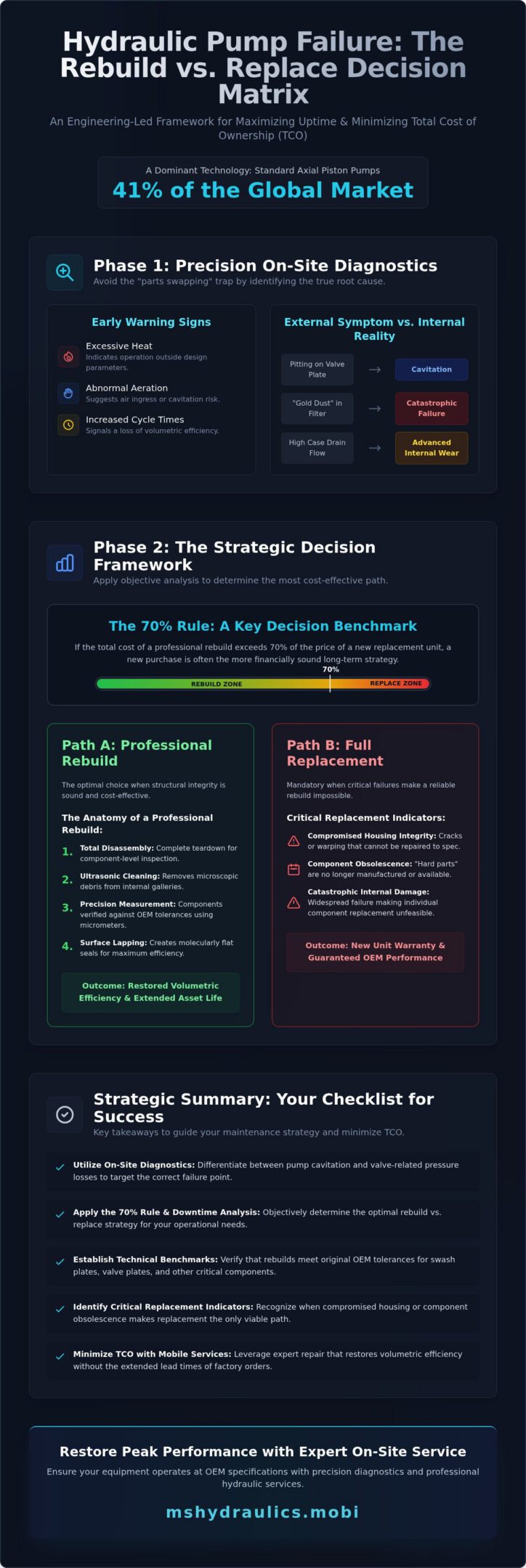
A standard axial piston pump represents approximately 41% of the global hydraulic pump market share, yet many operators still treat its failure as a simple binary choice between a repair invoice and a new asset purchase. The technical decision to rebuild vs replace hydraulic pump units is no longer just about the immediate cost; it’s a rigorous assessment of reliability under the mandatory ASME BPVC-2025 regulations. Rising OEM part costs and the risk of “band-aid” repairs failing in the field remain significant threats to your operational stability. You require a strategy that prioritizes restored volumetric efficiency over temporary fixes.
This engineering-led analysis provides the framework to determine the most cost-effective path for your failing equipment while adhering to the latest ISO 18464:2025 energy efficiency standards. You’ll learn how to evaluate internal wear and apply the new ANSI/HI 9.6.1-2024 NPSHR margins to ensure your system performance is fully restored. We will examine the critical factors that minimize total cost of ownership and validate your pump’s reliability for the next 2,000 plus operating hours.
Key Takeaways
- Utilize on-site diagnostics to differentiate between pump cavitation and valve-related pressure losses, ensuring that repair efforts target the correct failure point.
- Apply the 70% Rule and Downtime Deficit analysis to objectively determine the optimal rebuild vs replace hydraulic pump strategy for your specific operational requirements.
- Establish technical benchmarks for rebuilds by verifying that internal components, such as swash plates and valve plates, meet original OEM tolerances.
- Identify critical mechanical indicators, including compromised housing integrity or component obsolescence, that necessitate a full unit replacement over a restoration.
- Minimize total cost of ownership by leveraging mobile repair services that restore volumetric efficiency without the extended lead times of factory replacements.
The Critical Diagnostic: Evaluating Hydraulic Pump Failure in the Field
A definitive decision to rebuild vs replace hydraulic pump units requires more than a visual inspection. Operators often misinterpret system symptoms, leading to unnecessary expenditures or catastrophic secondary failures. Early warning signs like abnormal aeration, increased cycle times, and excessive heat indicate that the unit is operating outside its design parameters. However, these symptoms don’t always point to the pump itself. Faulty relief valves or compromised seals in other components can mimic pump failure. Without technical verification, you risk replacing a functional component while the root cause remains unaddressed.
Executing a precision diagnostic is the only way to avoid the costly “parts swapping” trap. Replacing a pump without a comprehensive pressure and flow test often ignores system-wide issues like contamination. This oversight leads to the immediate failure of the new or rebuilt unit. Professional On-Site Diagnostic Services are essential to isolate the pump from the rest of the circuit. These tests verify that the system integrity supports continued operation and prevent the “band-aid” repair cycle that plagues many heavy equipment fleets.
External Symptoms vs. Internal Reality
Understanding Hydraulic pump principles is necessary to distinguish between cavitation and standard mechanical wear. Cavitation, often caused by restricted suction lines or air ingress, creates distinct pitting on the valve plate and barrel face. In contrast, mechanical wear typically manifests as a gradual loss in volumetric efficiency. Technicians must evaluate the hydraulic fluid for metallic debris. Finding “gold dust” or silver flakes in the filter suggests a catastrophic breakdown of internal bearings or rotating groups. Flow meters provide the quantitative data needed to measure this efficiency loss against OEM specifications, providing a clear baseline for the rebuild vs replace hydraulic pump assessment.
The Role of Case Drain Pressure
Case drain flow serves as the primary indicator of internal pump health. In a piston pump, a specific volume of internal leakage is required for lubrication and cooling. However, when tolerances between the pistons and the barrel increase, the volume of oil returning through the case drain line rises significantly. Technicians measure this flow to determine the extent of internal bypass. If the case drain pressure exceeds specific PSI thresholds defined by the manufacturer, the pump’s volumetric efficiency has likely dropped below acceptable levels. Documenting these findings in a formal maintenance log allows for technical trend analysis. This data helps fleet managers predict when a pump will reach its functional end of life before a total field failure occurs.
The Anatomy of a Hydraulic Pump Rebuild: Restoring OEM Specifications
A professional restoration is a highly structured engineering process that goes far beyond the basic “clean and reseal” approach found in generic repair shops. When evaluating the rebuild vs replace hydraulic pump decision, the technical integrity of the restoration process determines the unit’s future service life. The procedure begins with total disassembly, followed by ultrasonic cleaning. This method uses high-frequency sound waves to create cavitation bubbles that remove microscopic debris from internal galleries that manual cleaning cannot reach. This level of cleanliness is vital for high-pressure systems where even minor contamination leads to premature wear.
Precision measurement follows. Technicians use micrometers and surface comparators to evaluate swash plates, pistons, and valve plates against strict OEM tolerances. Even a deviation of a few microns can compromise volumetric efficiency. If the base material is sound, “lapping” the valve plate and cylinder barrel surfaces creates a molecularly flat interface. This ensures a perfect hydraulic seal, which is essential for maintaining pressure under extreme thermal loads. This step is often what separates a factory-standard rebuild from a temporary field fix.
Component Evaluation Standards
Technicians categorize parts into two groups: wear items and hard parts. Seals, gaskets, and bearings are always replaced, regardless of their visual appearance. Hard parts, such as shafts or cylinder blocks, undergo rigorous NDT (Non-Destructive Testing) for cracks or warping. A cylinder block can often be salvaged through precision machining, provided the remaining material thickness meets safety standards. This meticulous approach is the cornerstone of professional hydraulic pump repair. It ensures that the core of the pump remains robust enough for another full service cycle.
The Bench Testing Protocol
A rebuild is technically incomplete without a simulated load test on a dedicated hydraulic test stand. This protocol monitors for internal leakage, flow rates, and thermal stability during a controlled break-in period. Technicians verify that the pump reaches its maximum rated pressure without excessive case drain flow. The goal is to ensure the rebuilt unit matches the performance standards expected of a Heavy Equipment Cylinder Rebuild or a new OEM unit. Validating these parameters under full operational load is the only way to confirm that the rebuild vs replace hydraulic pump choice was the correct strategic move for the asset.
Rebuild vs. Replace: A Strategic Comparison of Cost and ROI
The 70% Rule remains the primary benchmark for industrial maintenance. If the estimated cost of restoration exceeds 70% of a new unit’s purchase price, replacement is the technically sound choice. This calculation must include the Total Cost of Ownership (TCO) over the subsequent 5,000 operating hours. For Tier 1 brands such as Rexroth or Parker, a precision rebuild often costs 40% to 60% less than a new OEM unit. This financial delta allows for capital reallocation without sacrificing the asset’s reliability or performance standards.
The rebuild vs replace hydraulic pump decision isn’t purely about the initial invoice. If a pump has “grenaded,” sending metallic debris throughout the circuit, you must factor in the extensive cost of flushing the entire system and replacing all filters. A new pump installed into a contaminated system will fail within hours. Warranty coverage also differs. New OEM units carry factory warranties, while professional rebuilds are typically backed by the service provider’s performance verification. You must weigh the risk of field failure against the verified reliability of a bench-tested restoration.
Environmental stressors in North Texas significantly impact this ROI analysis. The combination of extreme summer heat and abrasive dust in the DFW Metroplex accelerates seal degradation and fluid oxidation. A pump that operates in these conditions requires more frequent monitoring. Choosing a rebuild with high-grade, heat-resistant seals often provides better local performance than a standard off-the-shelf replacement that may not be optimized for high-ambient temperatures.
The Financial Decision Matrix
Evaluating TCO requires looking past the immediate repair. A new unit offers a “zero-hour” baseline but comes with a higher acquisition cost. A rebuild restores the unit to near-original volumetric efficiency for a fraction of the price. If the pump housing and hard parts remain within tolerance, the ROI of a rebuild is superior for most high-pressure applications. This is especially true when the core components, such as the shaft and housing, show no signs of fatigue or stress cracking.
Lead Time Realities in North Texas
Supply chain fluctuations in 2026 continue to affect the availability of major brands like Eaton and Rexroth. Waiting for international shipping can lead to weeks of unplanned machinery downtime. A local, custom rebuild is often completed in days rather than weeks. Utilizing Mobile Hydraulic Repair allows for an immediate field assessment to determine if the unit can be serviced on-site or requires shop restoration. This local proximity minimizes the “downtime deficit” that often makes factory replacements less attractive for North Texas operators.
Technical Indicators: When Replacement is the Only Viable Path
Structural failure of the pump casing represents a non-negotiable end-of-life indicator. When the cast iron or aluminum housing exhibits hairline fractures or warping from extreme thermal cycles, the internal clearances required for high-pressure operation can’t be maintained. In these instances, the rebuild vs replace hydraulic pump debate concludes immediately. Attempting to rebuild a unit with a compromised housing leads to external leaks and internal pressure drops that no new rotating group can fix. Replacement becomes the only path to ensure the safety of the operator and the integrity of the machine.
Obsolescence is another critical factor for aging fleets. If a manufacturer has discontinued internal components, sourcing “new-old-stock” or aftermarket parts often introduces unacceptable risks. These “Frankenstein” pumps, built from mixed generations of parts, rarely achieve the precision required for modern high-cycle applications. Furthermore, the risk of infant mortality in a rebuilt unit increases if the core metallurgy is fatigued. If your technical assessment reveals that the cost of sourcing obsolete parts approaches the price of a modern equivalent, upgrading to a current-generation pump is the superior long-term investment.
Identifying Unsalvageable Components
Severe heat discoloration, commonly known as “bluing,” indicates a total metallurgical failure. This occurs when friction and lack of lubrication raise temperatures beyond the tempering point of the steel. Once the hardness of the cylinder block or pistons is compromised, the parts are unsalvageable. Similarly, splined shaft damage, such as twisted or sheared teeth, suggests the pump suffered a massive torque spike. These conditions indicate that the internal damage is likely too extensive for a reliable restoration. Professional Hydraulic Pump Repair services prioritize these inspections to prevent the failure of a newly installed unit.
The Root Cause Requirement
A new pump is just as vulnerable as a rebuilt one if the underlying system issues aren’t resolved. If a failure has caused a “contamination cascade,” metallic particles are now embedded in the suction lines and tank. You must verify the integrity of all Hydraulic Parts across the entire circuit before re-installation. Failure to flush the system and replace all filters ensures that the new pump will fail within its first few hours of operation. This highlights the necessity of a rigorous Heavy Equipment Maintenance schedule that includes regular oil analysis to catch these contaminants before they cause a total system shutdown.
Precision Hydraulic Service in Cleburne and North Texas
Ms. Hydraulics LLC operates on a foundation of engineering precision. We prioritize technical integrity over temporary field fixes. When facing the rebuild vs replace hydraulic pump decision, our technicians provide data-driven assessments that account for the unique operational demands of the North Texas industrial sector. We verify every internal component against OEM specifications to ensure that every restoration meets factory performance standards. This disciplined approach builds trust with major industrial players across the DFW Metroplex who value reliability above all else. Our goal is to provide a clear technical path that restores your machinery to peak operational status while adhering to the rigorous safety requirements of the 2026 industrial landscape.
Our mobile diagnostic capabilities extend throughout Johnson County and the broader North Texas region. We utilize advanced flow meters and pressure gauges to isolate failures directly in the field, reducing the risk of misdiagnosis that often leads to redundant component replacement. Having a local partner for emergency service minimizes the logistical burden and cost of transporting heavy machinery to a distant facility. This proximity allows for rapid identification of root causes, whether they stem from pump wear or valve malfunctions. We serve the construction, agriculture, and industrial sectors with a focus on maximizing fleet uptime through verified mechanical performance and precision maintenance protocols.
On-Site Support for Cleburne Industries
We offer expert on-site removal and installation to minimize transport costs and equipment downtime for local operators. Our technicians develop customized maintenance plans designed to identify early indicators of component fatigue before they lead to total system failure. Integrity is central to our operations. If our technical evaluation shows that a unit is beyond safe restoration due to housing cracks or metallurgical failure, Ms. Hydraulics LLC provides objective, engineering-led advice. We tell you if it’s better to buy new rather than attempting a high-risk repair. This ensures your capital is deployed effectively to maintain long-term system health and operational safety.
Next Steps for Your Failing System
Machine owners in Alvarado, Granbury, or Mansfield can secure an immediate diagnostic assessment to resolve performance issues. Before a technician arrives, ensure the machine is positioned on a level surface and follow all standard safety protocols. Clear access to the pump compartment facilitates a more efficient and accurate inspection of the hydraulic circuit. Making a definitive choice in the rebuild vs replace hydraulic pump process starts with professional verification of your system’s current state. Schedule a Diagnostic Service Call to restore your equipment’s volumetric efficiency and secure its reliability for the next several thousand operating hours.
Optimizing Asset Life Through Technical Verification
The technical decision to rebuild vs replace hydraulic pump units hinges on a rigorous assessment of internal component health and the latest 2026 industry standards. You’ve seen that restoring OEM tolerances through precision lapping and bench testing can significantly extend service life while reducing capital expenditure. However, when housing integrity is compromised or parts become obsolete, a full replacement remains the only viable path to ensure field reliability. Technical data must always drive your maintenance strategy.
Maintaining operational stability for your excavators, skid steers, and drill rigs requires a partner who understands the specific environmental stressors of the DFW Metroplex. Our expert technicians provide the factual data needed to make an informed decision, prioritizing your fleet’s long-term performance over temporary fixes. It’s essential to address root causes before small efficiency losses become catastrophic field failures.
Request an On-Site Diagnostic for Your Hydraulic Pump to receive a comprehensive analysis in Cleburne, Dallas, Fort Worth, or surrounding North Texas cities. We’re ready to help you restore your system’s efficiency and minimize unplanned downtime. Your equipment’s next 2,000 operating hours depend on the precision of today’s maintenance decisions.
Frequently Asked Questions
How long does a typical hydraulic pump rebuild take?
Turnaround times for a standard restoration typically range from two to five business days. This duration depends heavily on the availability of internal components for specific brands like Eaton or Rexroth. A local rebuild is often significantly faster than waiting for international shipping on a new OEM unit. The process includes thorough cleaning, precision measurement, and final load testing to ensure the unit meets performance standards before it returns to service.
Is a rebuilt hydraulic pump as good as a new one?
A professionally rebuilt unit achieves performance parity with a new pump when restored to original OEM tolerances. The rebuild vs replace hydraulic pump decision often favors restoration because the core housing and shafts remain viable. By replacing all wear items and lapping critical surfaces, technicians restore the volumetric efficiency required for high-pressure applications. Bench testing on a hydraulic stand verifies that the rebuilt unit handles full operational loads reliably.
What are the first signs that my hydraulic pump is failing?
Increased cycle times and abnormal aeration noise are the primary indicators of a failing hydraulic system. Excessive heat generation often follows as internal bypass increases within the pump. You should also monitor the case drain flow; a significant increase in return oil suggests that internal clearances have widened beyond acceptable limits. Catching these signs early prevents a catastrophic failure that could contaminate the entire hydraulic circuit with metallic debris.
Can I rebuild a hydraulic pump myself to save money?
Self-rebuilding is generally discouraged for high-pressure industrial pumps due to the requirement for specialized diagnostic and machining equipment. Achieving a molecularly flat seal through precision lapping requires tools and environments not found in standard field shops. Without a dedicated hydraulic test stand to simulate operational loads, you cannot verify the unit’s safety or efficiency. Professional restoration ensures the pump won’t fail prematurely under high-cycle stress.
Should I replace my hydraulic hoses when I replace the pump?
You should replace hydraulic hoses if the previous pump failure released metallic contaminants into the system. Reusing hoses that contain debris will cause the immediate failure of your new or rebuilt pump. Additionally, hoses that exhibit external cracking or internal lining degradation should be swapped during the pump service. Ensuring the entire circuit remains clean and capable of handling rated pressures is essential for protecting your investment.
What is the ‘70% rule’ in hydraulic repair?
The 70% rule is a financial benchmark used to determine the most cost-effective maintenance path. If the total cost of a precision rebuild exceeds 70% of the price of a new OEM unit, replacement is typically the better investment. This calculation helps managers evaluate the Total Cost of Ownership. It accounts for the age of the asset and the likelihood of the unit achieving another full 5,000 hour service cycle without additional failures.
Does Ms. Hydraulics LLC provide warranties on rebuilt pumps?
Performance verification and technical support are standard components of the professional service offerings at Ms. Hydraulics LLC. While specific terms depend on the component type and application severity, we ensure every unit passes a rigorous bench test before installation. You should review your specific service agreement for details regarding coverage and maintenance requirements. Our priority is ensuring that your restored pump provides reliable service throughout its next operational life cycle.