Mobile Hydraulic Service Near Me: A Technical Guide to On-Site Repair (2026)
Every hour your excavator or drill rig sits idle on a North Texas job site, the financial hemorrhage extends far beyond missed production targets. You understand that the logistical nightmare of transporting heavy machinery to a fixed facility is often as costly as the repair itself. Even worse is the frustration of hiring a technician who fails to identify the root cause of a component failure. Searching for a high-precision mobile hydraulic service near me should connect you with a technical partner, not just a parts courier.
We agree that immediate restoration of machine functionality is the priority, but it shouldn’t come at the expense of long-term reliability. This guide explores how expert on-site diagnostics, custom hose fabrication, and precision valve repairs minimize industrial downtime. You’ll discover the specific protocols used to verify system integrity and ensure your equipment returns to service according to international industry standards. We will detail the transition from emergency field calls to predictive maintenance strategies that protect your fleet’s performance through 2026 and beyond.
Key Takeaways
- Distinguish between simple component replacement and methodical on-site diagnostics, including pressure testing and flow analysis, to identify underlying system failures.
- Analyze the strategic benefits of field repair to eliminate the logistical burden and high costs associated with transporting heavy machinery to a fixed facility.
- Understand the technical process for custom hydraulic hose fabrication on-site, ensuring precise integration with JIC, ORFS, and Metric standard fittings.
- Learn how a specialized mobile hydraulic service near me provides the engineering expertise required for precision valve and pump repairs directly at the job site.
- Determine the criteria for transitioning from on-site maintenance to specialized cylinder rebuilds when mechanical requirements like rod polishing are necessary.
Defining Mobile Hydraulic Service: Beyond the Emergency Hose Fix
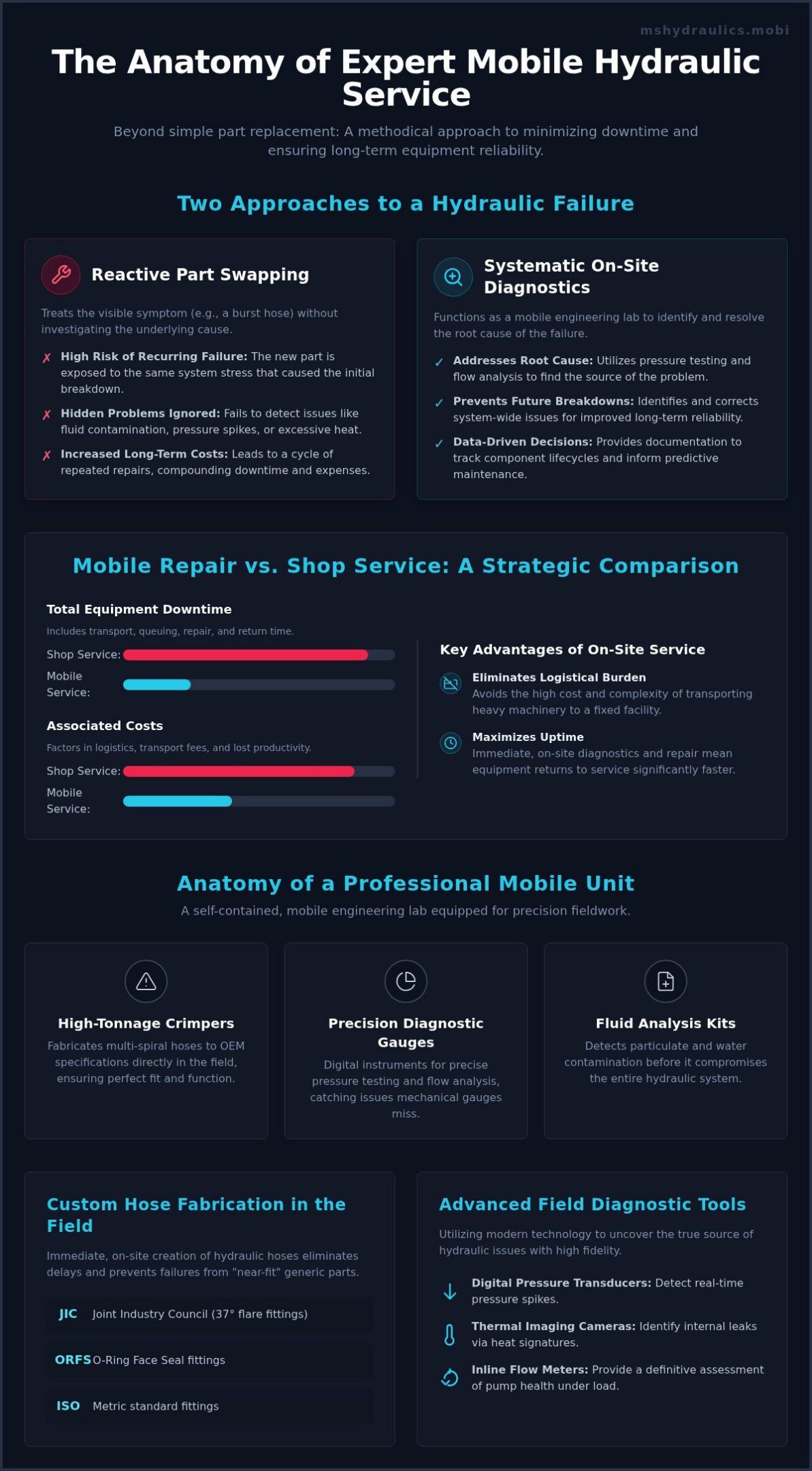
Mobile hydraulic service is frequently misunderstood as a mere emergency response to a burst hose. In reality, a professional field service operation functions as a mobile engineering lab. It provides integrated mechanical support for complex hydraulic machinery, ensuring that every component from the pump to the actuator operates within specified pressure and flow parameters. While many search for a mobile hydraulic service near me during a crisis, the value of a technical provider lies in their ability to perform full system diagnostics rather than just swapping a visible part.
For operators in the North Texas construction and agricultural sectors, equipment downtime represents a direct loss of revenue. A stalled excavator on a DFW job site can cost thousands of dollars in lost productivity and project delays. On-site fabrication is a critical component of this service. It allows for the immediate creation of custom hoses that meet specific industrial standards like JIC, ORFS, or Metric. This precision prevents the common failure point of using “near-fit” generic parts which often lead to premature leaks or catastrophic pressure drops.
The Anatomy of a Professional Mobile Unit
A technician’s capability is limited by their equipment. A professional unit specializing in mobile hydraulic service near me functions as a self-contained repair facility. Essential components of these units include:
- High-tonnage crimpers: Capable of fabricating multi-spiral hoses to OEM specifications in the field.
- Diagnostic gauges: Digital instruments for precise pressure testing and flow analysis.
- Fluid analysis kits: Tools to detect particulate contamination before it compromises the entire system.
Inventory management is equally vital. Units must be stocked with a diverse range of fittings and hose grades to service excavators, skid steers, and drill rigs without returning to a shop. Safety remains the primary objective during every intervention. Technicians follow strict protocols for high-pressure system lockout and energy dissipation to prevent fluid injection injuries.
Industrial Sectors Served in the DFW Metroplex
Operations focus on high-demand sectors across North Texas. This includes heavy earthmoving equipment maintenance for urban development projects and specialized agricultural machinery support for producers in Johnson and Ellis counties. Beyond field equipment, we provide troubleshooting for industrial production lines in Cleburne and the surrounding DFW corridor. Each sector demands a specific technical approach, whether it’s managing the high-cycle demands of a skid steer or the precision timing of a manufacturing valve assembly.
The Engineering Precision of On-Site Diagnostics
Precision diagnostics separate professional engineering from amateur part-swapping. A hydraulic system is simply a way to transfer energy through fluid under pressure; any interruption in that flow requires a methodical investigation. When you require a mobile hydraulic service near me, the technician’s ability to perform live pressure testing and flow analysis is paramount. We prioritize verifying all mechanical parameters before any component removal. This data-driven approach ensures that we address the root cause rather than just treating a visible symptom.
Identifying whether a failure stems from fluid contamination or mechanical wear is the first step in root cause analysis. Contamination often results in scoring on valve spools or pump pistons. Mechanical wear might manifest as increased internal leakage or reduced volumetric efficiency. Documenting these system performance metrics allows for a comprehensive diagnostic report. This documentation helps fleet managers track component lifecycles and prevents recurring failures that drain operational budgets. If you don’t find the source of the heat or the vibration, the new part will likely fail prematurely.
Diagnostic Tools for Field Technicians
Modern field diagnostics rely on high-fidelity sensors. Digital pressure transducers allow for real-time monitoring of pressure spikes that mechanical gauges often miss. Thermal imaging cameras are utilized to identify internal valve leakage by detecting localized heat signatures caused by fluid bypassing a seal. Additionally, inline flow meters provide a definitive assessment of pump health by measuring output under varying load conditions. When sourcing a mobile hydraulic service near me, look for providers who utilize these advanced tools. Our on-site diagnostic services provide the technical clarity needed to make informed repair decisions.
Common Failure Modes in North Texas Machinery
The North Texas environment introduces specific stresses on hydraulic systems. High ambient temperatures lead to accelerated seal degradation, causing internal bypassing and reduced machine response. Ozone and UV exposure are particularly aggressive in this region. These factors often compromise the outer cover of hydraulic hoses and lead to premature wire reinforcement corrosion. In high-dust environments like Alvarado and Grandbury, particulate ingress is a constant threat. Fine abrasive dust can bypass worn rod seals, entering the fluid stream and acting as a grinding paste within precision components.
Mobile Repair vs. Shop Service: A Strategic Comparison
Deciding between on-site intervention and shop transport requires a rigorous calculation of the Total Cost of Repair (TCR). This metric extends beyond simple labor rates; it encompasses the expense of heavy haul permits, trailer rentals, and the opportunity cost of machine downtime. When fleet managers search for a mobile hydraulic service near me, they’re often prioritizing the elimination of logistical complexity. Transporting a 40-ton excavator for a hydraulic failure that can be resolved in the field is rarely a cost-effective decision. On-site service allows for the immediate restoration of machine functionality while avoiding the risks associated with moving disabled heavy equipment.
Scheduled on-site maintenance further optimizes this TCR by identifying minor leaks or pressure drops before they escalate into catastrophic failures. This proactive approach minimizes operational disruption and ensures that major components reach their full design life. However, a technical distinction must be made regarding the scope of work achievable in the field versus the shop. While most heavy equipment maintenance tasks are suited for mobile units, certain mechanical restorations require the controlled environment of a specialized facility.
When to Call for Mobile Service
Mobile intervention is the primary choice for emergency hose bursts and catastrophic fluid loss. Technicians arriving on-site can immediately contain leaks and begin system-wide diagnostics to identify failing pumps or motors. This rapid response is critical for adhering to safety standards for hydraulic equipment, particularly when dealing with high-pressure systems that pose injection risks. Mobile service is also the only viable option for stationary industrial equipment or drill rigs where transport is physically or economically impossible. For these assets, a mobile hydraulic service near me provides the necessary engineering expertise to perform complex repairs without moving the machine from its foundation.
When Shop-Based Repair is Necessary
Shop-based service becomes mandatory when a component requires precision machining or a clean-room environment. A cylinder rebuild that involves deep rod scoring or barrel deformation necessitates specialized hydraulic benches and rod polishing equipment. These tools ensure the rod’s surface finish meets OEM specifications to prevent premature seal failure. Major pump overhauls also benefit from a shop environment where internal component replacement can be performed without the risk of environmental contamination. If a diagnostic report indicates the need for specialized lathes or honing equipment, the component should be removed and sent to a facility equipped for high-precision machining.
Custom Hydraulic Hose Fabrication in the Field
Technical proficiency in on-site hose fabrication is a critical requirement for any high-tier mobile hydraulic service near me. This process involves more than just cutting a length of hose; it requires a detailed assessment of the system’s peak operating pressures and the specific chemical compatibility of the hydraulic fluid. Technicians must select hose materials based on SAE standards, ensuring that the reinforcement layers, whether wire braid or multi-spiral, can withstand transient pressure spikes without compromising the assembly’s integrity. Verification of crimp specifications using precision calipers is mandatory. This step ensures that the fitting is compressed to the exact diameter specified by the manufacturer, preventing the risk of a blow-off under high-pressure conditions.
Matching fittings is a technical exercise that demands absolute accuracy. Modern equipment utilize a variety of standards, including JIC (37-degree flare), ORFS (O-ring Face Seal), and various Metric configurations like DIN or BSP. A misidentified thread or seat angle will result in immediate leaks or catastrophic failure once the system is pressurized. Material selection also considers environmental factors. Hoses exposed to high-cycle movement or abrasive contact require outer covers with enhanced abrasion resistance to prevent premature wire reinforcement corrosion. For specialized requirements, our custom hydraulic hose fabrication ensures your equipment remains compliant with OEM performance specifications.
Identifying Hydraulic Fittings and Threads
Accurate identification relies on the systematic use of thread gauges and calipers. Technicians measure the outside diameter of threads and the pitch to distinguish between closely related standards, such as NPT and BSPT. Common fitting failures in the field often stem from over-torquing, which cracks flare seats, or the reuse of damaged O-rings in face-seal fittings. Utilizing a professional guide to identifying hydraulic hose fittings helps operators understand the mechanical nuances of their specific machinery and prevents the installation of incompatible components.
The Benefits of On-Site Fabrication
On-site fabrication eliminates the “wrong part” risk inherent in traditional counter services where customers must transport an old hose to a physical shop. When you engage a mobile hydraulic service near me, the technician fabricates the assembly directly at the machine, ensuring the length and orientation are perfect for the application. This allows for immediate installation and live system testing, verifying the repair under actual operating loads. Furthermore, this approach reduces environmental impact. By resolving leaks immediately at the source, we prevent further hydraulic fluid discharge and minimize the volume of waste oil requiring disposal according to RCRA standards.
Ms. Hydraulics: Expert Mobile Solutions for North Texas
Ms. Hydraulics LLC operates as the primary hub for specialized industrial support across North Texas. Based in Cleburne, our mobile units are engineered to deliver high-precision mechanical intervention directly to the job site. When searching for a mobile hydraulic service near me, proximity is only one factor; the technician’s technical depth and equipment inventory determine the success of the repair. We maintain a strategic presence throughout the DFW metroplex, extending service to Alvarado, Grandbury, Mansfield, and the surrounding counties of Johnson, Tarrant, and Ellis. This geographical reach ensures that critical sectors like urban construction and heavy agriculture have access to elite technical support without the delays of long-distance dispatch.
Our field capabilities are specifically calibrated for the demands of heavy equipment maintenance. We provide comprehensive diagnostics and repair for excavators, skid steers, and drill rigs, ensuring these assets meet their operational parameters under the most strenuous conditions. Whether managing a catastrophic pump failure or performing routine hydraulic valve repair, our focus remains on restoring the machine’s engineering integrity. Our 24/7 availability for emergency field calls ensures that your operations aren’t compromised by unexpected hydraulic failure.
The Ms. Hydraulics Service Philosophy
The core of our operational model is a commitment to technical excellence and long-term reliability. We prioritize identifying the root cause of hydraulic instability over implementing superficial quick-fix patches that inevitably lead to secondary failures. Since 2021, we’ve supported local North Texas industries through a policy of technical transparency. This includes providing detailed diagnostic reports and clear labor structures, ensuring fleet managers make informed decisions based on factual data rather than estimates. We value integrity-based relationships, positioning ourselves as a dependable partner for major industrial players who require consistent performance.
Getting Started with Mobile Support
To facilitate an efficient response, please have specific machine data ready when requesting an emergency mobile hydraulic service near me. Essential information includes the machine make and model, a description of the symptoms, and any visible fault codes. Proper preparation of the job site is also critical for technician safety and access. Ensure the machine is in a stable position and the surrounding area is clear of debris or obstructions. For non-emergency requirements, you can schedule our On-Site Diagnostic Services to assess system health and plan preventative maintenance. This proactive approach minimizes the risk of catastrophic downtime and extends the service life of your hydraulic components.
Optimizing Fleet Reliability Through Technical Precision
Maintaining industrial momentum requires more than reactive maintenance. It demands an engineering-led approach to field repairs. By integrating advanced diagnostics with on-site fabrication, operators eliminate the logistical burden of machine transport while ensuring system integrity. We’ve detailed how verifying mechanical parameters and identifying root causes prevent the cycle of recurring failures that compromise North Texas job sites. You don’t have to sacrifice long-term reliability for immediate functionality.
When you require a mobile hydraulic service near me, selecting a partner with specialized diagnostic tools and high-tonnage field crimpers is essential. Ms. Hydraulics LLC provides these capabilities from our hub in Cleburne, TX, delivering expert technicians directly to your location. Whether you’re managing a drill rig or a fleet of excavators, our focus remains on precision and long-term performance.
Protect your equipment’s operational life by choosing a service provider that values technical transparency and verified results. You can Request Mobile Hydraulic Service from Ms. Hydraulics LLC to restore machine functionality and secure your project timelines. We look forward to supporting your next industrial challenge with the engineering excellence your fleet deserves.
Frequently Asked Questions
What information do I need to provide when calling for mobile hydraulic service?
You should provide the machine’s make, model, and serial number along with a detailed description of the symptoms or specific fault codes. Technical clarity helps our technicians prepare the necessary inventory and tooling before arrival. You should also specify the exact location on the job site and ensure the equipment is accessible. Mentioning whether there is active fluid loss or a complete loss of function allows the dispatch team to categorize the urgency of the request.
Can you fabricate custom hydraulic hoses for any machine on-site?
Yes, custom hydraulic hose fabrication is a core capability of our mobile units. We carry a comprehensive inventory of hose grades and fittings, including JIC, ORFS, and Metric standards. Our technicians use high-tonnage field crimpers to manufacture assemblies that meet or exceed OEM specifications. This on-site process ensures the correct length and orientation for immediate installation, eliminating the risk of using “near-fit” parts that often lead to premature leaks or system failure.
How do mobile hydraulic repair fees differ from shop labor rates?
Mobile hydraulic repair fees typically include hourly labor for on-site diagnosis and repair plus travel time and emergency response charges. While shop labor rates may appear lower, they don’t account for the substantial costs of heavy machinery transport or the extended downtime associated with moving equipment. A mobile hydraulic service near me optimizes the Total Cost of Repair by performing precision maintenance at your location, which removes the logistical burden and expenses of hauling disabled assets.
What is the typical response time for an emergency hydraulic repair in Cleburne?
Response times for emergency hydraulic repair in Cleburne are prioritized due to our central location in Johnson County. As our primary hub, Cleburne allows for rapid dispatch of technicians to local job sites and industrial facilities. While specific arrival times depend on current technician availability and the nature of the emergency, we focus on minimizing operational disruption through efficient routing and 24/7 availability for critical field calls across the DFW corridor and surrounding counties.
Do you provide mobile diagnostics for all types of heavy equipment?
On-site diagnostic services are provided for a wide range of heavy equipment, including excavators, skid steers, and drill rigs. Technicians utilize digital pressure transducers and flow meters to assess the health of pumps, motors, and valves. This methodical approach identifies internal leakage or volumetric efficiency losses without requiring component removal. These diagnostics are essential for industrial machinery in various sectors, from urban construction in Mansfield to agricultural operations in Waxahachie or industrial lines in Alvarado.
Is it possible to rebuild a hydraulic cylinder on the job site?
Minor hydraulic cylinder rebuilds, such as resealing and pressure testing, can often be performed on-site to restore functionality quickly. However, if the cylinder has significant rod scoring or barrel deformation, it requires specialized machining and polishing in a controlled shop environment. Field technicians evaluate the component’s condition to determine if on-site repair is viable or if the assembly must be transported to our facility for high-precision restoration to meet international industry standards and ensure long-term reliability.
What areas in North Texas do your mobile technicians cover?
Our mobile technicians provide comprehensive coverage across the North Texas region. Primary service areas include Cleburne, Alvarado, Grandbury, and Crowley. We also extend technical support to Arlington, Mansfield, Waxahachie, and Cedar Hill. By maintaining a presence throughout these DFW metroplex locations, we ensure that construction, agricultural, and industrial clients have access to professional mobile hydraulic service near me. This regional focus allows for consistent support of fleet operations and industrial production lines across Johnson and Ellis counties.
How can I prevent hydraulic hose failure on my construction equipment?
Preventing hydraulic hose failure requires a commitment to scheduled heavy equipment maintenance and regular inspections. Operators should monitor for external cover abrasion, UV degradation, and localized heat signatures. Implementing routine pressure testing and fluid analysis helps identify internal stresses before they lead to catastrophic bursts. Using custom-fabricated hoses with the correct pressure ratings and fittings is also vital. Proper routing and the use of protective sleeves further reduce the risk of environmental or mechanical damage during high-cycle operations.