Calculating the Real Cost of Equipment Downtime in Construction (2026)
When a primary asset fails on a high-stakes project, the financial damage extends far beyond the invoice for a replacement part. In 2026, unplanned equipment outages cost construction sites between $2,000 and $10,000 per day when accounting for idle labor and missed milestones. For project managers, calculating the real cost of equipment downtime in construction requires a rigorous analysis of both direct expenses and the secondary impacts on site productivity. With the average skilled trade salary reaching $95,168 this year, every hour a machine remains stationary represents a significant erosion of project profitability.
You likely recognize that idle crew wages and contractual penalties aren’t sustainable in a market defined by rising operational costs and a shortage of 439,000 workers. This article provides a data-driven framework to quantify these hidden variables and demonstrates how specialized mobile hydraulic repair and on-site diagnostic services protect your margins. We’ll examine technical formulas for total cost impact and discuss engineering-led maintenance strategies, such as hydraulic hose fabrication and cylinder rebuilds, that ensure your fleet maintains peak operational availability.
Key Takeaways
- Apply the 1:4 downtime ratio to recognize why direct repair invoices represent only a fraction of total project financial exposure.
- Utilize a standardized engineering formula for calculating the real cost of equipment downtime in construction by integrating labor burden, lost revenue, and overhead.
- Identify the specific hydraulic failure points, such as hose bursts, that trigger site-wide shutdowns and environmental compliance risks.
- Shift from reactive repair models to predictive heavy equipment maintenance strategies to detect mechanical wear before it necessitates an emergency stop.
- Assess how mobile hydraulic repair and on-site fabrication capabilities significantly reduce the duration of unplanned outages compared to traditional off-site service.
The Downtime Iceberg: Why Repair Costs Are Only the Tip
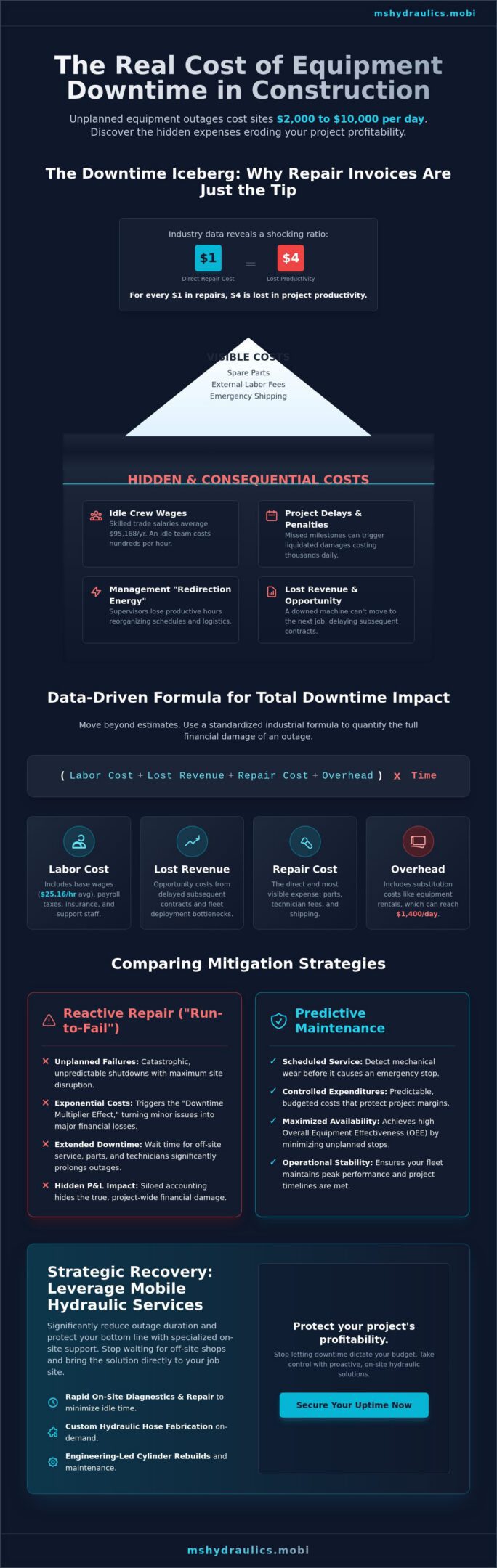
A common error in fleet management is viewing a repair invoice as the total financial impact of a machine failure. In reality, the “Real Cost” of an outage is an aggregate of direct, indirect, and consequential losses. Industry data suggests a 1:4 ratio for these events. For every $1 spent on a mechanical repair, $4 is lost in project productivity. When calculating the real cost of equipment downtime in construction, site managers must look beneath the surface of the immediate bill. Catastrophic unplanned failures, particularly in hydraulic systems, represent the most volatile threat to project margins. These systems operate under extreme pressure and mechanical stress, making them the primary source of sudden site shutdowns.
Direct vs. Indirect Cost Factors
Direct costs are the most visible but least damaging components of the iceberg. These include spare parts, external labor fees, and the premium paid for emergency shipping of critical components. Indirect costs, however, accumulate rapidly. With the average hourly wage for a construction worker reaching $25.16 in 2026, the cost of an idle crew can exceed $200 per hour for a small team. This doesn’t include the “redirection energy” expended by supervisors who must reorganize schedules to compensate for the missing asset. Consequential losses often include liquidated damages or missed milestone penalties that can reach thousands of dollars per day. To achieve high Overall Equipment Effectiveness (OEE), fleet managers must account for availability and performance losses that occur during these unplanned stoppages.
The Psychology of the “Repair-Only” Fallacy
Management often falls into the “Repair-Only” fallacy by siloing accounting data. When parts are tracked in one budget and labor in another, the total project-wide P&L impact remains hidden. This lack of transparency leads to “Run-to-Fail” mentalities that ignore the Downtime Multiplier Effect. The Downtime Multiplier Effect is the compounding financial impact where a single mechanical failure disrupts the synchronized workflow of an entire construction site, leading to exponential losses beyond the immediate repair expense. Calculating the real cost of equipment downtime in construction requires a holistic view that bridges the gap between the shop floor and the accounting office. While planned maintenance allows for controlled expenditures, unplanned outages in 2026 can cost a project between $2,000 and $10,000 per day in lost efficiency.
A Data-Driven Formula for Calculating Downtime Impact
To move beyond vague estimates, fleet managers require a repeatable mathematical model. The standard industrial formula for calculating the real cost of equipment downtime in construction is expressed as: (Labor Cost + Lost Revenue + Repair Cost + Overhead) x Time. This equation ensures that the “Wait Time” for technicians and the resulting project drift are captured as measurable variables. By applying this logic, the focus shifts from the price of a single hydraulic component to the total financial health of the project site.
The “Hourly Labor Burden” is a primary input in this calculation. It is not limited to the base wage of the operator; it must include payroll taxes, insurance, and the non-productive time of support staff. When an asset fails, opportunity costs arise because that machine cannot move to its next scheduled job site. This delays subsequent contracts and creates a bottleneck in the fleet’s deployment cycle. In many instances, managers must incur equipment rental substitution costs to keep a project moving. With daily rental rates for wheeled excavators reaching up to $1,400 in 2026, this variable alone can double the daily burn rate of a construction site.
Step 1: Quantifying Labor and Productivity Loss
Consider a scenario where a single excavator fails, idling a four-man crew. At an average wage of $25.16 per hour, the base labor loss exceeds $100 per hour. However, when you factor in skilled trade salaries that average $95,168 annually, the burdened cost of that idle team is significantly higher. If a failure occurs mid-pour or during a critical excavation phase, the cost of rework must be added. Hardened concrete or collapsed trenches require expensive remediation that would’ve been avoided with a functional machine. Utilizing on-site diagnostic services can compress the wait time variable, preventing these labor costs from cascading into the next shift.
Step 2: Assessing Project-Wide Delays
Construction scheduling relies on the critical path method. If a primary earthmover stops, every subsequent task on that path halts. The daily burn rate of a site includes site security, temporary facilities, and equipment insurance. These expenses continue even if production stops. Beyond the immediate P&L impact, reputation damage with general contractors is a quantifiable risk. A history of missed milestones due to mechanical failure leads to lower bid success rates on future high-value projects. Calculating the real cost of equipment downtime in construction must therefore include the long-term impact on the company’s ability to secure new work.
The Ripple Effect: How Hydraulic Failure Cascades Across the Job Site
Hydraulic hose bursts are statistically the most frequent catalyst for immediate site shutdowns. Unlike internal engine wear, which often provides early warning signs through telematics, a high-pressure hydraulic failure is instantaneous and creates an immediate safety hazard. In the North Texas environment, this risk is amplified by extreme thermal conditions. Ambient temperatures exceeding 100°F accelerate the thermal degradation of elastomeric seals and hose liners. This leads to premature hardening and brittle fractures in hydraulic components. When calculating the real cost of equipment downtime in construction, fleet operators must factor in these local environmental stressors. Prompt intervention through Expert Mobile Hydraulic Repair in Cleburne, TX is critical to preventing a single hose failure from compromising the entire project timeline.
The Environmental and Regulatory Penalty
A hydraulic failure often involves the discharge of pressurized fluid into the soil. Remediation costs for fluid spills on sensitive job sites are substantial. Beyond the physical cleanup, regulatory bodies like OSHA or local EPA branches may issue fines for uncontained hazardous materials. A failure also triggers mandatory safety inspections. These inspections extend the duration of the outage, adding hours or days to the recovery timeline. These administrative and environmental burdens are frequently omitted when managers focus solely on the mechanical repair bill. Accurate accounting requires a comprehensive view of these secondary regulatory risks.
North Texas Logistics: The Distance Penalty
Logistics play a decisive role in the total cost of downtime, particularly for remote sites in Alvarado or Grandbury. Traditional repair models require hauling heavy equipment from the field to a specialized shop in Dallas or Fort Worth. This process involves significant transportation fees and hours of non-productive transit time. Hauling an excavator or dozer isn’t just expensive; it’s a logistical bottleneck that removes the asset from the site for the duration of the transport. Utilizing On-Site Diagnostic Services is mathematically superior because it eliminates transit time and hauling fees. On-site technical support ensures that calculating the real cost of equipment downtime in construction accounts for the immediate restoration of machine availability without the “distance penalty” inherent in off-site repairs. This approach keeps the machine on the project footprint where it remains ready for immediate redeployment once the repair is finalized.
Comparing Mitigation Strategies: Planned Maintenance vs. Reactive Repair
The “Run-to-Fail” model is a high-risk strategy that prioritizes short-term savings over long-term project stability. In contrast, a predictive maintenance schedule leverages technical inspections to identify minor mechanical issues before they escalate into site-wide emergencies. For example, Heavy Equipment Maintenance protocols allow technicians to detect “weeping” hoses where fluid is slowly bypassing a seal or microscopic cracks have formed in the outer jacket. This proactive approach is central to calculating the real cost of equipment downtime in construction, as it replaces unpredictable emergency shutdowns with controlled, scheduled maintenance windows.
Replacing a compromised hose is a minor expense, whereas a reactive repair following a system-wide contamination event is a major capital loss. When a pump fails or a hose disintegrates internally, metallic debris and rubber particles circulate through the entire hydraulic circuit. This requires a full system flush and the potential replacement of valves and motors. Scheduled maintenance ensures these components operate within their designed mechanical parameters, preventing the “Downtime Multiplier Effect” from impacting the project’s P&L.
The ROI of Preventative Hydraulic Care
Preventative care should be viewed as a capital protection strategy. Regular Heavy Equipment Cylinder Rebuilds restore hydraulic force efficiency and prevent bypass leaks that slow down cycle times. By addressing seal wear early, fleet managers significantly extend the functional life of the asset. Fluid analysis serves as another diagnostic tool, identifying elevated copper or iron levels that signal internal pump wear before a catastrophic failure occurs. This data-driven insight allows for repairs during off-hours, ensuring the machine is available during high-productivity windows.
Emergency Response: The Mobile Advantage
When a failure does occur, the recovery method dictates the final cost impact. A traditional shop repair often results in a 48-hour turnaround due to hauling logistics and queue times. Mobile repair solutions compress this window to approximately two hours. Because specialized service vehicles carry raw materials for on-site hydraulic parts fabrication, the “parts-run” delay is eliminated. Justifying an emergency service fee is simple when viewed through the lens of saved crew hours. At an average annual salary of $95,168 for skilled trades in 2026, every hour gained through on-site repair directly preserves the project’s bottom line. By calculating the real cost of equipment downtime in construction, it becomes clear that mobile intervention is the most cost-effective recovery path.
If your fleet requires immediate technical support to maintain project timelines, contact Ms. Hydraulics LLC for professional mobile repair services.
Strategic Recovery: Leveraging Mobile Hydraulic Services to Protect Your Bottom Line
Software and telematics provide valuable data regarding fleet performance, but they cannot resolve a physical mechanical failure in the field. Ms. Hydraulics LLC functions as a tactical partner for North Texas fleets, providing the engineering expertise required to stop the financial hemorrhaging caused by unplanned outages. When calculating the real cost of equipment downtime in construction, the speed of recovery is the most influential variable in the equation. On-site diagnostic services eliminate the trial-and-error approach to repair, preventing the “wrong part” delay cycle that frequently extends downtime by several days. By deploying specialized technical support directly to the machine’s GPS coordinates, project managers can bypass the logistical bottlenecks of traditional shop-based service models.
Fleet managers should evaluate the financial benefit of rapid emergency response for critical-path tasks. When a primary asset like a wheeled excavator or a large-bore dozer fails, the daily loss of $2,000 to $10,000 is compounded by the ongoing 4-5% annual rise in labor costs. A disciplined recovery strategy prioritizes the immediate restoration of mechanical function. This ensures that the 439,000-worker shortage currently facing the industry does not result in expensive crews sitting idle while waiting for a technician to arrive from a distant metropolitan hub.
On-Site Hose Fabrication: Eliminating the Logistics Gap
Mobile hydraulic units equipped for on-site hose fabrication offer a decisive technical advantage. These units allow for the precision matching of hose specifications, including pressure ratings and fitting geometries, directly at the machine. This capability significantly reduces the Mean Time to Repair (MTTR) by eliminating the need for parts-run transit. Localized service in Cleburne and Fort Worth ensures faster response times that keep critical-path tasks on schedule. This engineering-led approach bypasses traditional supply chain delays, ensuring that a simple hydraulic failure doesn’t escalate into a week-long project delay.
Building a Long-Term Maintenance Partnership
Efficient fleet management requires a shift from transactional, reactive repairs to a strategic maintenance relationship. An integrity-first approach focuses on identifying the root cause of mechanical failure rather than simply treating the symptoms. This methodology reduces unnecessary part replacements and ensures that hydraulic valve, motor, and pump repairs are performed only when technically necessary. By integrating regular heavy equipment maintenance into the operational cycle, North Texas contractors can achieve higher asset availability and more predictable project margins. This long-term perspective is the most effective way to mitigate the rising operational costs of the 2026 construction market. You can protect your project margins with Ms. Hydraulics LLC by securing a partner dedicated to technical excellence and operational reliability.
Securing Project Profitability Through Technical Readiness
Effective fleet management in 2026 requires a transition from reactive repair to a data-driven availability strategy. By calculating the real cost of equipment downtime in construction, project managers can move beyond the repair-only fallacy and account for the 1:4 ratio of mechanical costs to productivity loss. Unplanned outages costing up to $10,000 per day aren’t just mechanical failures; they’re significant threats to your project’s critical path and overall P&L health. Utilizing a rigorous formula that integrates labor burden and opportunity cost is the only way to safeguard your margins against the rising operational costs of the modern industrial sector.
Ms. Hydraulics LLC provides the engineering precision needed to compress these recovery windows. From on-site custom hose fabrication to emergency diagnostics in Johnson County and expert cylinder rebuilds, our technical teams ensure your assets return to service with minimal delay. Minimize your downtime costs with Ms. Hydraulics LLC’s mobile repair and maintain the operational excellence your stakeholders expect. Technical reliability is the foundation of a successful build; we’re here to ensure your fleet remains a productive asset rather than a financial liability.
Frequently Asked Questions
How do you calculate the hourly cost of equipment downtime?
The calculation requires summing the burdened labor rate, lost project revenue, direct repair expenses, and fixed overhead, then dividing by the duration of the outage. Calculating the real cost of equipment downtime in construction must account for the total hourly burn rate of the job site. This ensures that the financial model reflects the actual impact on the project P&L rather than just the mechanical repair bill.
What is the average cost of downtime in the construction industry?
Unplanned downtime in 2026 typically costs construction sites between $2,000 and $10,000 per day. These figures are driven by high idle labor costs, with skilled trades averaging $95,168 annually. With a current industry shortage of 439,000 workers, the inability to reassign crews during a machine failure significantly inflates the total financial loss associated with every stationary asset.
Why are hydraulic failures the leading cause of construction downtime?
Hydraulic systems are prone to failure because they operate under extreme mechanical pressure and are highly sensitive to external variables. In North Texas, ambient heat exceeding 100°F accelerates the degradation of elastomeric seals and hose liners. Unlike engine components that may show gradual wear via telematics, hydraulic failures are often instantaneous, causing immediate site shutdowns and safety hazards.
Can preventative maintenance actually save money compared to reactive repairs?
Preventative heavy equipment maintenance reduces total expenditure by replacing high-risk components during scheduled windows. This avoids the 1:4 loss ratio where every dollar of repair cost results in four dollars of lost productivity. By identifying “weeping” hoses or worn seals early, fleet managers prevent catastrophic system contamination that would require expensive, long-term remediation and extensive flushing procedures.
What are liquidated damages in construction contracts related to equipment failure?
Liquidated damages are predetermined financial penalties assessed for every day a project exceeds its contractual completion date. If a primary asset failure occurs on the critical path, the resulting delay can trigger these daily fines. These costs are a consequential loss that must be included when calculating the real cost of equipment downtime in construction to understand the full risk of mechanical failure.
How does mobile hydraulic repair reduce the total cost of downtime?
Mobile repair reduces the Mean Time to Repair (MTTR) by deploying technical expertise directly to the machine’s location. This eliminates the time required for hauling and the “parts-run” delays inherent in traditional shop repairs. On-site fabrication of hydraulic hoses ensures that custom specifications are met immediately, allowing the asset to return to production within hours rather than days.
Is it cheaper to tow equipment to a shop or use a mobile repair service?
Mobile repair is generally more cost-effective because it eliminates hauling fees and non-productive transit time. Hauling heavy equipment to a Dallas or Fort Worth shop involves significant logistical coordination and expense. On-site diagnostic services keep the machine on the project footprint, ensuring it is ready for deployment the moment the mechanical restoration is finalized.
What hidden costs are most often missed when calculating equipment failure impact?
Environmental remediation for hydraulic fluid spills and the “redirection energy” of site supervisors are frequently overlooked. Spills on sensitive sites can lead to local EPA fines and mandatory safety inspections that extend the outage. Additionally, the long-term impact on reputation with general contractors can affect a company’s ability to secure future high-value contracts and bid successfully on new projects.