Avoiding Downtime with Hydraulic Maintenance: A Technical Strategy for North Texas Fleet Operators
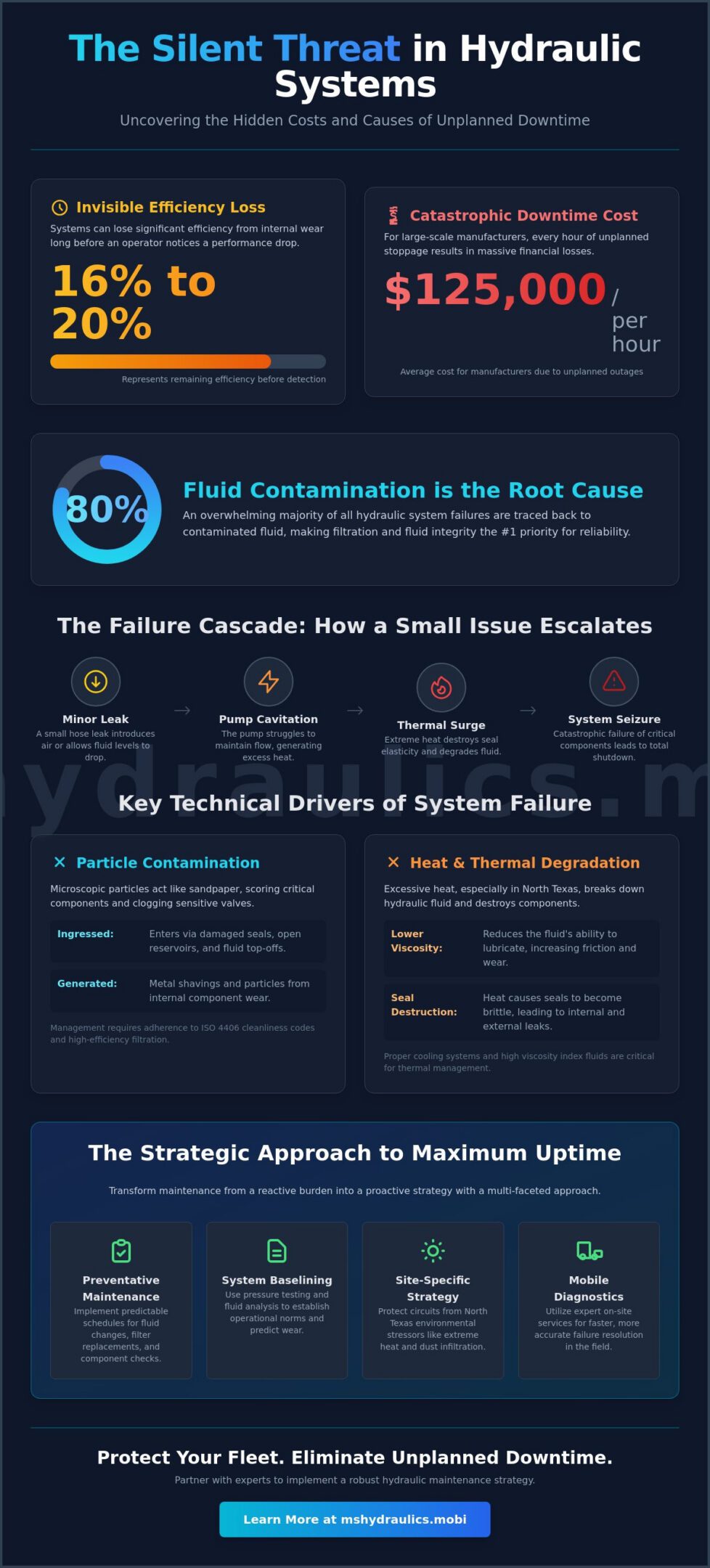
Did you know that hydraulic systems can lose 16% to 20% of their efficiency due to internal leakage and component wear before an operator ever notices a drop in performance? For fleet managers in North Texas, this invisible degradation often leads to catastrophic failure during critical operational windows. Avoiding downtime with hydraulic maintenance is not merely a matter of convenience; it’s a critical financial strategy in an industry where unplanned outages for manufacturers can cost an average of $125,000 per hour. You understand that every minute a machine is sidelined, the cost of idle operators and delayed timelines directly erodes your bottom line.
This article provides the technical protocols and preventative strategies required to eliminate unplanned hydraulic failures and maximize equipment uptime. You’ll learn how to implement a predictable maintenance schedule that accounts for environmental stressors like extreme Texas heat and shifting OSHA compliance standards. We’ll detail the specific diagnostic steps and component-level assessments, from cylinder rebuilds to hose fabrication, that ensure your fleet achieves peak mechanical reliability and lower long-term repair costs. This methodical approach transforms maintenance from a reactive burden into a manageable variable of your operation.
Key Takeaways
- Quantify the financial impact of unplanned interruptions by accounting for hidden costs like idle operator wages and project delay penalties.
- Master the technical protocols for avoiding downtime with hydraulic maintenance by mitigating fluid contamination and heat-induced thermal degradation.
- Establish operational baselines through rigorous system pressure testing and fluid analysis to predict wear in pumps, valves, and motors.
- Implement site-specific strategies for the North Texas environment to protect hydraulic circuits from extreme thermal stress and local dust infiltration.
- Utilize on-site diagnostic services and mobile repair units to achieve faster, more accurate resolutions for complex mechanical failures in the field.
The True Cost of Hydraulic Downtime in Industrial Operations
Hydraulic downtime is defined as any unplanned interruption in machinery operation caused by fluid power system failure, a state that immediately degrades the mechanical ROI of industrial assets. The efficient operation of complex hydraulic machinery requires precise pressure maintenance and fluid integrity. When these parameters deviate, the resulting cessation of work creates a significant financial vacuum. Avoiding downtime with hydraulic maintenance is a fundamental necessity for maintaining project timelines and protecting the structural integrity of high-value equipment in the North Texas industrial sector.
The “Failure Cascade” illustrates the risk of ignoring minor mechanical symptoms. A small hose leak is rarely an isolated issue; it’s typically the precursor to pump cavitation. As fluid levels drop or air enters the circuit, the pump struggles to maintain flow, which generates excessive heat. This thermal surge destroys seal elasticity and leads to total system seizure. Verified data for 2026 shows that fluid contamination remains the primary catalyst for 80% of these failures. Systems often lose 16% to 20% of their efficiency through internal leakage before an operator even detects a performance lag.
Direct vs. Indirect Financial Impact
Calculating the hourly burn rate of idle heavy equipment on North Texas job sites reveals staggering losses. Beyond the $125,000 per hour average downtime cost reported for large-scale manufacturers, fleet operators face immediate indirect expenses. These include the wages of idle operators, project delay penalties, and premium costs associated with emergency shipping for replacement parts. Long-term, these failures erode client trust and jeopardize the viability of future contracts. Reliability is a prerequisite for professional partnership and competitive bidding.
The Psychological Toll on Fleet Operators
Unreliable machinery creates a high-stress environment for the entire workforce. Forcing a machine to “limp” through tasks increases the risk of catastrophic failure and onsite safety hazards. Implementing a technical strategy for avoiding downtime with hydraulic maintenance shifts the workforce culture from reactive stress to proactive confidence. Predictable maintenance schedules don’t just protect the hardware; they improve workforce retention. Technicians and operators prefer working with fleets that prioritize engineering excellence over emergency repairs, as it ensures a safer and more orderly work environment.
Maintaining that sense of order is equally important when a company expands or relocates its physical base. For businesses transitioning their administrative hubs to the Gulf Coast region, employing reliable movers in League City TX ensures that the move is handled with the same level of precision and planning as a high-performance hydraulic maintenance program.
Identifying the Technical Drivers of Hydraulic System Failure
Mechanical failure in high-pressure hydraulic circuits is rarely the result of a single, isolated event. Instead, it is the culmination of technical stressors that exceed the design parameters of individual components. Avoiding downtime with hydraulic maintenance requires a precise understanding of these physical variables, particularly how they interact under heavy operational loads. When fluid power systems operate outside their specified pressure or temperature ranges, the rate of component degradation accelerates exponentially. Identifying these drivers before they reach a critical threshold is the foundation of a reliable fleet strategy.
Particle Contamination and Micron Ratings
Fluid contamination is the primary cause of 80% of hydraulic system failures. To manage this risk, technical teams must adhere to ISO 4406 cleanliness codes, which quantify the number of particles per milliliter of fluid at three specific micron levels. Contaminants are classified into two categories: ingressed and generated. Ingressed contaminants enter the system through damaged seals or open reservoirs during fluid top-offs. Generated contaminants are the result of internal mechanical wear, such as metal shavings from a pump or valve. High-efficiency filters with appropriate micron ratings are essential for capturing these particles before they score cylinder walls or clog sensitive orifices.
Heat Management and Viscosity Index
High operating temperatures in North Texas pose a significant risk to fluid stability. As hydraulic fluid absorbs heat, its viscosity index drops, which reduces its ability to maintain a protective lubricating film between moving metal parts. This thermal degradation leads to increased friction and internal leakage. Excessive heat also destroys seal elasticity, causing them to become brittle and fail. Oil coolers and thermal bypass valves must be inspected regularly to ensure they are shedding heat effectively. Signs of scorched fluid or varnishing on internal metal surfaces indicate that the system has exceeded its thermal limits. Precise on-site diagnostic services can identify these thermal irregularities before they cause permanent damage to your assets.
Mechanical erosion often stems from aeration and cavitation. Aeration occurs when outside air enters the fluid stream, leading to spongy controls and erratic movement. Cavitation is more destructive; it happens when the pump inlet is restricted, creating vapor bubbles that implode with enough force to pit metal surfaces. Pressure spikes also contribute to failure by fatiguing hose reinforcement layers and compromising fitting integrity. If a system suffers from recurring failures, it is often due to improper component sizing where the flow rate or pressure capacity of a replacement part does not match the original engineering specifications. Avoiding downtime with hydraulic maintenance means ensuring every valve, motor, and pump is technically compatible with the total system load.
Implementing a Strategic Preventative Maintenance (PM) Framework
Establishing a technical baseline is the first step in avoiding downtime with hydraulic maintenance. By recording initial system pressure and flow rates under load, fleet managers create a reference point for future diagnostics. This proactive approach to Heavy Equipment Maintenance ensures that every component operates within its original engineering specifications. Visual inspection protocols for hoses, cylinders, and valve banks must be standardized across the fleet to eliminate the variability inherent in subjective assessments. When these metrics deviate from the baseline, it’s a clear signal that internal wear is progressing toward a failure point.
Fluid Analysis: The Blood Test of Your Machinery
Collecting a representative fluid sample requires strict procedural discipline to avoid introducing external particulate matter. Technicians should draw samples from a turbulent area of the circuit while the system is at operating temperature. Lab reports provide a window into internal wear by identifying elevated levels of iron from gears or cylinders, copper from pumps or thrust plates, and silica from external ingression. This data allows operators to determine the optimal drain interval based on actual fluid condition rather than arbitrary service hours. It’s a method that maximizes the lifespan of expensive hydraulic motors and pumps by replacing fluid only when its chemical or physical properties have actually degraded.
Hose Integrity and Custom Fabrication
Standardized visual checks often reveal “weeping” fittings or cover abrasions that indicate imminent failure. Utilizing custom Hydraulic Hose Fabrication offers a technical advantage over generic replacements. Custom solutions ensure exact hose length and routing, which prevents mechanical interference and protects the assembly from heat soak in high-temperature environments. Avoiding downtime with hydraulic maintenance is significantly easier when the plumbing is engineered specifically for the machine’s duty cycle. Proper routing also reduces the risk of vibration-induced fatigue at the fitting connections.
Cylinder Health and Seal Life
Double-acting cylinders are prone to rod scoring and internal bypass leaks, which compromise lifting capacity and precision. Detecting these issues early prevents barrel damage that might otherwise necessitate a full replacement of the unit. Scheduling Heavy Equipment Cylinder Rebuilds at the first sign of wiper seal failure is a cost-effective strategy. Worn wiper seals allow abrasive dust to enter the system, leading to the contamination-driven failures that destroy internal tolerances. Maintaining seal integrity is the primary defense for the internal surfaces of the cylinder barrel and the longevity of the entire hydraulic circuit.
Field-Specific Maintenance for North Texas Operations
Operating heavy machinery in the North Texas corridor presents unique environmental challenges that aren’t addressed in standard manufacturer manuals. Avoiding downtime with hydraulic maintenance in this region requires a localized strategy that accounts for extreme thermal fluctuations and high concentrations of abrasive particulate matter. Whether your fleet is stationed in Cleburne or moving between job sites in Alvarado and Grandbury, the technical parameters of your maintenance program must adapt to these specific stressors. Failure to account for the local climate leads to premature component fatigue and unpredicted outages during peak operational windows.
Thermal Considerations for Cleburne and Dallas
Ambient temperatures in Cleburne and Dallas frequently exceed 100°F during the summer months, pushing hydraulic systems toward their thermal limits. At these temperatures, the viscosity of standard hydraulic fluids can drop below the minimum threshold required for effective lubrication. It’s essential to select fluids with a high viscosity index that maintain film strength under extreme heat. Maintenance teams must prioritize cleaning radiator fins and oil coolers to ensure the system sheds heat efficiently. If these components are restricted by debris, the resulting thermal surge causes seal hardening and the eventual failure of internal valves. Monitoring the condition of elastomers is critical, as constant UV exposure and heat cycles accelerate the degradation of any exposed seal surfaces.
Environmental Contaminants in Johnson County
The specific composition of North Texas clay and dust creates a highly abrasive environment for hydraulic cylinders. When machines operate in Alvarado or Grandbury, fine particles settle on extended cylinder rods. Without high-quality boots and scrapers, this material is pulled directly into the seal gland during the retraction stroke, scoring the rod and contaminating the fluid. Protective storage protocols are equally important for spare components. Spare hoses left in the Texas sun are susceptible to ozone cracking, which compromises the outer cover and allows moisture to reach the wire reinforcement layers. Maintaining a clean, UV-protected inventory of parts is a fundamental part of avoiding downtime with hydraulic maintenance.
High-intensity sectors, such as drill rig operations and heavy excavation, require accelerated maintenance schedules to compensate for these local variables. Standard service intervals don’t account for the relentless heat and dust of a North Texas summer. To maintain operational continuity, fleet managers should utilize On-Site Diagnostic Services to identify thermal and environmental stressors before they result in component seizure. For immediate assistance with system failures in the field, our team provides expert Mobile Hydraulic Repair to restore your equipment to peak mechanical integrity without the delay of off-site transport.
The Role of Expert Mobile Diagnostics in Downtime Mitigation
On-site diagnostics represent a critical shift from reactive component replacement to precise system analysis. For fleet operators in Arlington and Mansfield, the logistics of transporting heavy machinery to a central shop often introduce more downtime than the repair itself. By bringing technical expertise directly to the asset, mobile units eliminate transit delays and allow for a more accurate assessment of the failure. Avoiding downtime with hydraulic maintenance is most effective when diagnostics are performed while the machine is integrated into its working environment. This allows technicians to observe the system’s behavior under real-world operational loads where intermittent faults are most likely to manifest.
The technical capabilities of modern Mobile Hydraulic Repair units have evolved to mirror the precision of a fixed facility. These units are equipped to handle complex field failures, providing a localized solution that maintains the continuity of large-scale projects. Bringing the shop to the machine doesn’t just save time; it ensures that the repair is contextualized by the machine’s specific duty cycle and environmental stressors. This approach is essential for maintaining the mechanical ROI of fleets operating in the high-pressure industrial sectors of North Texas.
Advanced Field Diagnostics
Field technicians utilize specialized tools such as flow meters and pressure transducers to isolate faults within complex circuits. These instruments provide quantitative data on pressure drops and flow fluctuations that are often invisible during static shop tests. Troubleshooting under actual load conditions is the only way to verify the performance of a hydraulic pump or valve bank accurately. This technical rigor prevents the “parts-swapping” approach, which often fails to address the underlying systemic cause of a failure. By identifying the root cause in the field, operators can ensure that a repair is permanent rather than a temporary fix that will likely fail again under stress.
Emergency Response vs. Scheduled Field Service
Integrating mobile service calls into a monthly preventative maintenance plan provides a structured approach to fleet health. While emergency response is vital for critical infrastructure projects, scheduled field visits allow for the early detection of wear patterns that lead to catastrophic failure. Mobile repair units act as a technical force multiplier for local fleets by providing high-level diagnostic capabilities without the overhead of an internal specialized shop. Professional technicians verify every on-site repair through rigorous pressure and flow testing, ensuring the machine meets engineering performance standards before it returns to service. This integration of mobile support is a cornerstone of avoiding downtime with hydraulic maintenance in a high-demand industrial landscape.
Strategic Reliability for North Texas Industrial Fleets
Transitioning from reactive repair to a technical maintenance framework is the primary method for protecting the mechanical ROI of heavy equipment. By establishing baseline performance metrics and adhering to rigorous fluid analysis protocols, fleet operators can identify internal wear before it triggers a catastrophic failure cascade. This strategy is particularly vital in the North Texas corridor, where extreme thermal loads and abrasive dust levels demand a higher standard of component care. Avoiding downtime with hydraulic maintenance requires a disciplined commitment to engineering standards and localized environmental adaptations.
Maintaining operational continuity depends on access to precise technical support. Ms. Hydraulics LLC provides the specialized expertise necessary to verify system integrity through expert on-site diagnostics for Johnson County and surrounding areas. Capabilities in custom hydraulic hose fabrication and specialized cylinder rebuild services ensure that every repair meets or exceeds original equipment specifications. Minimize your downtime with Ms. Hydraulics LLC mobile repair services today. Implementing these professional standards ensures your fleet remains a dependable asset in even the most demanding industrial environments.
Frequently Asked Questions
What is the most common cause of hydraulic system downtime?
Fluid contamination is the primary driver of unplanned interruptions, accounting for up to 80% of all hydraulic system failures. This “silent killer” introduces microscopic particulates that score internal surfaces and clog sensitive valve orifices. Avoiding downtime with hydraulic maintenance requires strict adherence to ISO 4406 cleanliness standards to ensure that fluid remains free from both ingressed and generated contaminants before they reach a critical threshold.
How often should I perform hydraulic fluid analysis on my fleet?
The frequency of fluid analysis depends on the equipment’s duty cycle, though an interval of every 500 operational hours or every three months is a standard technical baseline. This predictive tool identifies elevated levels of iron, copper, and silica before they result in component seizure. For high-intensity operations in North Texas, more frequent sampling may be necessary to monitor the accelerated degradation caused by extreme thermal stress.
Can I replace a hydraulic hose myself on the job site?
While field personnel can technically replace a hose, professional fabrication is required to ensure the assembly meets specific pressure and flow requirements. Improperly routed or incorrectly rated hoses are prone to premature failure and mechanical interference. Utilizing specialized hydraulic hose fabrication ensures the assembly is engineered for the machine’s specific duty cycle, which is a key component of avoiding downtime with hydraulic maintenance.
What are the signs of hydraulic pump cavitation?
Hydraulic pump cavitation is primarily identified by a distinct high-pitched whining noise and erratic actuator movement. This condition occurs when the pump inlet is restricted, causing vapor bubbles to form and implode against internal metal surfaces. If left unaddressed, cavitation leads to rapid material erosion and eventual pump seizure, necessitating expensive hydraulic pump repair and causing significant project delays.
Why is my hydraulic system overheating in the Texas summer?
Overheating in the Texas summer is often caused by ambient temperatures exceeding 100°F combined with restricted oil coolers. When heat cannot dissipate, fluid viscosity drops below the minimum threshold required for lubrication, leading to increased friction and seal hardening. Maintenance teams should prioritize cleaning radiator fins and verifying the viscosity index of the fluid to ensure it can withstand high-temperature operation without degrading.
Is it better to rebuild or replace a leaking hydraulic cylinder?
Rebuilding a leaking hydraulic cylinder is generally the most cost-effective option if the barrel and rod are structurally sound. A professional rebuild replaces all seals and addresses minor rod scoring to restore original performance levels. As a technical rule of thumb, replacement is only recommended if the repair cost exceeds 50% of the price of a new aftermarket unit or if the barrel is irreparably damaged.
How does dust in North Texas affect my hydraulic seals?
The fine clay and dust characteristic of North Texas act as an abrasive medium that accelerates wear on hydraulic seals and cylinder rods. When these particles settle on an extended rod, they are pulled into the seal gland during retraction, leading to scoring and internal fluid contamination. High-quality wiper seals and protective boots are essential technical defenses to maintain seal integrity in these high-dust environments.
What should be included in a daily hydraulic inspection checklist?
A daily hydraulic inspection should prioritize fluid levels, visible leaks at fittings, and the physical condition of all hoses and cylinders. Operators should specifically look for “weeping” connections, cover abrasions, and rod scoring. Checking the cleanliness of oil coolers and ensuring all breather caps are secure prevents environmental contaminants and excessive heat from compromising the system during the work shift.