Leaking Hydraulic Quick Connect: Troubleshooting and Repair Guide (2026)
A leaking hydraulic quick connect is rarely a localized failure of a single seal; it’s frequently the primary indicator of underlying system pressure spikes or fluid contamination. While a puddle of hydraulic oil signals immediate environmental and financial loss, the internal damage to a coupling can lead to catastrophic failure under full load. You’re likely facing unexpected downtime and rising cleanup costs, searching for a definitive way to stop the leak without guessing on replacement parts.
We understand that maintaining high-pressure systems requires precision and adherence to strict engineering standards. This guide details how to identify the root cause of your leak, whether it involves simple seal degradation or complex internal mechanical wear. You’ll learn to evaluate the integrity of your coupling assembly against modern performance benchmarks, including the latest ISO 18464:2025 energy-efficiency standards. We provide the technical criteria needed to determine if a repair is viable or if a full assembly replacement is required to maintain system PSI. This analysis provides a clear protocol to restore operational reliability and minimize the risk of recurring fluid spills.
Key Takeaways
- Distinguish between minor weeping and high-pressure sprays to accurately assess system risks and environmental impact.
- Identify the mechanical and chemical factors contributing to a leaking hydraulic quick connect, ranging from seal abrasion to locking ball deformation.
- Evaluate coupler integrity to determine when a simple seal replacement is viable versus when the entire assembly requires replacement for safety.
- Implement a methodical shutdown and de-pressurization sequence to perform safe field troubleshooting on pressurized hydraulic circuits.
- Recognize the indicators that recurring failures require specialized on-site diagnostics and custom hose fabrication to ensure long-term reliability.
Identifying the Source of a Leaking Hydraulic Quick Connect
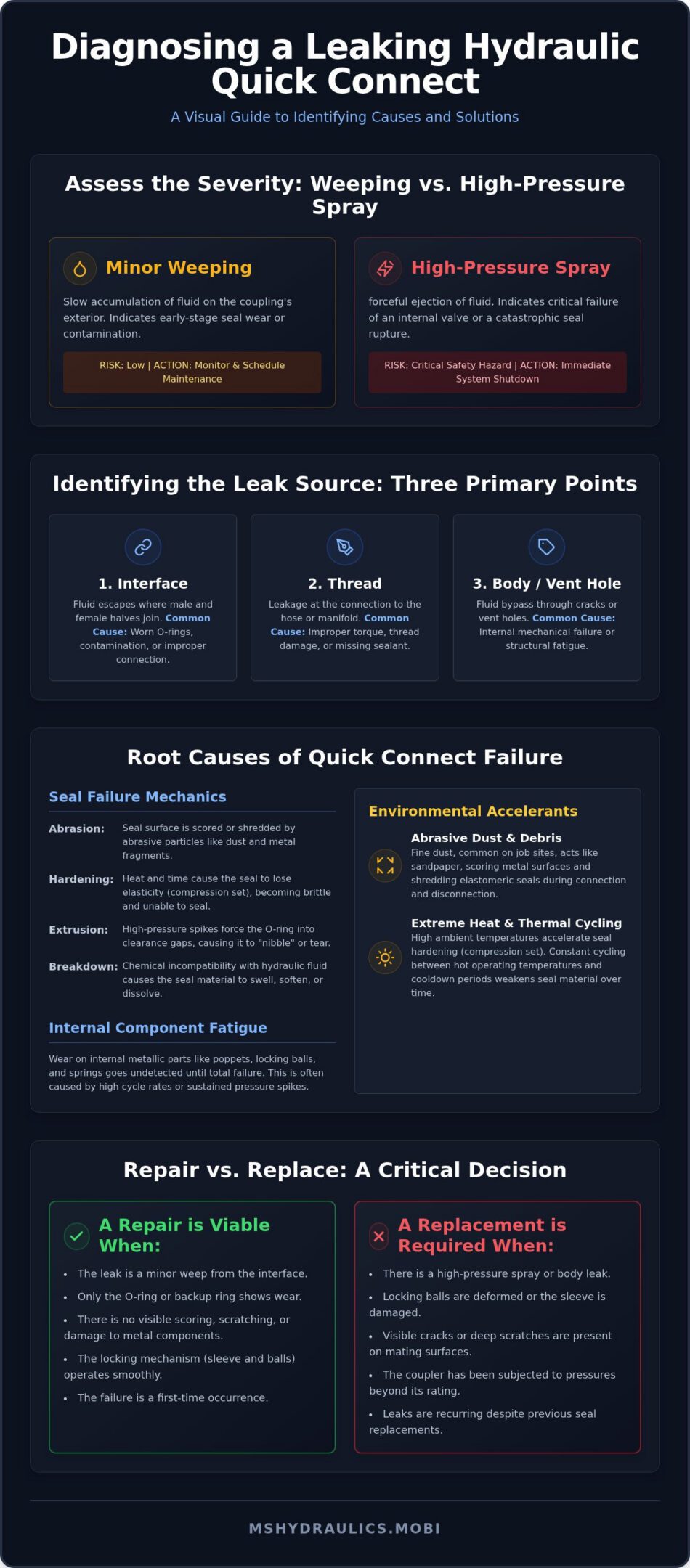
A leak in a quick connect fitting is defined as any unintended fluid bypass occurring at the coupling interface or within the component body. Identifying the specific nature of the failure is the first step in maintaining system pressure. Technicians must differentiate between a “weeping” connection, where fluid slowly accumulates on the exterior, and a high-pressure spray. A high-pressure spray indicates a critical failure of the internal check valve or a catastrophic seal rupture. It isn’t just a maintenance issue; it’s a safety hazard that requires immediate circuit isolation.
Accurate identification relies on understanding international engineering standards. Most industrial systems utilize components compliant with ISO 7241 or SAE J1502. These standards dictate the physical dimensions and pressure ratings of the coupling. When you’re troubleshooting a leaking hydraulic quick connect, verifying these standards ensures that replacement components will provide a flush, secure fit. Technicians should inspect three primary leak points:
- Interface: Fluid escapes where the male and female halves join, usually suggesting seal wear or contamination.
- Thread: Leakage occurs at the connection to the hose or manifold, often due to improper torque or thread damage.
- Vent Hole: Fluid bypass through a relief or vent hole typically indicates an internal mechanical failure of the poppet or sleeve.
Interface vs. Body Leaks
Interface leaks occur at the junction of the male nipple and female coupler. These are frequently caused by O-ring degradation or the presence of foreign particulate. In contrast, body leaks involve fluid escaping through cracks in the coupler housing itself or through the locking sleeve assembly. While an interface leak might be resolved with a new seal, a body leak indicates structural fatigue. This usually means the coupler has reached the end of its service life or has been subjected to pressures exceeding its design specifications.
The Impact of the North Texas Environment
Environmental conditions in Cleburne and the surrounding Johnson County area significantly accelerate component wear. The fine dust prevalent on local job sites acts as a high-grit abrasive. When this particulate enters the coupling interface, it scores the metal surfaces and shreds elastomeric seals. Additionally, the extreme Texas summer heat causes significant thermal expansion. Constant cycling between high operating temperatures and ambient heat leads to a loss of seal elasticity, known as compression set. For equipment stored outdoors, this degradation happens faster. The seals harden, become brittle, and eventually fail to maintain a tight interface under full system PSI. If you notice a leaking hydraulic quick connect after a period of equipment storage, the seal has likely lost its ability to conform to the mating surface.
Common Causes of Quick Disconnect Failure in Heavy Equipment
A leaking hydraulic quick connect is frequently the result of multiple converging failure modes rather than a single component defect. While technicians often prioritize O-ring inspection, the mechanical integrity of the entire assembly determines whether the connection will hold under full system load. Failure to address the root cause, such as high-frequency pressure spikes or abrasive contamination, ensures that any simple repair will be temporary. It’s vital to look at the system as a whole to understand why the coupling failed in the first place.
Seal Failure Mechanics
Elastomeric seals fail through three primary mechanisms: abrasion, hardening, and chemical breakdown. Extrusion and nibbling occur when system pressure exceeds the seal’s material limits, forcing the O-ring into the clearance gaps between the male and female components. This results in a jagged, torn appearance on the seal’s outer diameter. Compression set is equally problematic; over time, heat and pressure cause the seal to lose its “bounce,” resulting in a flattened profile that no longer conforms to the mating surface. In high-cycle applications, explosive decompression can occur if fluid penetrates the seal material and then expands rapidly during a pressure drop, causing internal ruptures.
Internal Component Fatigue
Mechanical wear on the internal metallic components often goes undetected until a total failure occurs. Poppet or ball-style check valves rely on precise spring tension to maintain a seal when the coupling is disconnected. Over millions of cycles, these springs suffer from fatigue, leading to a reduced seating force that allows fluid bypass. Brinelling is another critical issue, where constant vibration causes the locking balls to dent the surface of the male nipple. This deformation prevents a flush interface and creates a path for high-pressure leaks. Mismatched brands, even those supposedly following the same ISO standards, often have slight dimensional variances that accelerate this wear. For complex issues involving internal fatigue, seeking mobile hydraulic repair can prevent the costs associated with repeated part replacements.
Contamination remains a leading cause of check valve failure. Even microscopic grit can prevent a poppet from seating properly against its machined surface. With the industry shifting toward high-pressure hydraulic systems exceeding 350 bar, even minor seating issues are amplified into significant leaks. Pressure spikes that exceed the assembly’s rated PSI can also deform the locking sleeve grooves, permanently compromising the connection’s safety and performance. Identifying these mechanical stressors is essential when troubleshooting a leaking hydraulic quick connect on heavy equipment.
Repair vs. Replace: Evaluating Coupler Integrity
Determining the viability of a leaking hydraulic quick connect involves more than a visual inspection of the seal. Technicians must differentiate between a superficial elastomeric failure and a structural compromise of the coupling body. While a simple O-ring replacement often serves as a primary troubleshooting step, it’s sometimes a dangerous temporary fix if the underlying mechanical interface is degraded. A systematic evaluation prevents the cycle of recurring leaks and protects the system from catastrophic pressure loss.
The O-Ring Replacement Checklist
A new seal is only effective if the housing remains within original engineering tolerances. Before installing a replacement, technicians should inspect the internal seal groove for pitting, corrosion, or accumulated debris. In the high-dust environments of Cleburne, these grooves often harbor abrasives that prevent a flush seat. You must also select the correct material for the application. Buna-N is standard for most petroleum-based fluids, but Viton is necessary for high-temperature environments or specific synthetic fluids to prevent premature hardening. During installation, avoid twisting the seal; a twisted O-ring develops localized stress points that lead to rapid nibbling under pressure.
The condition of the mating nipple is equally critical. Even a microscopic burr or a deep scratch on the male tip acts as a cutting edge, shredding the new female seal during the first connection cycle. If the nipple shows signs of mushrooming or significant surface scoring, replace both halves of the coupling to ensure a verified seal. This precision is necessary to maintain the connection’s integrity when operating at full system PSI.
When Replacement is Mandatory
Mechanical deformation is a non-negotiable indicator for full component replacement. If the locking sleeve shows signs of sticking, or if the locking balls have created deep grooves in the housing, the coupler’s structural integrity is compromised. Body fatigue, often manifesting as persistent weeping after multiple seal changes, suggests that the housing has expanded beyond its elastic limit due to repeated pressure spikes. In these cases, a repair is no longer an option.
Modern operations are increasingly shifting toward non-spill or flat-face couplers to align with 2026 sustainability trends and reduce environmental cleanup costs. With five-gallon buckets of hydraulic fluid averaging $40 to $50, the cost of a single major leak often exceeds the price of a premium coupling assembly. For complex systems where the source of failure remains unclear, on-site diagnostic services provide the data needed to make an informed replacement decision rather than relying on trial-and-error repairs.
Field Troubleshooting: Steps to Stop a Hydraulic Leak
When you encounter a leaking hydraulic quick connect in the field, your priority shifts from long-term maintenance to immediate risk mitigation. Addressing a failure while the system is under load is dangerous and often ineffective. Technicians must follow a structured protocol to stabilize the equipment before attempting any mechanical intervention. This process ensures that the troubleshooting phase doesn’t lead to secondary component damage or personnel injury.
Pressure Release Safety Protocols
Safety is the primary concern when managing pressurized systems. You must never use your hand to check for high-pressure leaks, as hydraulic injection injuries can occur at pressures as low as 100 PSI. These injuries are often catastrophic, forcing fluid deep into the tissue and requiring immediate surgical intervention. Following OSHA 29 CFR 1910.147 Lockout/Tagout procedures is essential during maintenance. To neutralize the lines, shut down the engine and cycle the control valves through all positions. Utilizing “float” positions or dedicated bleeder valves helps dissipate residual energy that remains trapped even after the prime mover is deactivated. If the circuit remains pressurized, the coupling will be impossible to re-mate correctly.
Once the system is stabilized, the next phase involves a detailed physical assessment. A leaking hydraulic quick connect often reveals its failure point once the exterior grime is removed. If you find that field stabilization doesn’t resolve the pressure issues, you may require on-site diagnostic services to safely identify the blockage or valve failure.
Cleaning and Re-mating Procedures
Contamination control is the most critical factor in successful field repair. In the North Texas environment, fine particulates can easily enter an open coupling. Use lint-free cloths and appropriate solvents to clean both the male nipple and female coupler. Avoid using shop rags that leave fibers behind, as these can prevent the internal check valve from seating. Before re-mating, check for “trapped pressure” on the attachment side. If the male tip cannot be pushed in by hand, the thermal expansion of the fluid has likely pressurized the hose. You may need to use a pressure relief tool to vent this small volume of fluid safely.
Apply a small amount of clean system fluid to the interface seal to provide lubrication. This prevents the O-ring from catching or tearing during the connection process. Once the halves are securely locked, perform a low-load test by briefly engaging the hydraulic circuit at idle. Observe the connection for any sign of “weeping” before proceeding to full operational pressure. If the leak persists after these steps, the internal mechanical fatigue discussed in previous sections likely necessitates a component replacement.
Professional Hydraulic Service and Custom Solutions in Cleburne
Recurring failures often stem from system-wide issues that a simple component swap cannot resolve. When a leaking hydraulic quick connect persists despite the installation of new seals, the root cause is likely an upstream mechanical defect, such as a malfunctioning relief valve or pump cavitation. Ms. Hydraulics LLC provides on-site diagnostic services to identify these mechanical stressors before they compromise additional components on drill rigs or excavators. For heavy equipment operators in Cleburne, this technical precision reduces the risk of catastrophic failure during high-stakes project phases.
Mobile Diagnostic Capabilities
Field technicians utilize advanced flow meters and pressure transducers to perform real-time analysis of the hydraulic circuit. This data-driven approach determines if a leaking hydraulic quick connect is a symptom of excessive backpressure or thermal spikes that exceed the assembly’s rated capacity. In North Texas, environmental regulations regarding fluid spills are increasingly stringent, making professional diagnostics a financial necessity. Proper verification also helps regional businesses comply with used oil management standards, avoiding the rising recycling fees and disposal costs seen in 2026. Mobile service ensures that these complex evaluations happen directly on the job site, eliminating the logistical burden of transporting heavy machinery to a repair shop. This convenience is equally valuable for other large vehicles; for instance, motorhome owners can explore On-site mobile RV repair and maintenance service fees to see how professional on-site care maintains complex systems without the need for a shop visit.
Custom Fabrication and Upgrades
Damaged connection points or non-standard fittings often require specialized hydraulic hose fabrication to restore full functionality. Ms. Hydraulics LLC produces custom assemblies that integrate high-durability couplers specifically designed to withstand the abrasive dust and intense vibration typical of Johnson County job sites. Upgrading older machinery to modern flat-face standards is a cost-effective alternative to complete equipment replacement. These “non-spill” designs significantly minimize fluid loss during connection cycles, which is critical given that hydraulic fluid prices remain a significant operational expense for most fleets.
Preventative maintenance plans offer a structured way to monitor component health and ensure long-term reliability. By scheduling periodic inspections, technicians can identify microscopic metal fatigue, sleeve wear, or seal hardening before a leak occurs. This proactive strategy is essential for maintaining the high-pressure systems exceeding 350 bar that are becoming the global industry standard. To maintain your equipment’s reliability and ensure it can handle full system PSI, Schedule a mobile hydraulic repair technician in Cleburne today.
Restoring System Integrity and Operational Reliability
Managing a leaking hydraulic quick connect involves more than immediate fluid containment; it requires a systematic evaluation of the entire high-pressure circuit. We’ve established that while O-ring degradation is a common failure point, recurring leaks often signal deeper mechanical fatigue or contamination issues. This need for professional oversight of fluid systems is universal; for licensed residential and commercial plumbing in The Woodlands and Conroe, baxterfamilyplumbing.com ensures your property’s infrastructure remains reliable. Adhering to rigorous de-pressurization safety protocols and maintaining clean interfaces are essential steps to prevent catastrophic injection injuries and ensure long-term component performance. It’s vital to address these symptoms early to avoid the rising costs of environmental cleanup and equipment downtime.
When field troubleshooting reaches its technical limit, professional intervention is the most reliable path forward. Ms. Hydraulics LLC provides mobile on-site diagnostics and custom hose fabrication in North Texas to address complex failures directly at the source. Our technicians bring specialized expertise to Johnson County job sites, ensuring every connection meets the latest industrial standards for safety and efficiency. If your machinery requires verified repairs to handle full system PSI, Contact Ms. Hydraulics LLC for Mobile Repair in Cleburne. We’re ready to help you restore your equipment to peak performance.
Frequently Asked Questions
Can I replace a hydraulic quick connect O-ring without special tools?
You can typically perform this replacement using a basic O-ring pick set and a clean workspace. It’s advisable to use a pick made of brass or plastic to avoid scratching the precision-machined seal grooves in the coupler body. Scratches create bypass channels for fluid, which inevitably leads to a recurring leaking hydraulic quick connect even after a new seal is installed.
Why does my hydraulic coupler only leak when it is under pressure?
This phenomenon usually indicates seal extrusion, where the elastomeric material is forced into the clearance gap between the male and female halves as system PSI increases. At rest, the seal may appear intact, but it loses its ability to conform to the mating surface under load. This is often caused by a loss of seal durometer or because the coupler body has expanded beyond its elastic limit.
Are all hydraulic quick connects universal or brand-specific?
They are not universal, though many adhere to international standards like ISO 7241-A or ISO 16028. While a male nipple from one manufacturer may physically fit into a female coupler from another, slight dimensional variances can lead to premature wear or brinelling. For high-pressure systems exceeding 350 bar, you should use matched sets from the same manufacturer to ensure a verified, safe seal.
What is the difference between a poppet-style and a flat-face coupler?
Poppet-style couplers utilize a conical valve that moves away from a seat, which often results in small fluid spills during disconnection. Flat-face couplers, designed under ISO 16028 standards, feature a flush interface that minimizes fluid loss and prevents air ingestion. Flat-face designs are increasingly preferred to meet 2026 environmental compliance standards and reduce the cleanup costs associated with a leaking hydraulic quick connect.
How do I know if the male or female side of the quick connect is leaking?
Identify the source by cleaning both halves thoroughly and observing the interface while the system is under a low-load test. If fluid originates from the internal diameter of the female coupler, the internal O-ring or backup ring is likely compromised. If the leak occurs where the male nipple meets the hose, the failure is usually located at the thread interface or the hose crimp point.
What should I do if a hydraulic quick connect is stuck and won’t release?
A stuck connection is almost always caused by trapped pressure within the hydraulic circuit. You must safely de-pressurize the lines by cycling the control valves or utilizing a dedicated bleeder valve to neutralize the circuit. If the sleeve is physically jammed, it may be due to the locking balls being dented into the male nipple, a condition known as brinelling, which requires component replacement.
Can a leaking quick connect cause damage to the hydraulic pump?
A significant leak can lead to fluid aeration or cavitation, which causes rapid internal erosion of the hydraulic pump. When fluid levels drop, the pump may draw in air, leading to increased operating temperatures and a critical loss of lubrication. Since clean hydraulic fluid prevents 70 to 90 percent of failures, maintaining leak-free connections is critical for the longevity of the entire power unit.
How often should I replace the seals in my hydraulic quick disconnects?
Seals should be inspected every 500 operating hours or during seasonal transitions, as there is no universal replacement interval. In North Texas, extreme summer heat and abrasive dust accelerate elastomeric degradation. If you notice a loss of seal elasticity or signs of nibbling on the seal edges, replace them immediately to prevent unplanned downtime and ensure the connection can handle full system PSI.