Professional Hydraulic Cylinder Honing and Hydraulic Motor Repair in Granbury
Can a basic seal replacement actually restore a failing hydraulic system, or does it merely delay an inevitable mechanical breakdown? For many operators, the cycle of recurring leaks and unexpected downtime on Granbury job sites has become an expensive reality. If you’re managing a fleet, you’ve likely realized that a standard field fix doesn’t always address the internal wear that necessitates professional hydraulic motor repair Granbury. It’s often difficult to determine if a cylinder barrel is salvageable or if it requires a complete replacement without a technical assessment of its physical parameters.
This article demonstrates how precision honing and expert technical repair restore peak performance to heavy equipment across North Texas. You’ll discover how a documented crosshatch pattern is a functional engineering requirement for proper seal lubrication and system longevity. We’ll also define the clear technical rebuild requirements necessary to ensure your equipment maintains lifting power despite the extreme Texas heat. By focusing on verified mechanical standards, you can transition from reactive maintenance to a strategy of industrial excellence and reliability.
Key Takeaways
- Precision honing is a specialized abrasive machining process that establishes the specific surface finish necessary for high-pressure hydraulic integrity.
- A technical crosshatch pattern reduces friction and stabilizes the lubrication film, which directly prevents internal bypass and extends component life.
- Expert diagnostics for hydraulic motor repair Granbury help determine if a barrel is salvageable through honing or if it requires more intensive boring.
- Recognizing field signs like glazed barrel surfaces or load drifting allows for proactive maintenance before catastrophic system failure occurs.
- Utilizing engineering-grade rebuilds ensures that heavy equipment can maintain peak lifting power and performance in the demanding North Texas climate.
What is Hydraulic Cylinder Honing and Why is it Critical for Granbury Equipment?
Precision is the baseline for heavy equipment durability. Honing (metalworking) is an abrasive machining process used to produce a precision surface on a metal workpiece by scrubbing an abrasive stone against it along a controlled path. In hydraulic systems, this isn’t a cosmetic step. It’s a technical requirement. Many operators on Granbury job sites mistake basic cleaning for technical honing. While cleaning removes debris, professional honing corrects the internal geometry and surface texture of the cylinder bore. Skipping this process during a quick field repair often leads to localized wear and recurring leaks.
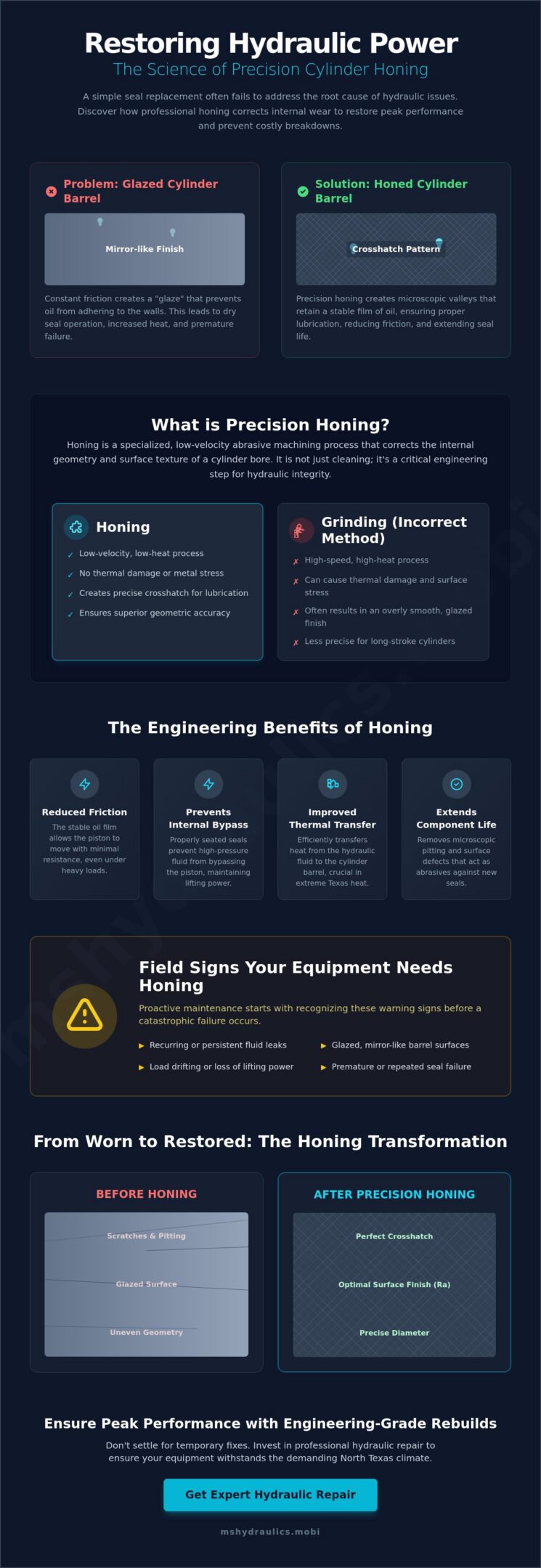
Over time, cylinder barrels develop a condition known as “glaze.” This is a mirror-like finish created by the constant friction of seals against the metal. While a smooth surface sounds ideal, glaze actually prevents hydraulic oil from adhering to the cylinder walls. This leads to dry seal operation and premature failure. Professional hydraulic motor repair Granbury involves stripping this glaze and addressing microscopic surface irregularities that compromise the system’s pressure-holding capabilities. Without this correction, new seals will likely fail within a few hundred hours of operation.
The Difference Between Honing and Grinding
Honing is a low-velocity process. Unlike high-speed grinding, it doesn’t generate excessive heat that can alter the metallurgy of the barrel. Grinding often introduces surface stress or thermal damage that weakens the component. Honing stones expand against the bore at controlled speeds and pressures. This method ensures superior geometric accuracy for long-stroke industrial cylinders. It maintains a consistent diameter from end to end, which is vital for the tight tolerances required in modern hydraulic motor repair Granbury projects.
Surface Finish and the Science of the Crosshatch
The primary output of a professional hone is the crosshatch pattern. These are microscopic valleys etched into the metal at specific angles. Their primary function is oil retention. These valleys hold a stable film of lubrication that the seals glide over during the stroke. If a barrel is polished to a mirror-smooth finish, the oil has nowhere to rest. This lack of lubrication increases frictional heat and causes seal degradation. The angle of this crosshatch must be precisely balanced. It ensures the oil stays in place while allowing the piston to move with minimal resistance, even under the heavy loads common in North Texas construction environments.
The Engineering Benefits of Precision Honing for Hydraulic Systems
Precision honing provides a mechanical foundation that exceeds the capabilities of standard surface cleaning. In the high-demand environments of North Texas, equipment often operates under peak thermal stress during the intense summer months. A honed barrel facilitates improved lubrication film stability. This stability is critical for maintaining high-pressure integrity. Without it, systems experience blow-by, a condition where pressurized fluid bypasses the piston seal. This results in a measurable loss of lifting capacity and increased fuel consumption. It’s a common issue that standard seal replacement alone cannot resolve.
Engineering benefits of this process include:
- Reduced friction at high-pressure interfaces.
- Improved thermal transfer between the hydraulic fluid and the cylinder barrel.
- Prevention of pressure loss via internal bypass.
- Removal of microscopic pitting that acts as an abrasive against new seals.
Optimizing Seal Performance and Longevity
The surface roughness, or Ra value, of a cylinder bore determines the wear rate of seal materials. Precision honing achieves a specific Ra that allows the seal to seat correctly during the initial break-in period. For systems operating at 3,000 PSI or higher, even microscopic scratches can create leak paths. These paths eventually erode the seal through high-velocity fluid bypass. By removing pitting and minor surface defects, honing ensures a consistent contact patch. This is a standard requirement for the high-quality hydraulic motor repair Granbury technicians provide to local fleets.
Correcting Bore Geometry: Roundness and Straightness
Hydraulic cylinders often become egg-shaped or tapered after thousands of duty cycles. This geometric distortion occurs due to side-loading or uneven wear patterns. A rigid hone corrects these distortions by removing material only where the bore is out of specification. This process maintains tolerances within ten-thousandths of an inch. While boring removes large amounts of metal, honing provides the final geometric correction required for industrial-grade performance. Ensuring a perfect circular bore is the only way to prevent internal bypass in high-pressure applications.
Efficient heat dissipation is a secondary benefit of a properly honed surface. In the North Texas heat, hydraulic fluid temperatures can spike rapidly. A consistent oil film, maintained by the crosshatch pattern, reduces frictional heat at the seal interface. This prevents the seal material from hardening or cracking due to thermal exposure. These precision adjustments are vital for any comprehensive hydraulic motor repair Granbury facility to perform. They ensure that heavy equipment survives the rigors of industrial use without premature mechanical failure.
Honing vs. Boring: Determining When a Component is Salvageable
Determining whether a hydraulic component can be salvaged requires a precise evaluation of material loss and structural integrity. While honing is the primary method for surface restoration, it has physical limits regarding the depth of damage it can correct. Standard honing typically removes between 0.001 and 0.005 inches of material. If deep scratches or gouges exceed these parameters, the process becomes insufficient for restoring the bore to a functional state. In such cases, a technician must decide between boring the cylinder or replacing the entire barrel assembly. This distinction is a critical part of a professional hydraulic motor repair Granbury evaluation.
The decision-making process involves a rigorous cost-benefit analysis. Machining a barrel to an oversized diameter necessitates the use of non-standard pistons and seal kits. This often increases lead times and costs. If the damage is localized or the tube wall thickness is compromised, replacing the barrel is the more reliable engineering choice. Maintaining original equipment manufacturer (OEM) specifications is usually the preferred path for long-term stability in heavy industrial applications.
Identifying Deep Scoring and Pitting
Technical thresholds define the transition from honing to boring. A scratch that can be felt with a fingernail is often deeper than 0.010 inches. Attempting to “hone out” such damage risks creating an oversized bore. This leads to seal extrusion, where the high-pressure fluid forces the seal material into the gap between the piston and the cylinder wall. Technicians use precision micrometers to verify the internal diameter at multiple points along the stroke. These measurements ensure that the final bore remains within safety margins for wall thickness, preventing catastrophic failure under peak loads.
The Two-Step Restoration: Boring and Honing
When surface damage is extensive but the component is too valuable to scrap, a two-step restoration process is required. Boring acts as the rough cut, removing significant amounts of metal to reach a clean, uniform surface. However, boring leaves a surface finish that is too coarse for hydraulic seals. Honing must follow to provide the final crosshatch pattern and geometric accuracy. This method is effective for restoring expensive, large-scale components where the cost of a new barrel is prohibitive.
Ms. Hydraulics LLC evaluates every piece of equipment to determine the most cost-effective restoration path. This evaluation includes a thorough diagnostic of the internal components to ensure the repair survives the rigors of heavy industrial use. Whether the solution involves a light finish hone or a complex boring operation, the focus remains on restoring the mechanical parameters to peak performance. This disciplined approach to hydraulic motor repair Granbury ensures that every rebuild meets the rigorous standards required for North Texas infrastructure projects.
Field Signs Your Machinery Requires Professional Honing or Hydraulic Motor Repair
Identifying mechanical degradation in the field requires an objective assessment of equipment performance and physical symptoms. A primary indicator of internal wear is the appearance of a mirror-like finish on the internal barrel surface, commonly referred to as glazing. While it might look clean, this finish indicates that the necessary crosshatch pattern has been worn away, preventing the oil film from adhering to the cylinder walls. This lack of lubrication leads to increased friction and accelerated seal wear. If your operations require seal replacements every few months rather than every few years, the root cause is likely a surface finish defect that necessitates professional hydraulic motor repair Granbury.
Performance cues often manifest as drifting loads or mechanical creep in excavators and skid steers. When a cylinder cannot hold its position under load, it’s a clear sign of internal bypass. This occurs when pressurized fluid moves past the piston seal due to bore irregularities or out-of-roundness. These issues are frequently accompanied by temperature spikes in the hydraulic fluid. As the oil temperature rises, its viscosity drops, which further reduces the effectiveness of the lubrication film. Monitoring these thermal parameters is a critical part of maintaining system integrity during intensive industrial use.
Field Diagnostics for Granbury Operators
Operators can perform a basic drift test on-site to quantify internal leakage. By extending the cylinder under a known load and measuring the change in rod position over a fixed interval, you can determine the severity of the bypass. You should also inspect the cylinder rod for vertical streaking. This streaking often indicates that internal barrel debris or scoring is damaging the seal as it moves. Utilizing On-Site Diagnostic Services allows for a technical verification of these symptoms, providing a clear data point for repair decisions before the component fails completely.
Environmental Factors in North Texas
The geography of the Brazos River valley introduces specific abrasive challenges for hydraulic systems. Fine silt and localized dust act as microscopic grinding compounds if they bypass the rod wipers. These particulates accelerate the scoring of the internal barrel, especially during the 100°F+ days common in the North Texas summer. High ambient temperatures combined with abrasive contaminants create a high-wear environment that quickly degrades standard finishes. Integrating preventative honing into a Heavy Equipment Maintenance cycle is a cost-effective strategy to manage these environmental risks. This proactive approach ensures that minor surface damage is corrected before it requires a more expensive boring operation or full barrel replacement.
If your machinery exhibits these symptoms, a technical rebuild is required to restore original performance levels. Contact Ms. Hydraulics LLC for a professional hydraulic motor repair Granbury evaluation to ensure your fleet remains operational and efficient.
Expert Hydraulic Restoration: Why Granbury Industries Trust Ms. Hydraulics LLC
Ms. Hydraulics LLC maintains a commitment to engineering-grade restoration through rigorous technical protocols. For construction and agricultural fleets in North Texas, the reliability of hydraulic components is non-negotiable. We integrate precision honing into every Heavy Equipment Cylinder Rebuild to ensure the final product meets industrial performance standards. This localized expertise allows Granbury operators to access specialized machining that is often unavailable through general maintenance providers. Our approach to hydraulic motor repair Granbury centers on mechanical verification and factual accuracy.
When a motor or cylinder enters our facility, we assess the specific operational requirements of the unit. This includes evaluating the intended seal materials and the pressures the system must withstand. By maintaining a local presence, Ms. Hydraulics LLC provides a level of accountability that international service centers cannot match. We understand the specific stresses of the North Texas environment, from the high ambient temperatures to the abrasive silt of the Brazos River valley. Our technicians function as disciplined industrial veterans, focusing on modern efficiency while respecting a legacy of mechanical excellence.
Our Precision Honing Process
The honing process is tailored to the specific seal material utilized in the rebuild to ensure compatibility. We don’t guess; we measure. Our process includes several critical technical steps:
- Selection of specific grit stones based on intended seal material, such as Urethane versus Viton.
- Use of high-quality honing oils to ensure consistent surface Ra values and debris removal.
- Application of rigid honing tools to correct geometric distortions like tapering or out-of-roundness.
- Post-honing cleaning protocols that ensure zero abrasive residue remains in the barrel.
Following the machining, these cleaning protocols prevent contaminants from entering the hydraulic circuit. This is a primary cause of post-repair failure in less disciplined shops. By establishing a proper oil-retaining crosshatch, we ensure that new seals survive the break-in period and beyond.
Minimizing Downtime for North Texas Industry
Logistical efficiency is a core component of our service model. We provide Mobile Hydraulic Repair to facilitate rapid teardown and diagnostics directly on Granbury job sites. Our mobile team identifies the failure point and manages the transport of heavy components to our facility for shop honing. This model reduces the burden on fleet managers and accelerates turnaround times for clients in Granbury, Cleburne, and Alvarado. Choosing a local expert like Ms. Hydraulics LLC ensures that your hydraulic motor repair Granbury is handled with a focus on long-term machinery performance and professional accountability. We provide the technical documentation and data-driven results required to keep your operations moving.
Maximizing Industrial Uptime through Technical Precision
Restoring heavy equipment to peak performance requires a disciplined approach to mechanical parameters. Precision honing establishes the surface Ra and crosshatch patterns necessary for high-pressure stability. By correcting internal geometry and removing surface glaze, operators prevent the recurring leaks and drifting loads that compromise project timelines. Our technicians specialize in heavy equipment diagnostics to determine the most efficient restoration path for your specific fleet. Since 2021, we’ve delivered precision engineering and hydraulic motor repair Granbury services to support the industrial infrastructure of Cleburne and North Texas. This commitment to factual accuracy ensures that every rebuild survives the rigors of the field.
Contact Ms. Hydraulics LLC for Expert Cylinder Rebuilds and Honing to secure the long-term reliability of your machinery. We look forward to partnering with you to maintain the efficiency and power of your heavy equipment.
Frequently Asked Questions
Is it possible to hone a hydraulic cylinder without removing it from the machine?
Professional honing cannot be performed while the cylinder is mounted to the machine. The process requires total disassembly so the barrel can be placed on a specialized honing machine to ensure precise alignment and stroke control. Attempting to hone an installed cylinder prevents the thorough removal of abrasive residue, which risks catastrophic contamination of the entire hydraulic circuit during operation.
How much material does a standard honing process actually remove from the cylinder wall?
A standard finish hone typically removes between 0.001 and 0.005 inches of material from the internal diameter. This minimal removal is sufficient to strip surface glazing and correct microscopic irregularities without compromising the structural integrity of the tube wall. If surface scoring is deeper than these parameters, a boring operation is required to reach a clean surface before the final hone is applied.
Does a honed cylinder require special break-in hydraulic fluid or procedures?
Special fluids aren’t required, but a specific cycling procedure is necessary for long-term reliability. After a professional hydraulic motor repair Granbury, the system should be cycled multiple times at low pressure without a load. This allows the new seals to seat correctly into the crosshatch pattern and establishes a stable lubrication film before the equipment is subjected to peak industrial stresses.
Can I use a handheld dingleberry hone for professional hydraulic motor repair?
Handheld flex hones, or dingleberry hones, are generally insufficient for industrial hydraulic standards. They lack the mechanical rigidity required to correct geometric distortions like tapering or out-of-roundness. Professional repairs utilize rigid, stone-based honing heads that maintain precise axial alignment. This ensures the bore remains perfectly circular throughout the entire stroke length, which is vital for high-pressure seal integrity.
What happens if I skip the honing step during a cylinder reseal?
Skipping the honing step frequently leads to premature seal failure and recurring leaks. Without a proper crosshatch pattern, the barrel surface is either glazed or physically scored. A glazed surface prevents oil retention, causing the seals to run dry and crack due to frictional heat. Conversely, a scored surface acts as an abrasive that physically shreds new seal material within a few hundred hours of use.
How do I know if my cylinder barrel is too thin to be safely honed or bored?
Technicians use ultrasonic thickness gauges and precision micrometers to verify the remaining wall thickness against the manufacturer’s original specifications. Every industrial barrel has a minimum thickness threshold required to safely contain peak operating pressures. If the calculated material removal for a repair would bring the wall thickness below this safety margin, the barrel assembly must be replaced to prevent a high-pressure burst.
What is the ideal crosshatch angle for a standard industrial hydraulic cylinder?
The ideal crosshatch angle for most industrial applications is between 20 and 45 degrees. This specific geometry is engineered to balance oil retention with efficient piston movement. If the angle is too steep, the oil drains too quickly; if it’s too shallow, the seals may experience hydroplaning. Maintaining this balance is a critical part of ensuring the lubrication film remains stable under heavy loads.
How long does the professional honing process typically take for a standard excavator cylinder?
The honing phase for a standard excavator cylinder usually requires one to three hours of machine time, depending on the severity of the internal wear. This timeframe does not include the essential pre-inspection, disassembly, and post-honing cleaning protocols. These technical steps are mandatory for a successful hydraulic motor repair Granbury to ensure no abrasive particulates remain in the barrel to damage the new internal components.