Construction Equipment Repair in Arlington, TX: Mobile Hydraulic Solutions for Heavy Machinery
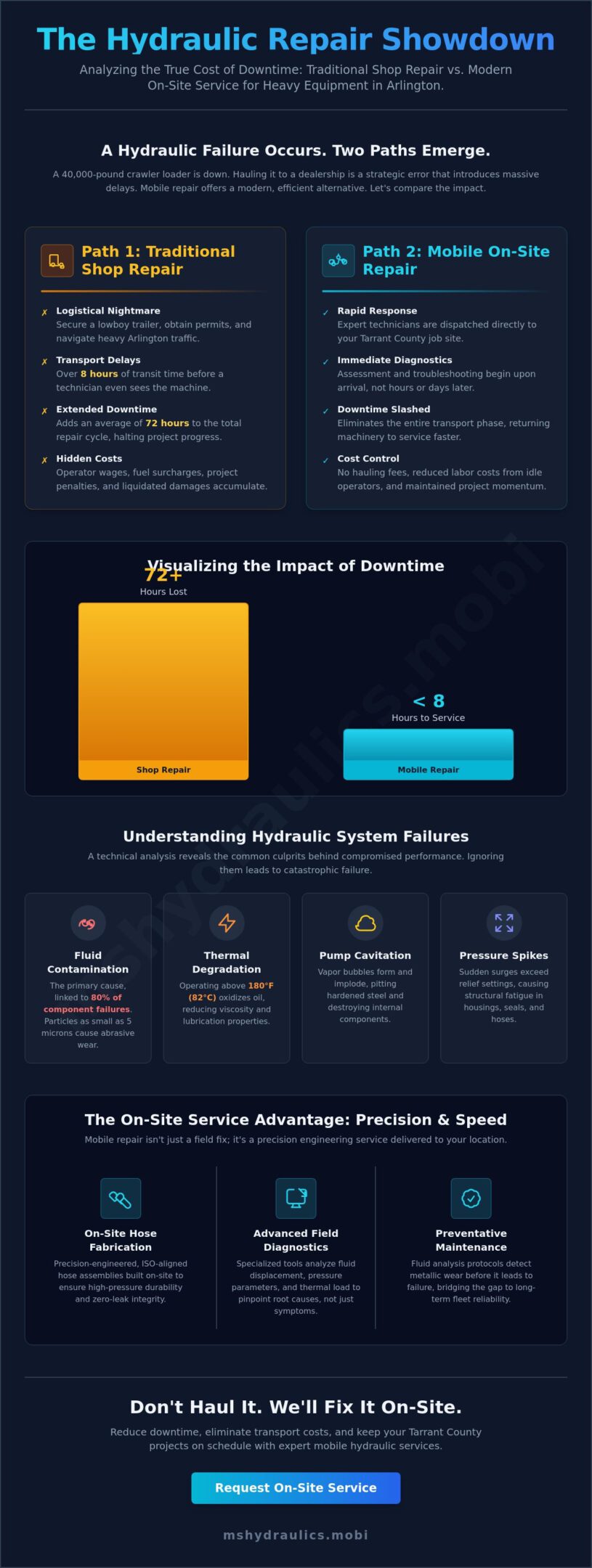
Hauling a 40,000-pound crawler loader to a dealership for a hydraulic failure isn’t just a logistical burden; it’s a strategic error that extends downtime by an average of 72 hours. You recognize that maintaining consistent system pressure and torque is vital for heavy machinery performance in the field. When a hydraulic line fails, the priority is a rapid return to service without the compounding costs of transport. Expert construction equipment repair Arlington services must prioritize on-site technical proficiency to keep Tarrant County projects on schedule.
This guide provides a technical analysis of how mobile hydraulic repair and precision on-site hose fabrication minimize mechanical failure rates and eliminate the need for equipment hauling. We’ll examine the engineering standards behind field-service diagnostics and the specific ISO-aligned protocols that ensure your machinery returns to service with zero-leak integrity. By focusing on precision displacement and transparent diagnostic reporting, we bridge the gap between emergency field fixes and long-term fleet reliability.
Key Takeaways
- Analyze the economic advantages of mobile service models over traditional shop repairs to significantly reduce project downtime on Arlington infrastructure sites.
- Identify the technical root causes of hydraulic failure, focusing on the critical relationship between fluid displacement, pressure parameters, and pump cavitation.
- Understand the precision engineering requirements for on-site hose fabrication to ensure high-pressure durability in modern heavy machinery.
- Implement advanced preventative maintenance protocols, including fluid analysis, to detect metallic wear before it leads to catastrophic component failure.
- Learn how specialized diagnostic tools and professional field expertise streamline construction equipment repair Arlington to maintain peak mechanical performance.
The High Cost of Construction Downtime in Arlington, TX
Machine failure on an active job site represents more than a temporary pause in production. In Arlington, where infrastructure projects must adhere to strict completion windows, a single hydraulic failure can disrupt the critical path of an entire development. The economic impact of equipment downtime scales exponentially as project milestones are missed. Traditional shop-based models often fail to meet the needs of local fleets because they introduce unnecessary logistical delays. When a primary excavator goes down, the time spent securing a lowboy trailer and transporting the unit to a fixed facility in Fort Worth or Cleburne can exceed eight hours before a single technician begins the assessment. This lag time is unacceptable for contractors managing high-stakes projects near the Entertainment District or the I-30 corridor.
Arlington’s Construction Boom and Equipment Demands
The rapid expansion of North Texas, particularly around the Highway 360 and I-30 interchanges, has placed unprecedented strain on heavy machinery. High-utilization assets like hydraulic excavators, dozers, and bored pile rigs are operating under peak load conditions for extended shifts. Navigating Arlington’s heavy traffic and restricted site access makes transporting disabled equipment a logistical nightmare. Mobile construction equipment repair Arlington services provide a strategic advantage by eliminating the transport phase. This allows technicians to address critical issues on-site, ensuring that machinery remains within the project perimeter and returns to service with minimal delay. This proximity to major transit veins necessitates a rapid response to prevent congestion and safety hazards on active sites.
Calculating the Real Cost of Idle Machinery
Determining the true financial impact of an idle machine requires a rigorous formula. Contractors must account for several variables that extend beyond the initial repair bill. The hourly loss is calculated by totaling operator wages, liquidated damages stipulated in municipal contracts, and the cost of schedule slips that affect subsequent trades. The mechanical complexity of modern Hydraulic machinery requires specialized diagnostics to identify faults in displacement and torque before they lead to catastrophic failure.
Contractors often overlook the hidden costs of hauling heavy equipment, which can involve specialized permits and significant fuel surcharges. Operational readiness in the context of hydraulic health is defined as the system’s capacity to maintain rated pressure and flow parameters under maximum load without thermal instability or fluid degradation. Relying on professional construction equipment repair Arlington experts ensures that these technical standards are met through precise on-site intervention. By prioritizing mobile solutions, Tarrant County contractors reduce the risk of schedule slips and maintain the high performance required for the demanding infrastructure landscape of North Texas.
Technical Analysis of Hydraulic System Failures in Heavy Equipment
Hydraulic performance in heavy machinery is governed by the precise interaction of displacement, pressure, and torque. When a machine loses power, it’s rarely a single-point failure; it’s usually a degradation of system efficiency. For instance, a 10% reduction in volumetric efficiency often leads to a 25% increase in thermal load as energy is lost to heat rather than mechanical work. Professional construction equipment repair Arlington necessitates a move beyond superficial fixes toward a rigorous analysis of these parameters.
Root cause analysis frequently reveals pump cavitation or valve erosion as the primary culprits. Cavitation occurs when the fluid pressure drops below its vapor pressure, forming bubbles that implode with enough force to pit hardened steel surfaces. Similarly, valve erosion alters the specified tolerances of directional control valves, leading to internal leakage. Industry data suggests that 80% of hydraulic component failures are directly linked to fluid contamination. Particles as small as 5 microns can bridge the lubricant film between moving parts, initiating a chain reaction of abrasive wear that compromises the entire system.
- Pressure Spikes: Sudden surges exceeding the relief valve setting can cause structural fatigue in housings and seals.
- Thermal Degradation: Operating above 180°F (82°C) oxidizes hydraulic oil, reducing its viscosity and lubricating properties.
- Aeration: Air ingestion causes “spongy” controls and accelerated oxidation of the hydraulic fluid.
Relying on a “patch and go” approach for visible leaks is a tactical error. A leak is often a symptom of excessive backpressure or vibration rather than the root problem. Comprehensive diagnostics ensure that the underlying cause is addressed before it destroys high-value components.
Hydraulic Pump and Motor Diagnostics
Internal bypass is the most common indicator of a failing pump. When internal clearances expand due to wear, fluid slips from the high-pressure side back to the suction side, causing a measurable drop in output flow. We utilize on-site diagnostic services to perform flow meter testing under load. This protocol isolates whether the pump is meeting its rated GPM at 3,000 PSI or if internal wear has rendered it inefficient. Precision testing prevents the unnecessary replacement of functional motors when the pump is the actual source of the power loss.
The Engineering Behind Cylinder Failures
Cylinders endure extreme stress during high-load cycles, often resulting in rod scoring or seal extrusion. Even a minor 0.002-inch deviation in rod straightness can cause uneven seal wear, leading to external leakage. Our restoration process emphasizes rod polishing and machining to restore the original surface finish, which is critical for maintaining the integrity of the wiper and U-cup seals. For a deeper look at these technical standards, review our guide on heavy equipment cylinder rebuild in Texas. Accurate construction equipment repair Arlington depends on these exacting engineering tolerances to ensure long-term reliability.
Maintaining peak operational status requires a partner who understands these mechanical intricacies. If your machinery is showing signs of cycle time slowing or increased operating temperatures, you can consult with MS Hydraulics to schedule a technical evaluation of your fleet’s hydraulic health.
On-Site Hydraulic Hose Fabrication: Speed vs. Precision
Field-based hydraulic hose fabrication is a critical component of professional construction equipment repair Arlington. When a high-pressure line ruptures on an excavator or skid steer, the replacement must meet or exceed the original equipment manufacturer (OEM) specifications to ensure system integrity. Modern heavy machinery often operates at working pressures exceeding 5,000 PSI, with frequent pressure spikes that can reach much higher levels during heavy lifting or digging cycles. Generic, off-the-shelf hoses frequently fail because they lack the specific reinforcement layers required to manage these dynamic loads.
Precision in the field requires specialized mobile crimping technology and high-speed saws that produce clean, square cuts. Contamination is the primary cause of hydraulic component failure, and on-site fabrication must include strict protocols to prevent dust and metal shavings from entering the system. Technicians utilize projectiles to clean the hose bore and immediately install protective caps and plugs. This meticulous approach maintains ISO 4406 cleanliness standards, protecting expensive pumps and valves from premature wear.
Mobile vs. Shop-Made Hoses
The primary advantage of mobile fabrication for Arlington construction sites is the elimination of travel time. Transporting a damaged hose to a brick-and-mortar shop typically results in 3 to 5 hours of machine downtime. Beyond speed, mobile services allow for superior routing. A technician can measure the exact length and orientation of the hose while it’s positioned on the machine, ensuring the bend radius complies with SAE J1273 standards. This prevents premature fatigue caused by twisting or abrasion. For contractors managing multiple sites, utilizing Expert Mobile Hydraulic Repair in Cleburne, TX provides the same level of technical precision and rapid response found in our Arlington operations.
Selecting High-Pressure Fittings and Materials
Matching the correct fitting is essential for a leak-free seal. Texas heavy equipment fleets utilize a diverse range of connection types, including:
- JIC (Joint Industry Council): A 37-degree flare fitting common in North American machinery.
- ORFS (O-Ring Face Seal): Known for superior leak prevention in high-vibration environments.
- BSPP (British Standard Pipe Parallel): Frequently found on European-manufactured equipment like Volvo or JCB.
The durability of the assembly depends on the reinforcement structure, such as four-wire or six-wire spiral steel. Hose impulse life refers to the number of pressure cycles a hydraulic hose can withstand before the reinforcement fatigue leads to failure, a critical metric for maintaining safety during high-intensity operations. Selecting materials with high impulse ratings ensures that the construction equipment repair Arlington teams provide long-term reliability rather than a temporary fix.
Preventative Maintenance for Arlington’s Construction Fleets
High-utilization machinery in North Texas operates under severe mechanical stress. Establishing a structured maintenance rhythm isn’t just a suggestion; it’s a technical requirement to avoid the high costs of unplanned construction equipment repair Arlington. Fluid analysis remains the most effective diagnostic tool for modern fleets. By monitoring the concentration of copper, iron, and chrome particles, technicians identify internal component degradation before a catastrophic pump failure occurs. This data-driven approach shifts the focus from reactive fixes to precision engineering management.
Operators serve as the first line of defense against hydraulic fatigue. Training them to recognize subtle changes in cycle times or increased noise levels in the pump stack can save thousands in hardware. A sluggish response often indicates a loss of volumetric efficiency. When a machine takes 15% longer to complete a standard lift cycle, it’s a clear indicator that internal bypass or pump wear is reaching a critical threshold.
Seasonal Maintenance Adjustments
Arlington’s climate presents unique challenges for hydraulic systems. During summer, ambient temperatures often exceed 100 degrees Fahrenheit, which significantly lowers hydraulic fluid viscosity. This thinning reduces the lubricating film strength and increases the risk of metal-to-metal contact. Switching to a higher viscosity index fluid helps maintain system pressure and protects internal components. Additionally, the abrasive North Texas soil quickly compromises seals and wipers. For more detailed protocols on protecting your assets, refer to our guide on Heavy Equipment Maintenance in Cleburne & North Texas.
The 500-Hour Hydraulic System Audit
A rigorous 500-hour audit ensures the system operates within OEM specifications. This methodical approach prevents the compounding effects of minor leaks and contamination. Our technicians follow a strict three-step protocol:
- Step 1: Visual inspection. Technicians examine all hoses, fittings, and cylinders for weeping or surface abrasions that could lead to a high-pressure burst.
- Step 2: Filter and breather replacement. We replace all high-pressure and return-line filters to maintain ISO 4406 cleanliness standards. We also check reservoir breathers to prevent airborne dust from entering the system.
- Step 3: Pressure verification. Using calibrated digital gauges, we verify that relief valve settings and pump compensator pressures match the manufacturer’s original benchmarks.
Maintaining these standards is critical for professional construction equipment repair Arlington. If your fleet shows signs of performance degradation or overheating, schedule a mobile hydraulic diagnostic to restore your equipment’s efficiency and reliability.
Ms. Hydraulics: Precision Mobile Repair Services for Arlington
Ms. Hydraulics operates with the disciplined approach of an industrial veteran. We recognize that construction equipment repair Arlington demands more than a temporary fix; it requires engineering precision delivered directly to the job site. Our mobile service units are equipped with state-of-the-art diagnostic sensors and fabrication tools designed to handle the most demanding hydraulic failures. We serve Arlington, Mansfield, and the broader Tarrant County region, ensuring that heavy machinery remains operational under peak load conditions. Our commitment to integrity means we prioritize long-term mechanical reliability over quick, superficial repairs.
Our Technical Capabilities in the Field
Field repairs at Ms. Hydraulics are governed by technical accuracy. Our technicians possess specialized expertise in cylinder resealing, where we address seal degradation and rod scoring with millimetric precision. We also manage complex pump repairs and valve troubleshooting, ensuring that fluid displacement and system pressure remain within safe operating limits. Our team is proficient with the hydraulic architectures of industry leaders like Caterpillar, John Deere, Komatsu, and Case. For those looking to expand their technical knowledge of these systems, we offer a Comprehensive Guide to Hydraulic Parts that details common failure points and maintenance standards.
Why Arlington Contractors Trust Ms. Hydraulics
Reliability in the heavy machinery sector isn’t subjective; it’s measured by uptime and performance data. Arlington contractors trust our team because we implement ISO-standard protocols in every mobile intervention. We eliminate the ambiguity of traditional repair shops by providing clear, data-driven assessments of machine health. Our no-nonsense mobile response is designed to minimize downtime, which is critical when project deadlines are fixed. We understand that a stalled excavator or loader can halt an entire job site’s progress. To request emergency hydraulic service in Arlington, contractors can contact our dispatch center for an immediate technical consultation. We deploy a technician equipped with the specific parts and tools required for your machinery’s make and model, ensuring the repair is completed correctly the first time.
- On-site diagnostic testing for all hydraulic circuits.
- Precision cylinder and rod repair services.
- Expertise in high-pressure pump and motor calibration.
- Serving the entire Tarrant County industrial corridor.
Securing Operational Efficiency Through Technical Precision
Maintaining high-pressure hydraulic systems requires more than simple fixes; it demands engineering-grade accuracy directly at the job site. When heavy machinery fails, the financial impact is immediate. Industry data from Construction Dive indicates equipment downtime costs average between $448 and $760 per hour. Mitigating these losses requires construction equipment repair Arlington services that prioritize technical specifications over temporary patches. MS Hydraulics delivers on-site diagnostic expertise and custom hose fabrication that adheres to ISO 18752 standards for high-pressure performance.
By implementing structured maintenance schedules and utilizing mobile units equipped for complex field repairs, operators maintain system integrity and prevent catastrophic torque loss or fluid contamination. Our technicians focus on precise displacement measurements and system pressure validation to ensure your fleet remains operational under peak load conditions. Don’t let a faulty seal or ruptured line stall your project’s timeline. We’re committed to restoring your machinery to its original design parameters with speed and precision.
Schedule Expert Mobile Hydraulic Repair in Arlington Today
Reliable performance starts with expert engineering, and we’re ready to get your equipment back to work.
Frequently Asked Questions
How quickly can a mobile hydraulic technician reach my job site in Arlington?
Our mobile technicians typically arrive at Arlington job sites within 60 to 90 minutes of a service dispatch. We prioritize rapid response to minimize downtime for heavy machinery on critical infrastructure projects. This deployment speed ensures that mechanical issues don’t compromise your project schedule. Our service fleet is strategically positioned across the Dallas-Fort Worth metroplex to optimize travel efficiency.
What types of construction equipment can you repair on-site in Arlington?
We provide comprehensive construction equipment repair Arlington for excavators, skid steers, wheel loaders, and articulated haulers. Our field capabilities cover hydraulic systems for brands like Caterpillar, Komatsu, and John Deere. We address issues ranging from boom cylinder leaks to complex valve bank failures directly at your location. This eliminates the logistical burden and cost of transporting oversized machinery to a fixed facility.
Can you fabricate custom hydraulic hoses at the machine location?
Yes, our service trucks function as mobile workshops equipped with high-pressure crimping machines and a full inventory of reinforced hose stock. We fabricate custom hydraulic hoses on-site to meet exact specifications for length and pressure rating. This immediate fabrication capability reduces equipment idle time by 100 percent compared to waiting for parts delivery. Each assembly undergoes a rigorous inspection to ensure it meets ISO 18752 standards.
Is it more cost-effective to repair or replace a hydraulic pump?
Industry data suggests that repairing a hydraulic pump is typically cost-effective if the restoration cost is less than 70 percent of a new unit’s price. We evaluate internal components like swash plates and piston blocks for wear beyond technical tolerances. If the pump housing remains structurally sound, a precision rebuild can restore performance to 95 percent of original manufacturer specifications. We provide detailed diagnostic reports to support your decision-making process.
How do I know if my hydraulic cylinder needs a rebuild or just new seals?
A rebuild is necessary if the cylinder rod shows scoring or if the barrel has internal pitting; however, external leaking often indicates simple seal failure. We perform a bypass test to measure internal leakage rates. If the cylinder drifts more than 0.125 inches under load within a specific timeframe, internal bypass is occurring. New seals won’t fix a scarred cylinder wall that compromises the hydraulic seal’s integrity.
What are the signs of hydraulic fluid contamination in heavy machinery?
Visible signs of contamination include milky fluid from water ingress or darkened fluid indicating thermal degradation. Increased operating temperatures exceeding 180 degrees Fahrenheit often signal that particulate matter is causing internal friction. You might also notice increased pump noise or chatter during operation. Laboratory analysis frequently reveals that 75 percent of hydraulic failures stem from fluid contamination issues that damage precision-machined surfaces.
Do you provide 24/7 emergency hydraulic repair for Arlington construction projects?
We offer 24/7 emergency construction equipment repair Arlington to support night-shift operations and urgent infrastructure repairs. Our technicians are available 365 days a year to address catastrophic hose bursts or pump failures that stop production. Rapid intervention prevents environmental contamination from fluid spills and keeps high-stakes projects on track. We understand that mechanical failure doesn’t follow a standard 8 to 5 schedule.
What specific hydraulic fittings do you carry on your service trucks?
Our service units carry a comprehensive inventory of JIC, ORFS, BSPP, and Metric DIN fittings to ensure compatibility with global equipment standards. We stock sizes ranging from -4 to -32 to handle everything from pilot lines to main pressure feeds. Carrying these diverse thread patterns allows us to complete 98 percent of field repairs without returning to the warehouse for parts. This precision inventory management is essential for maintaining high-pressure system integrity.