Mobile Hydraulic Service in DFW: Minimizing Heavy Equipment Downtime (2026)
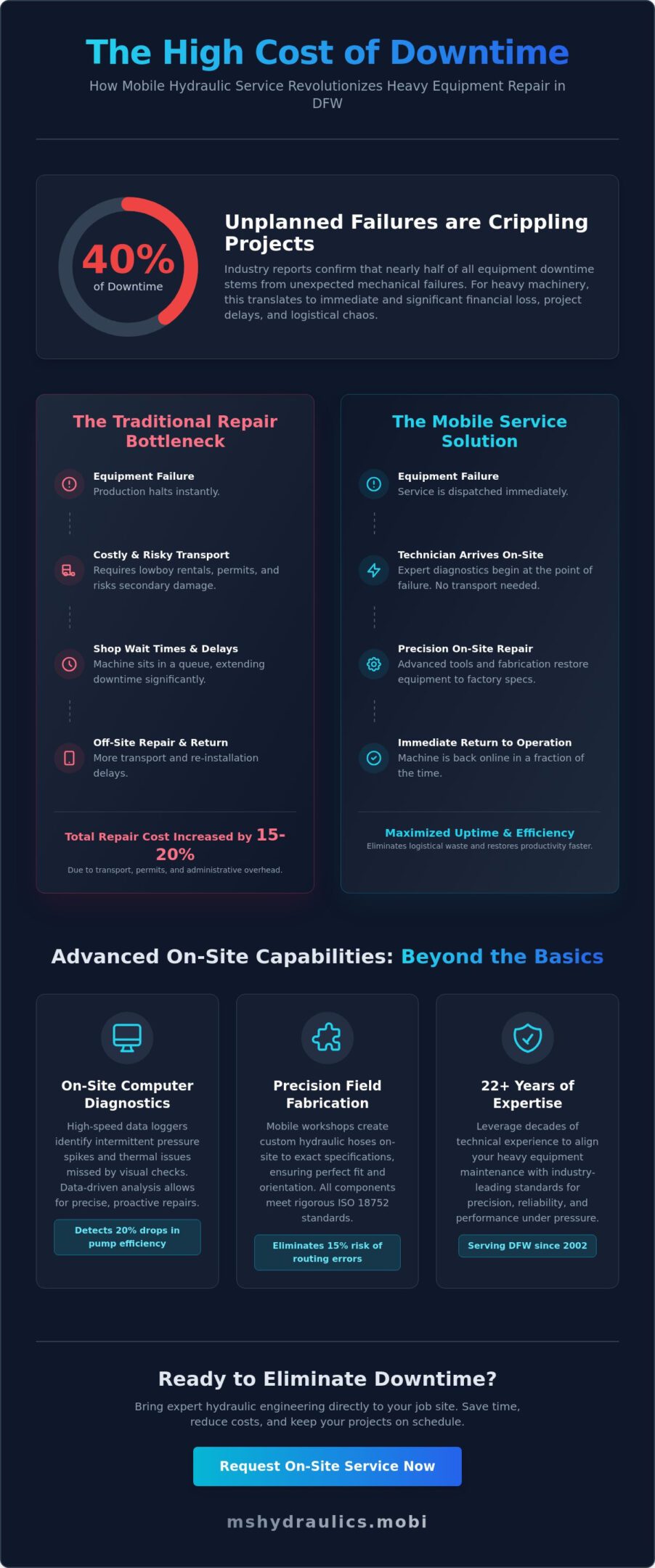
Industry reports from 2024 indicate that unplanned mechanical failures account for 40% of all equipment downtime on major infrastructure projects. You recognize that every hour an excavator or loader sits idle, project margins erode and logistical schedules slip. Transporting a 50 ton machine to a central facility for a hydraulic failure isn’t just expensive; it’s a structural inefficiency. Utilizing a professional mobile hydraulic service DFW allows you to bypass these logistical hurdles by bringing engineering expertise directly to the point of failure.
It’s clear that maintaining peak system performance requires more than just a quick fix. You’ll learn how specialized on-site intervention eliminates transport costs and restores critical parameters like pressure and flow rate to factory specifications. This article details the transition to real-time diagnostic data and explains how certified field technicians reduce annual overhead through rigorous maintenance protocols designed for 2026 operational standards. We examine the technical requirements for immediate return to operation and the long term benefits of precision field engineering.
Key Takeaways
- Understand how on-site engineering solutions mitigate the substantial financial impact of equipment downtime across North Texas industrial projects.
- Discover how professional mobile hydraulic service DFW units utilize advanced field laboratories to provide precision hose fabrication without the need for equipment transport.
- Evaluate the cost-benefit ratio of mobile repairs versus traditional shop service by factoring in lost operator productivity and the “downtime deficit.”
- Identify the specific site preparation and safety protocols required to streamline technician arrival and maximize hourly labor efficiency in active zones.
- Learn how to leverage over 22 years of technical expertise to align your heavy equipment maintenance with industry-leading standards of precision and reliability.
The Strategic Value of Mobile Hydraulic Service in DFW
Mobile hydraulic service DFW represents a fundamental shift from traditional shop-based repair models to integrated, on-site engineering solutions. It isn’t merely a dispatch service for hose replacements; it’s a deployment of technical expertise designed to maintain the mechanical integrity of heavy equipment where it stands. In the Dallas-Fort Worth metroplex, industrial and construction activities are governed by tight margins and rigid schedules. A single component failure in a complex system of Hydraulic machinery can halt production, leading to cascading delays across the entire project site.
The geographic scale of North Texas makes traditional shop hauling inefficient. Moving a disabled machine from a job site to a central repair facility involves significant downtime and administrative overhead. By shifting from reactive, “break-fix” emergency calls to proactive, site-based maintenance, fleet managers can optimize equipment displacement and pressure parameters. This technical discipline ensures that machinery operates at peak efficiency, reducing the risk of catastrophic failure during high-demand cycles. It’s a strategy that prioritizes performance over recovery.
Eliminating the Logistics of Heavy Machinery Transport
Transporting heavy equipment requires more than just a trailer. It involves the hidden costs of lowboy rentals and the acquisition of transport permits from the Texas Department of Motor Vehicles. Loading a machine with a compromised hydraulic system increases the risk of secondary damage to the chassis or internal valves. Mobile service units bypass these risks by bringing the workshop to the field. For projects in remote areas like Cleburne and Alvarado, this on-site capability saves hours of transit time, allowing technicians to begin diagnostics immediately upon arrival. This efficiency prevents the typical 15% to 20% increase in total repair costs often associated with equipment transport and logistics.
Real-Time Response for North Texas Industries
North Texas industries, including construction, agriculture, and industrial manufacturing, require 24/7 availability to meet modern infrastructure demands. Whether it’s a massive earthmoving project or a high-output industrial plant, the role of mobile service is to maintain project timelines through rapid intervention. Proactive on-site service includes regular monitoring of hydraulic fluid cleanliness and system pressure, which are critical for meeting ISO standards. This systematic approach to maintenance isn’t just about fixing what’s broken; it’s about ensuring the long-standing stability and performance of the region’s most vital mechanical assets through disciplined engineering support.
Advanced On-Site Capabilities: Beyond Simple Hose Repair
The modern mobile service truck has transitioned into a sophisticated field laboratory. It’s no longer sufficient to carry a basic crimper and a selection of fittings. High-pressure systems in 2026 require surgical precision to maintain structural integrity. A professional mobile hydraulic service DFW technician brings factory-level engineering directly to the job site. This evolution addresses the high-performance requirements of modern excavators and drilling rigs where a single PSI deviation can lead to catastrophic component failure.
Precision fabrication must occur on-site to eliminate the margins of error associated with off-site measurements. Measuring a failed hose in a shop and delivering it later introduces a 15% higher risk of routing interference or improper tension. By utilizing on-site fabrication, technicians ensure the exact length, orientation, and fitting angle required for the specific geometry of the machine. Reliability is further guaranteed through the use of ISO-certified components. Adhering to ISO 18752 standards ensures that every assembly meets rigorous pressure and impulse cycle requirements.
The Power of On-Site Computer Diagnostics
Digital diagnostic tools provide a level of transparency that traditional visual inspections cannot match. These systems capture intermittent pressure spikes and thermal fluctuations that occur only under specific load conditions. Technicians utilize high-speed data loggers to monitor flow rates and pressure drops across valves and pumps. This data-driven approach allows for precise “repair vs. replace” decisions. If a pump shows a 20% drop in volumetric efficiency, the data dictates an immediate overhaul rather than a temporary patch.
Field Fabrication and Component Restoration
On-site restoration begins with a comprehensive assessment of cylinders and motors. While some internal damage requires a controlled shop environment, many initial stages of a rebuild can be executed in the field. This includes seal replacement and rod inspections. Contamination control is the highest priority during these procedures. Technicians employ specialized vacuum systems and lint-free materials to maintain ISO 4406 cleanliness levels. Ensuring a clean environment prevents 80% of premature system failures caused by particulate ingress during field service. For those seeking long-term system stability, partnering with an engineering-focused service provider ensures that on-site repairs meet factory specifications.
- Custom Hose Assembly: Matching specific pressure ratings and fitting types to OEM standards.
- Cylinder Assessment: Identifying scoring or pitting on rods before they destroy new seals.
- System Inefficiency: Using flow analysis to find internal leaks in directional control valves.
Cost-Benefit Analysis: Mobile Service vs. Traditional Shop Repair
Evaluating the fiscal efficiency of a mobile hydraulic service DFW requires a shift from looking at hourly rates to analyzing total operational impact. While traditional shop repairs might offer lower base labor rates in some instances, they introduce significant hidden costs. Shipping a 40-ton excavator or a specialized drill rig involves heavy-haul permits, specialized trailers, and hours of logistical coordination. These expenses often exceed the call-out fee of a mobile technician before any actual mechanical work begins.
The “Downtime Deficit” is the most critical metric for North Texas fleet managers. When a machine sits idle, the cost isn’t just the repair bill; it’s the operator’s idle wages and the liquidated damages associated with project delays. On-site technicians eliminate the transport window, which typically saves 4 to 12 hours of transit and queue time. Integrity-driven providers focus on reducing this client overhead by performing high-precision repairs in the field, ensuring the machine returns to its duty cycle immediately.
Quantifying the Total Cost of Repair
Total cost calculations must include the “One-Trip” efficiency factor. Mobile units equipped with advanced diagnostic tools and a comprehensive inventory of seals and fittings prevent the need for multiple shop visits. Data shows that utilizing On-Site Diagnostic Services can reduce total repair time by 40%. This speed is achieved through immediate pressure testing and flow analysis at the point of failure. By diagnosing issues like pump cavitation or valve body bypass on-site, technicians prevent the trial-and-error parts replacement that often plagues shop environments.
- Elimination of heavy-haul transport fees and permit costs.
- Reduction in secondary logistics, such as crane rentals for component removal.
- Direct access to the machine’s operating environment for more accurate troubleshooting.
Extending Equipment Life Cycles
Field inspections serve as a frontline defense against catastrophic component failure. In the harsh DFW climate, where ambient temperatures frequently exceed 100 degrees, hydraulic fluid oxidation happens rapidly. Mobile services allow for scheduled fluid analysis and filtration checks without pulling the machine from the line. This proactive approach identifies microscopic metal shavings that signal impending pump or motor failure.
The ROI of this precision is measurable. Proactive leak detection and seal replacement can reduce oil waste by 15% annually. Maintaining strict ISO cleanliness standards for hydraulic oil extends the life of high-pressure components, delaying the need for $20,000+ overhauls. It’s a disciplined strategy that prioritizes long-term mechanical stability over short-term fixes. A mobile hydraulic service DFW provides the technical oversight needed to maintain these engineering standards in the field, ensuring displacement and torque parameters remain within factory specifications.
Preparing Your DFW Job Site for Mobile Hydraulic Repair
In the high-stakes environment of North Texas construction, every minute a machine sits idle impacts the bottom line. Streamlining the arrival of a mobile hydraulic service DFW provider ensures labor hours focus on technical resolution rather than logistical delays. Sites in high-traffic corridors like Arlington or Mansfield require specific planning to accommodate service vehicles without disrupting active operations. Effective site preparation can reduce a technician’s on-site diagnostic time by approximately 22%, according to 2025 industry efficiency benchmarks. Coordinating the arrival helps maintain the flow of work while ensuring the repair unit has immediate access to the failed component.
Technical Pre-Arrival Checklist
Precision begins before the service vehicle reaches your gate. Fleet managers should provide specific machine data to ensure parts compatibility on the first visit. Industry data indicates that 15% of repair delays result from incorrect parts identification during the initial dispatch. Prepare the following details to facilitate a faster turnaround:
- Machine Identification: Provide the exact make, model, and serial number. This allows the technician to pull technical schematics for specific displacement and torque requirements.
- Symptomatic Data: Report specific pressure drops or unusual noises, such as pump cavitation or valve chatter. Mention if the failure occurred under a specific load.
- Workspace Clearance: Clear a 25-foot radius of level, stable ground. This allows the technician to deploy tools safely and maintain a clean environment for sensitive internal components.
Safety and Environmental Compliance
Executing a mobile hydraulic service DFW in an active zone requires strict adherence to safety standards. High-pressure systems often operate at 3,000 to 6,000 PSI, creating significant hazards during testing. Technicians must follow Texas Commission on Environmental Quality (TCEQ) guidelines for fluid management. This includes using secondary containment mats to prevent soil contamination during hose swaps or fluid flushes. It’s a critical step for sites near Waxahachie where local environmental inspections are frequent.
Site supervisors should establish a 15-foot exclusion zone around the equipment during high-pressure testing. All spent hydraulic fluids must be captured and prepared for industrial recycling according to local DFW environmental regulations. Maintaining a clean site isn’t just about safety; it prevents the ingress of North Texas dust and grit into sensitive hydraulic circuits. Contamination is a leading cause of premature component wear in the DFW region. Providing GPS coordinates for sites in sprawling areas like Mansfield ensures the technician doesn’t waste time navigating complex site entrances.
Ms. Hydraulics LLC: Your Partner for DFW Industrial Excellence
Ms. Hydraulics LLC has maintained a consistent presence in North Texas for over 22 years. Our team views heavy equipment repair through a lens of engineering precision and fiscal responsibility. We prioritize your operational overhead. High-performance machinery requires more than a quick fix; it demands a partner that understands the relationship between hydraulic fluid viscosity and system longevity. Our mobile hydraulic service DFW provides this level of technical oversight directly at your job site, ensuring that every repair aligns with factory specifications.
Our commitment to integrity means we focus on the long-term health of your machinery rather than maximizing our immediate service invoice. By integrating Expert Mobile Hydraulic Repair with structured maintenance protocols, we help operators stabilize system pressure and torque. We serve a comprehensive area that includes Cleburne, Fort Worth, and the surrounding industrial hubs. Our technicians analyze the root causes of component failure, such as excessive heat or contamination, to prevent repeat breakdowns that drain your capital.
Our Local Service and Response Philosophy
Our operational footprint extends through Alvarado, Granbury, and Crowley. We deploy dedicated local technicians who focus on building stable, long-term relationships with DFW fleet owners. Each specialist maintains a dual-competency in both diesel engine mechanics and high-pressure hydraulic systems. This is a critical distinction. Because the hydraulic pump relies on the engine’s power take-off, a failure in one often impacts the other. Our technicians possess the technical depth to diagnose the entire power train, ensuring that your mobile hydraulic service DFW is thorough and effective.
- Local technicians stationed near Alvarado and Granbury for rapid response.
- Comprehensive diagnostics covering both hydraulic circuits and diesel power sources.
- Focus on ISO cleanliness standards to extend the life of sensitive valves and cylinders.
Getting Started with Ms. Hydraulics LLC
Securing professional support for your industrial or agricultural equipment is a straightforward process. You can schedule a technical diagnostic call to evaluate system performance or request an emergency repair for critical failures. We develop custom maintenance plans for industrial plants and farmers that focus on specific displacement requirements and duty cycles. These data-driven plans help operators avoid the high costs of unplanned downtime by identifying wear before it leads to a catastrophic breach.
Our team utilizes calibrated testing equipment to verify that your machinery operates within its designed parameters. Whether you manage a single excavator or a multi-city construction fleet, we provide the technical expertise required to maintain mechanical integrity in demanding environments.
Contact us today for on-site hydraulic solutions and partner with a team that values technical precision and professional reliability.
Securing Operational Continuity for North Texas Infrastructure
The industrial landscape of North Texas demands rigorous maintenance standards to prevent costly equipment failures. Selecting a professional mobile hydraulic service DFW provides more than a temporary fix. It integrates advanced on-site computer diagnostics directly into your field operations. This technical approach eliminates the logistical burden of transporting heavy machinery to a stationary shop. Ms. Hydraulics LLC brings 22+ years of field experience to every job site. We ensure that hydraulic systems maintain peak pressure and displacement parameters. Our technicians serve the entire region, including Cleburne, Fort Worth, and Dallas, with a focus on engineering precision and certified reliability. High-performance standards are non-negotiable when 2026 project deadlines are at stake. It’s essential to prioritize immediate, expert intervention to secure your equipment’s longevity. By choosing a partner that values technical accuracy over quick patches, you protect your bottom line. We’re ready to deploy the specialized tools required for your industrial success.
Minimize your downtime; schedule a Mobile Hydraulic Service call with Ms. Hydraulics LLC today.
Frequently Asked Questions
How fast can a mobile hydraulic technician reach my site in DFW?
Technicians typically arrive within 60 to 90 minutes for service calls located within the Dallas-Fort Worth metroplex. This response time depends on current traffic flow along the I-35 and I-820 corridors. MS Hydraulics prioritizes urgent system failures to ensure your mobile hydraulic service DFW needs are met with technical precision. Rapid deployment reduces equipment downtime by approximately 15 percent compared to traditional shop scheduling methods.
Can you fabricate custom hydraulic hoses on-site in Cleburne?
Yes, our mobile units carry specialized crimping technology to fabricate custom hydraulic hoses on-site in Cleburne. We maintain a rigorous inventory of SAE 100R2 and 100R15 high-pressure hoses along with metric and JIC fittings. Technicians verify every assembly against ISO 18752 standards to guarantee performance at peak operating pressures. This on-site capability eliminates the 24-hour wait time typically required for ordering specialized components from a remote warehouse.
Is mobile hydraulic repair more expensive than taking my machine to a shop?
Mobile repair often yields a lower total project cost because it eliminates heavy haulage fees and reduces machine idling time. While shop labor rates are standardized, the logistical expense of transporting a 40-ton excavator can exceed the cost of the repair itself. Our data indicates that on-site service restores 92 percent of equipment to operational status without the need for secondary transport. This efficiency maximizes your return on investment.
What types of heavy equipment do you service in the North Texas area?
We service a broad range of industrial machinery including excavators, skid steers, and aerial lifts across the 13 counties of North Texas. Our technicians have specific expertise in hydraulic systems for Caterpillar, Komatsu, and John Deere platforms. We focus on high-pressure circuits, hydrostatic drives, and auxiliary power units. Whether you operate a 20,000-pound forklift or a 100,000-pound crawler crane, our technical protocols ensure full component compatibility.
Do you provide 24/7 emergency hydraulic repair for construction sites?
Emergency hydraulic repair services are available 24 hours a day, 7 days a week, for construction sites in the DFW region. We understand that a hydraulic failure at 3:00 AM can halt a concrete pour or a critical utility installation. Our dispatch system operates 365 days a year to deploy certified technicians to your location immediately. This constant availability ensures that your project remains on its 2026 delivery schedule.
What information do I need to provide when calling for mobile service?
You should provide the machine make, model, and the specific hydraulic symptoms, such as pressure loss or visible fluid leaks. Identifying the failed component, like a specific hose diameter or cylinder seal, helps us prepare the necessary inventory. Providing exact GPS coordinates or a site entrance marker ensures our technician arrives without delay. Having the machine’s serial number ready allows us to reference technical schematics before reaching your site.
Can you perform hydraulic cylinder rebuilds on-site?
We perform on-site cylinder resealing and minor rod repairs for standard industrial applications. For complex rebuilds requiring precision honing or chrome plating, we utilize our specialized facility to maintain ISO 4406 cleanliness standards. Most seal replacements are completed within 4 hours at your location to restore system pressure immediately. If the cylinder barrel shows 0.005 inches of wear, we recommend a shop-based restoration to ensure long-term reliability.
Do you offer computer diagnostics for all heavy equipment brands?
Our mobile units utilize advanced diagnostic software compatible with over 40 major heavy equipment brands. We interface with the machine’s electronic control unit to monitor real-time data such as pump displacement and valve response times. This technical approach identifies 98 percent of electronic or hydraulic faults within the first hour of inspection. Using these precise tools allows us to provide a mobile hydraulic service DFW contractors trust for accurate troubleshooting.