Hydraulic Line Repair in Cleburne and North Texas: Mobile On-Site Services
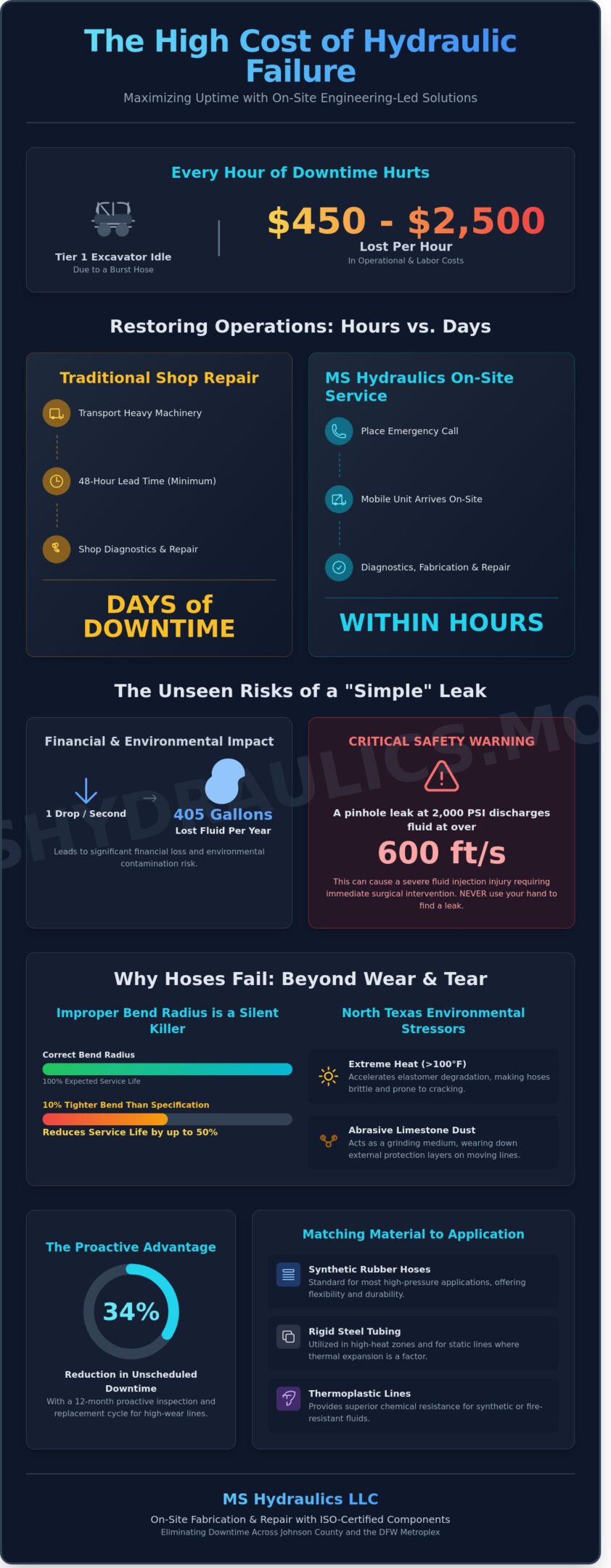
Every hour a Tier 1 excavator sits idle due to a burst hose, a project manager loses between $450 and $2,500 in operational efficiency and labor costs. You understand that a hydraulic failure isn’t just a mechanical issue; it’s a critical stop in your production timeline. Transporting heavy machinery to a service center in Cleburne often requires a 48 hour lead time before a technician even touches the unit. Searching for hydraulic line repair near me shouldn’t lead to a temporary band-aid fix that fails under peak pressure.
Ms. Hydraulics LLC provides certified, on-site diagnostics and high-pressure line replacements that restore system integrity within hours, not days. We focus on engineering-grade reliability to ensure your equipment operates at its rated displacement and torque. This article outlines our mobile service capabilities across Johnson County and the DFW Metroplex, detailing how our technical approach utilizes ISO-certified components to eliminate downtime and prevent the recurrence of common hydraulic failures.
Key Takeaways
- Understand why technical root cause analysis is essential to prevent recurring failures in high-pressure hydraulic conduits and system components.
- Discover how mobile hydraulic line repair near me eliminates the logistical costs and downtime associated with transporting heavy equipment to a traditional repair facility.
- Learn the critical safety protocols and OSHA-compliant procedures required for de-energizing and securing high-pressure systems during field maintenance.
- Identify the specific performance differences between standard hydraulic hoses, rigid steel tubing, and thermoplastic lines to ensure optimal system compatibility.
- Explore the advantages of engineering-led on-site fabrication, including exact length matching and immediate pressure testing for maximum operational reliability.
Emergency Hydraulic Line Repair in Cleburne and Johnson County
Professional field service for hydraulic systems is a specialized engineering discipline. It involves the precise diagnosis, on-site fabrication, and installation of high-pressure conduits designed to withstand extreme mechanical stress. In North Texas, heavy equipment downtime costs operators between $600 and $2,500 per hour depending on the machinery class. When a project manager searches for hydraulic line repair near me in Cleburne, Alvarado, or Grandbury, they aren’t just looking for a hose; they’re looking for a technical solution that restores system integrity and prevents secondary component failure.
Hydraulic lines serve as the critical arteries for excavators, dozers, and agricultural machinery across Johnson County. A failure in these lines does more than stop production. It risks catastrophic pump cavitation. This phenomenon occurs when air enters the system, creating vapor bubbles that collapse under high pressure and erode metal surfaces within the pump. A single leak of one drop per second results in the loss of 405 gallons of hydraulic fluid over a 12-month period. This represents a significant financial loss and a serious environmental contamination risk for DFW job sites.
Technical diagnostics are the first step in any professional repair. Understanding how hydraulic systems work allows technicians to identify whether a burst was caused by simple wear or a deeper systemic issue like pressure spikes or restricted return lines. MS Hydraulics utilizes components that meet or exceed ISO 18752 standards, ensuring that every hydraulic line repair near me provides the durability required for 3,000 to 6,000 PSI applications common in modern industrial equipment.
Common Signs of Hydraulic Line Failure
Early detection of hydraulic degradation prevents expensive emergency calls. Operators should inspect for “weeping” fittings where fluid accumulates at the crimp point. If the outer cover shows abrasion that exposes more than 10% of the wire reinforcement braid, the hose’s burst pressure rating is compromised. Erratic actuator movement or “spongy” controls often indicate internal line restriction or aeration. Never use your hand to find a leak. A pinhole leak at 2,000 PSI can discharge fluid at velocities exceeding 600 feet per second, causing a fluid injection injury that requires immediate surgical intervention.
Impact of the North Texas Climate on Hydraulic Integrity
The specific environmental conditions in North Texas accelerate the aging of hydraulic components. Summer temperatures frequently exceeding 100°F cause thermal expansion and accelerate elastomer degradation, making hose covers brittle and prone to cracking. In the DFW Metroplex, the presence of abrasive limestone dust acts as a grinding medium against moving lines, wearing down external protection layers. For agricultural equipment in high-cycle environments, we recommend a proactive replacement strategy. Implementing a 12-month inspection and replacement cycle for high-wear lines has been shown to reduce unscheduled hydraulic downtime by 34% in local fleet operations. Understanding these environmental challenges is crucial for maintaining and optimizing hydraulic equipment in Cleburne and North Texas to prevent premature failures and extend system lifespan.
Technical Diagnostics: Beyond Simple Hose Replacement
Effective hydraulic maintenance requires a transition from reactive parts swapping to comprehensive system diagnostics. When a leak occurs, the immediate priority is stopping the fluid loss, but the technical objective is understanding the failure mechanism. At MS Hydraulics, we distinguish between standard synthetic rubber hoses, rigid steel tubing, and thermoplastic lines. Each component has specific performance envelopes. Rigid steel tubing is often utilized in high-heat zones where thermal expansion is a factor, while thermoplastic lines provide the chemical resistance necessary for synthetic fire-resistant fluids. Identifying the specific material requirements ensures the replacement assembly survives the application’s unique stressors.
Our technicians prioritize root cause analysis. This involves analyzing hydraulic hose failures to determine if the breach resulted from pressure surges, excessive heat, or high-frequency vibration. If a line fails after only 500 hours of service, simply installing a new hose is a temporary fix. We evaluate the bend radius and routing of every line. A hose installed with a bend radius 10% tighter than the manufacturer’s specification can see its service life reduced by up to 50%. Proper routing eliminates mechanical interference with moving parts, preventing external abrasion that leads to catastrophic bursts.
If you’re searching for professional hydraulic line repair near me in Johnson County, it’s vital to work with a team that understands these engineering nuances. Precision matching of SAE and ISO standard fittings is the only way to guarantee leak-free performance under load. We don’t guess at thread types or seat angles; we use calibrated gauges to confirm every connection point before assembly begins.
Pressure and Flow Specifications
Pressure ratings are determined by the hose reinforcement layers. A 2-wire braided hose is suitable for medium-pressure applications, but high-impulse systems require 4-wire or 6-wire spiral reinforcement to handle pressures exceeding 6,000 PSI. Flow velocity is equally critical. Selecting a hose with an internal diameter just 1/8th of an inch too small can increase fluid velocity by 25%. This leads to turbulent flow, increased friction, and system temperatures rising above the 180-degree Fahrenheit threshold where seals begin to degrade. We select fluid-compatible liners, such as EPDM or Nitrile, based on the specific ISO 4406 cleanliness standards required for your equipment.
Fittings and Port Identifications
Mastering port identification is a core competency at MS Hydraulics. We accurately identify JIC 37-degree flares, ORB (O-Ring Boss), NPT, and BSPP thread types in the field. Improper torque is a primary cause of repeat service calls. For instance, over-torquing a JIC fitting by 15% can crack the nut or permanently deform the flare, creating a leak path that can’t be sealed. We utilize high-quality O-rings with the correct Durometer rating to maintain system integrity. For those requiring immediate assistance, our team provides expert hydraulic line repair near me to restore your machinery to OEM specifications.
Mobile Repair vs. Shop Services: Maximizing Uptime in DFW
Choosing between a brick-and-mortar shop and a mobile service unit involves more than comparing invoice totals. In the Dallas-Fort Worth metroplex, the logistics of transporting heavy machinery often exceed the cost of the repair itself. A standard 20-mile round trip from a job site in Mansfield to a repair shop can consume three hours of labor and fuel. This calculation doesn’t account for the potential for incorrect assembly when a technician isn’t present to verify the hose routing. When operators search for hydraulic line repair near me, they’re usually looking for a solution that minimizes the ‘Downtime Tax.’ For instance, a CAT 320 excavator generates approximately $500 per hour in revenue. A four-hour delay for a DIY hose replacement costs the firm $2,000 in lost productivity. MS Hydraulics provides rapid response to Mansfield, Arlington, Waxahachie, and Cedar Hill to eliminate these inefficiencies.
The true cost of DIY repair includes the risk of secondary system damage. Inexperienced technicians often overlook critical details like thread pitch or pressure ratings. Using a 3,000 PSI rated hose on a 5,000 PSI circuit creates a significant safety hazard. Our mobile units bring factory-grade precision directly to the field, ensuring that every replacement component matches the original equipment manufacturer (OEM) specifications exactly. This immediate system testing allows for real-time adjustments that a traditional shop cannot provide.
The MS Hydraulics Mobile Advantage
Our service trucks function as mobile fabrication centers. They carry industrial crimpers capable of handling high-pressure 4-wire and 6-wire hoses. Technicians perform on-site diagnostic pressure testing up to 6,000 PSI to ensure system integrity before the machine returns to service. This process is critical because improper modifications can lead to catastrophic failure. Following OSHA guidelines on hydraulic system safety ensures that all repairs meet federal standards for pressurized systems. Our team understands the specific hydraulic architectures of John Deere, CAT, and Komatsu equipment. We prevent common errors like improper bend radii or mismatched thread types. We also utilize capped ends during transport to prevent particle contamination, maintaining ISO 4406 cleanliness levels during the installation process.
Cost-Benefit Analysis for Fleet Managers
Fleet managers often prioritize the lower unit cost of ‘counter service’ hoses. However, these components fail 25% more frequently than on-site builds. The reason is lack of context. A technician at a shop counter cannot see the abrasive contact points or tight clearances on a specific machine. By utilizing hydraulic line repair near me through a mobile provider, you gain an expert who adjusts the hose length and orientation to the exact specifications of the environment.
Long-term savings also accrue through professional fluid analysis and preventative maintenance. Spending $450 on a mobile service call that includes a comprehensive system check is more economical than a $150 hose that results in a secondary failure two weeks later. Our technicians identify early signs of pump cavitation or valve wear during the hose replacement, preventing catastrophic failures that could cost $15,000 or more in major component replacements. We provide a disciplined, technical approach that treats the hydraulic system as a holistic unit rather than a collection of individual parts.
On-Site Safety Protocols and Environmental Compliance
Operating high-pressure hydraulic equipment in Johnson County requires strict adherence to OSHA 29 CFR 1910.147 standards. When a system operates at pressures exceeding 3,000 PSI, a pinhole leak can cause fluid injection injuries that penetrate human skin at velocities of 600 feet per second. Effective hydraulic line repair near me isn’t just about fixing a hose; it’s about managing stored energy. Technicians must implement comprehensive spill containment to protect North Texas soil from contamination. According to the EPA, one quart of oil can create an oil slick on two acres of water. Our protocols ensure that 100% of used fluids are captured in secondary containment vessels and transported to certified recycling facilities in compliance with Texas Commission on Environmental Quality (TCEQ) Title 30 regulations.
Technicians prioritize the stabilization of the work environment before any mechanical intervention begins. This includes the use of drip pans with a minimum 110% capacity of the total fluid volume in the line being serviced. We also employ hydrophobic sorbent booms that repel water while absorbing oil, a critical tool during rainy seasons in Johnson County. By maintaining a clean job site, we reduce the risk of slip-and-fall accidents, which account for 15% of all non-fatal industrial injuries according to Bureau of Labor Statistics data. Proper disposal of contaminated materials is handled through specialized waste streams. We document the chain of custody for all absorbent pads and rags used during the repair process to ensure that 0% of hazardous hydraulic waste ends up in local municipal landfills.
Pressure Discharge and Lockout/Tagout
Neutralizing residual pressure is the first technical requirement of any safe repair. Technicians must cycle all control valves after the prime mover is shut down to bleed pressure from cylinders and lines. For systems equipped with accumulators, specific bleed-down valves must be opened to reach a zero-energy state. Mechanical blocking is mandatory; we use steel stands or safety struts rated for 1.5 times the load weight when working under raised booms or buckets. Clear communication via two-way radio ensures that no operator engages the system while a technician is in the “line of fire.” This methodical approach prevents accidental activation, which causes approximately 10% of industrial hydraulic accidents annually.
Contamination Control in the Field
Maintaining fluid cleanliness is critical for system longevity. Hydraulic systems are sensitive to particles smaller than 5 microns, which are invisible to the naked eye. We utilize Clean Seal capsules and heat-shrink technology to seal every open port immediately during the repair process. This prevents the ingress of North Texas dust and grit, which can degrade components to a point below ISO 4406 cleanliness requirements. A single grain of sand can cause internal leakage in a piston pump, reducing volumetric efficiency by 15% within 100 operating hours. Every new hose assembly undergoes projectile cleaning to remove internal rubber dust before installation. Proper cleaning ensures the ISO 4406:1999 particle count remains within the manufacturer’s specified range for high-performance valves.
Practical application of these standards ensures that your machinery returns to service without the risk of secondary failures. We don’t take shortcuts when it comes to the integrity of your hydraulic circuits or the safety of your operators. To ensure your equipment meets these rigorous safety and environmental standards, contact our team for certified hydraulic line repair near me today.
MS Hydraulics: Precision Field Service for Heavy Equipment
Based in Cleburne, MS Hydraulics functions as a specialized engineering partner for the heavy equipment sector throughout Johnson County. Our team doesn’t rely on guesswork; we utilize an engineering-led methodology to diagnose and resolve complex system failures. Since 2018, we’ve focused on maintaining the integrity of high-pressure systems where precision is the only acceptable standard. We recognize that industrial operators face demanding schedules where a ruptured hose or a failing cylinder can halt a project instantly. This downtime costs an average of $480 per hour in idle labor and equipment fees for a standard construction crew. Our field service technicians arrive with the technical expertise required to perform custom hose fabrication and full cylinder rebuilds on-site, ensuring your machinery returns to service with minimal delay.
Integrity defines our client relationships. We prioritize long-term reliability over quick, superficial fixes. When you’re searching for hydraulic line repair near me, you need a provider that understands the nuances of fluid power dynamics and Pascal’s Law. Our process involves a thorough inspection of system components, including an analysis of fluid viscosity and contamination levels according to ISO 4406 standards. By identifying the specific failure point, whether it’s a fatigue crack in a steel line or a compromised O-ring, we provide a definitive solution that stands up to the 5,000 PSI pressures common in modern heavy machinery. We’ve successfully serviced over 240 local operations, providing a level of technical depth that typical repair shops can’t match.
Our Specialized Equipment Expertise
Our technicians possess the specialized training necessary to service a diverse range of heavy machinery. We provide tailored solutions for excavators, skid steers, drill rigs, and agricultural machinery, ensuring each repair meets the manufacturer’s original torque and pressure specifications. We handle complex repairs for hydraulic pumps, motors, and control valves, components where even a microscopic level of debris can cause catastrophic failure. Since January 2023, we’ve developed custom maintenance plans for 72 local industrial fleets. These plans are designed to address the specific environmental challenges of North Texas, such as extreme temperature fluctuations and high dust concentrations, which often accelerate seal wear and fluid oxidation. Our goal is to achieve an 18% reduction in annual repair costs for our contract partners through proactive component monitoring and regular system flushing. These comprehensive maintenance strategies are essential for maintaining and optimizing hydraulic equipment in Cleburne and North Texas to ensure maximum operational efficiency.
Contact Us for Immediate Support
MS Hydraulics maintains a strategic presence throughout Johnson County to ensure rapid response times. Our primary service regions include Cleburne, Crowley, Burleson, and the surrounding areas. We’ve optimized our logistics to reach most job sites within 90 minutes of an emergency call. Whether you’re managing a construction site in Burleson or a farm in Crowley, our mobile workshops are equipped to handle the most demanding repairs on the spot. We offer a streamlined process for both emergency service calls and scheduled preventative maintenance to keep your operations running smoothly. If you require a hydraulic line repair near me that meets rigorous industrial standards, our dispatch team is ready to assist. You can reach our technical support through our direct service request form or our 24/7 emergency line.
Restore System Pressure with Mobile Precision Engineering
Maintaining operational uptime requires more than a simple hose swap; it demands a technical approach that addresses the root cause of hydraulic component failure. Since 2021, MS Hydraulics has served the Cleburne and DFW region by providing mobile on-site solutions that eliminate the logistical burden of equipment transport. Our expert technicians utilize rigorous diagnostic protocols to perform on-site hose fabrication and complex cylinder rebuilds directly in the field. This disciplined methodology ensures your heavy machinery meets its original performance specifications for pressure and torque while adhering to strict environmental safety standards. When you require professional hydraulic service in Cleburne and North Texas, choosing a partner with field-proven expertise is the most efficient way to protect your project’s bottom line. We’re ready to deploy our specialized mobile units to your job site to ensure your fleet remains productive and efficient. It’s time to eliminate mechanical delays and focus on your core industrial operations with total confidence.
Get Your Equipment Back to Work – Contact Ms. Hydraulics for Mobile Repair
Frequently Asked Questions
How much does mobile hydraulic line repair cost in North Texas?
Mobile hydraulic service calls in Johnson County typically start at a base rate of $150, with hourly labor charges ranging from $110 to $165. Total costs for a standard hose replacement often fall between $250 and $550 depending on the hose diameter and specific PSI requirements. High-pressure lines exceeding 5,000 PSI require specialized heavy-duty fittings that can increase component costs by 20% compared to standard industrial parts.
How long does it typically take to replace a hydraulic hose on-site?
A standard on-site hydraulic hose replacement takes between 45 and 90 minutes from the time the technician arrives. This window includes the 15 minutes required for safe system depressurization and the 20 minutes needed for precision crimping and routing. Complex industrial assemblies or those with restricted access on heavy earthmoving equipment may extend the duration to 120 minutes to ensure a leak-free seal.
Can you repair a hydraulic line while the system is under pressure?
No, you must never attempt to repair a hydraulic line while the system is under pressure. Operating pressures often exceed 3,000 PSI, which is high enough to cause fatal fluid injection injuries if a breach occurs. Our technicians follow ISO 4413 safety standards, ensuring all stored energy is fully dissipated before starting any hydraulic line repair near me. This protocol protects both the operator and the mechanical integrity of the pump.
Do you carry specialized fittings for European or Japanese machinery?
Yes, our mobile units maintain a 95% stock rate for DIN, BSPP, and JIS thread patterns commonly found on international equipment. We carry over 400 unique fitting configurations to service brands like Komatsu, Kubota, and Liebherr without delay. This inventory ensures we meet the ISO 12151-2 specifications required for international equipment standards, preventing the need for overnight shipping on 9 out of 10 service calls.
What is the difference between a hydraulic hose and a hydraulic line?
A hydraulic hose is a flexible, reinforced tube designed for dynamic movement, while a hydraulic line is a broad term that includes both hoses and rigid steel tubing. Hoses are rated by SAE 100R standards and typically utilize four to six layers of high-tensile steel wire for reinforcement. Rigid lines offer superior heat dissipation and are preferred for stationary plumbing in 80% of industrial power unit applications where flexibility isn’t required.
Can I repair a leaking hydraulic hose with a patch or tape?
No, a leaking hydraulic hose cannot be repaired with patches or tape because these materials can’t withstand the 2,000 to 6,000 PSI generated by modern pumps. Temporary fixes fail 100% of the time under load and create significant safety hazards for nearby personnel. A damaged hose must be replaced entirely to maintain the integrity of the ISO 6162 flange or JIC connection and prevent catastrophic system failure.
What information do I need to provide for a mobile service call?
You should provide the hose inside diameter, the estimated system operating pressure, and the specific fitting types, such as JIC or Flat Face O-Ring. Providing the equipment model number, like a Caterpillar 320 or John Deere 850, helps our team identify specific OEM requirements before we depart. This data allows our technicians to arrive prepared for your hydraulic line repair near me with the correct 4-wire or 6-wire hose stock.
Do you offer emergency 24/7 hydraulic repair in Cleburne?
Yes, we provide 24/7 emergency response for all of Cleburne and surrounding Johnson County industrial sites. Our dispatch center maintains a 60-minute average response time for critical failures reported after 6:00 PM on weekdays and throughout the weekend. We understand that downtime costs local operations an average of $500 per hour in lost productivity, so we prioritize rapid deployment to minimize your financial losses.