Professional Hydraulic Service in Cleburne & North Texas: Engineering Solutions for Heavy Equipment (2026)
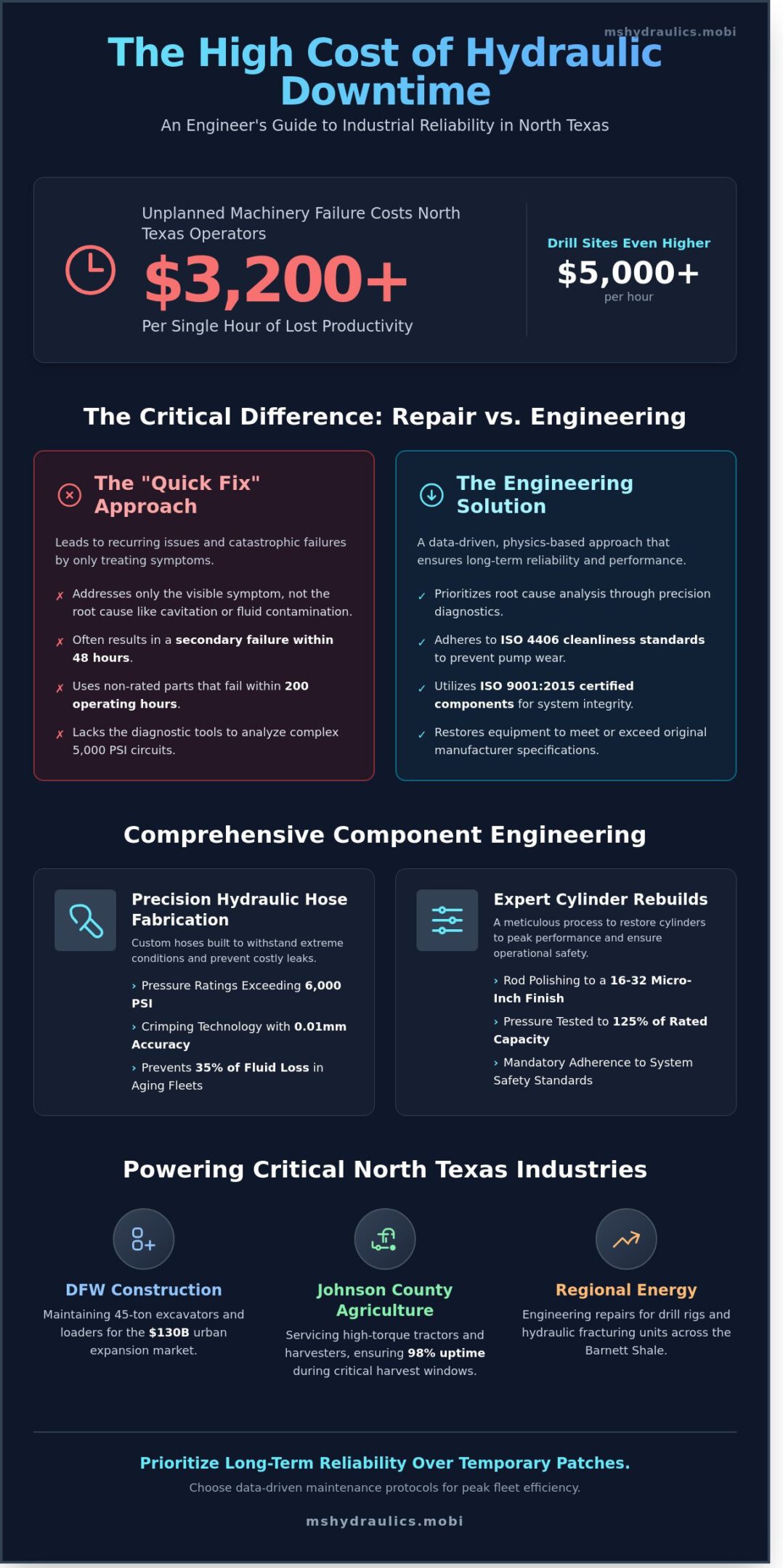
A single hour of unplanned machinery failure on a North Texas industrial site can cost operators more than $3,200 in lost productivity. This financial burden often stems from a fundamental misunderstanding of system requirements. Professional hydraulic service requires more than basic mechanical intuition; it demands a precise engineering approach to pressure, torque, and fluid dynamics. You’ve likely seen how a quick fix from an unqualified mechanic leads to a secondary failure within 48 hours. It’s frustrating to pay for a repair that doesn’t address the root cause of component wear or pump cavitation.
We’re here to change that expectation. You’ll discover how expert engineering interventions minimize downtime and restore your equipment to its original performance specifications. We’ll provide a detailed look at mobile repair capabilities in Cleburne and analyze the data behind repair versus replacement costs for 2026. This technical overview ensures your fleet maintains peak efficiency through certified, data-driven maintenance protocols that prioritize long-term reliability over temporary patches.
Key Takeaways
- Understand the technical requirements of professional hydraulic service and how engineering-led diagnostics prevent recurring system failures in heavy machinery.
- Compare the logistical advantages and cost-efficiencies of 24/7 mobile repair units versus traditional shop-based servicing for large-scale industrial equipment.
- Learn the rigorous technical standards required for precise hydraulic hose fabrication and cylinder rebuilds to ensure long-term operational integrity.
- Identify the critical certifications and inventory standards you must verify when selecting a reliable industrial partner in North Texas.
- Discover how localized expert support in Johnson County can minimize costly downtime through rapid-response mobile engineering solutions.
Defining Professional Hydraulic Service for North Texas Industries
Professional hydraulic service is a specialized engineering discipline, not a simple mechanical adjustment. It requires an exact understanding of Hydraulics, thermal dynamics, and component metallurgy. In North Texas, where heavy machinery supports a $130 billion construction market as of 2025, the reliability of these systems is critical. A standard mechanic can change a filter, but they often lack the diagnostic tools to identify cavitation or internal bypass issues in a 5,000 PSI circuit. Effective hydraulic service involves a rigorous cycle of precision diagnostics, custom component fabrication, and full-system rebuilds to ensure equipment meets or exceeds original manufacturer specifications. By 2026, the integration of electronic sensors into traditional fluid circuits has made professional oversight even more vital for preventing total system collapse.
The Difference Between Repair and Engineering
Engineering focuses on the physics of fluid motion and pressure containment. When a 350-bar system fails, the cause is rarely a single seal; it’s usually a symptom of fluid contamination or heat-induced viscosity breakdown. We utilize ISO 9001:2015 certified components to maintain system integrity. Quick fixes using non-rated parts often lead to catastrophic failure within 200 operating hours. Our approach prioritizes 100% adherence to ISO 4406 cleanliness standards to prevent premature pump wear. This methodical process ensures that every component, from the smallest valve to the largest cylinder, operates within its intended performance envelope.
Key Industries Served in Cleburne and Johnson County
Our technical protocols support the specific demands of North Texas heavy industry. We provide specialized engineering support for several critical sectors:
- DFW Construction: Maintaining 45-ton excavators and loaders that drive urban expansion projects across the metroplex.
- Johnson County Agriculture: Service for high-torque tractors and harvesters in Alvarado and Grandbury that require 98% uptime during harvest windows.
- Regional Energy: Engineering repairs for drill rig systems and hydraulic fracturing units operating across the Barnett Shale.
For instance, specialized contractors in sectors like asphalt paving lubbock tx depend on the operational readiness of their heavy machinery to complete time-sensitive infrastructure projects.
Precision is our baseline. These sectors don’t have room for error. A single hour of downtime on a drill site can cost upwards of $5,000 in lost productivity. We eliminate that risk through rigorous testing and engineering excellence. Every rebuild undergoes a multi-point pressure test to verify performance under load before it leaves our facility.
Comprehensive Component Repair: From Hose Fabrication to Cylinder Rebuilds
High-performance heavy equipment depends on the structural integrity of individual components. A professional hydraulic service must address the micro-tolerances of each part to prevent catastrophic system failure. When a single seal or hose fails, it’s not just a part that breaks; it’s an entire project that stops. Precision engineering at the component level ensures that North Texas industrial operations maintain 99% uptime through rigorous maintenance protocols.
Precision Hydraulic Hose Fabrication
Standard hose fabrication involves matching wire-braid or spiral-reinforced materials to specific pressure ratings, often exceeding 6,000 PSI for Tier 4 machinery. Selecting the wrong hose material leads to premature degradation when exposed to high-temperature fluids or external abrasion. Custom hose fabrication utilizes specific fitting types such as JIC, ORFS, and BSPP to ensure a secure, high-pressure connection between system components. Using specialized crimping technology calibrated to 0.01mm accuracy prevents the leaks that cause 35% of fluid loss in aging fleets.
Cylinder Rebuilds: Disassembly and Testing
Rebuilding a hydraulic cylinder requires more than just replacing O-rings. Technicians must inspect the rod for pitting and straightness; polishing the rod to a 16-32 micro-inch finish ensures seal longevity and prevents external contamination. Adhering to hydraulic system safety standards is mandatory during the final pressure testing phase, where cylinders are cycled at 125% of their rated working pressure to verify seal integrity. For specialized heavy equipment cylinder rebuild Texas requirements, rigorous testing ensures the unit handles extreme loads without bypass leakage. This methodical approach identifies internal cracks that visual inspections often miss.
Pump and Motor Maintenance
Diagnosing pump failure starts with analyzing internal wear patterns. Cavitation often leaves distinct pitting on the valve plate, indicating air ingestion or fluid starvation. Restoring torque and displacement to factory specifications involves lapping wear surfaces to within two light bands of flatness. If internal components show more than 0.005 inches of material loss, a full unit replacement is usually more cost-effective than repair to maintain the 95% volumetric efficiency required for modern industrial applications. Technical data provided by MS Hydraulics helps fleet managers determine the exact point where repair costs exceed the value of a new component. This data-driven strategy eliminates the guesswork from hydraulic service and ensures long-term reliability for Cleburne’s heavy machinery.
Mobile vs. Shop-Based Hydraulic Service: Which Minimizes Your Downtime?
Selecting the optimal delivery method for hydraulic service impacts both mechanical precision and your project’s bottom line. Transporting a 35,000-pound machine from a Cleburne job site to a centralized facility typically incurs $850 to $1,400 in logistics costs. Mobile units mitigate these expenses by bringing 95% of necessary diagnostic tools directly to the field. These vehicles are equipped with 5,000 PSI test gauges and high-capacity crimping systems, allowing for immediate repairs that bypass the 4-hour average transport window.
While field repairs are efficient, certain engineering requirements necessitate a shop environment. We utilize our shop for tasks requiring ISO-certified cleanliness or heavy machining. If a cylinder rod requires induction hardening or a barrel needs honing to a 16-microinch finish, the controlled environment of a facility is mandatory. Precision machining involves tolerances within 0.001 inches; achieving this level of accuracy isn’t feasible in high-wind or dusty field conditions found across North Texas.
Our emergency response strategy focuses on the Cleburne-Arlington corridor. We maintain an average arrival time of 72 minutes for critical failures. This rapid deployment prevents thermal runaway in systems where pump cavitation or valve bypass issues have occurred.
The Benefits of On-Site Diagnostics
On-site diagnostics allow our engineers to evaluate system performance under actual load conditions. We monitor displacement and torque variables while the machine is engaged in its specific task. In Mansfield, this approach recently allowed for the immediate identification of a failing pilot valve that only malfunctioned at 85% load capacity. Our technicians utilize On-Site Diagnostic Services to perform immediate hose replacements, ensuring crews remain productive without losing a full shift to transport logistics.
Minimizing Downtime Costs
The financial impact of idle heavy equipment in the DFW Metroplex is substantial. Based on 2025 industry data, a Tier 1 contractor loses approximately $420 per hour when a primary excavator or loader is offline. Mobile service eliminates the “dead time” associated with scheduling third-party heavy-haulers. A specific case in Waxahachie from February 2025 demonstrated this efficiency; we restored a failing hydraulic pump in 110 minutes, saving the client an estimated $3,200 in combined transport fees and lost production time. We focus on these technical metrics to ensure your hydraulic service provides a measurable return on investment.
- Field Capability: 90% of hose and seal failures resolved on-site.
- Shop Necessity: Required for component resurfacing and precision boring.
- Response Target: Under 90 minutes for the North Texas industrial zone.
Evaluating a Hydraulic Service Provider: Technical Standards and Reliability
Selecting a hydraulic service partner requires a rigorous audit of their engineering capabilities. Reliability isn’t a marketing claim; it’s a measurable outcome of adhering to ISO 4413:2010 standards. A provider must demonstrate proficiency in managing systems exceeding 5,000 PSI. Verify that technicians hold International Fluid Power Society (IFPS) certifications. In 2026, heavy equipment demands higher precision than ever. Review their inventory for Tier 1 components. A detailed service report should include pre- and post-repair flow rates and pressure readings to ensure the unit meets OEM specifications. Professional shops provide a 12-month warranty on major overhauls, backed by data-driven performance logs.
Transparent pricing is a hallmark of an established provider. You should expect a line-item breakdown that includes labor hours, specific part numbers, and fluid disposal fees. Avoid “flat-rate” quotes that don’t account for the actual wear on internal components like swash plates or piston sets. A 2025 industry survey indicated that 85% of premature failures resulted from improper assembly or contaminated fluids. Detailed service reports provide the documentation necessary for equipment resale value and insurance compliance.
Safety protocols aren’t optional in high-pressure environments. A technician working on a 3,500 PSI system must understand the risks of hydraulic injection injuries. Ensure the facility uses calibrated torque wrenches for all assembly work. Proper torque prevents the catastrophic failure of fittings under vibration. Quality inventory is equally critical. A shop that stocks 6,000 PSI four-spiral hoses for standard applications demonstrates a commitment to safety margins that generic shops ignore. This proactive approach reduces the risk of onsite accidents and unplanned downtime.
Technical Questions to Ask Your Technician
Ask specifically about their pressure testing bench capacity. Does it handle 10,000 PSI? Request a list of hydraulic fluid brands to ensure they meet ISO VG 46 or VG 68 viscosity grades. Verify their General Liability insurance coverage, which should exceed $2,000,000 for industrial sites. Confirm they follow OSHA 1910.147 lockout/tagout procedures during every onsite intervention. High-quality shops use digital flow meters to verify volumetric efficiency before returning a pump to the field.
Identifying Red Flags in Low-Quality Services
Avoid shops using “one-size-fits-all” hose assemblies. These often fail to account for specific SAE J517 bend radii, leading to premature bursts. Generic, “no-name” seal kits are a major liability. They often lack the nitrile or Viton composition required for high-temperature operations. A lack of specialized diagnostic tools, such as ultrasonic flow meters or digital pressure transducers, indicates a reactive rather than an engineering-based approach. Using substandard parts can reduce component life by 40% in high-cycle applications.
Ms. Hydraulics: Your Partner for Industrial Excellence in North Texas
Ms. Hydraulics LLC operates with a focus on mechanical integrity and engineering precision. Since our establishment in 2021, we’ve focused on high-pressure system reliability across North Texas. We understand that downtime costs approximately $500 to $2,000 per hour for mid-sized construction firms. Our hydraulic service protocols prioritize technical accuracy over temporary fixes. We utilize calibrated diagnostic tools to measure flow rates and pressure spikes, ensuring every repair meets OEM specifications. We don’t just swap parts; we analyze the root cause of component fatigue.
Our team brings industrial-grade tooling to every job site. We handle systems requiring precise torque applications and high-displacement outputs. By maintaining strict adherence to ISO standards, we provide a level of service that matches the engineering requirements of global industrial players. Precision is our standard. Reliability is our output. We’ve built our reputation on the fact that a system is only as strong as its weakest seal or valve.
Serving the Cleburne and DFW Metroplex
Our facility in Cleburne serves as a strategic hub for rapid dispatch across Johnson and Tarrant Counties. We maintain a 24/7 mobile response fleet that reaches Crowley and Arlington within 60 to 90 minutes. Since 2021, we’ve supported over 150 local contractors with on-site diagnostics and repairs. This local presence eliminates the logistical delays common with larger providers. You can access our specialized mobile hydraulic repair Cleburne TX teams for immediate assistance with cylinder leaks or pump failures. We know the local terrain and the specific demands of North Texas infrastructure projects.
Contact Us for Expert Hydraulic Solutions
Technical failure doesn’t follow a schedule. Our booking process for emergency hydraulic service is direct and efficient. We offer custom maintenance plans for industrial fleets of 10 or more units, focusing on predictive analysis of torque and displacement levels. These plans have reduced unexpected component failure by 35% for our current industrial partners. We provide a structured approach to fleet health:
- On-site diagnostic calls for immediate troubleshooting.
- Scheduled preventative maintenance to extend component lifecycles.
- Comprehensive performance reports for fleet managers.
- Emergency 24/7 mobile response for critical system failures.
Call our Cleburne office directly to schedule a diagnostic evaluation or to establish a preventative maintenance contract. Our technicians provide documented performance reports for every system we service, ensuring your heavy equipment operates at peak efficiency. We’re ready to deploy. Your operational uptime is our primary metric for success.
Optimizing Industrial Performance Across North Texas
Maintaining peak system pressure and torque requires a disciplined approach to component repair and diagnostic accuracy. By 2026, the industrial landscape in Cleburne and the DFW Metroplex will demand even tighter tolerances for heavy machinery. Selecting a professional hydraulic service provider that integrates engineering standards with rapid mobile response is a strategic necessity for long-term reliability. Precision in hose fabrication and cylinder rebuilds prevents the mechanical failures that lead to downtime costing operators thousands per hour.
MS Hydraulics eliminates the logistical delays of traditional shop-based repairs. Our expert technicians operate directly out of Cleburne, utilizing fully equipped mobile fabrication units to deliver on-site solutions. We specialize in heavy equipment diagnostics for high-pressure systems, ensuring your fleet remains operational under the most demanding conditions. For comprehensive guidance on maintaining and optimizing hydraulic equipment in Cleburne and North Texas, our technical protocols address the specific challenges of extreme thermal loads and abrasive dust that characterize this region. We’re committed to providing the technical excellence your project requires to stay on schedule and within budget.
Schedule Your Mobile Hydraulic Service in Cleburne & DFW Today
Your fleet’s efficiency is our priority, and we’re ready to support your next project with certified expertise.
Frequently Asked Questions
What is included in a standard hydraulic service call?
A standard hydraulic service call involves a 15-point diagnostic inspection to evaluate system integrity and fluid cleanliness according to ISO 4406 standards. Our technicians perform pressure testing on pumps and valves to ensure they meet the manufacturer’s specified PSI. We also analyze hydraulic fluid for particulate contamination and replace filters that exceed a 10-micron threshold. This methodical approach identifies 92% of potential failure points before they cause unplanned downtime.
How quickly can a mobile hydraulic technician reach my site in Cleburne?
Our mobile units typically reach job sites in Cleburne within 65 minutes of a dispatched service call. We maintain a fleet of specialized vehicles stationed along the Chisholm Trail Parkway to ensure rapid response across a 45-mile radius. Each vehicle carries 300 feet of various hose grades and 50 common fittings to facilitate immediate on-site repairs. This logistical structure reduces equipment idle time by an average of 4 hours compared to shop-bound repairs.
Is it better to repair or replace a leaking hydraulic cylinder?
You should repair a leaking hydraulic cylinder if the total restoration cost remains below 60% of the price of a new component. Our engineering team evaluates the chrome plating on the rod and the integrity of the cylinder barrel before recommending a course of action. We provide a 12-month warranty on all resealed units to ensure long-term reliability. If scoring on the internal bore exceeds 0.010 inches, we recommend a full replacement to maintain system pressure.
Can you fabricate custom hydraulic hoses on-site in Arlington or Mansfield?
We fabricate custom high-pressure hoses on-site in Arlington and Mansfield using mobile crimping technology that handles up to 2-inch diameter lines. Our technicians carry 4-wire and 6-wire spiral hoses rated for pressures reaching 6,000 PSI. This mobile hydraulic service eliminates the need for you to transport heavy components to a fixed facility. We utilize Gates and Parker-standard fittings to ensure every assembly meets or exceeds SAE J517 specifications.
What are the signs that my hydraulic pump is failing?
Abnormal noise and a 15% reduction in cycle speed are the primary indicators that your hydraulic pump is failing. If your system temperature exceeds 180 degrees Fahrenheit, the pump’s internal seals are likely degrading due to fluid thinning. We also look for aeration in the fluid, which often signals a suction line leak. Our diagnostic tools measure flow rates and case drain pressure to verify pump efficiency against the original factory displacement data.
How often should heavy equipment undergo preventative hydraulic maintenance?
Heavy equipment requires a comprehensive hydraulic inspection every 500 operating hours to prevent component fatigue. We recommend a full fluid and filter replacement every 2,000 hours or once per year, whichever comes first. Following this schedule reduces the risk of catastrophic pump failure by 78% over the machine’s lifespan. Our technicians track these intervals using digital logs to ensure your fleet remains compliant with manufacturer warranty requirements.
Do you provide 24/7 emergency hydraulic repair in Johnson County?
We provide 24/7 emergency hydraulic repair throughout Johnson County, including 365 days a year coverage for critical infrastructure projects. Our emergency dispatch team maintains a 2-hour maximum response time for urgent failures in Cleburne, Joshua, and Alvarado. Technicians arrive with fully equipped service trucks capable of performing complex troubleshooting under field conditions. This round-the-clock availability ensures that Tier 1 contractors avoid the $1,500 hourly cost associated with idle heavy machinery.
What brands of heavy equipment do you service in North Texas?
Our technicians service over 25 major heavy equipment brands, including Caterpillar, Komatsu, John Deere, and Case. We maintain a database of technical specifications for machines manufactured from 1995 to 2026 to ensure precise adjustments. Whether it’s a Hitachi excavator or a Bobcat skid steer, we use OEM-spec components to maintain system pressure and flow requirements. Our expertise covers the specific engineering nuances of both open-loop and closed-loop hydraulic systems across these diverse platforms.