Professional Hydraulic Hose Fabrication Near Me: Cleburne & North Texas Service Guide (2026)
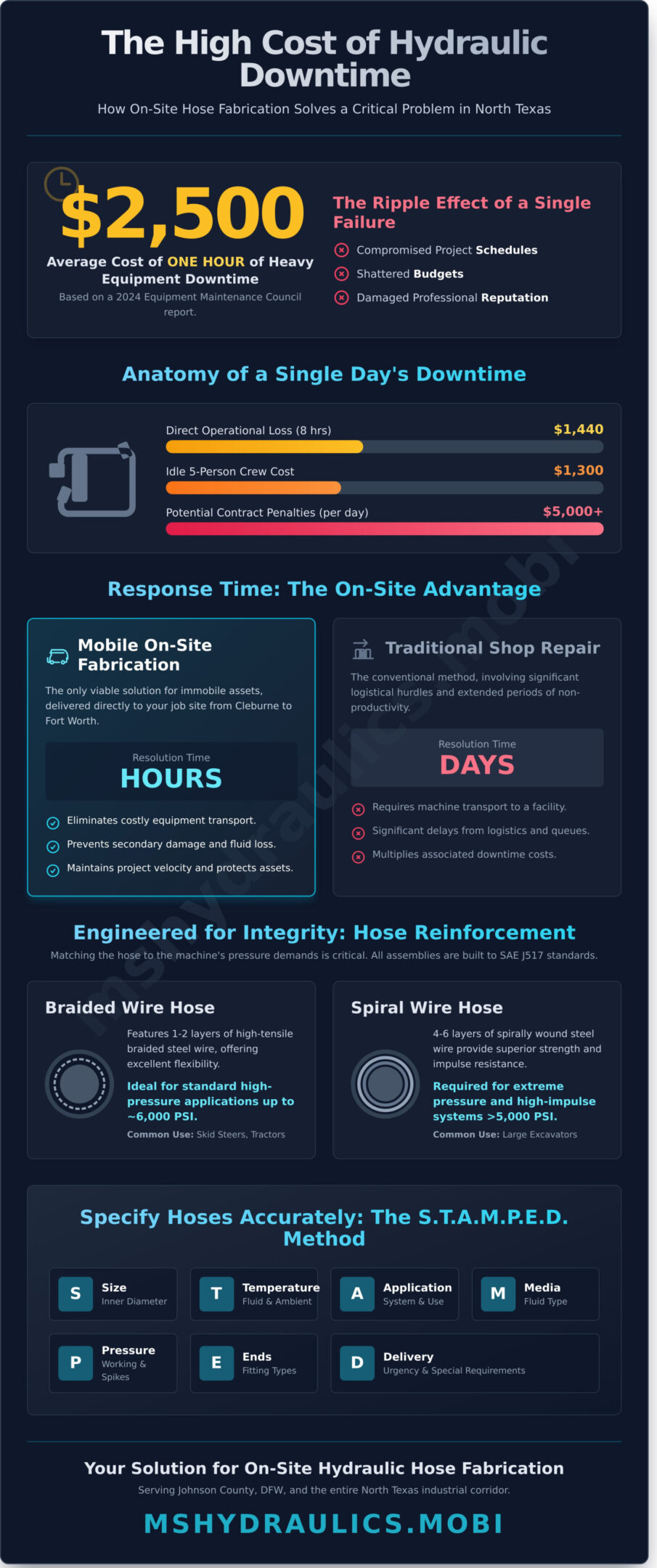
A 2024 analysis by the Equipment Maintenance Council reports that a single hour of heavy equipment downtime costs an average of $2,500 in lost revenue and project delays. For fleet managers and operators in North Texas, this isn’t just a number; it’s an operational reality driven by substandard hose assemblies failing under high PSI and intense heat. When a critical line ruptures on a job site from Cleburne to Fort Worth, it doesn’t just sideline one machine. It compromises schedules, budgets, and your professional reputation.
This guide provides the definitive solution to that costly problem. You will discover how to secure immediate, professional hydraulic hose fabrication near me, with custom assemblies built to meet or exceed OEM specifications directly at your location. We’ll examine the technical criteria for selecting a responsive on-site service, ensuring you can correctly identify complex JIC or ORFS fittings and receive a certified hose built for long-term operational integrity.
Key Takeaways
- Understand how local fabrication services directly mitigate the significant financial losses associated with equipment downtime in the North Texas industrial sector.
- Learn the engineering principles behind high-pressure hose assemblies, including the critical relationship between SAE standards, pressure ratings, and leak-free crimping technology.
- Utilize the industry-standard STAMPED method to accurately identify and specify your required custom hydraulic hose, ensuring correct component selection and performance.
- Discover the key criteria for selecting a provider for hydraulic hose fabrication near me, focusing on mobile capabilities and 24/7 availability to minimize operational interruptions.
The Critical Role of Local Hydraulic Hose Fabrication in North Texas
Hydraulic hose fabrication is not merely a component replacement; it is a custom engineering process critical to the operational integrity of heavy machinery. For industries across North Texas, from construction in Fort Worth to agriculture in Johnson County, a failed hydraulic hose signifies a complete work stoppage. Each assembly must be built to precise specifications, including length, orientation of fittings, and pressure ratings that meet or exceed original equipment manufacturer (OEM) standards. Understanding the fundamentals of how hydraulic systems work underscores the importance of this precision; a single incorrect fitting or improperly crimped ferrule can lead to immediate system failure, posing significant safety and financial risks.
The economic landscape of the Dallas-Fort Worth metroplex demands maximum uptime. A delay on one project has a cascading effect on contractors, suppliers, and timelines. This is why the search for reliable “hydraulic hose fabrication near me” is a strategic imperative, not a matter of simple convenience. Ms. Hydraulics provides a solution engineered to meet this demand, delivering certified, field-fabricated hose assemblies that restore operational capacity with minimal delay.
Understanding the Cost of Equipment Downtime
The financial implications of a failed hydraulic hose are severe and immediate. A mid-size excavator, for example, represents an average of $180 per hour in direct operational costs. When that machine sits idle for a standard 8-hour workday, the direct loss exceeds $1,440. This figure doesn’t account for the idle five-person crew, which adds another $1,300 in non-productive labor costs. On a high-stakes commercial project in Arlington or Mansfield, where timelines are governed by contracts with penalties often exceeding $5,000 per day, a single downed machine can erase an entire week’s profit margin. Local, on-site fabrication eliminates the multi-day delay and substantial cost associated with transporting heavy equipment to a distant repair facility.
These financial risks are not limited to mechanical failures. Inaccuracies in essential support equipment, such as industrial scales, can also lead to severe losses from incorrect material measurement or shipping discrepancies. Partnering with a dedicated calibration provider like Independent Scale Service is another crucial step in safeguarding operational finances, ensuring that all aspects of production are precise and reliable.
These calculations underscore the value of repairable, mission-critical machinery. However, fleet management also involves lifecycle planning for all assets, including those that are no longer economically viable to maintain. When a vehicle is truly at the end of its road, the financial consideration shifts from repair costs to liquidation value. For a look at how this process works for consumer and commercial vehicles in other areas, you can discover Cash For Junk Cars Michigan.
Mobile vs. Shop-Based Fabrication: A Regional Perspective
For equipment that is difficult or impossible to move, such as deep-foundation drill rigs or large agricultural combines, mobile fabrication is the only viable solution. Our field-side service is specifically designed for these assets. Addressing a hydraulic leak immediately at the job site prevents secondary damage, such as pump cavitation from fluid loss or environmental contamination requiring costly remediation. By providing expert hydraulic hose fabrication near me, our mobile units serve the entire Cleburne to Waxahachie industrial corridor, capable of mobilizing with the necessary inventory and equipment to perform a certified repair within hours, not days. This rapid response maintains project velocity and protects valuable capital assets from further degradation.
Technical Specifications: Engineering High-Pressure Custom Hose Assemblies
The operational integrity of any hydraulic system is fundamentally dependent on the engineering precision of its hose assemblies. A failure at 5,000 PSI is not an inconvenience; it’s a critical safety event and a source of costly downtime. We build every custom assembly to exacting technical parameters, ensuring performance under the specific mechanical and environmental stresses of your application. This process begins with strict adherence to the Society of Automotive Engineers’ guidelines, particularly the SAE J517 technical standards, which dictate material composition, dimensional tolerances, and performance testing for hydraulic hoses.
Hose Reinforcement and Pressure Parameters
The capacity of a hydraulic hose to contain extreme pressure is determined by its reinforcement structure. This isn’t a one-size-fits-all specification. A system with steady pressure has different needs than one with intense pressure spikes. The two primary reinforcement designs are:
- Braided Wire: Featuring one or two layers of high-tensile braided steel wire, this design offers excellent flexibility. It’s ideal for standard high-pressure applications up to approximately 6,000 PSI, common in mobile equipment like skid steers and agricultural tractors.
- Spiral Wire: Constructed with four to six layers of spirally wound steel wire, this design provides superior strength and impulse resistance. It is specified for extreme-pressure, high-impulse systems, such as the main hydraulic lines on a Komatsu PC490 excavator, where pressure can repeatedly spike above 5,000 PSI.
Matching these specifications to OEM requirements is non-negotiable. When you search for hydraulic hose fabrication near me to service CAT, John Deere, or Komatsu machinery, the fabricator must understand these distinctions. Using a two-wire braided hose where a four-spiral hose is specified will lead to premature failure. For safety compliance, it’s critical to understand that working pressure is the maximum continuous pressure a hose is rated for during operation, while burst pressure is the point of catastrophic failure, typically four times the working pressure, serving as a critical safety margin.
Environmental Factors in the DFW Region
A hose assembly that performs flawlessly in a controlled climate may fail rapidly in the field. The North Texas environment presents unique challenges that must be engineered for. The intense Texas heat, with ambient summer temperatures in Cleburne frequently exceeding 100°F (38°C), significantly accelerates the degradation of standard rubber compounds. This thermal aging process causes elastomers to become brittle and crack, compromising the hose’s structural integrity.
To counteract this, we select hose materials with superior temperature ratings and UV resistance. On dusty job sites, from Fort Worth construction projects to local quarries, abrasion is another primary cause of failure. A standard hose cover can be worn through quickly when rubbing against equipment frames or debris. We utilize abrasion-resistant covers, such as those with Tough Guard or MegaTuff® coatings, which can offer up to 300 times the abrasion resistance of a standard rubber cover. For a detailed assessment of your equipment’s environmental exposure, consult our hose fabrication specialists to ensure maximum service life.
Precision Fitting and Crimping: The Science of Leak-Free Connections
A hydraulic hose assembly is an engineered component where system integrity is measured by its weakest point. The connection between the hose and the fitting is a frequent point of failure, not due to material defects, but to improper assembly. At Ms. Hydraulics, our fabrication process is governed by the stringent quality management principles of ISO 9001, ensuring every connection is built for maximum service life and operational safety. The integrity of any hydraulic hose fabrication near me depends on a scientific approach to fitting selection and crimping, a discipline we have perfected for Cleburne’s most demanding industries.
The practice of reusing old fittings is a critical safety compromise that is strictly prohibited in our facility. A hydraulic ferrule is designed for a single compression; the crimping process permanently deforms the metal to create a seal, introducing stresses that cannot be replicated. Attempting a second crimp on a used fitting introduces metal fatigue and creates unpredictable weak points. This practice directly contravenes established hydraulic hose safety standards, which emphasize component integrity to prevent high-pressure fluid injection injuries. A new, certified fitting costs a fraction of the potential equipment downtime, which can exceed $5,000 per hour on a critical piece of machinery, or the immense cost of a workplace accident.
Identifying Hydraulic Fitting Standards
Our technicians are experts in identifying and matching the precise fittings required for your equipment. On Texas construction and agricultural sites, we most commonly encounter four primary standards:
- JIC (Joint Industry Council): Features a 37° flared seating surface for a reliable metal-to-metal seal, common on North American mobile equipment.
- ORFS (O-Ring Face Seal): Utilizes a captive O-ring for a superior, leak-free connection, making it the standard for high-vibration systems operating above 4,000 PSI.
- NPT (National Pipe Taper): A tapered thread fitting that seals along the threads, often requiring a sealant. It’s typically found on older machinery or in lower-pressure applications.
- BSPP (British Standard Pipe Parallel): Uses parallel threads and seals via a bonded washer or O-ring, ensuring a secure connection without thread deformation.
The engineering distinction between tapered (NPT) and parallel (ORFS, BSPP) threads is fundamental. Tapered threads create a seal through thread interference, while parallel threads rely on a dedicated sealing mechanism. Achieving a 100% leak-free seal depends on applying the exact manufacturer-specified torque to ensure correct seat alignment without over-compressing an O-ring or galling the threads.
Calibrated Crimping and Assembly Integrity
The final stage of fabrication is the crimp, where precision is non-negotiable. The “crimp diameter,” the final outside diameter of the ferrule after compression, must be controlled to within +/- 0.005 inches of the hose manufacturer’s specification. An over-crimped hose can damage the inner tube, while an under-crimped hose can lead to fitting blow-off under pressure spikes common in high-vibration environments. Ms. Hydraulics utilizes digitally calibrated crimping technology to guarantee this tolerance on every assembly. When you request on-site hydraulic hose fabrication near me, our mobile units arrive with field-certified crimpers that undergo the same rigorous daily calibration checks as our in-shop equipment, ensuring consistent quality regardless of location. Before any hose is reinstalled, it passes a final three-point inspection: a visual check for a uniform crimp, a micrometer measurement to verify the final diameter, and an internal flush to remove any potential contaminants from the assembly process.
Field Identification: How to Specify Your Custom Hydraulic Hose
Downtime in industrial operations is measured in lost production and revenue, not just hours. When a hydraulic hose fails on equipment in Cleburne, TX, the speed and accuracy of its replacement are paramount. Providing precise specifications from the field is the most effective way to expedite repairs. An operator who can correctly identify the failed component’s parameters enables our mobile technicians to arrive with the correct stock and fabricate a certified replacement on the first visit. This systematic approach minimizes diagnostic time and restores system integrity with engineering precision, a critical factor when searching for emergency hydraulic hose fabrication near me.
Before any inspection, ensure the equipment is fully de-energized. A high-pressure fluid injection injury from a pinhole leak, even one as small as 0.004 inches, can occur at pressures as low as 100 PSI and requires immediate medical attention. Never use your hand to locate a leak; use a piece of cardboard or wood instead. Once the system pressure is confirmed to be at 0 PSI, you can proceed with identification.
The STAMPED Method for Accurate Fabrication
The STAMPED acronym is an industry-standard protocol for defining hydraulic hose assemblies, ensuring every critical variable is accounted for. Following this method eliminates guesswork and prevents the installation of an incorrect component that could lead to premature failure or a catastrophic safety incident.
- Size: Identify the hose’s inner diameter (I.D.), typically printed on the layline. This is expressed in a “dash size,” where each number represents 1/16th of an inch (e.g., a -8 hose has an I.D. of 8/16 or 1/2 inch). Also, measure the Overall Length (OAL) from the end of one fitting to the end of the other.
- Temperature: Note both the ambient operating temperature and the maximum temperature of the fluid being conveyed. A standard SAE 100R2AT hose is typically rated for -40°F to 212°F, but applications involving engine compartments may require a hose certified for temperatures up to 300°F.
- Application: Define the hose’s function. Is it a static pressure line or part of a dynamic system with constant flexing, like on an excavator boom? The application dictates the required bend radius and abrasion resistance. A high-flex hose can reduce routing complexity and stress on fittings.
- Material: Specify the fluid type to ensure chemical compatibility. Standard petroleum-based hydraulic oils require a different hose tube composition than synthetic fluids like phosphate esters or water-glycol solutions. An incompatible material can cause the inner tube to swell or degrade in fewer than 100 operating hours.
- Pressure: Determine the system’s maximum working pressure, which must not exceed the hose’s rated working pressure. Don’t confuse this with burst pressure, which is typically four times the working pressure (a 4:1 safety factor). A system operating at 3,500 PSI requires a hose rated for at least that pressure.
- Ends: Identify the fitting types at both ends. Common types in North America include JIC (37° flare), NPT (tapered pipe thread), and ORFS (O-Ring Face Seal). Note their size, thread type, and orientation (e.g., a 90° elbow).
- Delivery: Communicate your urgency and location. This confirms the need for immediate on-site service.
Safety and Preparation for Service Calls
Preparing the worksite is as critical as identifying the part. Before our mobile unit arrives, execute your company’s Lock-Out/Tag-Out (LOTO) procedures, compliant with OSHA standard 1910.147, to prevent accidental machine startup. Clear a safe working area of at least 15×10 feet to allow our technicians to position their vehicle and equipment. Any spilled hydraulic fluid must be contained using absorbent materials as mandated by EPA regulations (40 CFR Part 112) to prevent environmental contamination. Taking these preparatory steps ensures our team can perform the replacement efficiently and safely, getting your equipment back online faster. When you need expert hydraulic hose fabrication near me, having this information ready is the first step. For expert assistance and rapid on-site service that adheres to the highest industry standards, contact our Cleburne mobile fabrication unit today.
Ms. Hydraulics: Expert Hose Fabrication Across Johnson County & DFW
In North Texas, operational uptime isn’t a goal; it’s a requirement. At Ms. Hydraulics, we build our client relationships on a foundation of integrity and technical excellence. We are not a transactional parts supplier. We are a long-term strategic partner dedicated to minimizing downtime and maximizing the productivity of your heavy equipment. Our commitment extends beyond a single repair to encompass the entire lifecycle of your hydraulic systems, ensuring reliability for operations across Johnson County and the Dallas-Fort Worth Metroplex.
Unplanned equipment failure demands an immediate, professional response. That is why our mobile service units are available 24 hours a day, 7 days a week. When a critical hose assembly fails on a job site at 3 AM, your search for ‘hydraulic hose fabrication near me‘ needs to lead to a solution, not a voicemail. Our dispatch system is engineered for rapid deployment, ensuring a certified technician is en route to your location promptly, equipped to diagnose, fabricate, and install the necessary components to get your machinery back online.
Our strategic base in Cleburne allows us to provide comprehensive coverage to key industrial and agricultural hubs. We are the trusted provider for businesses in:
- Cleburne: Serving as our central hub for rapid dispatch.
- Granbury: Supporting construction and marine applications around the lake.
- Alvarado: Providing critical support for manufacturing and logistics operations.
- And beyond: Our service area extends throughout Johnson, Hood, and Tarrant counties.
Our Mobile Fabrication Unit Capabilities
Each Ms. Hydraulics mobile service vehicle is a self-contained workshop, stocked with an inventory of over 1,500 unique fittings and a comprehensive range of hose types, from 1/4″ 100R1 to 1.5″ 6,000-PSI six-wire assemblies. Our Cleburne-based technicians are not just parts fitters; they are diagnostic experts trained to identify the root cause of hydraulic failure, whether it’s abrasion, improper routing, or system over-pressurization. This integrated approach ensures the replacement hose is not just a temporary fix but a lasting solution.
Serving the North Texas Industrial Community
We possess deep, sector-specific experience with the machinery that drives our local economy, including Caterpillar excavators in construction, John Deere combines in agriculture, and the complex systems of oil and gas drill rigs. Our reputation for “no-nonsense” service in Alvarado and Granbury is built on clear communication and efficient, precise execution. We understand the financial impact of every hour of downtime. For immediate, technically precise hydraulic hose fabrication near me, Contact Ms. Hydraulics LLC for emergency on-site hose fabrication today. We are your 24/7 partner in operational readiness.
Secure Your Operational Uptime with Expert Hydraulic Hose Fabrication
The operational integrity of your heavy machinery hinges on two non-negotiable principles: the precision engineering of high-pressure custom hose assemblies and the accurate field identification of technical specifications. A secure, leak-free connection achieved through expert fitting and crimping isn’t merely a goal; it’s a baseline requirement for both safety and productivity. When your project’s success requires dependable hydraulic hose fabrication near me, selecting a provider without a documented history of technical excellence introduces an unacceptable level of operational and financial risk.
Since 2021, Ms. Hydraulics has provided that expertise directly to job sites across Cleburne, Johnson County, and the greater North Texas region. Our specialist technicians are equipped for 24/7 emergency mobile repair, servicing excavators, drill rigs, and other critical industrial assets. Don’t let a failed hose derail your project timeline. Request Emergency On-Site Hose Fabrication and restore your equipment’s performance with a team built on local roots and technical mastery.
Frequently Asked Questions About Hydraulic Hose Fabrication
How quickly can you fabricate a hydraulic hose near me in Cleburne?
Our standard in-shop fabrication time for most hydraulic hose assemblies is under 30 minutes. For mobile service requests in Cleburne and the immediate vicinity, our target for dispatch and on-site completion is under 90 minutes, contingent on your location and current service volume. This rapid turnaround is engineered to minimize equipment downtime. We are the trusted provider for emergency hydraulic hose fabrication near me.
Do you offer 24/7 emergency hose fabrication in the DFW area?
Yes, we provide 24/7 emergency mobile hydraulic hose fabrication services throughout the Dallas-Fort Worth metroplex. Our emergency response units are fully equipped to address critical failures at any time, day or night. A dedicated after-hours dispatch line ensures immediate connection to a certified technician, with an average response time of 120 minutes for calls received outside standard 7 AM to 6 PM business hours.
Can you fabricate hoses for all brands of heavy equipment, like CAT or Deere?
Yes, our component inventory and fabrication capabilities support virtually all major brands of heavy equipment. We routinely build assemblies for Caterpillar (CAT), John Deere, Komatsu, Case, and Volvo machinery. Our technicians utilize an extensive cross-reference database to match or exceed OEM specifications for fittings and hose performance, ensuring full compatibility and operational integrity for your specific equipment model.
What information do I need to provide for a custom hose assembly?
To ensure precise fabrication, we require several key specifications for a custom hose assembly. Please provide the hose’s inside diameter, required pressure rating in PSI, overall assembly length, and the type and orientation of the end fittings. If the original failed hose is available, bringing it to our facility is the most effective method for guaranteeing an exact duplicate. Our on-site technicians will measure these parameters directly from the failed component.
Is mobile hose fabrication more expensive than going to a shop?
Mobile hose fabrication includes a service call fee and a specific hourly rate, which makes the direct invoice cost greater than our in-shop service. However, the total cost of ownership is often significantly lower. On-site service eliminates your equipment transport costs, reduces operator downtime by an average of 3-4 hours per incident, and prevents associated productivity losses. For critical operations, this makes mobile service the more cost-effective solution.
What is the maximum pressure rating for the hoses you fabricate on-site?
Our mobile fabrication units are equipped to build hydraulic hose assemblies with working pressure ratings up to 6,000 PSI. This capability covers the majority of high-pressure applications found in modern construction and industrial machinery, including systems utilizing 4-wire and 6-wire spiral hose. For applications exceeding 6,000 PSI, we recommend fabrication at our main facility where we can test assemblies up to 10,000 PSI.
Do you provide on-site diagnostics before fabricating the replacement hose?
Yes, on-site diagnostics are a standard component of our mobile service protocol. Before fabricating a replacement, our certified technicians perform a systematic inspection to confirm the point of failure and identify potential underlying causes, such as abrasion or improper routing. This diagnostic step ensures the replacement hose is specified correctly for the application and helps prevent recurring failures, which increases overall system reliability.
What cities in North Texas do your mobile units cover?
Our mobile service fleet provides comprehensive coverage for Johnson County and southern Tarrant County. Key cities in our primary service area include Cleburne, Burleson, Joshua, Alvarado, Keene, and Crowley. We also dispatch to Fort Worth, Arlington, and Mansfield. For service requests outside this 40-mile radius from our Cleburne shop, extended travel fees may apply. Please contact our dispatch for a precise service quote for your location.