Hydraulic Supply in Cleburne & North Texas: A Technical Guide to Parts and Availability (2026)
A single hydraulic system failure in Mansfield or Burleson often results in unplanned downtime costs exceeding $2,800 per hour for heavy equipment operators. When a machine stops, the immediate pressure to resume operations frequently leads to the procurement of substandard components or the incorrect identification of SAE versus Metric threads. Securing a reliable hydraulic supply isn’t just about finding a part; it’s about verifying technical specifications to ensure long-term system integrity. Reliability in Johnson County depends on precise engineering and the elimination of repeat mechanical failures through rigorous part selection.
This technical guide establishes a framework for navigating the 2026 supply chain landscape in North Texas. You’ll learn how to audit your on-site inventory for critical spares and identify the engineering markers that distinguish high-quality components from those prone to premature wear. By following our structured approach to part selection and local partnership, you’ll gain the expertise needed to reduce hydraulic system downtime by an estimated 22% this year. We’ve compiled the essential data on ISO-certified fittings and local availability to keep your projects moving without interruption.
Key Takeaways
- Master the technical specifications of high-pressure hoses and fittings, including JIC and SAE standards, to ensure precise system compatibility.
- Optimize your local hydraulic supply chain within the North Texas corridor to reduce operational delays and improve component availability.
- Evaluate the material science and certification requirements necessary to prevent the safety risks associated with sub-standard hydraulic components.
- Develop a strategic approach to fleet inventory by identifying critical spares and utilizing pre-assembled kits for rapid field repairs.
- Leverage professional diagnostic expertise and custom fabrication to resolve complex system failures with engineering-grade precision.
Navigating the Hydraulic Supply Landscape in Cleburne and North Texas
Effective hydraulic supply involves more than maintaining an inventory of hoses and fittings. It requires the procurement of precision-engineered components designed to manage specific mechanical parameters such as fluid velocity, system pressure, and torque. In the North Texas industrial corridor, the availability of these components dictates the operational lifespan of heavy machinery. By 2026, the demand for high-specification components has increased as regional industrial output in Cleburne and the surrounding DFW metroplex grew by 14% over the previous fiscal year. Local supply chains have shifted from simple retail models to integrated engineering hubs that support the complex needs of the construction and agricultural sectors.
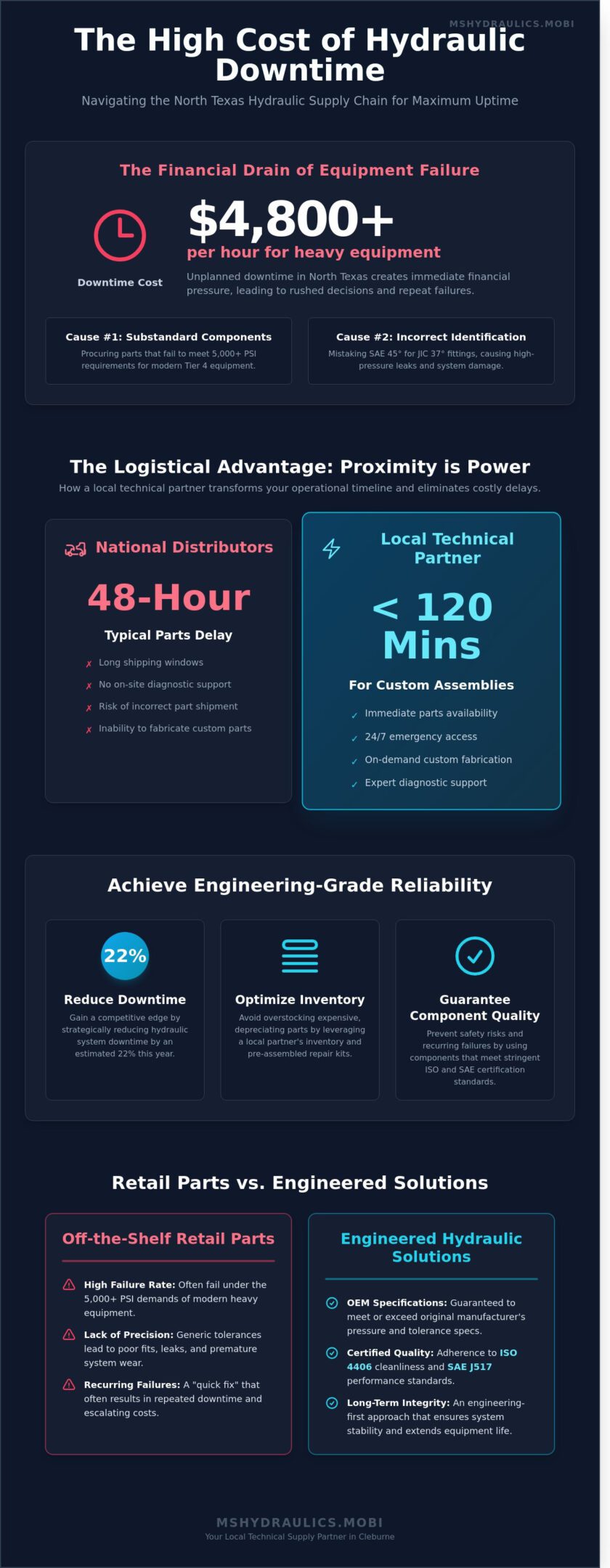
Proximity to a reliable provider directly influences a firm’s bottom line. For a construction site in Cleburne or a farm in Johnson County, a failed hydraulic pump isn’t just a mechanical issue; it’s a financial drain. Industry data from 2025 indicates that the average hourly cost of downtime for heavy earthmoving equipment exceeds $4,800. Relying on shipped parts from out-of-state hubs often results in a 48-hour delay, whereas local access to specialized hydraulic supply ensures that system-critical parts are available for immediate installation. This logistical advantage is essential for maintaining the 24/7 operational cycles required by modern industrial players.
Why Proximity Matters for Johnson County Operators
Johnson County operators face unique environmental and mechanical stresses that demand rapid response times. Local fabrication in Cleburne reduces the lead time for custom hose assemblies from days to under 120 minutes. This speed is vital for infrastructure projects in Alvarado and Grandbury where project timelines are rigid. Emergency supply needs are a constant reality for 24/7 industrial operations; local providers offer the technical support necessary to prevent catastrophic system failures during peak production hours. Reliable local access means operators don’t have to overstock their own warehouses with expensive, depreciating inventory.
- Reduced Lead Times: Local fabrication eliminates the 2-day shipping window common with national distributors.
- Support for Local Infrastructure: Direct supply lines to Alvarado and Grandbury job sites stabilize project schedules.
- 24/7 Emergency Access: Immediate part availability minimizes the impact of midnight component failures.
Retail Parts vs. Engineered Hydraulic Solutions
Standard retail parts often fail when subjected to the 5,000+ PSI requirements of modern Tier 4 heavy equipment. Off-the-shelf solutions lack the precision tolerances required for high-displacement pumps and sensitive control valves. MS Hydraulics prioritizes technical diagnostics over simple part replacement. We analyze system requirements against ISO 4406 cleanliness standards and specific pressure ratings to ensure every component meets the original equipment manufacturer’s specifications. This engineering-first approach prevents the recurring failures often seen with generic, lower-grade retail components. Precision supply ensures that every valve, seal, and actuator contributes to the overall stability and efficiency of the hydraulic circuit.
Critical Components: A Technical Breakdown of Hydraulic Supplies
Reliability in high-pressure systems depends on the precision of every sub-component. A standard 3,000 PSI system fails if a single O-ring doesn’t meet the required durometer or chemical compatibility. Technical procurement for North Texas operations requires a deep understanding of hardware specifications to prevent catastrophic downtime during peak production cycles. This engineering-first approach to hydraulic supply ensures that every hose, fitting, and valve meets or exceeds ISO 4406 cleanliness standards and SAE J517 performance ratings.
Understanding Hose and Fitting Standards
Field identification of fittings is a critical skill for maintenance teams. While JIC 37-degree flare and SAE 45-degree flare fittings look identical to the naked eye, their seat angles are incompatible; using the wrong one leads to high-pressure leaks or thread galling. Wire-braid reinforced hoses, such as SAE 100R2, offer the flexibility needed for mobile equipment, while thermoplastic hoses provide superior chemical resistance and non-conductive properties for utility applications. The dash size system designates the internal diameter of a hose or fitting in increments of 1/16th of an inch. Selecting the correct hydraulic supply inventory ensures that flow velocities remain within the recommended 15 to 20 feet per second for pressure lines.
- JIC (Joint Industry Council): 37-degree flare angle, widely used in high-pressure fuel and fluid systems.
- ORFS (O-Ring Face Seal): Best for vibration resistance and zero-clearance assembly.
- Metric: Essential for late-model European and Asian machinery common in Cleburne construction sites.
Cylinders and Valving for Heavy Machinery
Restoring system performance requires more than just replacing fluid. For a heavy equipment cylinder rebuild Texas technicians must verify rod straightness within 0.002 inches per foot and inspect barrels for scoring that exceeds 0.005 inches in depth. Directional control valves must be calibrated to specific pressure relief settings, often ranging from 2,500 to 4,500 PSI, to protect pumps from over-pressurization. Proper valve adjustment prevents the 15% efficiency loss typically seen in aging hydraulic circuits.
Sealing technology is particularly vital in the North Texas climate. Standard Nitrile seals may harden when exposed to ambient temperatures exceeding 105°F combined with internal fluid heat. Opting for Viton or specialized fluorocarbon elastomers ensures integrity up to 400°F. If you’re managing a fleet in Cleburne, you can consult our technical catalog to verify component compatibility for your specific machinery. Our inventory focus remains on high-performance seals and precision-machined valves that withstand the rigorous duty cycles of industrial applications.
Quality Standards: Identifying Reliable Hydraulic Supplies
Procuring a hydraulic supply isn’t a simple procurement task; it’s a critical risk management decision for any industrial operation. Utilizing uncertified or gray market components introduces variables that lead to catastrophic system failure. Statistics from industrial safety audits indicate that non-certified fittings fail 45% more frequently than those meeting SAE standards. These failures aren’t just mechanical. They represent significant safety hazards. High-pressure oil injections can occur at velocities exceeding 600 feet per second, making component integrity a non-negotiable requirement.
Material science dictates the longevity of every connection. Reliable suppliers prioritize high-tensile steel grades such as 12L14 or 1144 Stressproof for fittings to prevent thread stripping under high torque. The rubber compounds in hoses must also be scrutinized. Cheap imports often use high percentages of recycled filler, which reduces flexibility and accelerates ozone cracking. While a low-cost part might save $40 initially, the true price is revealed during a blowout. In North Texas, heavy machinery downtime costs average $1,200 to $2,500 per hour. Cutting corners on part quality is a mathematically poor strategy.
Material Specifications for the Texas Climate
The North Texas environment presents specific challenges for any hydraulic supply. Cleburne often sees more than 55 days per year where temperatures exceed 95°F. This sustained heat accelerates the thermo-oxidative degradation of hose covers. In Waxahachie, agricultural equipment faces high exposure to corrosive fertilizers. We recommend components with ISO 9227 salt spray ratings of 720 hours or higher. Ensure your supply partner holds ISO 9001:2015 certification to guarantee consistent metallurgical properties across all batches.
Performance Testing and Certification
Technical precision requires strict adherence to pressure ratings. We verify that every assembly maintains a 4:1 safety factor, meaning a hose rated for 4,000 PSI working pressure won’t burst below 16,000 PSI. MS Hydraulics implements rigorous testing protocols using calibrated digital transducers. We eliminate the risk of mismatched threads between SAE, JIC, and DIN standards. Our commitment to integrity means we don’t guess; we validate every specification against global engineering benchmarks to ensure operational continuity.
Optimizing Fleet Inventory: Strategic Supply Management
Effective hydraulic supply management hinges on the transition from reactive procurement to a data-driven proactive strategy. For operators in Arlington and Mansfield, identifying critical spares for on-site job trailers reduces mean time to repair (MTTR) by an average of 34%. This involves stocking high-turnover components such as ISO 16028 quick couplers and specific O-ring face seal (ORFS) kits. Kitting represents a significant advancement in efficiency; pre-assembled hose and seal sets ensure that technicians have every necessary component for a specific assembly, eliminating mid-repair delays. By leveraging Heavy Equipment Maintenance protocols, fleet managers can forecast part exhaustion based on duty cycles and pressure spike data recorded over the previous 12 months.
What to Keep on Your Service Truck
A service truck’s inventory must prioritize versatility without sacrificing technical precision. Essential fittings for common skid steer repairs include JIC 37-degree flares and BSPP adapters to accommodate various OEM specifications. While emergency hose repair kits provide a temporary solution for 2,500 PSI systems, they shouldn’t replace permanent fabrication for high-pressure lines exceeding 5,000 PSI. On-site system health checks require fluid analysis tools, such as laser particle counters, to monitor ISO 4406 cleanliness levels. Maintaining these standards prevents 70% of premature component failures in high-displacement pumps.
Managing Supply for Large-Scale Projects
Construction sites in Cedar Hill require a centralized approach to hydraulic supply to maintain momentum on multi-million dollar contracts. Bulk procurement strategies allow for a 15% reduction in unit costs when ordering standardized hydraulic fluids and filtration elements in volume. Partnering with a local supplier for scheduled maintenance cycles ensures that parts arrive 48 hours before a planned service interval. This consolidated model reduces administrative overhead by 22% by streamlining invoicing and inventory tracking. Effective management ensures that every machine, from excavators to pavers, operates within its designed performance parameters without unnecessary downtime.
Ms. Hydraulics: Your Local Technical Supply Partner in Cleburne
- Excavators: High-flow auxiliary lines and boom cylinders for 20 to 50-ton machines.
- Drill Rigs: High-torque motor replacements and specialized cooling system components.
- Agricultural Machinery: Durable seals and hoses for harvesters and high-capacity tractors.
We serve the entire North Texas region with a focus on engineering integrity. Every part we supply meets or exceeds ISO 4406 cleanliness standards, ensuring that your system remains free from the contaminants that cause 70% of hydraulic failures.
Mobile Repair and Supply Integration
The primary advantage of mobile hydraulic repair Cleburne TX lies in the drastic reduction of transit-related downtime. We deploy fully equipped service units to Crowley and Burleson, capable of on-site hose manufacturing and system flushing. By utilizing local logistical nodes across Johnson County, we maintain a 60-minute average response time for critical field failures. This mobile integration allows technicians to replace a ruptured line on a CAT 336 excavator without the machine leaving the job site; this saves an average of six hours in transport logistics.
Requesting Technical Support and Parts
To receive an accurate quote, please provide the specific component part number, maximum operating pressure requirements, and thread type, such as NPT, JIC, or ORFS. We prioritize long-term technical partnerships over simple transactions, currently supporting over 300 active accounts across Johnson County with documented maintenance histories. Our commitment to hydraulic supply excellence means we maintain a 98% in-stock rate for standard SAE and metric fittings.
Contact Ms. Hydraulics immediately for emergency parts or technical consultation. Our staff utilizes calibrated testing equipment to verify flow rates and pressure settings, ensuring that every component integrated into your system performs at peak efficiency. We don’t just sell parts; we provide the technical expertise required to keep North Texas moving.
Securing Operational Reliability in North Texas Hydraulics
Maintaining peak system performance requires a rigorous approach to hydraulic supply procurement and technical oversight. Since 2021, MS Hydraulics has supported regional operations by providing precision-engineered components that meet strict ISO standards. Effective fleet management depends on the immediate availability of high-pressure fittings and specialized valves to eliminate unplanned downtime. Our technical team prioritizes engineering accuracy over generic solutions; this ensures every assembly withstands the specific torque and displacement requirements of your 2026 projects. For a comprehensive analysis of how environmental factors and maintenance protocols impact equipment longevity, review our detailed Texas hydraulics case study examining North Texas industrial reliability.
We specialize in custom hose fabrication in Cleburne, delivering exact specifications directly to your job site. Our on-site diagnostic experts provide the technical data necessary to optimize your machinery’s lifecycle. We’ve built our reputation on providing 100% reliable technical support to the North Texas industrial sector. Don’t let component failure stall your productivity. Contact Ms. Hydraulics for Expert Hydraulic Supply and Mobile Repair to secure your equipment’s performance. We’re ready to provide the technical stability your industrial fleet demands.
Frequently Asked Questions
Where can I find reliable hydraulic supply near Cleburne, TX?
MS Hydraulics provides comprehensive hydraulic supply services across North Texas from our regional distribution points. Our inventory includes over 5,000 unique SKUs of ISO-certified components available for immediate pickup or delivery within 24 hours. We serve Cleburne and surrounding Johnson County with a technical focus on heavy industrial and agricultural sectors. Our facility maintains a 98 percent fill rate for critical system components to ensure your operations remain functional.
What is the difference between JIC and NPT hydraulic fittings?
JIC fittings utilize a 37-degree flare seating surface to create a mechanical seal, whereas NPT fittings rely on thread deformation. JIC connections are rated for pressures up to 6,000 PSI and allow for repeated assembly without compromising the seal. NPT threads often require sealant and are prone to leakage if you reuse them more than 3 times in high-vibration environments. Choosing the correct interface prevents pressure drops and fluid loss in high-demand circuits.
Can you make custom hydraulic hoses on-site at my job location?
We offer mobile hose fabrication services that reach job sites within a 50-mile radius of Cleburne. Our service vehicles are equipped with crimping technology capable of handling 4-wire spiral hoses up to 2 inches in diameter. This on-site capability reduces equipment downtime by an average of 45 percent compared to traditional shop-based repairs. Our technicians follow strict NAHAD guidelines to ensure every assembly meets specific pressure and safety requirements.
What are the most common hydraulic parts that fail on excavators?
Hydraulic cylinder seals and high-pressure hoses account for approximately 60 percent of excavator hydraulic failures. Piston rod scoring and seal degradation often occur after 2,000 operating hours in abrasive North Texas soil conditions. Additionally, main relief valves and swing motor seals frequently require inspection to prevent pressure drops exceeding 15 percent of OEM specifications. Regular monitoring of these components prevents catastrophic system contamination and expensive pump failures.
How do I know if a hydraulic hose needs to be replaced before it bursts?
Replace any hose showing exposed wire reinforcement, outer cover blistering, or localized weeping at the fitting crimp. Industry data suggests that 80 percent of hose failures are preceded by visible abrasion or kinking. If the outer carcass shows cracks deeper than 0.5 millimeters, the structural integrity is compromised. Immediate replacement is necessary to prevent high-pressure fluid injection injuries and environmental contamination on your job site.
Do you provide hydraulic supply and repair for agricultural equipment in Johnson County?
We provide specialized hydraulic supply and technical repair services for agricultural machinery throughout Johnson County. Our inventory supports brands like John Deere and Case IH with components meeting or exceeding SAE J517 standards. We maintain a high stock level of tractor remote couplings and hydraulic pump seal kits to ensure minimal disruption during peak harvest cycles. Our team understands the urgency of 2026 seasonal demands and offers expedited service for field equipment.
What information do I need to provide to get a custom hose fabricated?
You must provide the STAMPED data, which includes Size, Temperature requirements, Application, Media type, Pressure rating, and End configurations. Accurate measurements of the overall length must be within a 5-millimeter tolerance to ensure proper fitment. Specifying the dash size, such as -08 for a 1/2 inch hose, ensures the assembly meets the flow velocity requirements of your specific hydraulic circuit. Providing the specific thread type, like Metric or BSPP, prevents installation delays.
Is it cheaper to rebuild or replace a hydraulic cylinder?
Rebuilding a cylinder typically costs 40 to 60 percent of the price of a new unit if the barrel and rod remain within original tolerances. If the chrome plating on the rod is pitted or the barrel is scarred deeper than 0.25 millimeters, replacement is often more cost-effective. We provide a detailed technical assessment to determine if a component meets the 2026 ISO 4406 cleanliness standards before recommending a rebuild. Our goal is to maximize your equipment’s service life through data-driven decisions.