Hydraulic Pump Repair in Cleburne & DFW: Expert Diagnostics and Rebuilds
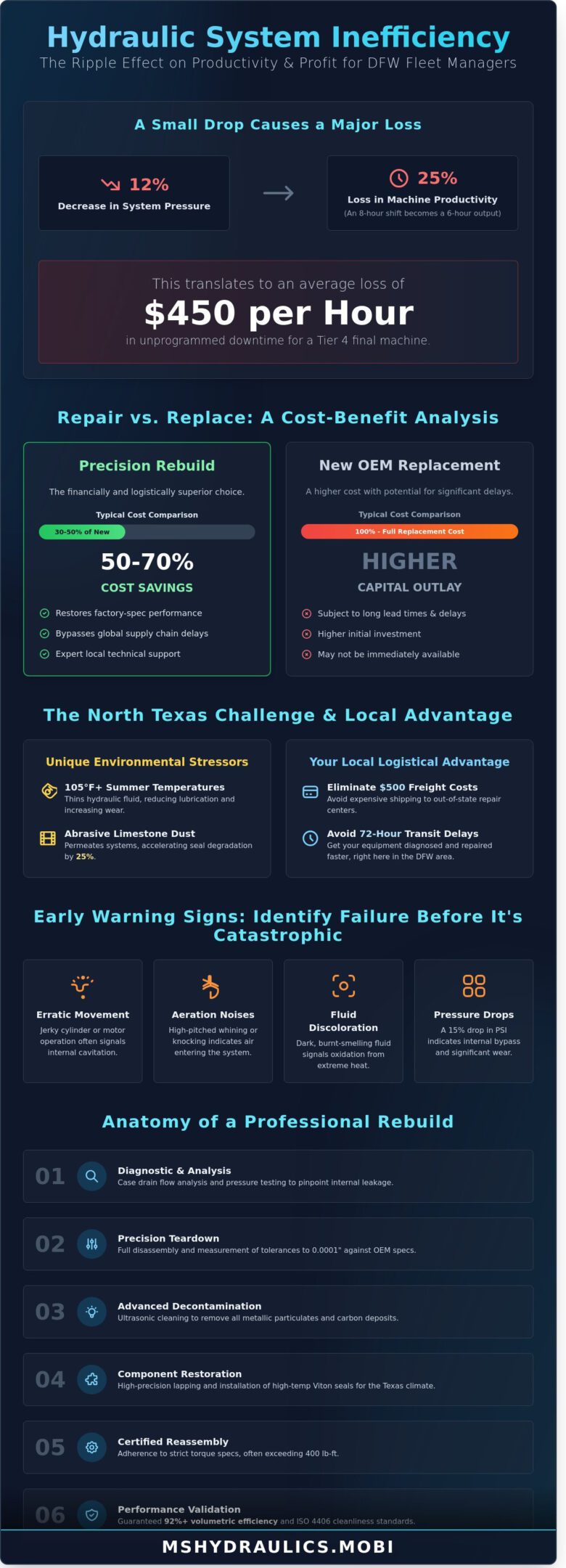
A 12% decrease in hydraulic system pressure can result in a 25% loss in machine productivity, effectively turning an eight-hour shift into a six-hour output. When searching for reliable hydraulic pump repair near me across the Dallas-Fort Worth Metroplex, most fleet managers focus on one critical metric: the cost of unprogrammed downtime. It’s a reality that every hour a Tier 4 final machine sits idle represents an average loss of $450 in project revenue and labor costs.
You recognize that maintaining strict torque and displacement parameters is non-negotiable for industrial reliability. This article provides the technical framework to evaluate your pump’s volumetric efficiency, compare the ROI of a precision rebuild versus a total unit replacement, and restore factory-spec performance. We’ll analyze diagnostic protocols for axial piston and gear pumps while outlining the streamlined logistics available at our Cleburne service center to minimize your transport delays.
Key Takeaways
- Understand the precision engineering required for professional rebuilds, including pressure testing and case drain flow analysis to pinpoint internal leakage.
- Evaluate the financial benefits of rebuilding gear, vane, and axial piston pumps, which typically offer 50-70% cost savings compared to purchasing new OEM units.
- Locate expert hydraulic pump repair near me in the DFW area to bypass global supply chain delays and minimize equipment downtime through local technical support.
- Identify the critical ISO-standard cleanliness and validation protocols necessary to ensure your hydraulic components meet original performance specifications.
- Learn why technical transparency and engineering precision are essential when selecting a service partner in Johnson County to maintain long-term industrial reliability.
Finding Reliable Hydraulic Pump Repair Near You in North Texas
Hydraulic pump repair is a rigorous precision engineering process. It involves full disassembly, component-level inspection, and the replacement of critical parts such as seals, bearings, and wear plates. Every rebuild concludes with performance validation on a test stand to ensure the unit meets original equipment manufacturer (OEM) specifications for flow and pressure. In Cleburne and the DFW Metroplex, technicians focus on three primary architectures: gear, vane, and axial piston pumps. Finding expert hydraulic pump repair near me ensures that your machinery returns to service with technical validation rather than a temporary patch.
The North Texas environment presents unique mechanical challenges. Summer temperatures in Johnson County frequently surpass 105°F, which thins hydraulic fluid and reduces its lubricating properties. Additionally, the region’s fine limestone dust permeates systems, acting as an abrasive that accelerates seal degradation by 25% compared to more temperate climates. Utilizing a local facility in Cleburne provides a logistical advantage. It eliminates the $500 freight costs and the 72-hour transit delays typically associated with shipping heavy components to out-of-state repair centers.
Why Proximity Matters for Heavy Equipment Downtime
Idle machinery on a DFW construction site generates losses averaging $225 per hour in lost productivity. When a pump fails in Alvarado, Grandbury, or Mansfield, local diagnostics provide a critical advantage. Technicians can perform on-site pressure testing to identify if the issue is a pump failure or a simple valve blockage. Rapid response is vital for North Texas drilling and agricultural operations. A single day of downtime can stall a $50,000 project phase, making a local hydraulic pump repair near me the most cost-effective choice for fleet managers.
Common Pump Failure Symptoms in Local Machinery
Identifying failure early prevents catastrophic system contamination. Operators should monitor for these specific indicators:
- Erratic Actuator Movement: Jerky cylinder or motor operation often signals internal cavitation.
- Aeration Noises: High-pitched whining or knocking sounds indicate air is entering the system.
- Fluid Discoloration: If hydraulic fluid appears dark or smells burnt, it’s likely oxidized due to the 100-degree Texas sun.
- Pressure Drops: A 15% drop in operating pressure (PSI) typically indicates internal bypass or worn wear plates.
Monitoring these metrics ensures your equipment remains within ISO 4406 cleanliness standards. Addressing a 10% efficiency loss now prevents a 100% component failure later.
The Technical Diagnostic Process: How Professional Rebuilds Work
Professional hydraulic pump service begins with a rigorous external inspection to identify visible structural fatigue or fluid contamination. Technicians deploy calibrated pressure gauges to monitor system performance under load. If you’re searching for hydraulic pump repair near me, you need a facility that prioritizes case drain flow analysis. An excessive flow rate in the case drain line often signals internal bypass; this occurs when fluid escapes past the rotating group rather than contributing to work.
Once the unit is on the bench, we disassemble every component to measure tolerances against original OEM specifications. We use precision tools like Mitutoyo micrometers to detect wear patterns as small as 0.0001 inches. When operators look for hydraulic pump repair near me, they often overlook the cleaning phase. Every part must undergo a decontamination cycle in an ultrasonic bath or a specialized chemical tank to remove carbon deposits and metallic particulates before reassembly.
Evaluating Displacement and Volumetric Efficiency
Volumetric efficiency represents the ratio between actual fluid delivery and the theoretical maximum displacement. A healthy pump should maintain a volumetric efficiency of 92% or higher at its rated pressure. Wear on the swash plate or piston shoes creates a gap that allows fluid to slip, directly reducing this percentage. Our technicians utilize dial indicators to verify that swash plate angles remain within 0.5 degrees of factory settings, ensuring the pump reaches its full 5,000 PSI potential.
Component Restoration and Lapping Processes
The interface between the cylinder block and the valve plate is a critical seal. We utilize a high-precision lapping process to restore these surfaces to a flatness measured in light bands. For units operating in North Texas, where ambient temperatures exceed 100°F, we replace standard elastomers with high-temp Viton seals to prevent thermal degradation. Final assembly requires strict adherence to torque specifications, often exceeding 400 lb-ft for heavy-duty flange bolts. You can review our technical certifications to see how we maintain these rigorous standards.
Repair vs. Replace: A Cost-Benefit Analysis for Industrial Pumps
Deciding between a rebuild and a total replacement requires a cold assessment of the balance sheet. Financial data indicates that a professional rebuild typically captures 50% to 70% cost savings when compared to purchasing new OEM units. The math is clear. For a high-displacement piston pump costing $12,000 new, a $4,800 precision rebuild returns the asset to 95% of its original volumetric efficiency. It’s a pragmatic choice for operations managing tight quarterly budgets.
Availability often dictates strategy more than price. Current global supply chain reports show that lead times for specialized OEM pumps frequently exceed 18 weeks. Choosing a local facility for hydraulic pump repair near me in the Cleburne area reduces this downtime to a 5 to 10-day window. This speed prevents the cascading financial losses associated with idled production lines in the DFW metroplex.
Legacy equipment presents a unique challenge. Many industrial machines operating in North Texas utilize pumps that manufacturers discontinued over a decade ago. In these instances, a rebuild isn’t just a cost-saving measure; it’s the only alternative to a $40,000 system-wide retrofit. We focus on restoring these obsolete units through precision machining and custom seal integration to maintain existing infrastructure.
There is a point of no return. If the pump housing shows signs of catastrophic heat discoloration or internal scouring deeper than 0.010 inches, the structural integrity is compromised. At this stage, the risk of housing failure under 5,000 PSI loads makes replacement the only safe path. We prioritize engineering safety over temporary fixes.
When to Commit to a Full Rebuild
Technicians must first inspect the drive shaft and housing bores. If the rotating group shows standard wear but the casting remains within a 0.0015-inch tolerance, a rebuild is highly viable. We assess the availability of Tier 1 seal kits and internal components to ensure the repair meets ISO standards. If the labor investment yields a projected 12,000-hour service life, the ROI is confirmed. It’s about long-term mechanical reliability, not a quick patch.
The ROI of Preventative Maintenance in DFW
Scheduled maintenance is an investment in uptime. A planned reseal costs approximately 15% of the price of an emergency field failure. We utilize fluid analysis to monitor metallic particulate levels, adhering to ISO 4406 cleanliness codes. Keeping the system “clean” doesn’t just save the pump; it protects downstream proportional valves and high-torque motors from contamination-related scoring. Searching for hydraulic pump repair near me before a total blowout occurs is the hallmark of a disciplined maintenance program.
Critical Standards for Selecting a Hydraulic Service Partner in Johnson County
Selecting a provider for hydraulic pump repair near me requires evaluating technical benchmarks rather than marketing claims. Industrial performance depends on strict adherence to ISO 4406 cleanliness standards. Engineering data indicates that fluid contamination accounts for 82% of component failures in high-pressure systems. A professional partner maintains a controlled environment to ensure that every rebuild meets or exceeds original factory specifications. Reliability isn’t a promise; it’s a measurable outcome of engineering discipline.
Operations across North Texas rely on heavy machinery from Caterpillar, John Deere, and Case. These systems operate under high-pressure conditions often exceeding 4,000 PSI. Technicians must understand these specific manufacturer tolerances to prevent premature wear and catastrophic failure. Long-term industrial relationships are built on this technical integrity. We prioritize factual accuracy and performance data over generic service guarantees. Consider these essential requirements:
- ISO-Certified Testing: Every pump must undergo load testing to verify volumetric efficiency.
- Material Traceability: Use of OEM-spec components ensures the metallurgy matches the original design.
- Contamination Control: Teardown areas must be separated from machining zones to prevent particle ingress.
Verifying Technical Expertise and Certifications
A shop’s testing bench capabilities reveal their true expertise. You should ask if their equipment can simulate full load conditions at 5,000 PSI and 100 GPM. If a shop can’t verify performance under these parameters, the repair is incomplete. We use certified seal kits that withstand the thermal expansion typical in Texas summers. Service in Arlington, Waxahachie, and Cedar Hill demands this level of precision to minimize downtime for field-based assets.
The Role of Mobile Repair Capabilities
On-site service provides a strategic advantage for stationary industrial power units and heavy excavators. Mobile technicians equipped for on-site hose fabrication reduce the 3-hour average wait time for parts delivery. This approach also mitigates the safety risks of transporting 500-pound pumps through busy worksites. Precise mobile diagnostics allow for immediate pressure adjustments, often resolving issues without a full shop teardown. High-efficiency operations require this immediate technical response.
Ms. Hydraulics: Expert Mobile Pump Diagnostics and Repair Services
Ms. Hydraulics LLC stands as the technical authority for industrial and mobile hydraulic systems in Cleburne and the Dallas-Fort Worth metroplex. We focus on engineering precision rather than temporary fixes. Every pump rebuild we execute adheres to strict ISO 9001:2015 quality standards to ensure that volumetric efficiency meets or exceeds original manufacturer specifications. Our team provides total technical transparency; we deliver granular diagnostic reports that detail specific component wear, such as micron-level scoring on port plates or cavitation damage on piston blocks. For operators searching for hydraulic pump repair near me, our service model prioritizes reliability and documented performance. We operate 24/7 mobile units to mitigate the financial impact of unplanned downtime, which often costs North Texas contractors over $3,000 per day in lost production.
Our Service Area Across North Texas
Our strategic location allows for rapid technician dispatch across the I-35W corridor and surrounding counties. We maintain a fleet of mobile service trucks equipped with high-pressure diagnostic tools and digital flow meters to service these primary hubs:
- Cleburne: Our central headquarters for deep-bench technical rebuilds and component machining.
- Burleson and Crowley: 20-minute average response times for local industrial and construction sites.
- Fort Worth: Comprehensive support for major infrastructure projects and heavy logistics fleets.
We possess the specialized tooling to manage a vast range of machinery. Our technicians service everything from compact skid steers with 12 GPM gear pumps to 120,000-lb excavators utilizing complex variable displacement axial piston pumps. We typically arrive on-site within 90 minutes of an emergency call to begin the recovery process.
Request a Technical Diagnostic Today
Don’t wait for a catastrophic system blowout. A subtle 10% drop in hydraulic flow often indicates internal bypass or advancing seal degradation. We recommend scheduling a comprehensive pressure and flow test if your equipment shows increased cycle times or hydraulic fluid temperatures exceeding 185 degrees Fahrenheit. For DFW fleets operating more than six units, we offer custom maintenance plans that have historically reduced emergency repair expenditures by 24% annually. Contact Ms. Hydraulics LLC now for immediate on-site support. We’re the professional choice for hydraulic pump repair near me when your operation depends on precision torque and sustained pressure.
Restore Peak Performance to Your Hydraulic Systems
Maintaining high-pressure efficiency requires more than reactive maintenance; it demands technical precision. Our data indicates that a professional rebuild can extend a component’s service life by 15,000 operational hours, often offering a 40% cost saving over full assembly replacement. When you’re searching for hydraulic pump repair near me, it’s vital to choose a partner that understands the specific torque and displacement requirements of your heavy machinery. MS Hydraulics provides this level of expertise through our specialized mobile repair units, which deliver expert cylinder and pump rebuilds directly to your facility in Johnson County.
As a locally owned and operated business in Cleburne, TX, we’ve spent 20 years refining our diagnostic protocols to ensure every repair meets strict industrial standards. You don’t have to settle for prolonged downtime or sub-par components. Our team focuses on restoring your equipment to its original manufacturer specifications with speed and engineering accuracy. We’re ready to help you maintain a competitive edge through superior mechanical reliability and disciplined service.
Schedule an On-Site Pump Diagnostic in Cleburne or DFW
Frequently Asked Questions
How much does it typically cost to repair a hydraulic pump near me?
Repair costs for a hydraulic pump near me typically range from 40% to 60% of the price of a new replacement unit. For a standard gear pump, this might mean a $450 repair versus a $1,100 replacement. We provide a detailed line-item quote after a teardown inspection. This ensures you only pay for the specific seals, bearings, or rotating groups that require replacement to meet OEM specifications.
Can a hydraulic pump be repaired on-site, or does it need to go to a shop?
Initial diagnostics and pressure testing occur on-site, but full rebuilds must take place in our controlled service center. Precise hydraulic tolerances require a clean-room environment to prevent particulate contamination during assembly. We utilize specialized test stands to verify volumetric efficiency at 100% rated pressure before the pump returns to the field. This process guarantees that the unit meets ISO 4406 cleanliness standards.
What are the first signs that my hydraulic pump is failing?
Increased noise levels exceeding 80 decibels and operating temperatures rising above 180°F are the primary indicators of pump failure. You’ll also notice a 15% to 20% reduction in cycle times as internal leakage increases. These symptoms often stem from aeration or cavitation within the system. Ignoring these signs leads to metal-to-metal contact, which destroys the internal housing and makes the unit non-repairable.
How long does a typical hydraulic pump rebuild take in the DFW area?
A standard hydraulic pump rebuild in the DFW area takes 3 to 5 business days from the initial teardown. This timeframe includes the 24-hour window for component cleaning and the 4-hour performance verification on our test bench. If we have the necessary seal kits and rotating groups in our Cleburne inventory, we often complete the process in under 48 hours. This efficiency helps minimize your operational downtime during critical projects.
Is it better to repair an obsolete hydraulic pump or retrofit a new one?
We recommend a retrofit if the repair cost of an obsolete pump exceeds 70% of a modern equivalent’s price. Modern units often provide a 12% improvement in energy efficiency and better parts availability. If your pump is over 20 years old, sourcing internal components often causes delays of 4 to 6 weeks. Retrofitting a current series pump ensures long-term reliability and simplifies future maintenance requirements.
Does Ms. Hydraulics provide warranties on pump rebuilds and repairs?
Ms. Hydraulics provides a 12-month warranty on all full pump rebuilds and major repairs. This coverage applies to both the precision-machined parts and the labor performed by our engineering technicians. We document every repair with a final test report that shows the pump’s performance data at peak torque and pressure. Our warranty reflects our confidence in meeting or exceeding the original manufacturer’s performance curves for every unit.
What brands of hydraulic pumps can you repair in Cleburne?
Our Cleburne facility services major industrial brands including Bosch Rexroth, Vickers, Parker Hannifin, and Eaton. We also specialize in Sauer-Danfoss and Kawasaki units used in heavy construction equipment. Our technicians use genuine OEM parts for 95% of our rebuilds to ensure the displacement and pressure ratings remain consistent. We maintain a library of technical manuals for over 50 different pump series to ensure precise assembly and calibration.
How can I extend the life of my hydraulic pump in the Texas heat?
Maintaining oil temperature between 140°F and 160°F is critical for extending pump life during Texas summers. When ambient temperatures hit 100°F, hydraulic fluid loses its viscosity, which reduces the lubricating film on internal components. You should inspect heat exchangers for a 25% blockage or more and consider switching to a high-viscosity index fluid. Regular fluid analysis every 500 hours helps detect thermal degradation before it causes mechanical failure.