Hydraulic Maintenance Checklist for Daily Fleet Checks
A hydraulic maintenance checklist for fleet managers should cover fluid level and condition, leaks, pressure, temperature, and controls during daily checks. Schedule a full hydraulic inspection every 250 operating hours or 3 months, whichever comes first, and increase inspection frequency to every 150 hours in high-duty or contaminated environments. Consistent checks help identify developing faults before they interrupt vehicle work.
Daily fluid and leak checks are essential, but they don’t tell the whole story. Sluggish movement, pressure changes, excess heat, or an unresponsive control valve can also signal a hydraulic problem.
This guide explains what to include in a fleet maintenance checklist, how to set inspection intervals, and which observations to record each day. It focuses on valves and hydraulic controls, where drift or inconsistent operation can point to a fault. Use these steps to build a practical routine for your equipment and workload, and to distinguish routine checks from issues that need technical diagnosis or repair.
Key Takeaways
- Build preventive maintenance around each vehicle’s operating demands and manufacturer-recommended service intervals, rather than relying on reactive repairs.
- Use a practical checklist that operators can complete consistently, and record recurring issues so maintenance decisions reflect equipment history.
- Watch for control-system changes such as sluggish response or cylinder drift; holding a fully elevated tipper body for 3 minutes can help reveal drift.
- When hydraulic faults require repair, Ms. Hydraulics LLC provides services including hose fabrication, cylinder rebuilds, heavy equipment maintenance, and mobile hydraulic repair.
How often should a hydraulic system inspection be performed on service vehicles?
Schedule a full hydraulic inspection every 250 operating hours or 3 months, whichever comes first. For trucks working in high-duty or contaminated environments, shorten the interval to every 150 hours. These planned intervals supplement daily vehicle inspection checks, not replace them.
Organize servicing with monthly, quarterly, and annual reviews. Monthly checks can cover fluid analysis, filter condition, leaks, and system performance against manufacturer guidance. Use quarterly and annual service records to spot recurring contamination, pressure changes, or repairs needing follow-up. Set intervals according to operating hours and actual duty conditions.
Routine hydraulic maintenance cost per fleet vehicle in the United States depends on equipment type, service scope, fluid volume, and operating conditions; pricing is provided after a quote request.
To depressurize a system, park securely, lower attachments, shut down the vehicle, and isolate its energy source. Follow the manufacturer’s procedure to release stored pressure, then verify the system is depressurized before maintenance. Never loosen a fitting to test for pressure.
- Record monthly fluid-analysis results and compare them with earlier samples, because a change can flag contamination or degradation.
- Inspect filters for restriction, damage, or contamination; replace them according to the manufacturer’s service interval and findings.
- Check hydraulic fluid level and appearance at the specified inspection point, noting cloudiness, particles, or an unusual odor in the records.
- Confirm the fluid grade suits the cold temperatures the vehicle will encounter, since unsuitable fluid can affect system response.
- For high-use vehicles, verify critical fluid levels and battery condition weekly, and track consumables against planned service intervals.
Keep documentation tied to each vehicle, including operating hours, analysis results, filter changes, and corrective work. If hydraulic-related downtime exceeds 20% of total downtime, increase inspection frequency and review whether current intervals match fleet conditions.
What is a Fleet Maintenance Checklist?
A fleet maintenance checklist is a documented schedule of inspections and service tasks for each vehicle. A hydraulic maintenance checklist for fleet managers makes preventive work repeatable, rather than leaving teams to wait for breakdowns or emergency repairs. Base tasks and intervals on manufacturer instructions, vehicle use, operating hours, and service history. A truck doing frequent heavy work may need a different plan from one used mainly for highway travel. Similarly, for companies balancing service equipment with corporate travel, utilizing professional providers like myblackcarride.com ensures executive airport and business transportation runs smoothly without diverting internal fleet resources.
U.S. workplace procedures and manufacturer instructions should guide hydraulic servicing. For commercial motor vehicles, the Federal Motor Carrier Safety Administration says carriers must systematically inspect, repair, and maintain vehicles under 49 CFR Part 396.
- Record each vehicle’s manufacturer service intervals, due dates, operating hours, and completed work so planned maintenance stays visible.
- Include checks for guards, safety interlocks, stabilizers, and attachment controls, because a failed safety feature can affect safe operation.
- Track engine oil and filter changes against vehicle type and operating conditions, rather than applying one interval across the fleet.
- Use maintenance records to flag overdue tasks, repeated defects, and repairs that need follow-up before returning a vehicle to service.
Typical oil and filter intervals vary by equipment: light-duty trucks use 5,000-7,500 miles, while medium-duty trucks use 10,000-25,000 miles. Heavy-duty trucks in highway use use 10,000-20,000 miles, and construction equipment uses 250-500 engine hours. Treat these as planning references, then follow the applicable manufacturer schedule and duty conditions.
Record the inspection date, vehicle identification, operating hours, findings, corrective work, and completion status. Link the hydraulic maintenance checklist for fleet managers to these records so recurring pressure or control faults are easier to spot and unresolved defects aren’t mistaken for completed repairs.
For equipment issues that need technical attention, hydraulic maintenance support can help address faults identified through the checklist.
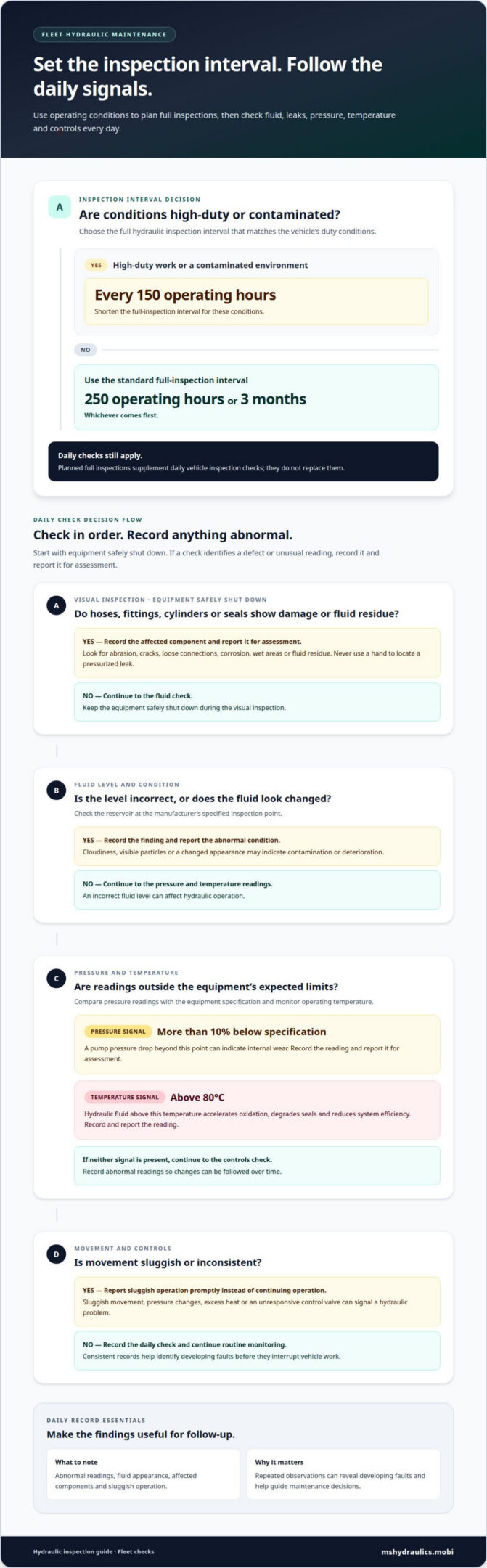
Daily fluid-level, condition, leak, pressure, and temperature checks
A daily checklist should cover fluid level and condition, visible leaks, operating pressure, temperature, hoses, fittings, cylinders, and controls. Operators should record abnormal readings and report sluggish operation promptly, before continued use worsens damage or downtime.
With equipment safely shut down, visually inspect hoses, fittings, cylinders, and seals. Look for abrasion, cracks, loose connections, corrosion, wet areas, or fluid residue. Never use a hand to locate a pressurized leak. Record the affected component and report defects for assessment.
- Check the reservoir level at the manufacturer’s specified inspection point, because an incorrect level can affect hydraulic operation.
- Look for cloudy fluid, visible particles, or a changed appearance, since these may indicate contamination or deterioration.
- Compare pressure readings with the equipment specification; a pump pressure drop more than 10% below specification can indicate internal wear.
- Monitor operating temperature; hydraulic fluid above 80°C accelerates oxidation, degrades seals, and reduces system efficiency.
- Check joints for secure coupling and sufficient grease, then report sluggish movement instead of continuing operation.
Set check frequency according to exposure: operators should complete visual and operating checks daily, while high-use vehicles need critical fluid levels and battery health confirmed weekly. Periodic inspections can add closer component checks and trend reviews, helping teams catch recurring faults before reactive repairs interrupt service.
In winter, check that fluid is suitable for expected cold temperatures, and inspect seasonal hydraulic attachments alongside the vehicle carrying them. Follow the manufacturer’s instructions, record findings, and confirm that controls respond normally before putting equipment into operation. Track any corrective work through repair and release-to-service signoff.
Consistent records turn individual observations into useful maintenance history. Compare pressure, temperature, fluid condition, and leak reports across inspections. Recurring changes can point to a developing fault and help guide planned replacement before component failure causes avoidable downtime. When unexpected faults do occur and critical replacement parts or fittings must reach a repair facility immediately, dedicated same-day transport from Salus Securities & Courier Services (SS Courier) can help minimize operational delays.
Valves and hydraulic control systems
Valves direct hydraulic flow and affect how equipment starts, stops, holds, and moves. A control fault may show up as delayed response, uneven movement, drifting cylinders, or an attachment that won’t hold position. Record the affected function and operating conditions so technicians can distinguish recurring problems from isolated symptoms.
Test controls only under the equipment manufacturer’s operating procedure, with people clear of moving parts and suspended loads. On a tipper, check for body drift while fully elevated for 3 minutes. For other cylinders, observe position drift under load over a 5-minute period, where the equipment procedure allows this test. Stop operation if movement becomes unsafe or control response changes unexpectedly.
- Operate each hydraulic control through its normal range and note delayed, erratic, or sluggish response, because these changes can indicate a valve or control-system fault.
- Check that attachments stop and hold as intended, since unintended movement can create an immediate safety problem.
- Observe cylinders for drift during the specified hold test, because gradual movement may reveal a loss of holding performance.
- Inspect valve housings and connected lines for visible leaks or damage, because fluid loss can affect pressure and operation.
- Record the function tested, load condition, symptoms, and follow-up action, so maintenance records support diagnosis and planned repairs.
For construction equipment, include controls and seasonal attachments in the same inspection program as the vehicle. Compare new symptoms with earlier records; repeated drift or inconsistent response needs attention before it leads to emergency downtime. Don’t adjust valves or raise pressure settings to mask a problem. Testing and adjustments must follow the manufacturer’s procedure and equipment specifications.
Use inspection findings to separate routine monitoring from faults requiring technical assessment. If a valve or control fault persists, request help with hydraulic control problems before continued operation turns the defect into a larger repair.
Ms. Hydraulics LLC: Hydraulic Hose Fabrication
Ms. Hydraulics LLC provides hydraulic hose manufacturing for fleets addressing damaged or leaking hoses identified during inspections. Replacing a compromised hose addresses the immediate component fault, while recurring leaks or performance changes may need further diagnosis. Hydraulic equipment and cylinder repair and mobile hydraulic repair are relevant options for cylinder drift or impaired movement. Heavy equipment maintenance can support broader service needs.
When arranging service, use inspection records to describe the affected equipment, observed symptoms, and operating conditions. This detail helps connect the reported issue to the repair needed, whether it involves a hose, cylinder, or wider hydraulic system.
Contact Ms. Hydraulics LLC to discuss hydraulic hose fabrication or related equipment repair.
Make inspection findings actionable
A checklist is useful when findings lead to clear decisions, assigned follow-up, and a reliable record of completed work. Use recurring observations to refine the maintenance program and identify when a developing hydraulic issue needs technical attention. This keeps the hydraulic maintenance checklist for fleet managers connected to real operating conditions, rather than turning it into a form completed for its own sake.
When inspection records point to hose damage, cylinder problems, or wider equipment concerns, match the next step to the fault. Ms. Hydraulics LLC provides hydraulic hose manufacturing, hydraulic equipment and cylinder repair, and heavy equipment maintenance.
Contact Ms. Hydraulics LLC to discuss hydraulic service for your fleet and put your inspection findings to work.
Frequently Asked Questions
How often should construction equipment be inspected?
Inspect construction equipment daily before it enters active service. During the walk-around, operators can check the hydraulic attachment, hose routing, control response, and visible damage. Record defects against the machine so the next operator knows its status. For construction fleets around Cleburne, Dallas, Fort Worth, Alvarado, Granbury, Crowley, Arlington, Mansfield, Waxahachie, and Cedar Hill, a consistent pre-use routine helps identify issues before equipment moves between job sites.
What is the difference between daily inspection and preventive maintenance?
A daily inspection is an operator’s check for visible defects and abnormal operation; preventive maintenance is planned service performed at defined intervals. For example, an operator may report a new leak during a shift, while scheduled maintenance reviews service history and completes manufacturer-directed work. Both matter: inspection findings can trigger repairs, while preventive tasks address wear before it causes a breakdown.
How often should fleet hydraulic systems be inspected and serviced?
Schedule a full hydraulic inspection every 250 operating hours or 3 months, whichever comes first. Increase inspection frequency to every 150 hours for vehicles working in high-duty or contaminated environments. Keep daily checks separate from full servicing, and use operating hours, contamination history, and recurring defects to refine the maintenance plan. Record completed work and outstanding faults by vehicle.
How to check hydraulic fluid level, condition, and contamination?
Park the equipment as directed by its manufacturer, then check the reservoir at the specified inspection point. Compare the level with the marked range and examine a sample for cloudiness, particles, or other visible changes. Fluid cleanliness testing provides a more reliable contamination assessment than appearance alone; ISO 16/14/11 or better is the stated cleanliness target. Record test results with the machine’s service history.
What hydraulic system operating pressure and temperature limits should fleet managers check?
Use the pressure and temperature specifications for the specific machine, since hydraulic limits vary by system. Compare operating readings with manufacturer specifications rather than applying one pressure target across the fleet. A pump pressure drop more than 10% below specification can indicate internal wear. Hydraulic fluid operating above 80°C accelerates oxidation, degrades seals, and reduces system efficiency, so investigate readings that exceed the equipment’s limits.
How to maintain hydraulic filters and determine replacement intervals?
Inspect filters for visible damage, contamination, or signs of restriction, and track changes between services. Replace filters according to the equipment manufacturer’s intervals and instructions; operating conditions and contamination can affect when attention is needed. Record each replacement, the associated operating hours, and any recurring restriction. This history helps distinguish routine filter service from a persistent system contamination problem.