Hydraulic Hoses and Fittings: A Technical Reference for North Texas Fleet Managers
For a fleet manager in Fort Worth, a single blown hydraulic hose represents more than a mechanical failure; it’s a $600 per hour drain on operational efficiency. During 110-degree North Texas summers, standard hydraulic hoses and fittings frequently reach their thermal limits, leading to accelerated elastomer degradation and unplanned maintenance. You understand that the difference between a 20-minute field repair and a lost day of production usually depends on your team’s ability to instantly distinguish between a metric DIN fitting and a standard American JIC thread pattern.
This technical reference provides the engineering data necessary to identify failed components accurately and select high-performance replacements that exceed ISO 18752 standards. You’ll gain a clear framework for managing complex thread patterns and implementing preventative maintenance schedules that reduce system failures by 35 percent. We’ll examine specific hose constructions, pressure rating requirements, and the logistics of securing custom fabrication to keep your machinery operational in the most demanding environments.
Key Takeaways
- Identify critical technical parameters for hose assemblies to maintain system pressure and eliminate the safety risks associated with mismatched fittings.
- Implement the STAMPED methodology to conduct comprehensive inventory audits and select high-performance components for heavy equipment.
- Navigate the technical differences between JIC 37° Flare and SAE 45° Flare standards common across North Texas industrial sites.
- Mitigate the impact of thermal degradation and cover cracking caused by the 100°F+ Dallas climate and abrasive terrain.
- Utilize mobile engineering units for on-site diagnostics and the precise fabrication of hydraulic hoses and fittings to reduce operational downtime.
Technical Identification of Hydraulic Hoses and Fittings in the Field
In high-pressure systems, the hydraulic assembly acts as the primary conduit for power transmission. It’s responsible for maintaining system pressure and delivering the torque required for heavy equipment operation. Precise selection of hydraulic hoses and fittings isn’t just a maintenance task; it’s a matter of operational safety. Mismatching components often results in catastrophic failure, including high-velocity injection injuries where fluid penetrates human skin at pressures as low as 100 PSI. Understanding Hydraulic machinery principles ensures that fleet managers choose between permanent crimped ends for factory-spec reliability or field-attachable ends for emergency repairs. Modern manufacturing relies on ISO 12151 standards to guarantee dimensional consistency across global supply chains.
Anatomy of a High-Pressure Hydraulic Hose
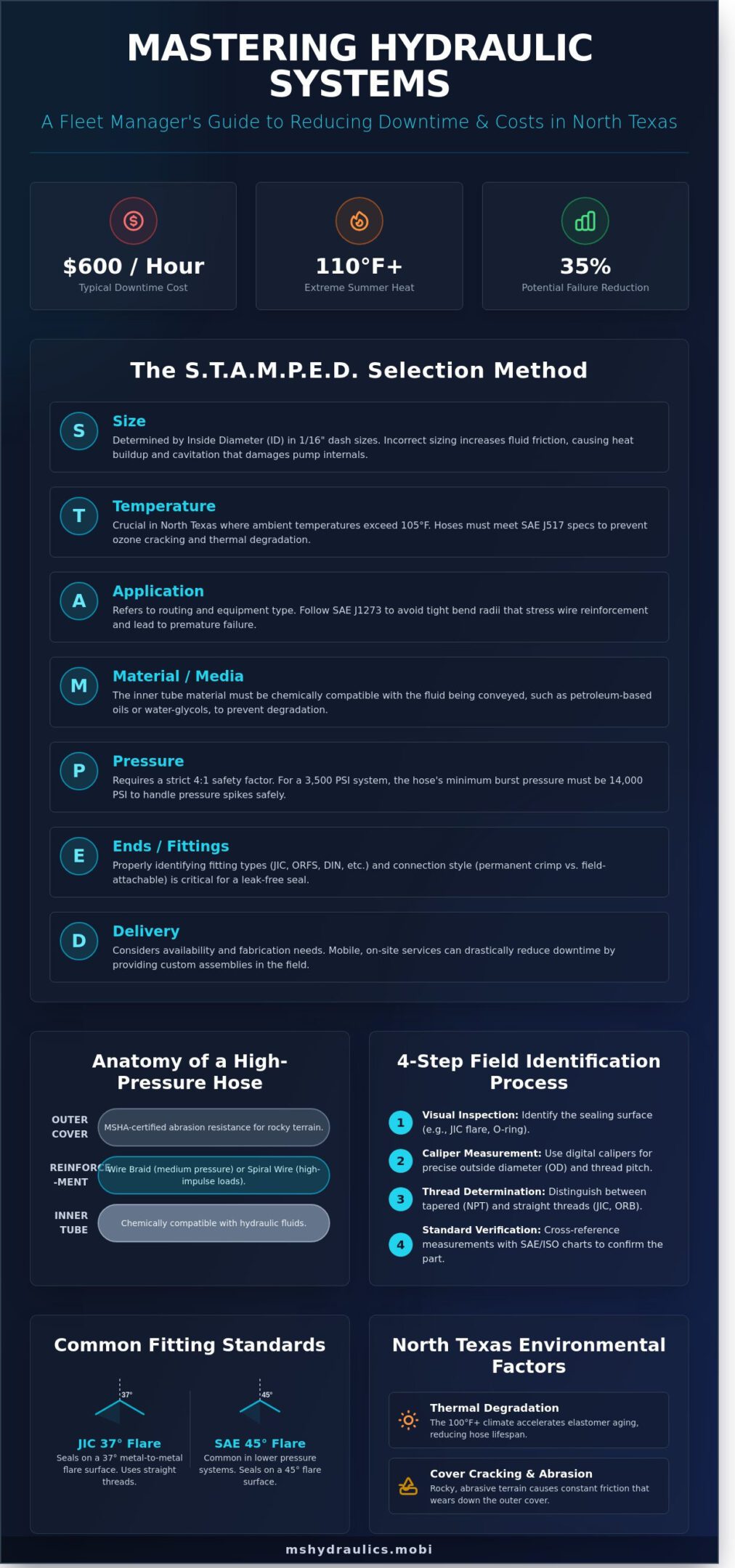
A standard hose consists of three distinct layers engineered for specific stressors. The inner tube must demonstrate chemical compatibility with specific fluids, such as petroleum-based oils or water-glycols. Reinforcement layers dictate the hose’s pressure rating. Wire braid designs suit medium-pressure applications, while spiral wire configurations handle the high-impulse loads common in heavy excavators. On rocky Cleburne job sites, the outer cover’s MSHA-certified abrasion resistance prevents premature failure caused by constant friction against machine frames.
The Four-Step Identification Process
Precision identification requires a methodical approach to prevent downtime. Following these steps ensures the replacement hydraulic hoses and fittings meet original equipment manufacturer specifications:
- Visual Inspection: Identify the sealing surface. Look for 37-degree JIC flares, O-ring face seals (ORFS), or metal-to-metal tapered threads to determine the sealing method.
- Caliper Measurement: Use digital calipers to measure the outside diameter (OD) and thread pitch. A difference of 0.5mm can be the margin between a secure seal and a high-pressure leak.
- Thread Determination: Distinguish between NPT (tapered), JIC (straight), ORB, or Metric standards. Tapered threads seal via thread interference, while straight threads require an O-ring or gasket.
- Standard Verification: Cross-reference measurements with SAE J514 or ISO 12151 tables to confirm the exact part number before installation.
Adhering to this technical rigor reduces the 80% of hydraulic failures that typically result from contamination or incorrect component selection. It’s the only way to ensure the integrity of the system under peak load conditions.
The STAMPED Method: Selecting High-Performance Hydraulic Components
The STAMPED method is the engineering standard for selecting hydraulic hoses and fittings. It provides a methodical framework to ensure system safety and longevity. North Texas fleet managers utilize this protocol to audit existing inventory and specify replacements that withstand the rigorous demands of the regional climate. Adhering to these seven variables reduces the risk of catastrophic component failure and environmental contamination. It’s a disciplined approach that prioritizes technical data over guesswork.
S.T.A.M. (Size, Temperature, Application, Material)
Size is determined by the inside diameter (ID) of the hose, measured in 1/16-inch increments known as dash sizes. A dash -08 hose has an ID of 1/2 inch. Incorrect sizing leads to improper flow velocity. If the ID is too small, fluid friction increases, causing heat buildup and cavitation that destroys pump internals. Temperature considerations are equally vital. North Texas ambient temperatures frequently exceed 105°F during summer months. This requires hose covers that meet or exceed SAE J517 specifications to prevent ozone cracking and thermal degradation. Application-specific routing must also be analyzed. Every assembly should follow SAE recommended practices for hydraulic hose assemblies to avoid tight bend radii that stress the wire reinforcement.
P.E.D. (Pressure, Ends, Delivery)
Pressure ratings require a strict 4:1 safety factor between the maximum working pressure and the burst pressure. For a system operating at 3,500 PSI, the hose must withstand 14,000 PSI before failure. This buffer is necessary to absorb the hydraulic shocks typical in heavy excavation equipment. Selecting the correct ends is the final technical hurdle. Fleet managers must distinguish between JIC, ORFS, and NPT connections to ensure leak-free performance. Mismatched threads remain the leading cause of hydraulic fluid loss in the field. Regarding delivery, logistics play a significant role in uptime. Mobile fabrication services in Johnson County allow for the immediate assembly of hydraulic hoses and fittings at the job site. This localized support eliminates the 4-hour delays often associated with traditional parts sourcing. If your fleet requires a technical audit of its current pressure systems, you can request a professional consultation to optimize your component lifecycle.
Common Hydraulic Fitting Standards for DFW Heavy Equipment
North Texas construction sites operate a diverse array of machinery, ranging from domestic brands like Case to international manufacturers like Volvo and Hitachi. This globalized fleet composition forces fleet managers to manage a complex inventory of hydraulic hoses and fittings that adhere to disparate thread standards. Mistaking a metric fitting for an American one leads to cross-threading, which often costs companies upwards of $500 per hour in equipment downtime. Precision in identification is the only way to maintain system integrity across these mixed fleets.
American Standard Fittings (SAE & NPT)
The JIC 37° Flare remains the primary standard for North Texas construction equipment. It utilizes a 37-degree seating surface to create a reliable metal-to-metal seal. While it looks identical to the SAE 45° Flare used in automotive or refrigeration applications, the 8-degree difference prevents a proper seal and will cause immediate failure under high-pressure loads. For port connections, engineers prefer SAE O-Ring Boss (ORB). This straight-thread design uses an elastomeric O-ring to ensure a leak-free connection, even when subjected to thermal expansion. When selecting components, referencing SAE J1273-2021 Recommended Practices ensures your assembly meets established safety and reliability benchmarks for high-pressure environments. National Pipe Thread (NPT) is still used in older systems, but it carries risks. Over-tightening NPT fittings often results in cracked castings, as the tapered threads exert high outward pressure on the female port.
International and Metric Standards
European-made excavators frequently utilize British Standard Pipe (BSP) threads. These come in two forms: BSPP (Parallel) and BSPT (Tapered). Local crews often struggle with Metric DIN fittings, which follow the German ISO 12151-2 standard. These fittings use a 24° cone and are categorized into Light (L) and Heavy (S) series based on their pressure ratings. A common pitfall involves Japanese Industrial Standard (JIS) fittings. While JIS often uses a 30° flare, the thread pitch may match BSPP, leading to improper identification and assembly. Precision is mandatory. Using a thread gauge and calipers is the only way to verify these standards before installation on hydraulic hoses and fittings. Reliability depends on the exact match of thread pitch and seat angle.
Hose Assembly Failure Analysis: Environmental Factors in North Texas
North Texas environmental conditions impose unique stressors on hydraulic systems. Ambient temperatures in the Dallas-Fort Worth area frequently exceed 100°F for more than 40 days annually, accelerating the thermal degradation of elastomer compounds. When internal fluid temperatures surpass 200°F, the outer cover of the assembly loses its essential plasticizers. This results in brittle cracking, which permits ozone and moisture to penetrate the steel reinforcement, initiating oxidation. Once the reinforcement begins to corrode, the assembly’s burst pressure rating drops significantly, often leading to sudden failure during peak operation.
Mechanical abrasion represents approximately 80% of hose failures for skid steers and excavators working in the region’s limestone and rocky terrain. Beyond visible wear, pressure spikes serve as a silent killer. These surges can exceed 125% of the assembly’s rated working pressure, inducing fatigue in the wire braids. Over time, this repetitive stress compromises the structural integrity of hydraulic hoses and fittings, even if the exterior appears intact. Chemical compatibility also plays a role; as hydraulic fluids oxidize at high temperatures, they form acidic byproducts that harden the inner tube, causing it to crack when flexed.
Preventing Premature Failure
Engineers can increase service life by 30% through strategic shielding. Installing high-density polyethylene (HDPE) or textile protective sleeving on high-friction areas prevents direct contact with abrasive North Texas soil. Proper clamping is equally critical. It mitigates vibration-induced fatigue that typically causes failure at the coupling interface. Fleet managers should implement a preventative maintenance schedule that includes visual inspections every 500 operating hours. This proactive approach ensures that minor cover abrasions don’t escalate into catastrophic ruptures that stall project timelines.
When to Repair vs. Replace
Patching a high-pressure hose isn’t an engineering-sound option and contradicts SAE J1273 industry standards. If the internal wire reinforcement shows signs of “bird-caging” or broken braids, the assembly must be decommissioned immediately. For most North Texas operations, a cost-benefit analysis favors mobile replacement. With heavy equipment downtime costing upwards of $250 per hour, utilizing a mobile service for hydraulic hoses and fittings minimizes the financial impact of machine transport and lost productivity. Investing in a new, certified assembly is the only way to guarantee the 4-to-1 safety factor required for industrial applications.
Mobile Hydraulic Hose Fabrication in Cleburne and North Texas
Ms. Hydraulics operates mobile fabrication units engineered to meet ISO 4406 cleanliness standards directly at your job site. We maintain a service radius covering Cleburne, Alvarado, Granbury, and the surrounding DFW Metroplex. Our field technicians don’t just replace hydraulic hoses and fittings; they perform comprehensive root-cause analysis. If a hose fails at 2,000 hours when its rated service life is 4,000, we identify the systemic pressure spikes or external abrasion points causing the premature fatigue.
Technical accuracy serves as our primary revenue driver. By ensuring every crimp meets exact manufacturer specifications for wall thickness and reinforcement layers, we eliminate the 15% failure rate common in generic components. Our mobile units carry extensive inventory for high-pressure spiral and braided applications. This preparation ensures that 98% of field calls reach resolution during the initial dispatch, preventing the need for secondary visits.
The Ms. Hydraulics Advantage
Our field capabilities extend far beyond simple assembly. We specialize in heavy equipment maintenance for Caterpillar, John Deere, and specialized drill rigs used in North Texas infrastructure projects. Technicians possess the diagnostic tooling to address cylinder seal failures and pump cavitation alongside standard hydraulic hoses and fittings replacement. This comprehensive engineering approach removes the need for a “trip to the hose shop,” a logistical delay that typically adds 4 hours of unproductive downtime to every repair cycle.
Requesting Emergency or Scheduled Service
To achieve the lowest possible Mean Time To Repair (MTTR), fleet managers should provide specific technical parameters during the initial service request. Please identify the dash size, fitting thread type (such as JIC, NPT, or ORFS), and the maximum operating pressure of the circuit. Having this data ready allows our fabrication units to arrive with pre-staged materials; this often reduces the total repair window to under 60 minutes. Contact Ms. Hydraulics for On-Site Hose Fabrication to restore your fleet’s operational capacity with engineering-grade precision.
Optimizing Fleet Performance Through Technical Precision
Maintaining fleet uptime in the North Texas climate requires a disciplined approach to component selection and failure analysis. By utilizing the STAMPED method and adhering to precise ISO standards for hydraulic hoses and fittings, fleet managers can mitigate the risk of catastrophic system failure. Environmental stressors such as the extreme heat and abrasive dust found across Johnson County necessitate regular on-site diagnostics to identify wear patterns before they result in downtime. Precision in assembly and standard identification ensures that every connection point maintains its rated pressure under load.
MS Hydraulics has provided technical expertise to the region since 2021. Our team specializes in custom hose fabrication and comprehensive cylinder rebuilds, ensuring every component meets exact engineering specifications. We provide on-site diagnostics for all heavy equipment brands to maintain operational efficiency across your entire fleet. Precise maintenance isn’t just a recommendation; it’s a requirement for industrial reliability. You can rely on our expert technicians to deliver high-performance solutions directly to your job site.
Schedule Mobile Hydraulic Repair in North Texas
Frequently Asked Questions
How do I measure a hydraulic hose size correctly?
You measure a hydraulic hose size by determining the inside diameter (I.D.) using the industry-standard Dash Size system, where each unit represents 1/16th of an inch. For example, a -08 hose has an I.D. of 8/16″ or 1/2 inch. You should use precision calipers to verify the I.D. before selecting hydraulic hoses and fittings to ensure the assembly meets the required flow velocity and pressure ratings. This method prevents the turbulence and heat buildup associated with undersized components.
What is the difference between JIC and NPT fittings?
JIC fittings utilize a 37-degree flare seating surface to create a mechanical seal, while NPT fittings rely on tapered threads to form a metal-to-metal wedge. JIC connections are rated for higher pressures and are reusable after disassembly. In contrast, NPT threads often require PTFE tape or sealant and can only be tightened 2 or 3 times before the threads deform beyond safe operating tolerances. This distinction is critical for maintaining high-pressure system integrity in heavy machinery.
Can you repair a hydraulic hose on-site in Dallas or Fort Worth?
MS Hydraulics offers on-site repair services across the Dallas-Fort Worth metroplex using mobile service units equipped with advanced crimping technology. Our technicians typically arrive within 60 minutes of a service call to minimize equipment downtime. We carry an inventory of over 1,500 hydraulic hoses and fittings on each truck, allowing us to complete 98% of field repairs during the initial visit without returning to the shop. It’s a faster way to get your fleet back in operation.
How long does a custom hydraulic hose take to fabricate?
A standard custom hydraulic hose assembly takes between 10 and 20 minutes to fabricate at our North Texas facilities. This timeframe includes cutting the hose to length, cleaning the interior, and crimping the specified fittings to ISO 9001 quality standards. For complex multi-spiral hoses or high-volume fleet orders, we provide a detailed production schedule to ensure your project remains on track. We don’t sacrifice precision for speed, even when working on urgent industrial requirements.
Why do my hydraulic hoses keep blowing on my excavator?
Excavator hose failures usually stem from operating at pressures exceeding the SAE 100R rating or from external abrasion against the boom. Statistics show that 80% of premature failures involve improper routing that causes the hose to rub during movement. If your system experiences 5,000 PSI pressure spikes, you must upgrade to a four-wire or six-wire spiral reinforcement to prevent catastrophic bursts. Our engineers can analyze your specific failure points to recommend a more durable reinforcement layer.
What are the signs that a hydraulic fitting needs to be replaced?
You should replace a hydraulic fitting if you observe fluid weeping at a rate exceeding 0.5 drops per minute or if the swivel nut shows visible cracking. Inspect the threads for galling or flattening, which indicates a 15% or greater loss in clamping force. Any fitting showing surface corrosion that has penetrated the plating must be discarded to prevent a high-pressure injection injury. Regular inspections help identify these issues before they cause a total system shutdown.
Does Ms. Hydraulics provide 24/7 emergency hydraulic repair in Cleburne?
We provide 24/7/365 emergency hydraulic repair services to all industrial and agricultural sites within the Cleburne area. Our mobile technicians cover a 35-mile radius from the Cleburne city center, ensuring rapid response for 3 a.m. equipment failures. You’ll speak directly with a certified technician who arrives with the specific tools required to restore your system’s hydraulic integrity immediately. We understand that downtime costs money, so we keep our response teams ready at all hours.
What thread types are most common on Caterpillar or John Deere equipment?
Caterpillar equipment predominantly uses O-Ring Face Seal (ORFS) threads, which account for 90% of connections on modern models to eliminate leaks. John Deere machinery frequently utilizes a mix of JIC 37-degree flares and Metric DIN fittings depending on the manufacturing origin. Identifying the specific ISO 12151 standard for your machine’s port is essential to prevent cross-threading. Our technicians maintain a database of thread specifications for all major OEMs to ensure we provide the exact match every time.