How to Identify Hydraulic Pressure Loss and Weak Operation
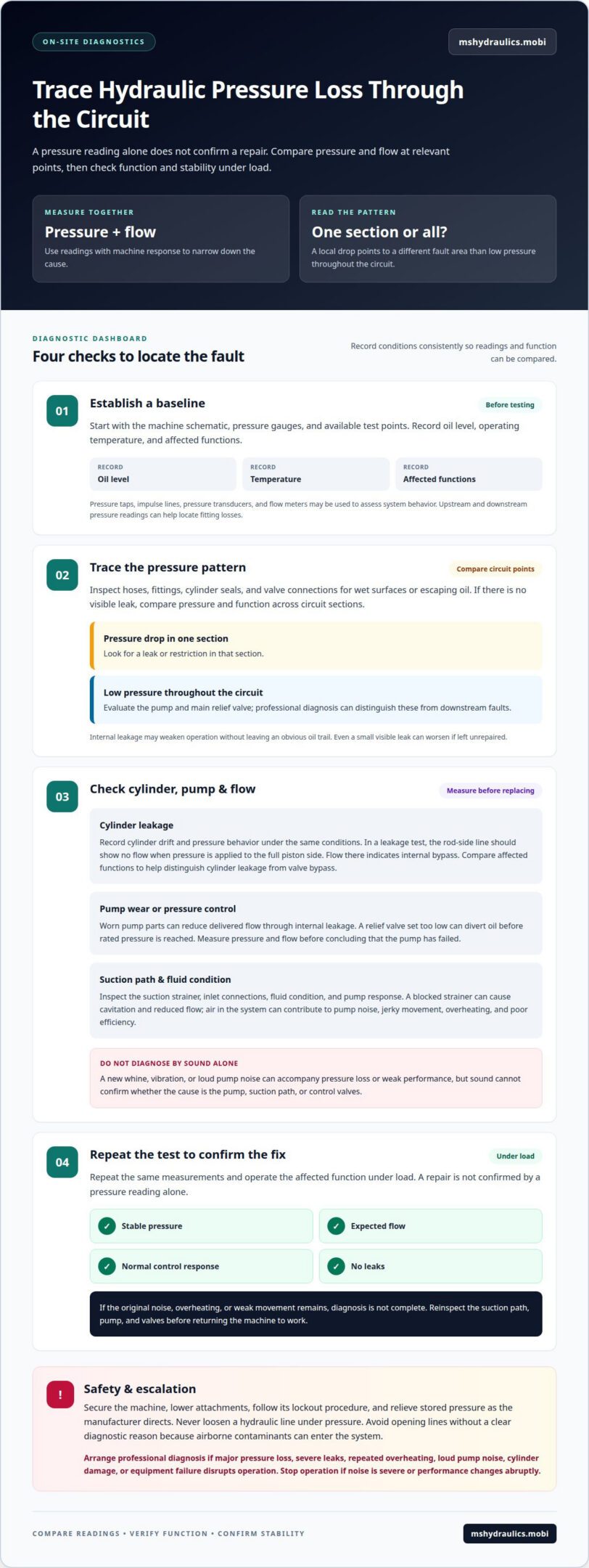
A pressure reading alone does not confirm that a hydraulic repair has worked. Effective troubleshooting hydraulic system pressure loss on-site compares pressure at relevant points in the circuit and checks whether flow, control response, and operation stay stable under load. The pattern matters: low pressure throughout the circuit points to a different fault than a pressure drop limited to one section.
Weak lifting, slow cylinder movement, and reduced machine performance signal that something needs attention, but the pump is not automatically the cause. This guide explains how to distinguish pressure loss from flow problems, trace likely faults through the circuit, and confirm a repair with functional testing. It also covers when major pressure loss, repeated overheating, or loud pump noise calls for professional diagnosis.
Key Takeaways
- Separate visible external leaks from internal leakage, which can weaken operation without leaving an obvious fluid trail.
- Use changes in pump sound and signs of cavitation to help trace possible suction-side or pump problems.
- Inspect filter condition and suction restrictions as potential causes of reduced flow before assuming the pump has failed.
- Use systematic circuit testing to locate the fault and determine whether professional hydraulic diagnosis is needed.
When Is Professional Hydraulic Diagnosis Needed?
Arrange professional diagnosis if major pressure loss, severe leaks, repeated overheating, loud pump noise, cylinder damage, or equipment failure disrupts operation. On-site troubleshooting may use pressure taps, impulse lines, pressure transducers, and flow meters to assess system behavior.
-
Gather On-Site Diagnostic Tools
Start with the machine schematic, pressure gauges, and available test points. Record the oil level, operating temperature, and affected functions before testing. The National Institute of Standards and Technology describes pressure transducers and flow meters as instrumentation for measuring system behavior. Pressure readings upstream and downstream can help locate fitting losses. Avoid removing components without a clear reason, since opening hydraulic lines exposes parts to airborne contaminants.
-
Inspect for External and Internal Leaks
Inspect hoses, fittings, cylinder seals, and valve connections for wet surfaces or escaping oil. A visible leak can lower pressure and reduce machine performance, and even a small leak can worsen if left unrepaired. If no external leak is visible, compare pressure and function across circuit sections. A local pressure drop points to a leak or restriction in that section. Pressure loss throughout the circuit calls for evaluation of the pump and main relief valve.
-
Test Cylinders for Internal Leakage
Check whether a cylinder drifts as pressure drops. That combination can indicate a leaking valve, but internal cylinder leakage should also be assessed. In a leakage test, the rod-side line should show no flow when pressure is applied to the full piston side. Flow there indicates that oil is bypassing internally rather than being held in the cylinder. Record drift and pressure behavior under the same operating conditions, then compare affected functions to distinguish cylinder leakage from valve bypass.
-
Assess Pump Wear and Leakage
Measure pressure and flow before concluding that the pump has failed. Worn pump parts can allow internal leakage, reducing delivered flow and weakening operation even without an obvious external oil leak. A whining pump, vibration, or excessive heat is further reason for professional testing. Check whether the main relief valve is diverting oil prematurely: a valve set too low can prevent rated pressure. If readings stay low across the circuit, professional diagnosis can distinguish pump wear from relief-valve or downstream faults.
How Do Hydraulic System Diagnostics Confirm the Fix?
Secure the machine, lower attachments, and follow its lockout procedure before testing. Relieve stored pressure as the manufacturer directs, and never loosen a hydraulic line under pressure.
-
Recognize Pump and Flow Problems by Sound
Listen to the hydraulic pump during operation and compare its sound with machine response. A new whine, vibration, or loud noise can accompany pressure loss, overheating, and weak performance. Record when the sound occurs, such as during cylinder movement or when a function meets resistance. Stop operation if the noise is severe or performance changes abruptly: continued operation can contribute to larger failures.
Before hands-on testing, isolate the machine and keep clear of moving equipment. A technician can use test points and gauges to compare pressure and flow for the affected function. Sound can help locate a symptom, but it cannot confirm whether the pump, suction path, or control valves caused it.
-
Check Causes of Pump Pressure Loss
Inspect the suction strainer, inlet connections, fluid condition, and pump response. A blocked suction strainer can cause cavitation and reduced flow. Air in the system can lead to unstable operation, pump noise, jerky movement, overheating, and poor efficiency. Because these symptoms overlap, compare them with measured pressure and flow rather than assuming a single cause.
Next, assess pump wear and pressure control. Worn pump components can reduce output; a relief valve set too low can divert oil to the tank before rated pressure is reached. A technician can measure flow through the system relief valve while gradually increasing its pressure setting. This controlled test helps distinguish pump capacity from relief-valve behavior.
Confirm the repair by repeating the same measurements and operating the affected function under load. Check for stable pressure, expected flow, normal control response, and leaks. If the original noise, overheating, or weak movement remains, diagnosis is not complete. Reinspect the suction path, pump, and valves before returning the machine to work.
What Does Low Hydraulic Pressure Look Like?
Low pressure can show up as weak lifting, slow cylinder movement, or reduced machine performance. There is no single normal pressure for every machine: compare readings with the equipment specification and operating conditions.
- First, record the symptoms and check the oil level and temperature. A loader that lifts weakly, for example, may have low fluid or a restriction. Note whether the problem affects every function or just one. This distinction helps narrow down the circuit area for further inspection.
- Inspect the filter and suction path for blockage or restricted flow. A clogged filter or blocked suction strainer can limit pump supply, and a blocked strainer can also cause cavitation and reduced flow. Check for a collapsed suction hose, loose connection, or visible obstruction. Avoid opening lines without a diagnostic reason, because contaminants can enter the hydraulic system.
- Examine reservoir condition and maintenance records. Check the oil level, fluid appearance, filter condition, and temperature trend. Dirty hydraulic fluid can damage pumps, valves, seals, and cylinders. Replace fluid immediately if it looks dirty, and follow the equipment manufacturer’s maintenance recommendations for filter service and fluid care.
- When the machine performs weakly, compare pressure at relevant test points. A pressure drop across a filter or suction section can indicate a restriction; reduced pressure across the full circuit points to a broader supply or relief issue. Consider readings alongside flow and machine response rather than treating one gauge value as a diagnosis. If overheating accompanies restricted flow, inspect filters, cooler condition, fluid level, and viscosity.
No single pressure reading applies to all equipment; normal values depend on the machine and its operating conditions.
Identifying pressure loss and weak operation
A structured approach to troubleshooting hydraulic system pressure loss on-site starts with symptoms, operating history, and the hydraulic schematic. Distinguish pressure problems from flow problems, then trace the affected circuit before choosing a component to test.
-
Collect Symptoms and Operating History
Record which function fails, when it occurs, and what changed beforehand. Note whether a cylinder moves slowly, lifting weakens under load, or several functions lose performance together. Compare behavior at cold start with operation after the machine warms up. One weak function suggests a local circuit issue; several weak functions may point to a shared supply or control problem.
Use the operator’s account and maintenance history to identify recent repairs, recurring leaks, or changes in noise. Mark each symptom on the schematic and record the conditions under which it appears. This history helps distinguish a new failure from a fault that emerges under specific operating demands. Avoid replacing an expensive component based on a single symptom.
-
Review Hydraulic System Components
Follow the schematic from the power supply through the pump, relief valve, directional valves, and actuator. Identify the components serving the affected function, then compare pressure readings along that path. If pressure is low throughout the circuit, investigate the pump or main relief valve. If the drop is local, focus on the valve, line, or restriction in that section.
For troubleshooting hydraulic system pressure loss on-site, isolate the power supply to distinguish its fault from a downstream issue. Compare affected and unaffected functions under similar conditions. In the described hand-pump test, a directional valve should hold pressure for at least one minute without bypassing to the tank. If readings remain inconclusive, request on-site hydraulic diagnosis to trace the circuit and identify the faulty component.
Ms. Hydraulics LLC: On-Site Diagnostic Services
Ms. Hydraulics LLC provides on-site diagnostics for hydraulic pressure loss and weak equipment operation. Turn to the team when symptoms persist, readings point to several possible faults, or testing requires tracing the machine’s hydraulic circuit.
On-site diagnosis can help identify whether the issue involves a hose, cylinder, or another hydraulic component. When a repair is needed, Ms. Hydraulics LLC also provides hydraulic hose fabrication, hydraulic cylinder rebuilds, and heavy equipment maintenance. The appropriate work depends on the fault and the equipment’s condition.
Describe the symptoms and affected machine functions when you report the problem. Contact Ms. Hydraulics LLC to discuss on-site hydraulic diagnosis.
Move From Symptoms to a Clear Repair Decision
Unresolved pressure loss can prevent a machine from performing reliably and make maintenance harder to plan. The next step is to identify the faulty circuit or component so repair decisions are based on evidence, not guesswork. A disciplined approach to troubleshooting hydraulic system pressure loss on-site helps distinguish an isolated issue from one affecting broader machine operation.
Share the machine’s operating history, affected functions, and any changes in sound or performance. This context gives diagnosis a practical starting point and supports decisions about the repair needed. Ms. Hydraulics LLC can address identified hose, cylinder, or maintenance issues through its hydraulic services.
Arrange the next diagnostic step with Ms. Hydraulics LLC. A clear assessment can help move the machine toward a sound repair plan and dependable operation.
Frequently Asked Questions
Does a Pressure Drop Always Mean the Pump Is Failing?
No. A pump is one possible cause, but pressure can also drop because a relief valve diverts oil, a seal leaks, a line is restricted, or a control valve is faulty. For example, if only one attachment loses force, compare its circuit readings with another function before blaming the shared pump.
What Are the Most Common Hydraulic Fault Symptoms?
Common signs include weak lifting, slow or jerky cylinder movement, drifting, unusual pump noise, overheating, vibration, and visible fluid leaks. Symptoms can occur together: air in the system, for example, may contribute to noisy operation and unstable movement. Note which functions are affected and under what conditions. That pattern helps distinguish a circuit-specific problem from a broader machine issue.
What Information Helps a Hydraulic Engineer Diagnose a Fault?
Provide the equipment model, hydraulic schematic, affected functions, and a clear description of when the problem occurs. Include recent repair or maintenance history and any pressure or temperature readings already recorded. For equipment around Cleburne, Dallas-Fort Worth, Alvarado, Granbury, Crowley, Arlington, Mansfield, Waxahachie, and Cedar Hill, this information gives diagnostic work a useful starting point.
When Should You Stop the Machine?
Stop operation if a severe leak, major pressure loss, repeated overheating, damaged cylinder, loud pump noise, or complete equipment failure occurs. Hydraulic leaks can create hazards, and continued operation can worsen component damage. Keep clear of escaping fluid and moving attachments. Resume work only after the fault has been assessed and it is safe to operate the machine.
Why Does Pressure Loss Keep Coming Back?
Recurring pressure loss often means the underlying cause remains or another condition is damaging the repaired component. For example, replacing a pump without addressing a blocked suction strainer can leave flow problems unresolved. Contaminated fluid, recurring leaks, or a relief valve that diverts oil prematurely can also contribute. Compare symptoms before and after repair, then test the affected function under operating conditions.
What Are the Common Causes of Hydraulic System Pressure Loss?
Common causes include low fluid, external or internal leakage, worn pump parts, damaged valves, clogged filters, suction restrictions, and a relief valve set too low. The affected circuit offers a useful clue: a local pressure drop directs attention to that section, while low pressure across the system suggests a shared supply or pressure-control issue. Pressure and flow testing help narrow down the cause.