Fixed price cylinder rebuilds and part replacements in Cleburne
A cylinder may seem to need only new seals, but inspection can reveal a broader repair. The cost of a fixed price hydraulic cylinder rebuild in Cleburne depends on the cylinder’s condition, required parts, and repair scope. A quote sets out the work involved, whether that means resealing or replacing worn components.
Resealing requires disassembling the cylinder and replacing its internal rubber and plastic seals. Inspection during the rebuild can also show whether parts such as the gland, bushing, piston, or eye need replacement.
This guide covers the cylinders and equipment that may need service, the parts a rebuild can address, and the process from diagnosis through reassembly. It also explains what shapes the repair scope and quote, so you can plan the next step for equipment that’s out of service.
Key Takeaways
- Understand how teardown and inspection reveal whether a cylinder needs resealing, component replacement, or a more complete rebuild.
- Learn how wear or damage to the gland, bushing, piston, and eye can shape the repair scope.
- See how the cylinder’s condition and required parts affect the work and the quote.
- Explore the equipment and cylinder applications covered, including examples such as excavators, skid steers, and drill rigs.
- Recognize when hydraulic hose fabrication may be relevant alongside cylinder repair.
What types of hydraulic cylinders do you repair?
Hydraulic cylinder rebuild shops near Cleburne, Texas, assess the cylinder’s construction, condition, and application before defining repair scope. A mobile hydraulic repair service in Cleburne can inspect equipment at its worksite when removing or transporting the machine is impractical.
A cylinder’s function helps guide diagnosis. A single-acting cylinder applies hydraulic force in one direction, while a double-acting cylinder uses fluid pressure to move in both directions. Cylinders used for lifting, steering, digging, or extending equipment face different operating demands. An excavator boom cylinder, for example, works under loads and movement patterns unlike those of a steering cylinder. These details guide the inspection, but the cylinder’s actual condition determines the work required.
Inspection begins with the reported problem and visible symptoms. Fluid around the rod may point to a sealing issue, while uneven movement can lead to an examination of the rod, barrel, and internal components. The technician also considers how the cylinder is mounted and connected to the machine. A cylinder removed from a skid steer may be easier to examine on a workbench, while one installed on a drill rig may call for an on-site diagnostic assessment. Symptoms guide inspection, but they don’t prove which part has failed.
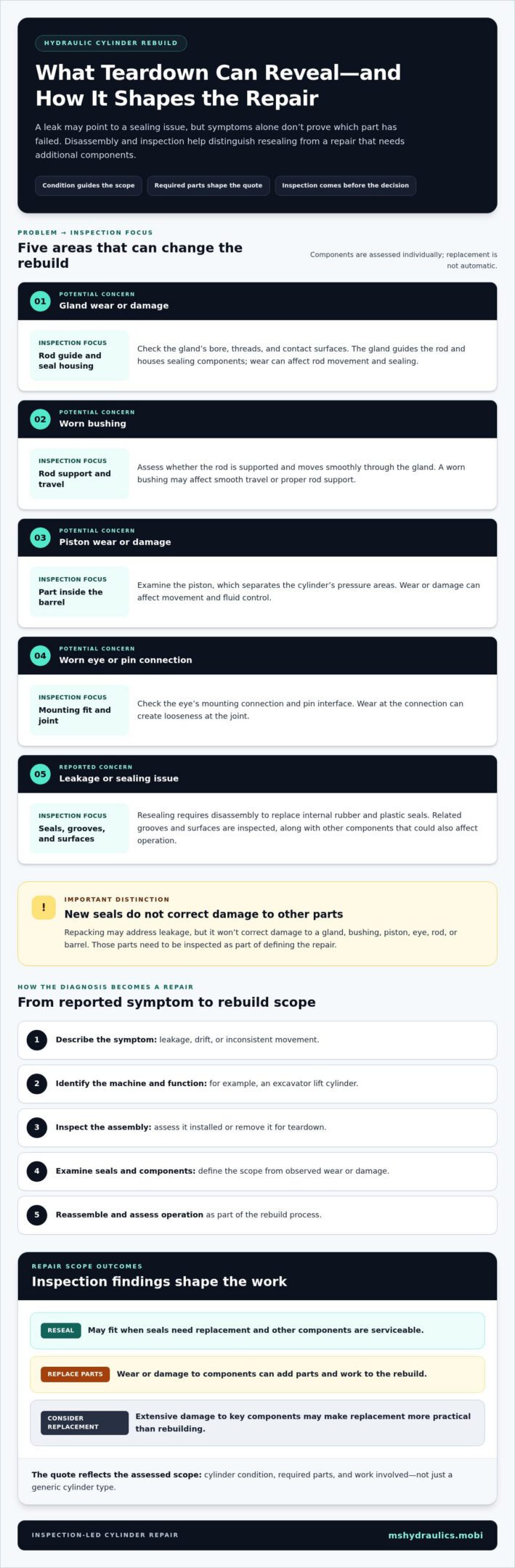
A rebuild begins with disassembly so the cylinder’s components can be examined. Resealing requires teardown to replace the internal rubber and plastic seals. Inspection during disassembly can reveal wear or damage that a surface check may miss. The rod, barrel, and internal parts are assessed for condition and signs that may affect operation. The gland, bushing, piston, and eye may also need attention, depending on their condition. This process distinguishes a seal-focused repair from work that requires replacement parts.
A practical sequence keeps the diagnosis tied to the repair:
- Describe the symptom, such as leakage, drift, or inconsistent movement.
- Identify the machine and cylinder function, such as an excavator lift cylinder.
- Inspect the installed assembly or remove the cylinder for teardown.
- Examine seals and components, then define the repair scope from observed wear or damage.
- Reassemble the cylinder and assess its operation as part of the rebuild process.
This sequence provides a more specific assessment than identifying the cylinder type alone. A worn seal may call for resealing, while piston or rod damage can change the work required. The cylinder’s design, application, and inspection findings all inform the rebuild. For a fixed price hydraulic cylinder rebuild in Cleburne, the quote reflects the assessed scope and required parts, not a generic label such as “excavator cylinder.”
Gland, bushing, piston, and eye replacement
A cylinder’s gland guides the rod and houses sealing components. A worn or damaged gland can affect rod movement and sealing, so inspection focuses on its bore, threads, and contact surfaces. The bushing supports and aligns the rod as it moves through the gland. If it is worn, the rod may not travel smoothly or remain properly supported. These components are assessed individually, not replaced automatically.
The piston moves inside the barrel and separates the cylinder’s pressure areas. Wear or damage can affect movement and fluid control. The eye connects the cylinder to the machine through a pin or mounting point. A worn eye or pin connection can create looseness at the joint. During teardown, each part is checked for visible damage and proper fit. The findings help determine whether it can remain in service or needs replacement.
Seals serve a different purpose from the cylinder’s structural components. Resealing, also called repacking, requires disassembling the cylinder to replace its internal rubber and plastic seals. A technician removes the old seals, inspects the related grooves and surfaces, then installs replacement seals suited to the assembly. Replacing seals may address leakage, but it won’t correct damage to a gland, bushing, piston, eye, rod, or barrel. Those parts must also be inspected.
Repair scope depends on the condition of the assembly. Replacing seals and a worn bushing may be appropriate when the other components are serviceable. A damaged piston or eye can add parts and work to the rebuild. Extensive damage to key components may make replacement more practical than rebuilding. The decision depends on component condition, cylinder design, mounting interfaces, and equipment application. A replacement must suit the machine’s connections and function, not merely resemble the old cylinder.
- Gland: Inspect the rod-guiding area, sealing surfaces, and threads.
- Bushing: Assess rod support and movement through the gland.
- Piston: Examine the component that separates pressure areas inside the barrel.
- Eye: Check the cylinder’s mounting connection and pin interface.
- Seals: Replace internal rubber and plastic seals during disassembly and repacking.
The price depends on teardown findings, replacement parts, and the work required; the exact figure is provided in a quote for your case. For a cylinder with leakage or worn components, review the cylinder rebuild service as a relevant next step.
Repair process and customer communication
A useful rebuild quote starts with details that identify the cylinder and its problem. Share the machine make and model, the cylinder’s function, its symptoms, and any visible identification markings. Photos of the full cylinder, mounting points, ports, and damaged areas can help clarify its configuration. Dimensions and connection details are especially useful for custom or older cylinders.
Describe what the equipment is doing, not just what the cylinder looks like. For example, report external leakage, drifting under load, uneven extension, or a rod that binds during movement. Note when the symptom occurs and whether the cylinder is installed or removed. This context helps distinguish reported behavior from the repair scope that inspection may reveal.
The repair process moves from initial assessment to teardown, inspection, and a defined work scope. Once disassembled, the cylinder’s seals and components can be checked for wear or damage. The findings show whether the work involves repacking, component replacement, or a broader rebuild. Before repair proceeds, a clear update should identify the observed issue, proposed parts, and work included in the quote.
Custom and obsolete cylinders require attention to interfaces, not just appearance. Record the rod and barrel dimensions, port arrangement, mounting style, and eye or pin connections. An older cylinder may have worn markings or no readable identification plate, making measurements and photographs especially useful. These details help identify the assembly and assess whether suitable parts can be used to rebuild it.
Good communication connects each finding to a practical decision. If inspection reveals a damaged piston, for example, the scope may differ from a seal-only repair. If the cylinder has unusual mounting dimensions, preserving those interfaces matters for equipment fit. The quote should reflect the work and parts identified for that cylinder, rather than assume every unit needs the same repair.
Before arranging an assessment, gather the information that best describes the cylinder:
- Equipment details: Make, model, and the cylinder’s role on the machine.
- Symptoms: Leakage, drift, binding, or inconsistent movement, with the conditions when they occur.
- Identification: Cylinder markings, photos, dimensions, ports, and mounting connections.
- Access: Whether the cylinder remains installed or has been removed.
The quote depends on inspection findings, required parts, and repair scope. For custom or obsolete assemblies, complete dimensions and clear photos help describe the cylinder accurately and establish a suitable rebuild plan.
Types of cylinders and equipment served
Hydraulic cylinders convert fluid pressure into linear movement, but their configuration depends on the machine’s task. An excavator uses cylinders to move its boom, arm, and bucket. A skid steer may use cylinders for lift and attachment movement. A drill rig uses hydraulic motion for functions specific to its operation. These examples show why the machine and cylinder function matter when identifying repair needs.
Single-acting cylinders use hydraulic pressure to move in one direction, with another force returning the cylinder. Double-acting cylinders use pressure to move in both directions. This distinction affects how the assembly operates and connects to the hydraulic system. The cylinder’s ports, mounting points, and movement pattern help identify its configuration. The machine’s function provides useful context, but the cylinder itself determines the repair assessment.
Equipment also places different demands on cylinders. An excavator boom cylinder supports repeated lifting and positioning, while an arm or bucket cylinder performs a different part of the machine’s work. On a skid steer, lift cylinders and attachment movement depend on the machine’s setup. A drill rig’s cylinders serve functions specific to that equipment. These distinctions help describe where a cylinder operates and what movement has changed.
To identify a cylinder accurately, record the equipment and its location before arranging service. For example, “boom cylinder on an excavator” gives more context than “leaking cylinder.” Include visible markings, ports, and mounting details where available. If the machine has several similar cylinders, note which position is affected. This information helps distinguish a boom cylinder from an arm, bucket, lift, or other application.
- Excavators: Identify whether the affected unit works at the boom, arm, or bucket.
- Skid steers: Describe whether the cylinder relates to lift movement or an attachment function.
- Drill rigs: Explain the equipment function linked to the cylinder’s movement.
- Other equipment: Provide the machine type, cylinder location, and operating symptom.
Equipment identification can also help distinguish cylinder repair from a broader machine issue. If an excavator boom moves unevenly, the affected cylinder is one part of the hydraulic system to assess. If a skid steer’s lift function changes, describing the movement and cylinder position helps focus diagnosis. A symptom alone doesn’t identify the failed component, so both the cylinder’s application and its condition matter.
For equipment operating in Cleburne and the surrounding Dallas-Fort Worth area, clear application details make the service discussion more specific. State whether the cylinder remains installed on an excavator, skid steer, or drill rig, and describe its role. Heavy equipment maintenance may also be relevant if cylinder concerns affect the machine’s wider operation. Matching the assessment to the cylinder’s equipment and function keeps the work focused.
Complete cylinder rebuilds
A complete rebuild addresses the cylinder as an assembly, not just its seals. Work begins by identifying how the cylinder mounts, connects, and functions on its machine. A leaking excavator cylinder, for example, may need more than repacking if inspection finds damage to other components. Teardown provides access to internal parts and helps define work based on their observed condition.
Each stage supports the next. Disassembly makes internal inspection possible, and inspection identifies which components need attention. Depending on the findings, the repair scope may include seal replacement and work on worn or damaged parts. Reassembly returns the cylinder to an assembled state for operational assessment. The repair plan should reflect the cylinder’s design and application, rather than assume every rebuild requires the same parts.
- Identify the assembly: Record the machine, cylinder function, mounting arrangement, ports, and visible markings.
- Disassemble the cylinder: Separate the assembly to access its internal seals and components.
- Inspect the parts: Assess the rod, barrel, gland, bushing, piston, eye, and seals for wear or damage.
- Define the scope: Determine which parts can remain and which require replacement or repair.
- Reassemble and assess: Put the cylinder back together and evaluate its operation in relation to its intended movement.
A seal-only repair and a complete rebuild address different conditions. Repacking replaces internal rubber and plastic seals, while a broader rebuild may include additional components identified during inspection. If an excavator boom cylinder has a damaged piston as well as leaking seals, the work must account for both findings. The assessment should also consider how the cylinder’s mounting and connections affect its return to the equipment.
The choice between replacement and rebuilding depends on the cylinder’s condition and the parts required. A rebuild may suit an assembly that can be serviced while retaining its usable components. Extensive damage or an unsuitable repair scope can make replacement more practical. Fit is essential: the cylinder must match the equipment’s mounting points, ports, and required movement. Comparing these factors keeps the decision tied to the machine’s needs.
Before authorizing a complete rebuild, review the proposed work against the inspection findings. Confirm that the scope accounts for identified damage, required parts, and the cylinder’s function. A drill rig cylinder and a skid steer lift cylinder, for example, may need different considerations because they serve different roles. A clear scope helps separate necessary work from assumptions based only on symptoms.
If a cylinder needs this broader service, arrange a hydraulic cylinder rebuild based on its condition and equipment application.
Ms. Hydraulics: Hydraulic Hose Fabrication
Ms. Hydraulics LLC provides Hydraulic Hose Fabrication for equipment that needs hose work alongside cylinder service. A cylinder rebuild addresses the cylinder assembly; a damaged or worn hose is a separate part of the hydraulic system. The company also provides Hydraulic Cylinder Rebuilds, Mobile Hydraulic Repair, and Heavy Equipment Maintenance for relevant repair needs.
Consider hose fabrication when a hydraulic hose needs repair or replacement, or when equipment needs attention beyond the cylinder itself. For a cylinder concern in the field, Mobile Hydraulic Repair brings service to the equipment. The right work depends on the component and issue involved.
For service details or to discuss your equipment needs, visit mshydraulics.mobi.
Plan the next step for your equipment
A cylinder issue is also a useful opportunity to consider the equipment’s broader maintenance needs. Decide whether the immediate priority is the cylinder alone or whether related hydraulic work belongs in the same service discussion. This distinction helps shape a practical repair plan around the machine’s operating requirements.
Ms. Hydraulics LLC provides Hydraulic Cylinder Rebuilds for cylinder repair, Hydraulic Hose Fabrication for hose needs, and Heavy Equipment Maintenance for broader equipment service. If you’re considering a fixed price hydraulic cylinder rebuild in Cleburne, discuss the repair scope and equipment’s intended use with Ms. Hydraulics LLC. These details help connect the work to the operating need without assuming every cylinder requires the same approach.
Use the next step to discuss the cylinder and the work you need completed. Contact Ms. Hydraulics LLC about your cylinder to start that conversation, and move forward with a repair plan suited to your equipment.
Frequently Asked Questions
Got a Cylinder Down?
If a cylinder has stopped moving, note the machine function and what changed before arranging repair. For example, record whether an excavator boom won’t lift, a skid steer attachment won’t extend, or fluid is visible near a cylinder. If the machine is still assembled, on-site diagnostics and mobile hydraulic repair can help assess it in place. Clear symptom details make the initial service discussion more focused.
What does a hydraulic cylinder rebuild include?
A rebuild includes disassembly, inspection, and work on the parts identified for service. Resealing replaces the cylinder’s internal rubber and plastic seals. The assessment may also identify other worn components that affect operation. For example, a cylinder used for lifting equipment may need more than new seals if inspection finds damage elsewhere. The scope depends on the assembly’s condition and intended function.
Do Cleburne hydraulic shops offer upfront quotes or flat-rate pricing?
Hydraulic cylinder rebuild pricing may be structured as a flat rate or as labor plus parts, depending on the project. The key is whether the quote reflects assessed work and components or is only an initial estimate based on symptoms. In Cleburne and the surrounding Dallas-Fort Worth area, share equipment details and describe the cylinder’s behavior so the proposed scope can account for its repair needs.