Expert Hydraulic Valve Repair in Cleburne & North Texas: 2026 Guide
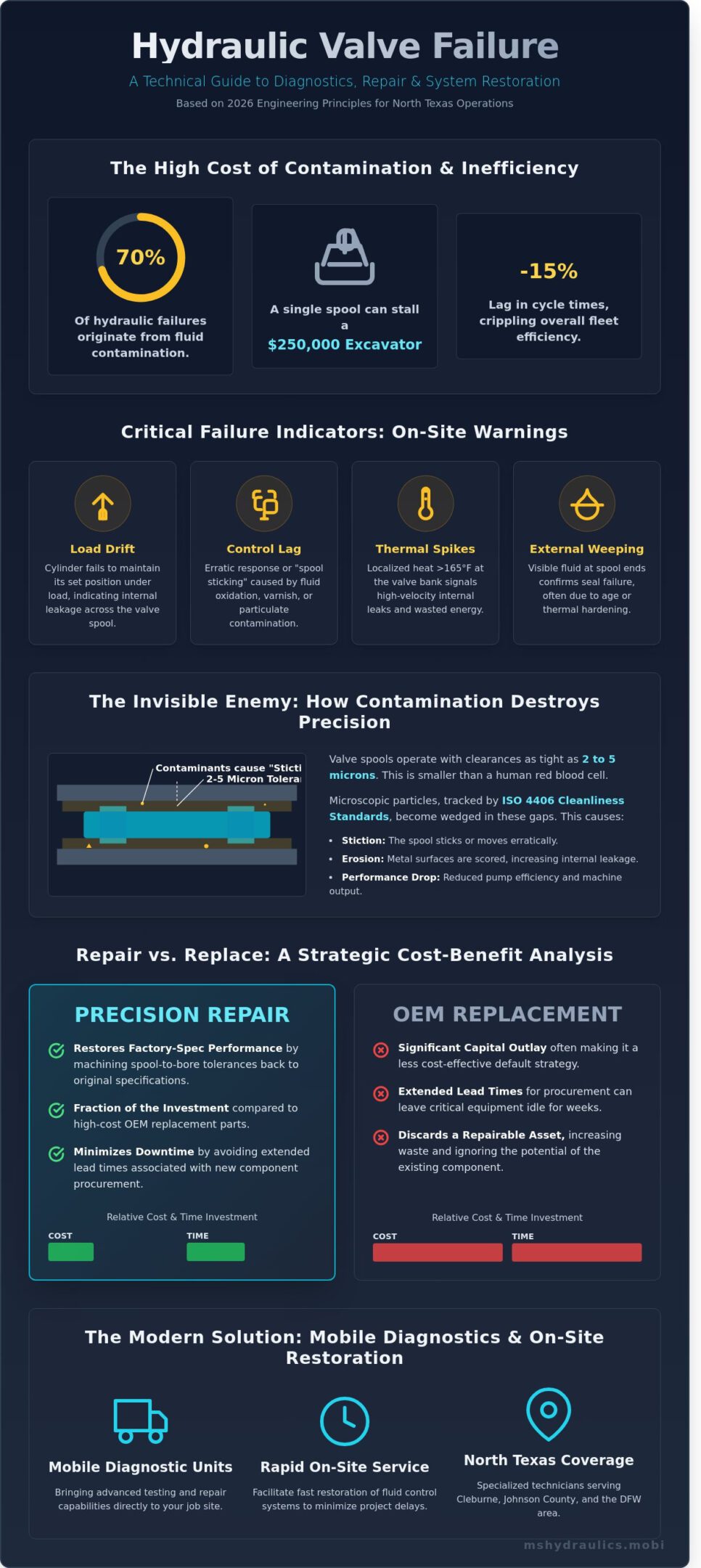
A single malfunctioning spool in a directional control valve can stall a $250,000 excavator within minutes, yet 70% of hydraulic system failures originate from fluid contamination that degrades these precise components long before they seize. When machine response becomes inconsistent or cycle times lag by even 15%, the operational efficiency of your entire fleet is at risk. You know that in the demanding environments of Cleburne and North Texas, equipment downtime doesn’t just delay a job; it erodes your bottom line. Relying on the high cost of OEM replacement parts shouldn’t be your default strategy when a precision Hydraulic Valve Repair can restore factory-spec performance at a fraction of the investment.
This 2026 guide provides the technical framework required to master the essentials of valve diagnostics and system restoration. You’ll learn how to identify the specific root causes of failure, such as internal leakage or solenoid burnout, and determine if a professional rebuild is a viable path forward. We’ll also provide the criteria for selecting a reliable local technician within the DFW area who understands ISO standards and high-pressure requirements. By applying these engineering principles, you’ll minimize project delays and ensure your heavy equipment remains a dependable asset on every job site.
Key Takeaways
- Identify critical failure indicators, such as load drifting and erratic spool response, to mitigate the risk of catastrophic machinery failure and extended downtime.
- Gain technical insight into the specialized process of Hydraulic Valve Repair, focusing on restoring exact spool-to-bore tolerances and maintaining optimal system PSI.
- Evaluate the strategic cost-benefit of rebuilding existing valve components against the extended lead times currently associated with new OEM procurement.
- Discover how specialized mobile diagnostic units facilitate rapid, on-site restoration of fluid control systems to maintain operational safety across North Texas.
Understanding Hydraulic Valves: The Core of Machinery Control
Hydraulic valves serve as the central nervous system for any fluid power system. They function as the brain that regulates fluid direction, pressure, and flow rate to ensure precise machine movements. Without these components, a pump’s raw power would be destructive rather than productive. In the context of industrial operations in North Texas, maintaining these valves is critical for operational safety. A valve failure at 3,500 PSI can lead to immediate equipment downtime or catastrophic structural damage. Proper Understanding Hydraulic Valves requires a technical look at how they manage energy within a circuit.
Most heavy equipment relies on three primary valve categories to maintain performance standards:
- Directional Control Valves: These manage the path of fluid to actuators, determining whether a cylinder extends or retracts.
- Pressure Relief Valves: These act as safety benchmarks, opening when system pressure exceeds a set limit, typically between 2,000 and 6,000 PSI.
- Flow Control Valves: These regulate the volume of oil passing through a specific point, which directly dictates the speed of hydraulic motors and cylinders.
Precision tolerances are the foundation of modern machinery. Manufacturers often design valve spools with clearances as tight as 2 to 5 microns. Even a slight deviation in these measurements results in internal leakage, which reduces the total output of the machine. Professional Hydraulic Valve Repair focuses on restoring these exact specifications to ensure the equipment operates at its original design capacity.
The Mechanics of Flow and Pressure Regulation
Spool movement within the valve body dictates the speed and force of the connected actuator. When the spool shifts, it opens specific ports that channel pressurized oil. If the valve housing is worn, fluid bypasses the spool, causing a measurable drop in pump displacement efficiency. A hydraulic valve is a precision metering device engineered to modulate fluid power by controlling direction, pressure, and flow rates within a closed-loop system. It’s the primary interface between mechanical input and hydraulic output.
ISO Standards and Valve Performance
Valve longevity depends heavily on ISO 4406 cleanliness standards. This code tracks the number of particles per milliliter of fluid across three sizes: 4, 6, and 14 microns. Microscopic contaminants are the leading cause of “stiction,” where particles wedge between the spool and the bore, causing the valve to stick or move erratically. Internal leakage increases as these particles erode the metal surfaces over time. For industrial sectors in North Texas, utilizing certified technical Hydraulic Valve Repair ensures that components are tested on benches that meet or exceed these ISO requirements. This methodical approach prevents premature failure and maintains the stability of high-pressure systems.
Common Indicators of Hydraulic Valve Failure in North Texas
Early identification of valve degradation prevents catastrophic system failure and protects high-value components like pumps and actuators. Equipment “drifting,” where a cylinder fails to maintain its set position under a 5,000 psi load, directly indicates internal leakage across the valve spool. When operators in Cleburne report erratic response or “spool sticking,” it’s typically a result of fluid oxidation or physical scoring of the precision-ground surfaces. Excessive heat at the valve bank, often exceeding 165°F, signals an internal bypass where high-pressure fluid escapes to the return line without performing mechanical work. This energy loss manifests as a 15% to 20% drop in overall system efficiency.
- Load Drift: Internal bypass allows fluid to slip past the spool, causing unintended movement.
- Control Lag: Varnish buildup or particulate contamination prevents the spool from shifting smoothly.
- Thermal Spikes: Localized temperature increases at the valve block indicate high-velocity internal leaks.
- External Weeping: Visible fluid at the actuator or spool ends confirms seal failure, often due to thermal hardening.
Environmental Impacts: The Texas Heat and Dust Factor
North Texas operating environments impose severe thermal stresses on hydraulic hardware. Ambient temperatures in the Dallas-Fort Worth metroplex frequently exceed 105°F during summer months. These conditions accelerate the thermal degradation of nitrile and Viton seals, leading to a 22% reduction in seal elasticity compared to systems in temperate climates. In Alvarado and Grandbury, airborne particulate matter often exceeds 45 micrograms per cubic meter. These abrasive particles penetrate rod seals and score valve spools, necessitating professional Hydraulic Valve Repair to restore the tight tolerances required for pressure compensation.
Diagnostic Techniques for Field Technicians
Precision diagnostics are the foundation of The Technical Repair Process for heavy machinery. Technicians utilize differential pressure testing to isolate internal leakage points within a multi-spool bank. Thermal imaging cameras are employed to detect localized hot spots, which often reveal a hairline fracture in the valve body or a failing relief valve. Before any Hydraulic Valve Repair commences, a fluid analysis per ISO 4406 standards is mandatory. This determines if the failure stems from chemical breakdown or mechanical wear. For operators observing these symptoms, scheduling a comprehensive bench test prevents a minor seal leak from evolving into a total system shutdown.
The Technical Repair Process: Restoring Precision
Professional Hydraulic Valve Repair begins with a systematic teardown and ultrasonic cleaning to eliminate microscopic particulates. Technicians document every component’s condition against original equipment manufacturer (OEM) technical data sheets. This rigorous approach ensures that every valve leaving the facility meets ISO 9001:2015 quality standards. While many operators try to diagnose and repair hydraulic valve block leaks in the field, internal bypass issues often require shop-level intervention to restore volumetric efficiency. We don’t compromise on the teardown phase; it’s the only way to identify hairline fractures in the valve body.
Spool and Bore Inspection Criteria
Evaluation focuses on identifying scoring, pitting, and erosion that disrupt laminar flow. If the valve bore exhibits wear exceeding 0.015 mm, the body requires over-sizing or replacement to maintain pressure integrity. Technicians utilize digital bore gauges to verify geometric tolerances. Spool-to-bore clearance must be measured within a precise tolerance of 2 to 6 microns to prevent internal leakage and ensure responsive control. When surfaces show signs of cavitation or thermal discoloration, we implement precision honing or replace the spool with a hard-chrome plated alternative to extend service life.
Contamination Control During Reassembly
Assembly occurs in a climate-controlled environment to prevent airborne contaminants from entering the hydraulic circuit. We adhere to ISO 4406 cleanliness codes, ensuring that all Hydraulic Valve Repair projects remain free of debris that causes premature failure. The process relies on methodical execution and specialized tools.
- Seal Selection: We utilize Viton seals for high-temperature applications up to 204°C, while Nitrile (Buna-N) remains the standard for 105°C operations.
- Lubrication: Components are pre-lubricated with filtered hydraulic fluid to prevent dry-start scoring during initial cycles.
- Torque Accuracy: Fasteners are tightened to within 2% of OEM torque specifications using calibrated digital wrenches.
Final validation involves bench testing on a 150-horsepower hydraulic test stand. We monitor flow rates and pressure drops across the entire operating range. Each valve is calibrated to its specific relief setting, typically within a 1.5% margin of the design parameters. This data-driven process guarantees that the repaired unit performs reliably under the 3,500 PSI loads common in North Texas industrial environments. It’s a level of precision that field repairs simply cannot match.
Repair vs. Replace: Evaluating Costs and Downtime
Deciding between a component rebuild and a total replacement requires a technical analysis of the valve’s current state and the project’s timeline. For most industrial applications in North Texas, Hydraulic Valve Repair represents a strategic cost-saving measure. A standard rebuild typically costs between 40% and 55% of the price of a new OEM unit. When a new valve bank exceeds $5,200, the economic advantage of a precision repair is clear. Supply chain data from 2025 indicates that lead times for new specialized valves remain volatile, often stretching to 14 weeks. Local repair services in Cleburne reduce this window to under 5 business days.
Replacement becomes the only viable path when structural integrity is compromised. Our technicians look for specific failure markers that dictate a full unit swap:
- Cracked valve blocks or castings that can’t be safely welded.
- Severe internal spool erosion exceeding 0.0007 inches of clearance.
- Obsolete valve series where internal seal kits are no longer manufactured.
- Extreme thermal warping from localized system overheating.
Economic Factors for DFW Business Owners
Downtime in high-stakes environments like Waxahachie or Mansfield directly erodes project profitability. Local construction firms report that a single idled excavator can cost $320 per hour in lost productivity. MS Hydraulics provides transparent cost estimation based on precise measurements of internal clearances and seal integrity. We focus on the Total Cost of Ownership. This metric accounts for the initial repair price, the speed of deployment, and the projected service life of the restored component.
Warranty and Reliability Considerations
A professional Hydraulic Valve Repair isn’t a temporary fix; it’s a restoration to factory specifications. We back our work with a technical warranty that provides more security than purchasing used or “surplus” components from unverified sources. Longevity depends on system cleanliness. Every repair follows a strict protocol including a full system fluid flush to remove contaminants that caused the initial failure. For more details on maintaining your fleet, consult our Heavy Equipment Maintenance Guide. We ensure every valve meets ISO 4406 cleanliness standards before it returns to the field.
Professional Mobile Valve Services: Minimizing Downtime in Johnson County
On-site diagnostics in Arlington provide a strategic advantage for fleet managers who can’t afford the logistics of transporting heavy machinery to a central shop. Ms. Hydraulics deploys specialized mobile units that function as fully equipped field laboratories. These units allow our technicians to address complex Hydraulic Valve Repair issues directly at the job site. By eliminating the need for lowboy transport and heavy rigging, operators often reduce total repair expenses by 18% while cutting machine downtime from several days to just a few hours.
In Crowley, the construction and agricultural sectors rely on these mobile interventions to maintain peak operational efficiency during tight project windows. A malfunctioning control valve on a backhoe or a pressure relief failure on a harvester requires immediate technical precision. Our field engineers utilize digital flow meters and ultrasonic leak detectors to identify internal bypass or spool wear without removing the component from the chassis. This methodology ensures that system pressure and torque specifications remain within OEM parameters throughout the restoration process. Our mobile service trucks carry high-pressure testing rigs and a comprehensive inventory of seals and O-rings compatible with major brands like Rexroth and Vickers, ensuring most repairs are completed in a single visit.
Serving the North Texas Industrial Corridor
We maintain a localized presence across Cleburne and Alvarado to ensure rapid deployment for critical valve failures. Our emergency response protocols prioritize assets that halt entire production lines or municipal job sites. Ms. Hydraulics serves as a technical partner for the North Texas metroplex, providing engineering support that exceeds standard mechanical fixes. We focus on restoring factory-spec performance to every valve assembly we service, utilizing data-driven benchmarks to verify success.
Requesting a Technical Consultation
Efficiency starts with accurate data. When contacting us, please provide the component serial number and a detailed description of symptoms, such as erratic actuator movement or visible external leakage. It’s helpful to ensure the equipment is parked on a level surface and the hydraulic circuit is depressurized before our technician arrives. This preparation allows for a safer and more expedited diagnostic phase. Ready to restore your system’s integrity? Schedule your on-site valve diagnostic with Ms. Hydraulics to secure expert Hydraulic Valve Repair and minimize your operational interruptions.
Restore Operational Precision to Your Hydraulic Systems
Maintaining hydraulic systems requires technical precision and rapid response. Since 2021, MS Hydraulics has provided the DFW Metroplex with specialized cylinder and valve rebuild expertise that meets rigorous industrial standards. Our data indicates that early detection of pressure fluctuations prevents total system failure. Mobile technician labor for on-site diagnostics eliminates the logistical burden of transporting heavy machinery across Johnson County. This proactive approach ensures your equipment meets 2026 performance benchmarks while maintaining optimal torque and displacement parameters.
When precision control falters, professional Hydraulic Valve Repair restores the mechanical integrity required for demanding industrial operations. We’ve optimized our service protocols to support Cleburne’s heavy industry with technical accuracy and engineering-led solutions. Reliability isn’t a vague goal; it’s a measurable metric our technicians verify through documented on-site testing and performance validation. We’re committed to ensuring your machinery operates at peak efficiency.
Get Expert Mobile Hydraulic Valve Repair in Cleburne
Your machinery’s uptime remains our primary objective and we’re ready to assist your team today.
Frequently Asked Questions
Can a hydraulic valve be repaired without removing it from the machine?
Minor external issues like O-ring replacements or solenoid swaps can often be performed in-situ, but internal component failures require bench testing. For repairs involving spool honing or internal seal replacement, 95% of components must be removed to maintain ISO 4406 cleanliness standards. Field environments rarely provide the 0.5 micron filtration levels necessary for sensitive internal valve adjustments. It’s vital to protect the system from the 80% of contaminants introduced during field disassembly.
How much does a typical hydraulic valve repair cost in North Texas?
Professional hydraulic valve repair in North Texas typically ranges from $450 to $2,800 depending on the specific valve series and damage severity. A standard rebuild for a directional control valve averages $650, while complex proportional valves often reach the higher end of the spectrum. These costs represent a 40% savings compared to purchasing new OEM replacements in the 2026 market. We provide detailed quotes after a 24-hour teardown inspection.
What are the most common causes of hydraulic valve failure?
Fluid contamination accounts for 75% of all hydraulic valve failures in industrial machinery. Microscopic particles exceed the 5 micron tolerances between the spool and housing, leading to silt-lock or erosive wear. Excessive heat above 180 degrees Fahrenheit also causes seal hardening, which results in internal bypass and pressure drops across the valve body. Regular fluid monitoring prevents these 2 primary failure modes from damaging your hardware and causing downtime.
How long does a professional valve rebuild take to complete?
A standard professional valve rebuild takes 2 to 5 business days from initial inspection to final pressure testing. Complex units requiring specialized machining or parts from international suppliers might extend to 10 days. We verify every repair on a test stand to ensure it meets 100% of the original manufacturer’s flow and pressure specifications before delivery. This rigorous protocol ensures the component performs reliably for its next 2,000 hours of service.
Is it better to repair or replace a sticking hydraulic spool valve?
Repairing a sticking spool is the preferred option if the housing bore remains within 0.0005 inches of the original tolerance. If the spool or bore shows scoring deeper than 0.001 inches, replacement is usually necessary to prevent excessive internal leakage. Our technicians use precision micrometers to determine if a component meets the 85% efficiency threshold required for a reliable rebuild. We won’t recommend a repair that doesn’t meet these strict engineering standards.
Do you provide mobile hydraulic valve repair in Fort Worth and Dallas?
We provide on-site diagnostic services across Fort Worth and Dallas, though most hydraulic valve repair tasks must be completed in our controlled shop environment. Our mobile units arrive with flow meters and pressure gauges to identify the 3 most likely failure points on your equipment. This 24-hour response service minimizes downtime by ensuring only the necessary components are pulled for bench work. It’s the most efficient way to handle complex system failures.
What happens if I continue to operate a machine with a leaking valve?
Operating with a leaking valve leads to a 15% to 30% reduction in system efficiency and significant energy loss through heat generation. External leaks create environmental hazards and violate OSHA safety standards, while internal leaks cause “drift” in hydraulic cylinders. If left unaddressed for more than 40 operating hours, a minor leak can cause catastrophic pump cavitation or total system failure. Addressing the leak early saves approximately 60% in total repair costs.
How can I prevent my hydraulic valves from failing prematurely?
Implementing a strict fluid analysis program every 500 operating hours is the most effective way to prevent premature valve failure. You should maintain a target ISO 4406 cleanliness level of 16/14/11 for high-pressure systems. Replacing filters when they reach 80% of their dirt-holding capacity and maintaining oil temperatures below 140 degrees Fahrenheit will extend valve life by 3 to 5 years. These preventative steps ensure your equipment maintains peak performance levels.