Construction Machinery Hydraulic Inspection in Crowley: Key Checks
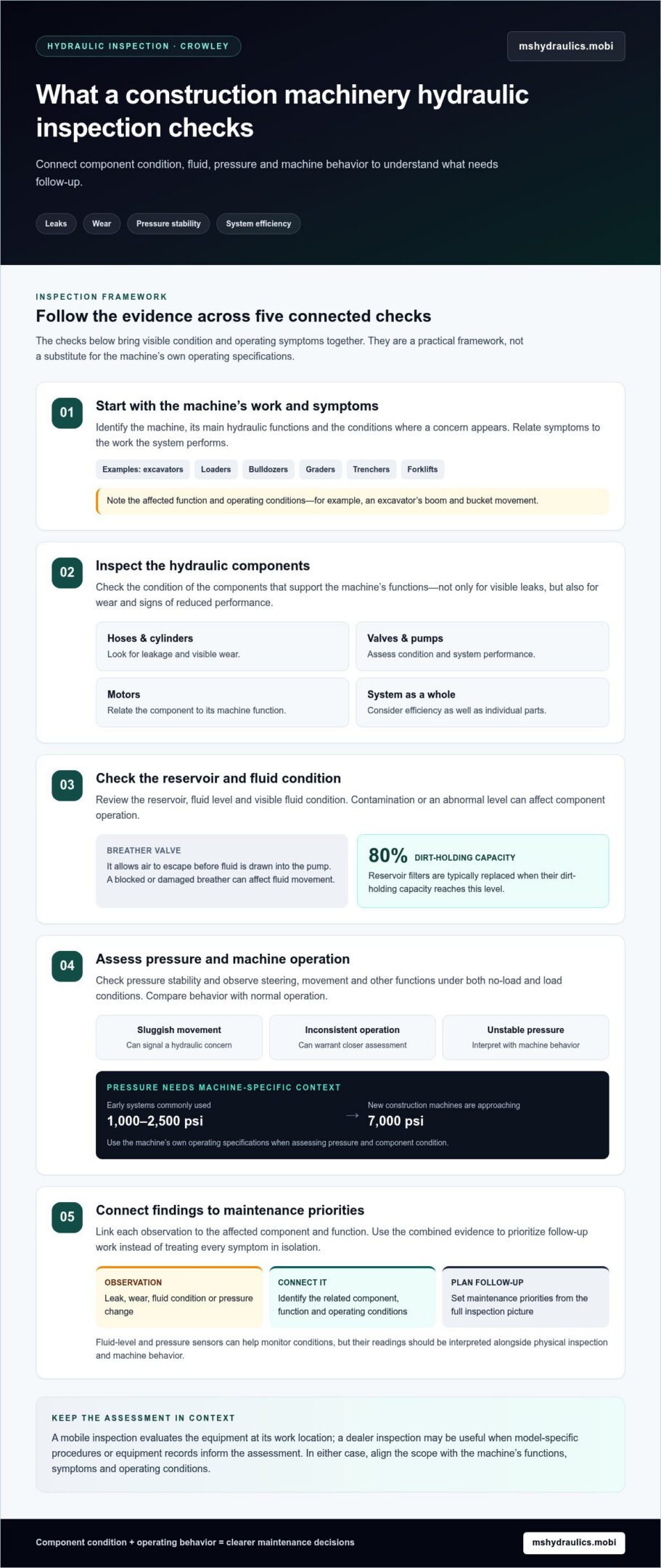
A construction machinery hydraulic inspection in Crowley looks beyond visible leaks. It assesses cylinders, hoses, valves, and pumps for leakage, wear, pressure stability, and system efficiency. Operational checks can also evaluate steering, movement, and other functions under no-load and load conditions. The findings help identify defects and guide maintenance before hydraulic problems disrupt equipment operation.
Visible damage is only one sign of hydraulic trouble. Unstable pressure, sluggish movement, or inconsistent operation can also indicate a problem. Connecting these symptoms to component condition gives operators and maintainers a clearer basis for maintenance decisions.
This guide explains what to inspect, how leaks and wear affect performance, and what pressure checks can reveal. It also shows how inspection findings inform construction machinery maintenance, from identifying developing issues to deciding when repair is appropriate.
The goal is practical: understand the hydraulic system’s condition, interpret the inspection findings, and use them to support dependable equipment operation.
Key Takeaways
- Inspect hoses, cylinders, valves, and pumps for leaks, visible wear, and signs of unstable pressure or reduced efficiency.
- Assess machine operation under no-load and load conditions; changes in steering, movement, or function can help reveal hydraulic problems.
- Use inspection findings to prioritize maintenance and corrective work, rather than treating each symptom as an isolated issue.
- For field-based hydraulic concerns, on-site diagnostic services and mobile hydraulic repair can help address equipment issues where the machinery is located.
- In the United States, crane and derrick operations on construction sites are covered by OSHA regulation 29 CFR 1926 Subpart CC, according to the Occupational Safety and Health Administration.
Hydraulic-powered construction equipment
Hydraulic systems convert fluid pressure into movement for earthmoving, lifting, and material handling. A construction machinery hydraulic inspection in Crowley evaluates how the components support those functions, not just whether the machine starts.
The inspection scope may include excavators, backhoe loaders, bulldozers, wheel loaders, skid loaders, graders, trenchers, and forklifts. Their pumps, cylinders, valves, hoses, and motors serve different functions, so checks should connect symptoms to the machine’s work. An excavator’s boom and bucket, for example, rely on controlled hydraulic movement for digging and lifting.
Hydraulic construction equipment has changed substantially over time. Early systems commonly used gear and vane pumps operating at 1,000-2,500 psi. New construction machines are approaching hydraulic pressures of 7,000 psi, making the machine’s own operating specifications essential context when assessing pressure and component condition. The first hydraulic excavator, built by Sir W.G. Armstrong & Company in 1882, used water hydraulics to power its digging arm.
Inspection and Fluid Checks
Heavy construction equipment inspection combines visual component checks with fluid-condition and operating-function checks. The reservoir’s breather valve allows air to escape before fluid is drawn into the pump, so a blocked or damaged breather can affect fluid movement. Reservoir filters are typically replaced when their dirt-holding capacity reaches 80%.
Checking the reservoir, fluid level, and visible fluid condition can reveal issues that affect pumps, valves, and cylinders. Relate each observation to the affected machine function, such as an excavator’s lifting or digging movement. This gives maintenance teams a practical basis for prioritizing follow-up work.
Mobile and Dealer Inspections
A mobile inspection evaluates equipment at its work location. An inspection at a dealer may be useful when model-specific procedures or equipment records inform the assessment. The distinction matters when moving a machine would disrupt work or when its design makes particular inspection procedures relevant.
For equipment near Crowley, compare the inspection scope rather than assuming either approach covers every hydraulic component. Make sure the assessment addresses the machine’s functions, observed symptoms, and operating conditions. An on-site check can also show how the machine behaves in its working environment.
Inspection Standards and Regulations
Applicable requirements depend on the equipment and work activity; the supplied U.S. facts identify specific OSHA rules for crane operations and trench work. In the United States, crane and derrick operations on construction sites are covered by OSHA regulation 29 CFR 1926 Subpart CC, according to the Occupational Safety and Health Administration.
Workers in trenches deeper than 5 feet need a protective system such as shielding, shoring, or sloping, according to the Occupational Safety and Health Administration. These requirements address site safety; hydraulic inspection also needs to assess component condition and machine function. Keeping the two scopes distinct helps teams plan the equipment check and the work area appropriately.
On-Site Inspection Scheduling
An on-site hydraulic inspection in Crowley evaluates machinery at its location, where access and operating conditions can inform the assessment. Scheduling depends on the equipment’s location, site access, machine availability, and the scope needed to inspect its hydraulic components.
Before the visit, identify the machine type, its main hydraulic functions, and symptoms such as leakage or inconsistent movement. This helps define which components and operating checks are relevant. Make the equipment accessible and organize its work area to support an efficient inspection, without assuming a fixed appointment or completion time.
Construction machinery maintenance
Hydraulic inspection is most useful when its findings inform the wider maintenance plan. Construction machinery maintenance considers how hydraulic performance interacts with braking, transmission, driveline, electrical, and structural condition. A machine that lifts unevenly, for example, may need hydraulic diagnosis alongside checks of related systems. This broader view helps teams prioritize work based on equipment function and project demands.
Regular inspections help operators and maintainers notice changes before they disrupt work. Compare current behavior with normal operation: inconsistent crane lifting, reduced trencher movement, or a loader that responds differently may warrant closer assessment. Record the affected function and operating conditions so decisions reflect an observed symptom, not an assumption.
Hydraulic fluid condition and level also matter. Fluid carries energy through the system, while contamination or an abnormal level can affect component operation. Predictive maintenance sensors can monitor fluid level and pressure to help prevent breakdowns. Interpret their readings alongside physical inspection and machine behavior, not as a complete assessment on their own.
Maintenance planning should account for the machine’s operating demands and manufacturer intervals. Depending on those intervals, equipment hydraulic pumps can last between 10,000 and 15,000 operating hours before replacement or rebuilding. That range is not a universal replacement schedule: pump condition, machine use, fluid cleanliness, and maintenance history all affect the decision. Tracking operating hours alongside pressure or performance changes helps teams identify when further diagnosis is warranted.
Maintenance priorities vary by machine. A small loader used for material handling and a large excavator assigned to continuous earthmoving place different demands on hydraulic functions. Attachments and repeated lifting cycles also affect component use. Match inspection records to the machine, its work, and any observed changes. This makes comparisons over time more useful across construction projects.
- Record symptoms: Note the affected function, such as travel, lifting, or steering, and the conditions when it appears.
- Connect systems: Consider hydraulic findings alongside braking, transmission, driveline, and electrical condition.
- Use trends: Compare sensor readings and inspection notes with operating history and manufacturer intervals.
When findings point to broader machine needs, heavy equipment maintenance can support the next step, while hydraulic pump repair may address a diagnosed pump issue. Regular inspections keep maintenance decisions tied to equipment condition, function, and work demands.
Hydraulic leaks, pressure stability, and wear
A hydraulic inspection checks cylinders, hoses, valves, and pumps for leaks, pressure stability, wear, and system efficiency. These findings can explain slower lifting, uneven movement, or reduced capacity. Record the affected component and function together: a loader that hesitates while raising its bucket provides a more useful diagnostic clue than a general note about changed performance.
Start with the visible hydraulic circuit. Look for wetness around hose connections, cylinder seals, valve bodies, and the hydraulic pump. Leaks may leave fluid on a surface or collect around a fitting. Abrasion, cracking, corrosion, or deformation can indicate physical wear. Note where the condition appears and whether it changes during operation. A clean exterior does not prove that pressure or efficiency is stable.
Pressure readings need to be interpreted against the machine’s configuration and operating function. Load-sensing construction machinery in the 1980s commonly used implement pressures of 4,000 psi, with travel-circuit pressures above 5,000 psi. These figures describe system examples, not universal inspection targets. A Halla HE280LC shovel has a typical hydraulic pump pressure of 4,500 psi, while another hydraulic pump example can generate a maximum pressure of 3,000 pounds per square inch. Machine specifications and the circuit being tested determine the relevant comparison.
Pressure stability matters because fluctuating pressure or a reading that fails to hold can accompany internal leakage, worn components, or a control issue. Compare pressure behavior with the function being assessed: a truck’s hydraulic attachment may respond differently from a loader’s lift circuit. Consider pressure and movement together rather than interpreting a gauge reading without operating context. This can help distinguish a local mechanical concern from a wider loss of system efficiency.
Wear develops in response to operating conditions, fluid cleanliness, and component loading. A hose routed against a frame may show abrasion, while visible damage to a cylinder rod can affect its seal. Valve wear may show up as inconsistent response, and a pump issue may coincide with reduced output. Document the location, symptom, and machine function to support maintenance decisions and track changes over time.
- Record: Identify the affected component, function, and visible leak or wear pattern.
- Compare: Interpret pressure against the machine and circuit specifications, not a generic figure.
- Connect: Relate pressure behavior to movement, load response, and system efficiency.
For construction machinery in Crowley, these observations make hydraulic inspection more useful during equipment development and ongoing maintenance planning. They help clarify whether the next assessment should focus on a hose, cylinder, valve, or pump.
Can hydraulic inspections be done on-site in Crowley, and how soon can providers schedule?
Yes. Hydraulic inspections can be performed at a construction site in Crowley when the machine is safely accessible and its functions can be evaluated there. An on-site assessment is useful for equipment that is difficult to move, such as an excavator, loader, or trencher, or when symptoms appear only in the work environment. The inspection scope should match the machine and the concern.
Scheduling depends on practical factors, not a universal turnaround period. Workload, travel distance, site access, machine availability, and inspection scope all affect appointment timing. Assessing one machine with a known hydraulic concern differs from assessing several machines across a project site. These details shape the time needed to coordinate a visit and prepare for inspection.
Preparation can make the visit more productive. Identify the machine type, its location, and the affected hydraulic function. Describe the symptom precisely, such as a boom that lowers unevenly or an attachment that responds inconsistently. Note when it occurs, such as during travel, lifting, or another operation. These observations help define which components and operating checks matter.
Site readiness also affects the inspection. Provide clear access to the machine and relevant components, and keep the work area organized. Clearing surrounding scrap and construction debris helps maintain safe pathways; for property owners or project managers handling site cleanup in regions like Melbourne, JD Rubbish Removal offers prompt waste collection and disposal services. If safe operating checks are needed, the machine must be available under suitable site conditions. A machine assigned to active work or inaccessible at the time of inspection may limit what can be assessed.
- Describe the equipment: Provide the machine type and its current location near Crowley.
- Document the symptom: Identify the affected function and the conditions when it occurs.
- Plan access: Arrange machine availability and a workable inspection area.
- Define the scope: Clarify whether the concern involves one component or broader hydraulic performance.
An on-site inspection connects reported symptoms with the machine’s actual operating conditions. For example, observing an excavator under site conditions may help distinguish an intermittent issue from one that occurs consistently. The findings can guide whether further diagnosis or repair is appropriate, rather than relying only on a description given away from the equipment.
For Crowley projects, precise equipment details and site arrangements help define the inspection scope and scheduling. They also keep the assessment focused on the machine’s use, access needs, and reported hydraulic behavior.
What safety steps are required before inspecting construction machinery hydraulics?
Before inspecting an excavator, loader, or crane, control machine movement and stored hydraulic energy. Park on stable ground, keep people clear of moving parts, and follow the manufacturer’s shutdown and isolation procedures. Lower attachments to the ground where practical, secure the machine, and prevent unintended startup. A stopped engine does not necessarily mean hydraulic pressure has dissipated.
Hydraulic circuits can retain pressure after shutdown. Before loosening a connection or removing a component, follow the machine’s specified procedure to relieve pressure and verify that the circuit is safe. Never use a hand to search for a pinhole leak: escaping fluid can penetrate skin. Use a visual method and suitable tools, keeping hands and body away from suspected leak paths.
Site conditions matter as much as the machine. Inspect the ground, access route, and work area for unstable surfaces, traffic, suspended loads, or nearby excavation hazards. Keep bystanders outside the work zone, and coordinate with the site lead before operating any function for inspection. If a crane or derrick is involved, its use on a construction site falls under OSHA regulation 29 CFR 1926 Subpart CC, according to the Occupational Safety and Health Administration.
Trench work requires particular attention to excavation conditions. Workers in trenches deeper than 5 feet need a protective system such as shielding, shoring, or sloping, according to the Occupational Safety and Health Administration. Do not position inspection personnel or equipment where trench stability or edge conditions create exposure. The competent site team should account for excavation hazards before machinery is operated nearby.
- Secure the machine: Park on stable ground, lower attachments, and prevent unintended movement or startup.
- Control hydraulic energy: Follow the manufacturer’s procedure before testing, disconnecting, or opening a circuit.
- Set the work zone: Keep personnel clear of moving equipment, suspended loads, and potential leak paths.
- Review the site: Account for trenches, traffic, ground stability, and the planned operating test.
During functional checks, communicate clearly with the operator and stop if a component moves unpredictably, a hose shifts, or a leak appears. Resume only after the hazard is assessed and controlled. Record the affected component and machine function without touching pressurized fittings.
If a hydraulic concern needs professional assessment, arrange on-site hydraulic diagnostics before returning affected equipment to work.
Ms. Hydraulics LLC: Hydraulic Hose Fabrication
Ms. Hydraulics LLC provides Hydraulic Hose Fabrication when an inspection identifies a damaged or unsuitable hose in construction machinery. A hose issue may also point to the need for a broader hydraulic assessment, especially when equipment has recurring leaks or inconsistent operation.
For related repair needs, Ms. Hydraulics LLC also offers Hydraulic Cylinder Rebuilds, Mobile Hydraulic Repair, and Heavy Equipment Maintenance. These services support next steps when findings involve a worn cylinder, an equipment issue at the work site, or maintenance needs beyond a single hose. Matching the service to the observed fault keeps corrective work focused on the equipment’s condition.
Contact Ms. Hydraulics LLC to discuss hydraulic hose fabrication or related equipment needs, or visit mshydraulics.mobi.
Turn Inspection Findings Into a Maintenance Plan
A construction machinery hydraulic inspection in Crowley is most useful when its findings point to a clear next step. Record the affected component, machine function, and any action needed. This creates a practical reference for maintenance planning and helps teams distinguish an isolated repair from a recurring equipment concern.
When findings point to hose damage, cylinder wear, or broader equipment needs, Ms. Hydraulics LLC offers Hydraulic Hose Fabrication, Hydraulic Cylinder Rebuilds, and Heavy Equipment Maintenance. The right service depends on the condition identified and the machinery involved. A focused discussion of the inspection findings can connect the observed issue with relevant repair or maintenance work.
Keep the inspection record with the machine’s maintenance history and use it to guide future assessments. Consistent documentation helps operators and maintainers track changes and plan work around equipment needs.
Contact Ms. Hydraulics LLC for help with hydraulic hose fabrication or related equipment maintenance. A clear next step can help keep your maintenance planning moving forward.
Frequently Asked Questions
What construction machinery hydraulic inspection services are available in Crowley, Texas?
For equipment in Crowley and nearby communities, including Cleburne, Dallas-Fort Worth, Alvarado, Granbury, Arlington, Mansfield, Waxahachie, and Cedar Hill, Ms. Hydraulics LLC offers On-Site Diagnostic Services, Mobile Hydraulic Repair, and Heavy Equipment Maintenance. These services address field-based hydraulic concerns and broader machinery maintenance needs. Related repairs include Hydraulic Hose Fabrication, Hydraulic Cylinder Rebuilds, and hydraulic pump, motor, or valve repair. The appropriate service depends on the equipment’s condition and whether the need is diagnostic, corrective, or part of ongoing maintenance.
What does a construction equipment hydraulic inspection include?
A hydraulic inspection examines system components and operating performance, then records findings to guide corrective action. For a useful equipment record, note the machine identification, affected function, operating conditions, observed defects, and recommended follow-up. For example, document whether an attachment responds inconsistently during a particular operation. This detail connects the reported symptom with the relevant circuit and helps inform maintenance planning.
How often should construction machinery hydraulic systems be inspected?
Inspection timing should follow the equipment manufacturer’s maintenance intervals, with additional assessments prompted by performance changes or known component issues. Track operating hours, maintenance history, and recurring symptoms in the machine log. After a hydraulic repair, for example, record the work completed and monitor the affected function during subsequent use. This history helps maintenance teams identify patterns and plan inspections around equipment condition and operating demands.
What are common signs of hydraulic system failure in construction equipment?
Common warning signs include visible fluid leaks, unstable pressure, unusual wear, reduced system efficiency, and changes in machine movement. An excavator boom that responds inconsistently or a loader attachment that moves more slowly than usual gives maintainers a specific function to investigate. Record when the symptom occurs and which operation is affected. Clear records help distinguish a recurring performance change from an isolated observation.