How to Troubleshoot Slow Hydraulic Cylinders and Find the Cause
A slow hydraulic cylinder doesn’t automatically mean the cylinder has failed. Troubleshooting slow hydraulic cylinders starts with distinguishing a cylinder fault from low system flow or pressure, contaminated fluid, a valve problem, or mechanical resistance.
Slow movement, weak lifting, jerky motion, drifting under load, overheating, and visible leaks can point to different causes. A professional assesses these symptoms together and uses fluid checks and system testing to narrow down the fault, rather than replacing parts based on speed alone. This guide explains what slow or weak cylinder behavior can indicate, how fluid contamination affects performance, and which common faults to consider. It also covers when a cylinder rebuild or broader hydraulic repair may be appropriate.
Key Takeaways
- Use cylinder isolation and pressure or flow testing to distinguish a cylinder fault from a wider system problem.
- Assess hydraulic fluid condition and contamination because dirty or compromised fluid can impair component performance.
- Compare symptoms such as drift, jerky movement, leaks, and overheating to narrow down likely failure causes.
- Trace weak or slow movement through the hydraulic system before deciding whether the cylinder itself needs attention.
What Causes a Hydraulic Cylinder to Fail?
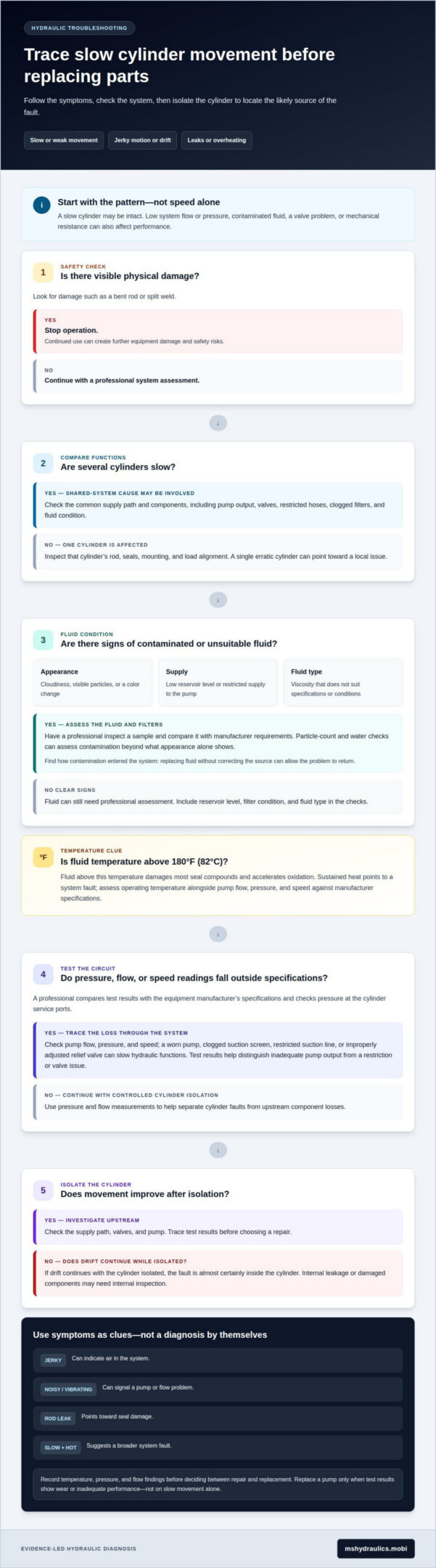
Professionals diagnose low pump flow or pressure by comparing pressure and flow test results with the equipment manufacturer’s specifications, then isolating components to locate losses. They stop operation if the cylinder shows physical damage, and follow manufacturer instructions during testing to reduce equipment and safety risks.
-
Professional Temperature and Pump Output Checks
Measure operating temperature and assess pump flow, pressure, and speed against the manufacturer’s specifications. Fluid above 180°F (82°C) damages most seal compounds and accelerates oxidation, so sustained heat points to a system fault. A worn pump, clogged suction screen, restricted pump suction line, or improperly adjusted relief valve can slow hydraulic functions, according to the U.S. Department of the Army.
Use pressure and flow testing to distinguish inadequate pump output from a restriction or relief-valve issue. Check pump speed too, since low RPM can reduce available output. Replace a pump only when test results show wear or inadequate performance, not on the basis of slow movement alone.
-
Professional Checks for Insufficient Cylinder Pressure
Compare pressure at the cylinder’s service ports with the manufacturer’s intended operating range, then isolate the cylinder for controlled testing. A gauge and flow measurements can help show whether pressure loss comes from the cylinder or upstream components. When troubleshooting slow hydraulic cylinders, professionals also check for worn, cracked, or otherwise damaged parts.
If movement improves after isolation, investigate the supply path, valves, and pump. If drift continues with the cylinder isolated, the fault is almost certainly inside the cylinder. Pressure testing can also reveal internal leakage, blocked filters, relief-valve issues, or leaking valves, helping guide the repair decision.
- Trace test results through the circuit before choosing a repair. Low system pressure may result from a worn pump, leaking seals, damaged valves, clogged filters, or low fluid. Restricted flow to the pump can also affect cylinder performance. Compare readings under different operating conditions to distinguish insufficient supply from pressure loss at the cylinder.
- Record temperature, pressure, and flow findings before deciding between repair and replacement. A cylinder fault may require internal inspection, while a pump fault calls for pump-focused diagnosis. Stop operation if physical damage is present, since continued use can cause further equipment damage and safety risks.
Hydraulic fluid condition and contamination
Have a professional assess fluid condition before blaming sluggish movement on the cylinder. Contamination and incorrect viscosity can restrict flow, increase friction, and affect internal components.
-
Professional Assessment of Hydraulic Fluid Condition
Have a professional inspect a fluid sample and compare its condition with the equipment manufacturer’s requirements. Cloudiness, visible particles, or a color change can indicate contamination or degradation. Fluid condition matters to the pump as well as the cylinder because contaminants circulate through connected components.
Include reservoir level, filter condition, and fluid type in the assessment. A low level can impair supply, while unsuitable viscosity can resist flow, particularly during startup. Replacing fluid without finding how contamination entered the system can allow the problem to return and cause further downtime.
-
Professional Checks for Particle and Water Contamination
Request particle-count and water checks when contamination is suspected. ISO 4406 reports particle counts at three size thresholds; a typical mobile hydraulic system targets a cleanliness code such as 18/16/13. This gives the professional a defined way to assess fluid cleanliness rather than relying on appearance alone.
Particles can damage precision surfaces, wear seals, or interfere with valves. Particles 4 microns or larger can contribute to varnish and valve sticking; particles 6 microns or larger can cause abrasive wear. Water also accelerates oxidation, and 1% water in hydraulic oil cuts bearing life by roughly half.
-
Professional Assessment of Contamination and High Viscosity
Have a professional compare the fluid’s viscosity with the specified fluid and operating conditions. Fluid that is too viscous can resist movement through passages and reduce flow to a cylinder. Contamination can add to the restriction by increasing friction or damaging internal surfaces, so assess the fluid and filters together.
Use test results to guide fluid replacement, filtration, and correction of the contamination source. If a system has remained contaminated, simply adding clean oil may leave particles inside hoses, valves, or the reservoir. For persistent contamination affecting pump performance, hydraulic pump repair can address the pump as part of the diagnosis.
Common causes of hydraulic cylinder failure
Have a professional connect operating symptoms to specific components before identifying the source of failure. Clogged filters or restricted hoses limit flow, so a cylinder may move slowly or lack force even when it is intact.
-
How Professionals Identify Symptoms and Likely Causes
Match each symptom to the system components that could cause it. Jerky movement can indicate air in the system; a noisy or vibrating pump can signal a pump or flow problem. Leaks around a rod point toward seal damage, while overheating alongside slow operation suggests a broader system fault.
Compare symptoms across functions. If several cylinders move slowly, the cause may be shared, such as a valve or supply path. If just one cylinder moves erratically, inspect its rod, seals, mounting, and load alignment. Physical damage, including a bent rod or split weld, means operation should stop immediately.
-
How Professionals Trace Causes of Slow Cylinder Movement
Track the affected cylinder through its operating cycle, noting whether extension, retraction, or both are slow. A bent rod or misaligned load creates side loading, which can cause uneven wear and prevent full travel. Worn seals may allow internal leakage, reducing effective force or causing erratic movement.
Compare the cylinder’s behavior under load and without load. Drift while holding a load can point to fluid bypass across piston seals or leakage through directional or check valves. Air in the hydraulic system can also cause spongy movement, noise, and poor efficiency. These symptoms help identify which component to test next.
-
Professional Checks for Clogged Filters and Restricted Hoses
Inspect the filter and hose path for restrictions that limit fluid reaching the cylinder. A clogged filter limits flow; a kinked, internally damaged, or otherwise restricted hose can cause similar pressure loss. Professionals also examine hose coverings, fittings, and connections for cracks, bulges, leaks, or looseness.
Compare flow and pressure readings before and after the suspected restriction. If several functions slow together, a shared filter or supply hose may be the cause. If only one function is affected, trace its branch and valve. This helps distinguish a flow restriction from cylinder failure and directs repair toward the affected component.
Diagnosing slow and weak hydraulic functions
Professionals assess the complete operating pattern, not cylinder speed alone. Equipment response, load behavior, and visible evidence help identify the likely cause.
- Compare cylinder speed under consistent operating conditions. Hydraulic speed depends approximately on flow rate divided by piston area, so reduced flow slows movement. A larger load can also change pressure demand and reveal a weakness that unloaded movement may hide. Compare extension and retraction, then note whether other functions slow too.
- Inspect the cylinder, mounting points, and load alignment for visible damage. A bent or corroded rod, scored surfaces, damaged seals, or loose mounts can impair movement. Misalignment creates side loading, which can cause uneven wear and prevent full travel. If the cylinder is physically damaged, stop operating the equipment to limit further damage and safety risks.
- Use the equipment and cylinder manufacturer’s manuals to guide system-specific testing. Professionals compare pressure and flow readings with the intended operating ranges, then consider whether the fault affects one function or the wider hydraulic system. A weak single function points toward its branch, valve, or cylinder; several weak functions suggest a shared supply issue.
- Consider movement alongside pressure, temperature, noise, and drift. Slow response with overheating may indicate restricted flow or excessive system load. Whining, vibration, or pressure loss can direct inspection toward pump performance. Jerky motion can point to air or inconsistent flow, while drift under load can indicate leakage through piston seals or control valves.
- Record the symptoms and testing results before selecting a repair. Include the affected function, load condition, visible damage, and whether movement changes through the cycle. This evidence helps separate cylinder problems from system-level causes and supports focused maintenance. For professional assessment of weak or inconsistent functions, request mobile hydraulic diagnostics.
Ms. Hydraulics: Hydraulic Cylinder Rebuilds
Ms. Hydraulics LLC provides Hydraulic Cylinder Rebuilds when testing points to internal cylinder wear, seal failure, or other repairable damage. A rebuild can address performance problems when the cylinder’s core housing remains suitable for repair. If diagnostics instead identify a damaged hose or broader equipment issue, Hydraulic Hose Fabrication, Mobile Hydraulic Repair, or Heavy Equipment Maintenance may address the cause.
Share the symptoms, affected equipment, and diagnostic findings to help focus the next step. Contact Ms. Hydraulics LLC to discuss hydraulic cylinder service.
Turn Diagnostic Findings Into a Clear Repair Plan
Use the test findings to decide whether the fault lies in the cylinder, its supply path, or another part of the equipment. A focused approach to troubleshooting slow hydraulic cylinders ties repairs to the identified cause instead of treating the symptom alone. Share which function is affected, how it behaves under load, and what inspection or testing has revealed.
Ms. Hydraulics can support the next step with Hydraulic Cylinder Rebuilds, Hydraulic Hose Fabrication, or Heavy Equipment Maintenance, depending on the repair need. Diagnostic findings help connect the performance problem to the appropriate service.
For help moving from diagnosis to a repair plan, contact Ms. Hydraulics. Clear findings give the next repair decision a stronger starting point.
Frequently Asked Questions
How does a professional read what the system is actually doing?
A professional compares the cylinder’s response under repeatable operating conditions. They note the direction of travel, load, control input, and whether other functions behave similarly. For example, a speed change that appears only after the equipment warms up can point to a temperature-sensitive restriction or component issue. These observations help focus testing instead of treating one symptom as a complete diagnosis.
Why Is My Hydraulic Cylinder Moving Slowly?
A cylinder may move slowly because the hydraulic system isn’t supplying usable flow at the required rate, or because resistance is limiting movement. The distinction depends on how the cylinder responds in each direction and under changing loads. If movement slows as the load increases, the professional assesses pressure delivery and mechanical resistance together instead of assuming the cylinder needs rebuilding.
What causes a hydraulic cylinder to move slowly?
Slow movement can result from restricted flow, inadequate pump speed, valve settings, internal leakage, or mechanical binding. The pattern helps distinguish these causes: a function that slows in just one direction can direct attention toward its circuit path, while broader sluggishness can indicate a shared supply problem. The professional compares operating symptoms with test results before recommending component repair.
How do professionals check hydraulic fluid level, viscosity, and contamination?
Professionals assess reservoir level and fluid condition against the equipment manufacturer’s requirements. They evaluate viscosity for the operating conditions and use fluid sampling or particle analysis when appearance alone cannot establish cleanliness. A sample can also help identify water contamination. Results guide decisions about filtration or fluid replacement, while inspection of filters and the reservoir can help locate contamination sources.
How do professionals test for internal cylinder seal bypass or external leaks?
They inspect the rod, seals, cylinder body, hoses, and fittings for visible leakage or damage, then use controlled pressure or flow testing to assess performance. To investigate internal bypass, they isolate the cylinder and observe whether drift continues under the test conditions. Continued drift after isolation points toward an internal cylinder fault; leakage elsewhere calls for tracing the connected circuit.
How do hydraulic relief valves and flow control valves affect cylinder speed?
A relief valve that opens below the intended operating pressure can divert flow and reduce the force available to move a load. The U.S. Department of the Army lists improperly adjusted relief valves as a possible cause of slow hydraulic functions. A flow control valve regulates flow to a function, so a restriction or incorrect setting can reduce cylinder speed even when other functions operate normally.