Insured Heavy Equipment Mechanic in Dallas for On-Site Repairs
What happens when a heavy equipment fault can’t be repaired at the job site? An insured heavy equipment mechanic in Dallas can assess the machine, identify the repair requirements, and determine whether the work can be completed where the equipment is located. The make and model matter, along with the fault, access to the failed component, and the tools and parts the repair requires.
It’s reasonable to want a mechanic familiar with your equipment manufacturer and clear about insurance and credentials before work begins. Those details serve different purposes: manufacturer experience relates to the machine, while insurance and licensing relate to business protection and authorization. This guide explains how to assess manufacturer fit, what insured and licensed service means, and what typically determines the next step when an on-site repair isn’t practical. It also covers how diagnostic findings help define the work before equipment is moved or further repairs are planned.
Key Takeaways
- Manufacturer familiarity matters, but the equipment type and specific fault also shape whether a repair can be completed on-site.
- Insurance and certification address different aspects of service; understand what each covers before work begins.
- If a repair requires shop-based work, diagnostic findings can help clarify the repair plan and equipment’s next steps.
- Written estimates, warranties, and emergency availability depend on the service arrangement, so learn what factors affect each before proceeding.
Do you service equipment from all manufacturers?
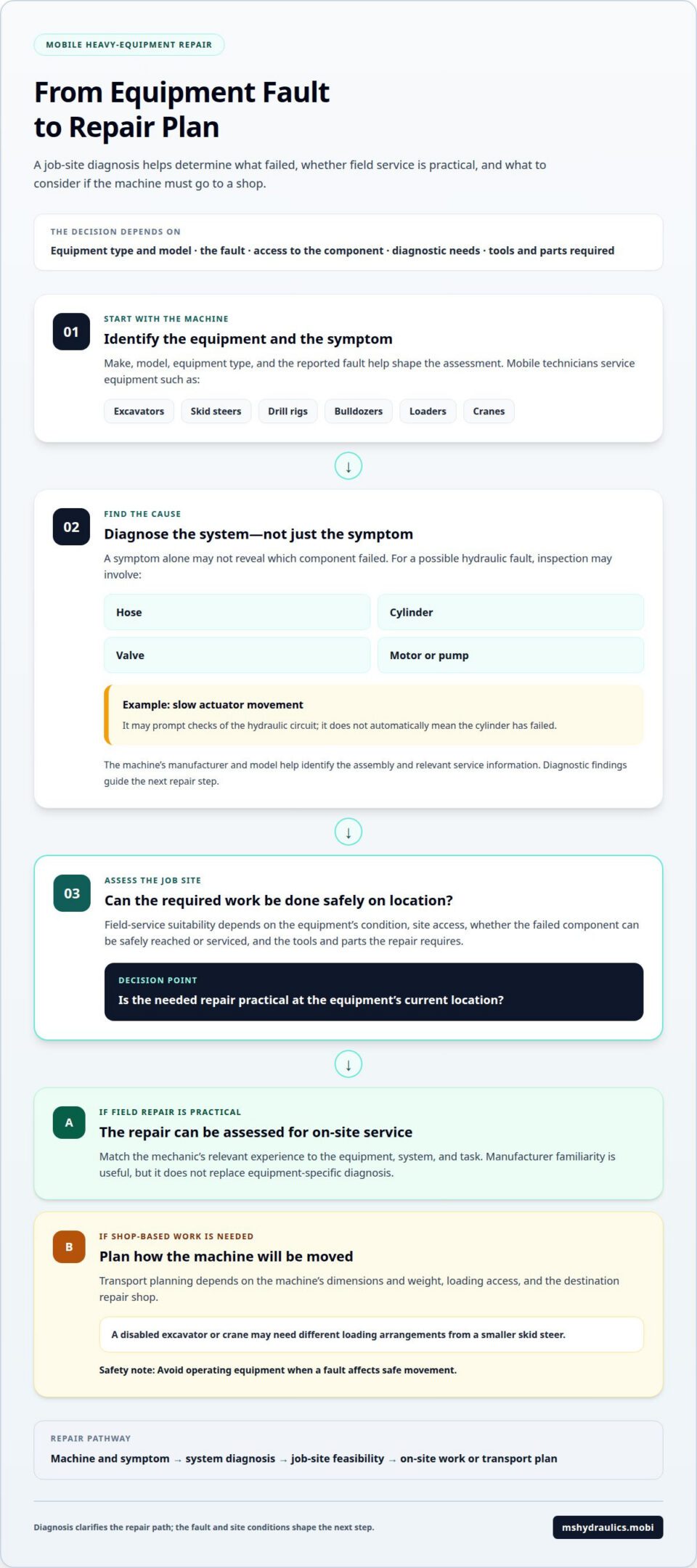
The manufacturer alone doesn’t determine whether a repair is suitable for field service. Equipment type, the failed system, access to the component, and diagnostic requirements all affect the repair plan. Excavators, skid steers, and drill rigs are examples of equipment serviced by mobile heavy-equipment technicians. Bulldozers, loaders, cranes, and other machinery also need assessment based on their specific fault and configuration.
For a machine that stops operating at a Dallas-Fort Worth job site, diagnosis can help identify whether the issue involves hydraulics or another mechanical system. A hydraulic fault may require inspection of a hose, cylinder, valve, motor, or pump. The machine’s manufacturer and model help identify the assembly and relevant service information. A symptom alone may not reveal which component failed, so a diagnostic assessment guides the next repair step.
If field repair isn’t practical, moving the machine becomes part of the repair plan. The decision depends on the equipment’s condition, site access, and whether the failed component can be safely reached or serviced on location. Transport planning must account for the machine’s dimensions, weight, loading access, and destination repair shop. A disabled excavator or crane may need different loading arrangements from a smaller skid steer. Avoid operating equipment when a fault affects safe movement.
Manufacturer familiarity is useful, but it doesn’t replace equipment-specific diagnosis. A mechanic needs to understand the machine’s system and the repair required, whether the work involves a hydraulic component or broader maintenance. For heavy truck repair businesses, garage liability insurance can protect against bodily injury and property damage claims connected to business operations. Garagekeepers coverage can apply to customers’ trucks in a repair business’s care, custody, or control, including during test drives or overnight storage. These policies address business risks, not whether a mechanic can service every manufacturer.
Certified and insured mechanics
Certification and insurance answer different questions about a repair. Certification can indicate training or qualification in a defined technical area, while insurance addresses certain business risks. Neither term alone describes every repair a mechanic can perform. For example, a technician experienced in hydraulic diagnostics may work on a different system from one specializing in engine or transmission repair. Relevant expertise depends on the machine, fault, and work required.
For mobile repair involving a hydraulic pump, ask what technical experience applies to that system. A useful explanation connects the observed symptom to the inspection process and proposed repair. For example, slow actuator movement may prompt checks of the hydraulic circuit, rather than an automatic assumption that the cylinder has failed. Clear findings help distinguish diagnosis from repair authorization and identify when towing or transport may be needed.
Insurance also involves separate forms of protection. Garage liability can address bodily injury and property damage claims related to repair-business operations. Workers’ compensation concerns employee injuries on the job; ISE Insurance Services describes it as required in most states. Inland marine coverage can protect mobile tools and diagnostic equipment in a shop or on the road. Commercial auto insurance applies to service trucks, mobile units, or company-owned vehicles. These policies serve different purposes and shouldn’t be treated as interchangeable.
For a reliable assessment, match the mechanic’s experience to the equipment and task, then understand which business risks the insurance addresses. A mobile technician servicing construction equipment may need diagnostic gear at the job site, while a repair shop may handle work requiring fixed facilities. Coverage limits, deductibles, business size, and claims history can affect insurance premiums. That’s why “insured” doesn’t identify the exact protection a business carries. Certification also shouldn’t be assumed to cover every manufacturer or system. Match the qualification to the work, such as hydraulic troubleshooting, and the insurance type to the exposure, such as employee injury or tools in transit.
Licensed and insured mechanics
For Dallas equipment owners, “licensed” and “insured” refer to separate credentials. A license relates to authorization for a regulated activity; insurance addresses financial exposure from covered claims. One doesn’t establish the other. An insurance policy alone doesn’t demonstrate a mechanic’s qualifications or licensing status. A license also doesn’t explain which business risks an insurance policy covers. Treat each as a distinct part of evaluating a repair partner.
In Dallas, garage liability insurance isn’t legally required in every case for auto repair shops. Landlords, lenders, or state licensing may require it. That fact concerns auto repair shops, so it shouldn’t automatically be applied to every heavy-equipment operation. For truck repair businesses, garage liability can protect against bodily injury and property damage claims related to business operations. This coverage relates to business risks, not proof of a mechanic’s technical qualifications.
Commercial auto insurance applies to service trucks, mobile units, or company-owned vehicles. It serves a different purpose from garage liability coverage. For example, a service truck traveling to a construction site involves vehicle exposure, while a repair operation can involve injury or property damage claims. Don’t assume one policy type covers both situations. The equipment fault and worksite help define the repair risks involved.
On-site diagnostic work can clarify the machine’s symptoms and identify which system needs attention. For example, a hydraulic fault may require inspection before a repair plan is set. The diagnostic process and insurance credentials answer different questions: one concerns the equipment, the other concerns business coverage. A trusted repair partner explains the findings and distinguishes technical qualifications from insurance protection. This helps equipment owners understand the service arrangement without treating “licensed and insured” as a complete description of the repair process.
Do Dallas heavy equipment mechanics provide written estimates, warranties, and emergency service?
Written estimates, warranties, and emergency service are separate parts of a repair arrangement. An estimate should describe the diagnosed fault, proposed work, and included parts or labor. For example, a hydraulic leak may require identifying the affected hose and the work needed before repairs proceed. If inspection reveals another fault, the revised scope should be clear before additional work begins.
A useful written estimate also distinguishes diagnosis from repair. It can record the equipment and reported symptoms, findings, recommended work, and any assumptions affecting the scope. For a disabled loader, that record connects the diagnostic result to the proposed repair. It also gives the equipment owner a reference if the machine’s symptoms change or further work becomes necessary. Clear documentation supports decisions about repair and transport.
Warranty terms need separate attention. They define which parts or workmanship are covered, the coverage period, and any exclusions or conditions. For example, a warranty covering a replaced hydraulic component may differ from coverage for unrelated wear or a later failure elsewhere. The written terms, not the word “warranty” alone, describe the protection. Keep the estimate and warranty documentation with the machine’s maintenance records.
Emergency service describes response availability, not a repair outcome. Dispatch timing and the work possible at a job site can depend on location, equipment access, fault severity, and parts requirements. A machine with a fault affecting safe movement may need transport rather than continued operation. On-site diagnostics can establish whether field repair is practical or shop work is needed. To discuss an equipment fault and its repair requirements, request an equipment repair assessment.
Ms. Hydraulics: Heavy Equipment Maintenance
Ms. Hydraulics LLC provides heavy equipment maintenance and mobile hydraulic repair for equipment with mechanical or hydraulic issues. When a fault appears at a job site, on-site diagnostics can help identify the affected system and guide the repair plan. Hydraulic hose fabrication and cylinder rebuilds address specific component needs when inspection indicates that work is required.
If a machine’s hydraulic function is impaired, the right next step depends on the fault and whether the repair can be completed on-site. Diagnostic findings help define the work, while the equipment’s condition informs the repair approach. Ms. Hydraulics LLC can help when construction equipment needs maintenance, hydraulic troubleshooting, or component repair.
Contact Ms. Hydraulics LLC to discuss the equipment issue and the repair support you need.
Plan the next step for your equipment
Keep the repair decision focused on the machine’s condition and the work required. A clear description of its symptoms, affected functions, and operating status can help frame a useful technical discussion. When looking for an insured heavy equipment mechanic in Dallas, consider insurance alongside the equipment fault and repair scope, which guide the service plan.
Ms. Hydraulics LLC can discuss the equipment issue and the repair support that fits. Contact Ms. Hydraulics LLC about your equipment to begin that conversation. With the issue clearly described, you can move toward an informed repair plan and the next step for your equipment.
Frequently Asked Questions
Construction Equipment Down in Dallas?
For equipment stopped at a Dallas job site, report the machine type, its location, and the symptoms. Note any dashboard codes, visible leaks, unusual sounds, or functions that stopped working. Include whether the machine can move safely and whether technicians can access it. These details help frame an on-site diagnostic assessment and clarify what information is useful before arranging repair support.
Need Equipment Repair Now?
For a disabled machine, share its make, model, site address, and fault symptoms when requesting service. Ms. Hydraulics LLC provides mobile hydraulic repair and on-site diagnostics for heavy equipment across the Dallas-Fort Worth region and surrounding areas. Describe whether the issue affects steering, lifting, or another function, and whether the equipment can be moved safely. Those details help define the service need and practical conditions at the job site.
What’s your response time to a construction site in DFW?
Arrival timing depends on the site location, travel conditions, technician scheduling, and the information available about the fault. A site near Dallas and one farther across the DFW region may involve different travel requirements. Provide the exact location, equipment type, and symptoms when arranging service. Access restrictions or a machine that cannot move may also affect the field plan.
What does an insured heavy equipment mechanic in Dallas repair and service?
Heavy equipment mechanics handle maintenance and repairs within their technical scope. Ms. Hydraulics LLC works on equipment such as excavators, skid steers, and drill rigs, with services including hydraulic hose fabrication and cylinder rebuilds. For a machine with intermittent hydraulic performance, diagnostic findings can help identify whether the issue involves a hose, cylinder, valve, motor, or pump.
Which heavy equipment mechanics in Dallas are licensed, insured, and bonded?
Licensing, insurance, and bonding are separate credentials, not interchangeable labels. Garage liability insurance isn’t legally required in every case for auto repair shops in Dallas, though landlords, lenders, or state licensing may require it. That distinction doesn’t establish a particular heavy-equipment mechanic’s credentials. For repair planning, separate technical ability from questions about business coverage and any applicable authorization.
What insurance coverage should a Dallas heavy equipment mechanic carry?
Coverage depends on the business’s risks and operations. Garage liability can address bodily injury and property damage claims tied to business operations; commercial auto applies to service trucks or mobile units. Workers’ compensation concerns employee injuries, while inland marine can cover tools and diagnostic gear in transit. Garagekeepers coverage may apply to customer vehicles in a repair business’s care, custody, or control.