Hydraulic system upgrades for older farm tractors in Alvarado
A hydraulic system upgrade for older farm tractors in Alvarado doesn’t have to mean replacing the tractor. If a fan-belt-driven pump is difficult to keep properly tensioned, a crankshaft-driven pump mounted at the front casting is one option. It can also leave the PTO available for other equipment. A rear PTO pump may be less suitable if the PTO is needed to run a conditioner.
Choosing an upgrade means matching the tractor’s existing hydraulic setup to the implements it needs to operate. This guide outlines the main pump-drive options, what to consider for your tractor’s work, and how diagnostics and repairs can help address performance issues. You’ll have a clearer basis for deciding whether to change the pump setup, address related hydraulic components, or focus on repair and maintenance.
Key Takeaways
- Match the pump drive arrangement to the tractor’s regular implement demands and the functions that must remain available.
- Assess the full hydraulic circuit, including hoses and cylinders, so an upgrade addresses the source of the performance problem.
- Distinguish between a system that needs a different pump setup and one that may benefit from targeted repair or maintenance.
- Hydraulic hose fabrication, cylinder rebuilds, mobile hydraulic repair, and heavy equipment maintenance can address different parts of an older tractor’s hydraulic needs.
Hydraulic system upgrade for older farm tractors in Alvarado
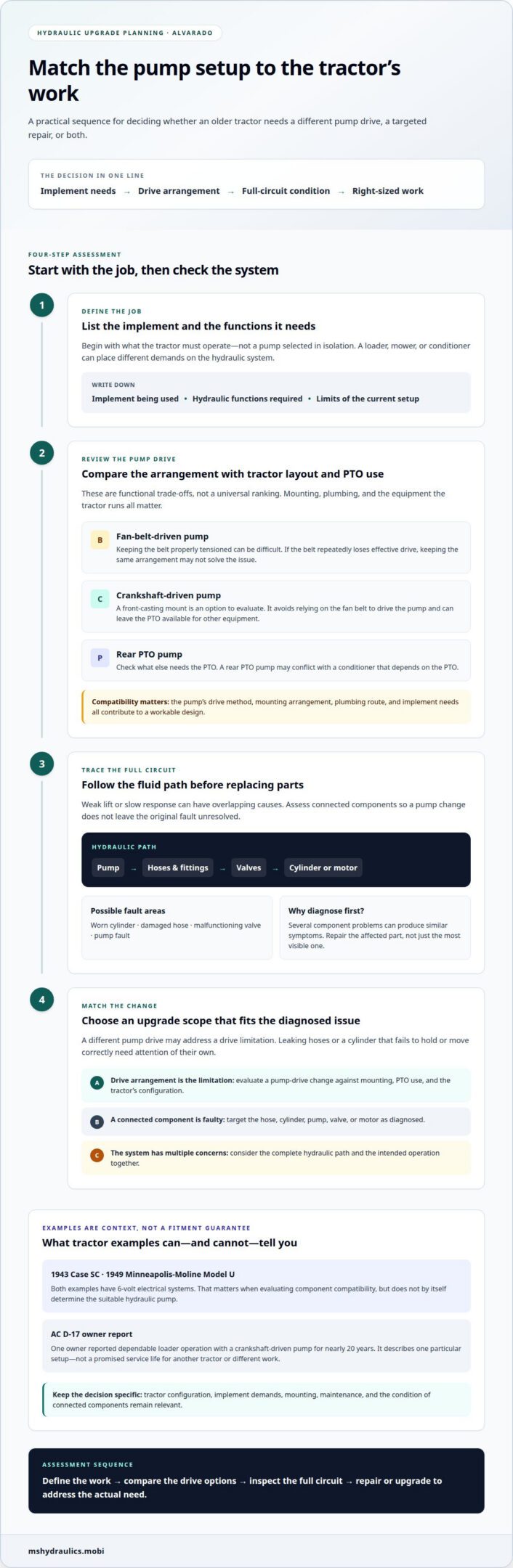
Start with the work the tractor must do, not with a pump chosen in isolation. A loader, mower, or conditioner places different demands on the hydraulic system and may influence which drive arrangement makes sense. For a hydraulic system upgrade for older farm tractors in Alvarado, first identify the implement, the hydraulic functions it requires, and any limits in the tractor’s current setup.
Take a 1943 Case SC or a 1949 Minneapolis-Moline Model U. Both examples have 6-volt electrical systems, a detail that matters when evaluating proposed components and their compatibility. It does not, by itself, determine which hydraulic pump is suitable. The pump’s drive method, the tractor’s mounting arrangement, the plumbing route, and the implement’s operating needs all contribute to a workable design.
Older tractors may use a fan-belt-driven pump, but keeping the belt properly tensioned can be difficult. A crankshaft-driven pump mounted at the front casting is another arrangement to consider. It avoids relying on the fan belt to drive the pump and can preserve the PTO for equipment that needs it. A rear PTO pump may conflict with a conditioner that depends on the PTO. These are functional trade-offs, not a universal ranking of pump types.
Past use provides context, but not a guarantee for another tractor. One AC D-17 owner reported dependable loader operation with a crankshaft-driven pump for nearly 20 years. That example shows how a pump arrangement can work over time in a particular setup. It does not establish the same service life for a Case SC, a Minneapolis-Moline Model U, or a tractor operating different implements. Mounting, use, maintenance, and system condition remain relevant.
Assess the full hydraulic path from pump to implement. The pump supplies flow, hoses and fittings carry fluid, valves direct it, and cylinders or motors do the work. A weak lift or slow response may have several causes. A worn cylinder, damaged hose, malfunctioning valve, or pump fault can produce overlapping symptoms. Replacing the pump before identifying the fault may leave the original problem unresolved.
- Define the job: identify the implement and hydraulic functions the tractor must operate.
- Review the drive: consider belt, crankshaft, or PTO arrangements against tractor layout and implement use.
- Trace the circuit: assess the pump, hoses, valve, and cylinder or motor as connected components.
- Match the change: choose an upgrade scope that addresses the diagnosed issue and intended operation.
Keep PTO use central to the decision. If the tractor’s PTO runs a conditioner, a rear PTO pump may interfere with that work. If a belt-driven pump repeatedly loses effective drive, keeping the same arrangement may not solve the problem. If the tractor has a suitable front casting, a crankshaft-driven option may be worth evaluating. The right choice depends on the tractor’s configuration and the work it performs.
Distinguish an upgrade from a repair. If the pump drive is the limitation, changing the drive arrangement may address it. If hoses leak, a pump conversion alone won’t repair them. If a cylinder fails to hold or move correctly, it may need attention. Hydraulic hose fabrication, cylinder rebuilding, and pump, valve, or motor repair address different components. Accurate diagnosis helps align the work with the actual fault.
For an older tractor in Alvarado, a sound decision weighs implement compatibility, PTO requirements, pump drive, mounting, and the condition of connected components. A tractor’s age or electrical system alone cannot identify the right upgrade. The Case SC, Model U, and AC D-17 examples illustrate why the decision should begin with the tractor’s configuration and operating demands, then extend through the complete hydraulic circuit.
Owner feedback can highlight practical concerns, but weigh it against the tractor’s layout and intended work. One commenter reported difficulty keeping a fan-belt-driven hydraulic pump tightly driven, making belt tension a practical point to assess during installation. Compare that concern with the full scope of the proposed work, while keeping compatibility, reliability, and implement requirements central to the decision.
Ms. Hydraulics
Ms. Hydraulics LLC helps tractor owners assess hydraulic problems and address faults that affect system performance. On-site diagnostic services can help identify whether an issue involves a pump, valve, motor, cylinder, or hose, so the next step can target the affected component. Mobile hydraulic repair is useful when the tractor needs service at its location, while hydraulic pump repair and hydraulic hose fabrication address specific system components.
For a tractor being considered for an upgrade, diagnostics and repair can help distinguish a repair need from a pump-drive change. Hydraulic cylinder rebuilds and heavy equipment maintenance can also support the condition of connected equipment. Contact Ms. Hydraulics LLC to discuss your tractor’s hydraulic system and repair needs.
Plan the Next Step for Your Tractor
A hydraulic system upgrade for older farm tractors in Alvarado is most useful when it reflects the tractor’s real operating demands. Before committing to a change, define which implements the tractor must run and which hydraulic functions need to remain available. This gives the repair or upgrade a clear practical objective.
Ms. Hydraulics LLC supports this work with hydraulic hose fabrication, hydraulic cylinder rebuilds, and heavy equipment maintenance. These services address distinct parts of the system and can be considered alongside the tractor’s overall hydraulic condition. The appropriate work depends on the fault and intended use.
To discuss your tractor and its hydraulic needs, contact Ms. Hydraulics LLC. A focused conversation is a practical next step toward an upgrade plan that fits the work ahead.