On-Site Hydraulic Reservoir Cleaning in Cedar Hill
A hydraulic reservoir can undermine system reliability even when the fluid looks usable. For equipment in Cedar Hill, on-site hydraulic reservoir cleaning and flushing removes accumulated contamination that can increase component wear, obstruct filters, and restrict fluid flow. Monitoring fluid cleanliness after cleaning also helps assess the system’s condition.
When equipment performance changes, it’s easy to focus on pumps, valves, and cylinders, but reservoir contamination can affect the entire hydraulic circuit. This article explains how dirt, metal, water, and varnish affect components, why reservoirs need cleaning, and how flushing and cleanliness monitoring fit into the service process. It also covers factors that shape the cleaning method and what to expect from on-site hydraulic service.
Key Takeaways
- Use particle-count monitoring to assess fluid cleanliness after flushing and determine whether the system has reached its intended cleanliness level.
- Dirt, metal, water, and varnish can wear components, obstruct filters, and restrict hydraulic-fluid flow.
- Choose a reservoir-cleaning method based on the contamination present and the equipment’s cleaning requirements.
- On-site diagnostics can help identify hydraulic system issues and guide the next maintenance steps.
Particle-count monitoring and fluid cleanliness
Particle counts and fluid analysis help assess flushing results and inform refill decisions. The appropriate cleanliness target depends on the hydraulic system and its operating needs.
Fluid Analysis and Contamination Control
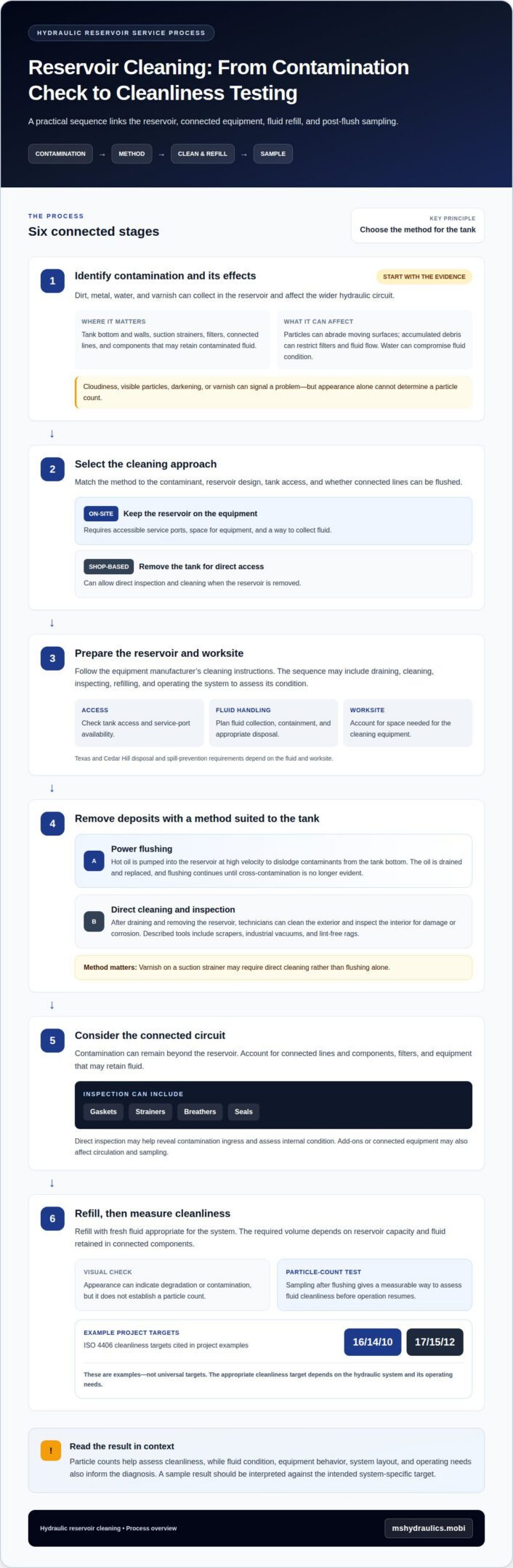
Particle-count testing measures suspended debris and helps assess hydraulic-fluid cleanliness after flushing. Project examples have used ISO 4406 targets of 16/14/10 or better and 17/15/12; these are examples, not universal targets for Cedar Hill equipment. Fluid analysis can also identify contamination that visual inspection misses. A reservoir add-on or connected equipment may affect circulation and sampling, so technicians consider the system layout when assessing results.
Fresh-Fluid Refills and Degradation Signs
After draining, refill the reservoir with fresh fluid appropriate for the system. The required volume depends on reservoir capacity and fluid retained in connected components. Cloudiness, visible particles, darkening, or varnish deposits can indicate degraded fluid or contamination, but appearance alone cannot determine a particle count. Sampling after flushing provides a measurable way to assess cleanliness before operation resumes.
On-Site and Shop-Based Flushing
On-site flushing keeps the reservoir on the equipment, while shop-based cleaning allows direct access when a tank is removed. The right approach depends on where contamination is located, tank access, and whether connected lines can be flushed. The work requires accessible service ports, space for equipment, and a way to collect fluid. Ms. Hydraulics LLC provides mobile hydraulic repair and on-site diagnostics for equipment in Cedar Hill and the surrounding DFW area.
Texas and Cedar Hill disposal and spill-prevention requirements depend on the fluid and worksite; the service plan must account for appropriate handling and containment. Price depends on reservoir size, contamination, access, fluid volume, and analysis scope, and is provided after a quote request.
Contamination and premature component failure
Contamination can damage hydraulic components before a machine shows an obvious fault. Hard particles circulate with the fluid and abrade moving surfaces. In pumps, valves, and cylinders, repeated contact can increase wear and reduce operating precision. Signs may include inconsistent movement, slower response, or difficulty maintaining intended pressure.
Filters are essential for contamination control, but they cannot indefinitely compensate for debris entering from a reservoir. As contaminants accumulate, a filter can become restricted and limit fluid flow through the circuit. This can affect hydraulic power and place added demands on connected components. Effective cleaning addresses where contaminants collect instead of relying on fluid replacement alone.
Water and metal particles present different concerns. Water can compromise fluid condition, while metal debris may indicate wear within the hydraulic system. Particle-count results help assess cleanliness, but diagnosis should also consider equipment behavior and fluid condition. If a valve responds inconsistently, for example, technicians can evaluate contamination alongside other possible causes rather than assuming the valve has failed.
Cleaning is relevant during commissioning when a system must start with controlled fluid cleanliness, and after maintenance that could introduce debris. The process should account for the reservoir, connected lines, and components that may retain contaminated fluid. Removing contamination at its source helps protect critical equipment and supports reliability. For persistent performance changes, hydraulic system diagnostics can help identify whether contamination or another fault is affecting operation.
IFM says heavy contaminants, including dirt, metal, and water, can collect at the bottom of reservoirs in lube oil and hydraulic oil systems. Varnish can also adhere to reservoir walls, pump suction strainers, sight glasses, and other internal surfaces.
Reservoir and oil storage tank cleaning
A hydraulic reservoir stores the fluid that powers pumps, valves, and other system components. Dirt, metal, water, and varnish can settle inside, including on reservoir walls and suction strainers. Cleaning addresses deposits that routine filtration may not remove. Before commissioning equipment or during a turnaround, reservoir cleaning can remove accumulated contamination before operation resumes.
One method is power flushing. IFM describes pumping hot oil into a reservoir at high velocity to dislodge contaminants from the tank bottom. The oil is then drained and replaced, and flushing continues until cross-contamination is no longer evident. Circulating fluid reaches internal areas, while technicians assess the cleaning result before the system returns to operation.
For direct access, technicians can drain the system and remove the reservoir, then clean its exterior and inspect the interior for damage or corrosion. IFM also describes confined-space cleaning after draining the console, using scrapers, industrial vacuums, and lint-free rags. Direct inspection can reveal contamination ingress and help assess gaskets, strainers, breathers, and seals.
The method depends on the contaminant and reservoir design. Varnish on a suction strainer, for example, may require direct cleaning rather than flushing alone. Removing deposits can help prevent the strainer from plugging and allow oil to cool more efficiently. A thorough approach also considers connected equipment and filters, since debris can remain beyond the reservoir itself.
Follow the equipment manufacturer’s cleaning instructions to avoid damage. The sequence may include draining, cleaning, inspecting, refilling, and operating the system to assess its condition. The goal is to choose a method suited to the reservoir, not assume one process works for every tank. Addressing contamination before it restricts flow can help reduce the risk of component failure.
Hydraulic reservoir cleaning
An effective cleaning sequence links reservoir preparation, contaminant removal, filtration, and post-service testing. For equipment with recurring fluid concerns, the scope of on-site hydraulic reservoir cleaning and flushing in Cedar Hill depends on the tank’s condition and connected hydraulic components.
Cleaning and Flushing Service Inclusions
The process may include draining the system, circulating a cleaning solution, operating the system, then draining and refilling it with fresh hydraulic fluid. Technicians assess the reservoir and connected circuit so cleaning reaches areas where debris can collect. Filtration and fluid sampling help evaluate cleanliness after flushing, while inspection can identify deposits or damage that need attention.
Manufacturer guidelines determine the procedure. A reservoir with varnish deposits, for example, may need direct cleaning to remove residue from internal surfaces. The work may also include checking strainers, seals, and breathers, since their condition affects fluid movement and contamination control. Testing after cleaning helps assess whether the system is operating normally before returning to production.
Service Duration
Service duration depends on reservoir capacity, contaminant type, access, and the hydraulic circuit’s fluid volume. A tank accessible through service ports may require a different process from one that must be removed for interior access. The work also depends on how much fluid needs to be drained, filtered, and replaced.
Flushing continues until the cleaning objective is met, rather than for an assumed fixed period. If sampling shows persistent contamination, further filtration or cleaning may be needed. Post-service testing can add time because the system must operate so its performance and stability can be assessed. Equipment configuration and any required repairs also affect the work sequence.
Cleaning and Flushing Frequency
Cleaning frequency depends on reservoir condition, fluid-analysis results, and maintenance events. Industrial hydraulic systems should be inspected at least once a quarter, with fluid analysis and component testing performed annually. These checks can reveal contamination or wear that may call for cleaning.
A reservoir may also need cleaning during a turnaround or before a new system is commissioned. A spill, internal repair, or visible debris can prompt an additional assessment. For equipment in Cedar Hill, on-site hydraulic reservoir cleaning and flushing can be scheduled based on evidence of contamination, system performance, and recent maintenance rather than the calendar alone.
For a reservoir cleaning assessment, request hydraulic service based on the equipment’s condition and maintenance needs.
Ms. Hydraulics LLC: On-Site Diagnostic Services
Ms. Hydraulics LLC provides on-site diagnostics for equipment with changing hydraulic performance or recurring contamination concerns. Diagnostics help assess whether an issue relates to fluid condition, a hydraulic component, or another system fault, providing a clearer technical basis for maintenance decisions.
Consider on-site diagnostics when equipment response changes, fluid condition raises concerns, or performance problems continue after a repair. Findings can guide next steps, such as heavy equipment maintenance, hydraulic hose fabrication, or hydraulic cylinder rebuilds when those services are needed. The right work depends on the equipment’s condition and diagnostic findings.
Contact Ms. Hydraulics LLC to discuss hydraulic equipment concerns in Cedar Hill.
Plan the Next Maintenance Step
For facilities planning on-site hydraulic reservoir cleaning and flushing in Cedar Hill, connect the cleaning scope with the equipment’s broader maintenance needs. A reservoir issue can prompt an assessment of related hydraulic components and whether additional work is appropriate. Ms. Hydraulics LLC also provides hydraulic hose fabrication, hydraulic cylinder rebuilds, and heavy equipment maintenance.
Share the system’s symptoms, recent maintenance history, and operating concerns when discussing the work. This context helps focus the service conversation on the equipment’s condition and a practical next step, without assuming every performance issue starts in the reservoir.
Contact Ms. Hydraulics about reservoir cleaning to discuss your equipment and maintenance needs. A clear starting point can help you plan the work with confidence.
Frequently Asked Questions
Why Clean a Hydraulic Reservoir?
Cleaning removes accumulated material that can undermine fluid condition and hydraulic-system performance. It can help prevent reservoir contamination from continuing to circulate after a component repair. Cleaning is also relevant before commissioning a system or during a planned turnaround, when equipment is already being prepared for service. In Cedar Hill, reservoir condition and system symptoms help determine when an assessment is appropriate.
What steps are involved in hydraulic reservoir cleaning and flushing?
The process generally involves draining the fluid, cleaning or flushing the reservoir and connected circuit, then refilling and assessing system operation. The method depends on whether circulation can dislodge contaminants or the tank requires direct access. Technicians also follow the equipment manufacturer’s cleaning guidance, because a method suited to one reservoir may not suit another design or system configuration.
What fluid cleanliness standards and particle-count targets apply after hydraulic system flushing?
There is no single particle-count target that applies to every hydraulic system. ISO 4406 cleanliness codes can be used to state a target, but the required level depends on the system and its operating requirements. For a specific machine, the acceptance criterion should align with manufacturer guidance and the intended application. Particle-count testing provides a measurable way to assess fluid cleanliness after flushing.
What are the risks of improper hydraulic reservoir cleaning or flushing?
Incomplete cleaning can leave contamination in the reservoir or circuit, allowing debris to continue affecting hydraulic components. An unsuitable procedure can also damage equipment, so follow the manufacturer’s cleaning instructions. Cross-contamination during flushing is another concern; continue the process until it is no longer evident. After service, operating checks can help identify leaks, overheating, or other system problems before normal use.