Hydraulic Cylinder Rebuild vs Buy New Cost: Which Costs Less
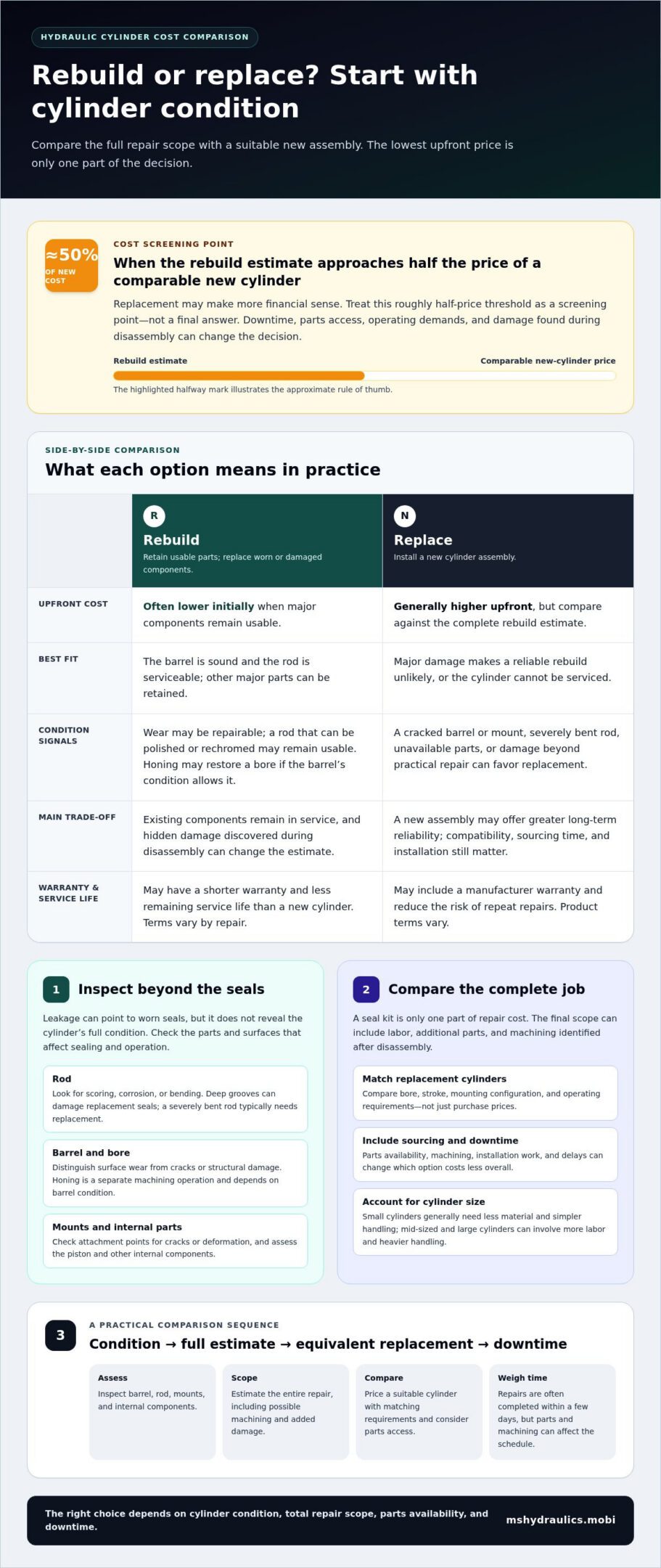
A new cylinder can cost more upfront, but rebuilding is not automatically the lower-cost choice. In a hydraulic cylinder rebuild vs buy new cost comparison, rebuilding generally costs less initially when the barrel and other major components remain usable. If the estimated rebuild cost approaches or exceeds roughly half the price of a comparable new cylinder, replacement may make more financial sense.
Start with the repair estimate, but remember that seals are only part of the calculation. Rod or barrel damage, parts availability, and downtime can all change which option costs less overall. This guide explains how cylinder condition and repair scope affect the decision, what a rebuild involves, and when replacement may be more practical. A comparison table and decision guide help you weigh the trade-offs for your equipment.
Key Takeaways
- Compare the full repair scope with the cost and availability of a suitable replacement, not just the price of a seal kit.
- Assess the barrel, rod, mounts, and internal components to distinguish serviceable wear from damage that makes replacement more practical.
- Factor in parts availability and equipment downtime alongside the repair estimate when weighing the options.
- A sound rebuild involves disassembly, inspection, replacement of worn components, and testing before the cylinder returns to service.
When Should You Rebuild a Hydraulic Cylinder?
Choose based on cylinder condition, total repair scope, downtime, and parts availability. Replacement costs more upfront, but may be more practical when major damage makes a reliable rebuild unlikely.
Rebuilding Versus Replacing
A rebuild retains usable components and replaces worn or damaged parts; replacement installs a new assembly. Rebuilding is often suitable when the barrel is sound and the rod is serviceable. Replacement may be a better option if the barrel or mounting point is cracked, the rod is severely bent, parts are unavailable, or the cylinder cannot be serviced. A new assembly may offer greater long-term reliability, while a rebuild can make good use of a cylinder’s serviceable parts.
The Rebuild-versus-Replacement Cost Threshold
Compare the complete rebuild estimate with the price of a comparable new cylinder, not just the seal work. A common rule of thumb favors replacement when rebuilding exceeds roughly half the new-cylinder cost. The 50% threshold is a screening point, not a substitute for assessing downtime, parts access, and the equipment’s operating demands. Hidden damage discovered during disassembly can also change the estimate.
Replacement Cylinder Price Comparisons
Compare equivalent cylinders: match bore, stroke, mounting configuration, and operating requirements before weighing prices. Aftermarket cylinders may cost less than OEM assemblies, but compatibility and sourcing time matter. A lower purchase price may not offset installation work or delays while parts are sourced. For older or uncommon machines, rebuilding may be the practical route if a suitable replacement is difficult to find.
| Option | Upfront cost | Best fit | Main trade-off |
|---|---|---|---|
| Rebuild | Often lower | Major parts remain usable | Existing components remain in service |
| Replacement | Generally higher | Major damage or unsuitable rebuild | New assembly and sourcing considerations |
Choose the option that suits the cylinder’s condition and total cost, including the effect of downtime.
Warranty and Insurance Differences
A rebuilt cylinder may have a shorter warranty and less remaining service life than a new cylinder. A new cylinder may include a manufacturer warranty and reduce the risk of repeat repairs. Warranty terms vary by product and repair. The choice between repair and replacement does not by itself determine insurance coverage, which depends on policy terms and the circumstances of the loss. Neither option automatically determines a business tax deduction; tax treatment depends on the business’s circumstances and applicable rules.
Hydraulic-cylinder reseal costs
A reseal replaces worn seals, but the seal kit is only one part of the repair. The final scope depends on cylinder size, disassembly, rod and barrel condition, and any additional wear found during inspection. A seal-only repair and a full rebuild are different jobs, even if both start with leakage.
Use cylinder size as an initial guide, not a complete estimate. Small cylinders generally require less material and simpler handling than large ones. Mid-sized and large cylinders can involve more labor, heavier handling, and additional machining. A scored rod or damaged barrel can turn a reseal into a broader repair, so the initial parts list may not reflect the completed work.
Barrel honing adds work when the cylinder bore needs its surface restored. It is a separate machining operation, not part of simply replacing seals. Whether honing is suitable depends on the barrel’s condition and whether it can restore a usable bore. If the damage is too extensive, further machining may not make repair practical. Inspection after disassembly helps determine the right approach.
- Seal work: replace worn seals and inspect mating surfaces for damage.
- Rod work: assess scoring, corrosion, or bending before reassembly.
- Barrel work: determine whether honing can restore the bore.
Include downtime in the comparison because an out-of-service machine can delay work. Hydraulic cylinder repairs are often completed within a few days, but parts availability and machining needs can affect the schedule. Plan for the full sequence: removal, inspection, parts sourcing, machining, assembly, and testing. If a reseal uncovers rod or barrel damage, the repair may take longer than seal replacement alone.
For a cylinder that leaks or needs inspection, hydraulic cylinder rebuild work can address seal and component wear. The useful next step is to assess the disassembled cylinder’s seals, rod, and barrel together, then compare the repair scope with replacement and downtime.
Cylinder damage and common failure issues
Leakage can indicate worn seals, but it does not reveal the cylinder’s full condition. Replacing seals may address external leakage when the rod and barrel remain serviceable. Internal leakage can also cause a cylinder to drift or lose force under load. Inspection should distinguish seal wear from damage to the rod, piston, barrel, or the surfaces that contact the seals.
Rod condition is a key indicator when assessing a rebuild. Corrosion, scoring, or a minor bend can damage new seals and cause leakage to return. A rod that can be polished or rechromed may still be usable, while a severely bent rod typically needs replacement. Deep scoring matters because the damaged surface can cut or wear down seals as the cylinder moves.
Check these failure signs during inspection:
- Scored rod: look for grooves that can damage replacement seals.
- Bent rod: assess whether the bend is minor or severe.
- Barrel damage: distinguish surface wear from cracks or structural damage.
- Mounting damage: inspect the attachment points for cracks or deformation.
- Repeated failure: consider whether the same cylinder problem has returned.
A cracked barrel or mounting point can make replacement the more practical choice. Major body damage, unavailable parts, or repeated failures also weigh against rebuilding. By contrast, a structurally sound barrel and serviceable rod may support a repair, even if worn components need replacing. The key question is whether the cylinder’s major parts can function reliably after the damaged components are addressed.
If a rebuilt cylinder fails again, inspect the complete hydraulic system rather than repeatedly replacing seals. Contamination, pressure problems, or an issue with a connected component may contribute to the failure. Review the failure pattern and check both the cylinder and system to determine whether the cause is inside the assembly or elsewhere. This helps distinguish cylinder damage from a recurring system-level fault.
Hydraulic cylinder rebuild process
A controlled rebuild proceeds from disassembly and inspection to component replacement, reassembly, and testing. Each stage can reveal damage that changes the repair scope. Hydraulic cylinder repairs are often completed within a few days, though parts availability and machining needs can affect the schedule. Judge the rebuild by the condition of the completed cylinder, not by the seals alone.
- Disassemble and inspect: expose the piston, rod, barrel, and seals. Record wear, scoring, corrosion, and any damage that could affect sealing or movement.
- Assess reusable parts: determine whether the rod, barrel, and piston can return to service. Separate replaceable wear components from damage that changes the repair scope.
- Fit replacement seals: keep components clean and avoid nicking rubber during installation. Warm water or warm oil can help make piston seals easier to fit. White lithium grease can help install a piston when the cylinder bore is beveled.
- Reassemble carefully: align the rod and piston, then secure the assembly and connections. Cleanliness matters; debris or damaged rubber can compromise the rebuilt cylinder.
- Test under pressure: confirm the cylinder holds its rated pressure and the rod moves without drift under load.
Inspection determines whether a reseal is enough or more work is needed. For example, a rod with surface damage may need attention before new seals can function properly against it. If inspection reveals a cracked barrel or other major damage, rebuilding may no longer be appropriate. Document the findings so the repair plan clearly identifies which components can be reused and which need replacement.
Testing is a functional check, not an optional final step. A pressure test can reveal leakage or movement problems that assembly alone will not show. Confirming pressure retention and rod behavior under load provides a clearer basis for returning the cylinder to service. If the cylinder fails again after rebuilding, inspect the complete hydraulic system to identify the cause.
For a cylinder requiring inspection, request hydraulic cylinder rebuild service to assess its components and rebuild needs.
Ms. Hydraulics: Hydraulic Hose Fabrication
Ms. Hydraulics LLC provides Hydraulic Cylinder Rebuilds when inspection shows the cylinder can be repaired. The company also offers Heavy Equipment Maintenance and Mobile Hydraulic Repair for related equipment needs. Hydraulic Hose Fabrication can address hose problems affecting equipment operation.
These services are relevant when cylinder symptoms occur alongside hose problems or broader equipment concerns. Assessing related components can help distinguish a cylinder fault from a wider hydraulic or maintenance issue and guide the repair plan.
Contact Ms. Hydraulics LLC to discuss your cylinder or equipment repair needs.
Make the Next Equipment Decision with Confidence
Use a hydraulic cylinder rebuild versus buying new cost comparison as part of a broader maintenance decision. The right choice should suit the machine’s operating demands and the full repair plan, not simply address one symptom. If the cylinder problem is connected to other equipment or hydraulic needs, coordinating the work can keep maintenance focused.
Ms. Hydraulics LLC provides Hydraulic Cylinder Rebuilds, Heavy Equipment Maintenance, and Hydraulic Hose Fabrication for equipment with cylinder, maintenance, or hose repair needs.
Contact Ms. Hydraulics LLC for help with your equipment’s hydraulic repair needs. A clear next step can help you move forward with a repair decision suited to the machine.
Frequently Asked Questions
How Do You Decide Whether to Rebuild or Replace?
Compare the cylinder’s condition, repair scope, replacement compatibility, and the operational impact of downtime. Start by identifying the required bore, stroke, mounting points, and operating demands. Then compare the complete repair plan with a suitable replacement assembly. A hydraulic cylinder rebuild vs buy new cost comparison is most useful when it accounts for both the machine’s operating needs and the full repair scope.
Breaking Down the Bill: Where Does Your Money Go?
A rebuild estimate can include labor for removal and disassembly, seals and other replacement components, machining, reassembly, and testing. Cylinder size and the condition of the rod and barrel affect the work involved. For example, a reseal with sound internal surfaces has a different scope from a repair that requires rod restoration. Break out each task in the estimate to see what drives the total.
What Are the Disadvantages of Rebuilding?
Rebuilding retains parts of the existing cylinder, so their condition affects the result. Wear found only after disassembly can expand the scope, and a rebuilt assembly may have less remaining service life than a new one. Custom or obsolete components can also complicate repairs. If the same cylinder keeps failing, the underlying cause may need attention beyond another rebuild.
What Are the Disadvantages of Replacing?
A new cylinder usually requires a higher upfront investment, and sourcing a matching assembly can take time. Its dimensions and mounting details must suit the machine; a similar-looking unit may not fit or perform correctly. Replacement also means disposing of or setting aside the old assembly. For older equipment, finding a compatible cylinder can be an important part of the decision.
How much does it cost to rebuild a hydraulic cylinder in the U.S.?
Cost depends on cylinder size, labor, seals, removal, and any required rod or barrel work. A seal-only job differs significantly from a rebuild that needs machining or additional components. A hydraulic cylinder rebuild vs buy new cost estimate is more useful when it separates these tasks instead of treating every leaking cylinder as the same repair. The final cost depends on the findings after disassembly and inspection.
How much does a new hydraulic cylinder cost by size and application?
Replacement cost varies with cylinder dimensions, mounting configuration, application, and the availability of a compatible assembly. Larger or specialized equipment may need a cylinder built to specific operating and fit requirements. Compare equivalent specifications, including bore, stroke, ports, and mounts, rather than relying on size labels alone. Installation work and sourcing time also affect the practical cost of replacement.