Ways to find causes of hydraulic system failures in Waxahachie
A failed component is a symptom until its cause is established. Hydraulic system failure analysis in Waxahachie should start by matching the investigation method to the fault: use 5 Whys for a clear, isolated problem, and a broader approach when several conditions may be interacting. The goal is to identify what allowed the failure to occur, not just replace the part that stopped working.
When equipment is down, restoring operation is the immediate priority. But a repair that leaves the underlying cause unresolved can lead to another failure. Hydraulic system failure analysis in Waxahachie helps connect machine symptoms to the conditions behind them, so corrective work can target the fault.
This article explains how to select a root cause method, assess fluid and filtration, apply 5 Whys to straightforward faults, and evaluate pumps, valves, cylinders, hoses, and mechanical loads as a connected system. You’ll have a practical framework for narrowing down likely causes and deciding what to investigate next.
Key Takeaways
- Match the root cause method to the fault: use a focused approach for a clear, isolated issue and a broader investigation when causes may interact.
- Assess fluid condition and filtration for signs of contamination that can affect component operation and system performance.
- Use 5 Whys to trace a straightforward component fault beyond its immediate symptom, then check whether the underlying cause is addressed.
- Evaluate pumps, valves, cylinders, hoses, fluid, and mechanical loads together; turn to hydraulic repair support when diagnosis points to a damaged component or recurring system problem.
1. Choosing an appropriate root cause analysis method
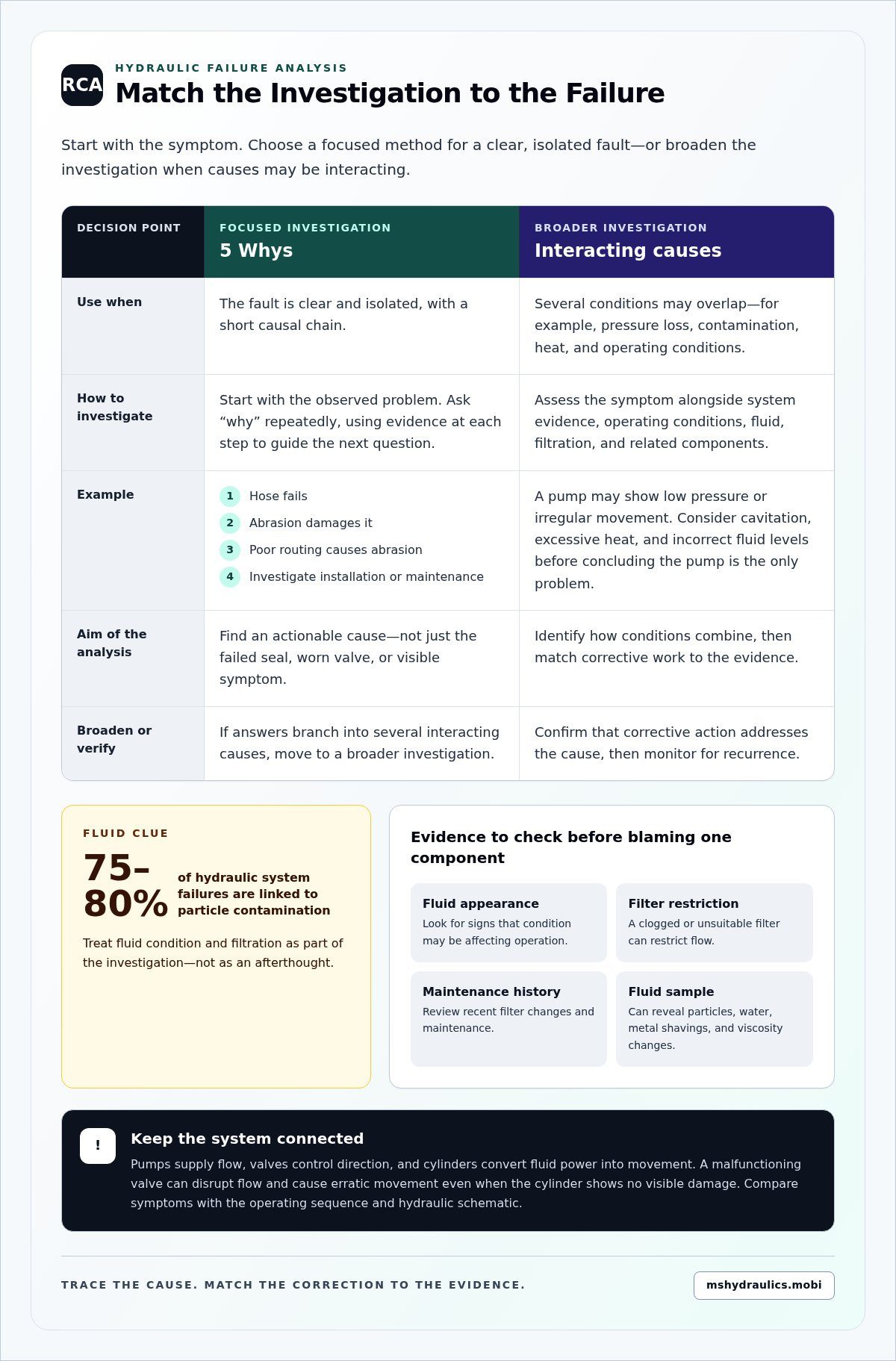
Choose the method based on whether the failure has one clear cause or several interacting causes. For an isolated fault, use 5 Whys to trace the sequence from the failed component to the condition that damaged it. If pressure loss, contamination, heat, and operating conditions overlap, use a broader investigation. Replacing only the visibly damaged part can leave the root cause active and invite another failure.
Start with the symptom, then assess its possible causes. A hydraulic pump may produce low pressure or irregular movement, but cavitation, excessive heat, and incorrect fluid levels can all contribute to pump failure. Review operating conditions and system evidence before concluding that the pump is the only problem. Match corrective work to the cause: address fluid or filtration issues, adjust maintenance practices or operating conditions, or repair worn components.
For a straightforward fault, ask “why” repeatedly and record the evidence at each step. A hose may fail because of abrasion; abrasion may result from poor routing; and poor routing may point to an installation or maintenance issue. Continue until you identify an actionable cause, rather than blaming an operator or simply repeating the symptom. Confirm that the corrective action addresses the cause, then monitor for recurrence.
For hydraulic repair shops in Waxahachie and Ellis County, TX, mobile hydraulic repair and on-site diagnostic services can address equipment faults at the machine. Match the needed work to the evidence, such as a hose leak, cylinder fault, or pump problem.
For an urgent hydraulic failure near Waxahachie, stop the affected equipment and arrange diagnosis before returning it to operation. Mobile hydraulic repair can assess an equipment fault on site; urgency alone doesn’t identify its cause.
Warning signs include fluid leaks, falling pressure, erratic movement, or a pump noise resembling marbles or gravel. Leaks and unexpected movement can create hazards, so keep people clear and follow the equipment’s shutdown procedure.
For hydraulic equipment repair, review the written warranty and service policy for covered work, exclusions, and claim steps. These terms explain what the repair covers and how concerns are handled.
2. Contamination, filtration, and fluid condition
Hydraulic oil carries power and lubricates moving components, so its condition affects pressure, heat, and system efficiency. Particle contamination is linked to 75-80% of hydraulic system failures. Dirt can restrict clearances, accelerate wear, and interfere with valve movement. A filter may capture particles, but a clogged or unsuitable filter can also restrict flow and contribute to poor operation.
Inspect the fluid and filtration path before treating a damaged component as the only cause. Note the oil’s appearance, check for abnormal filter restriction, and review recent filter changes and maintenance. A fluid sample can reveal particulate ingress, water, metal shavings, chemical stability, and viscosity changes without dismantling the machine. Interpret oil analysis alongside the equipment’s operating symptoms to help distinguish contamination from component wear.
Pay particular attention to water contamination. Water in hydraulic oil can promote oxidation and sludge, reducing the oil’s lubricating ability. Dirt, water, or entrained air can contribute to corrosion, clogging, and overheating. If irregular movement begins after a fluid change, consider whether contamination entered during handling or whether the replacement fluid is suitable for the system. A mismatch between components and fluid can undermine performance even when parts appear intact.
A general recommendation is to test hydraulic oil every three to six months, depending on how hard the machine works. Record the sample date, operating conditions, and recent repairs so you can compare later results. A rising particle count or changing viscosity can help focus troubleshooting on filtration, fluid condition, or internal wear.
Near Waxahachie, hydraulic fluid contamination testing can assess a sample for particles, water, and wear metals. On-site diagnostic services can connect fluid concerns with operating symptoms and component behavior; on-site hydraulic diagnostics can help assess the equipment at the machine.
Dirt, water, and air in hydraulic fluid are more than a fluid-quality concern: they can reduce system efficiency and contribute to corrosion, clogging, and overheating. Consider these connected possibilities when assessing machine behavior, rather than assuming a single symptom identifies the cause.
Hydraulic fluid analysis can detect metal shavings, water, and other contaminants. This evidence helps determine whether contamination is part of the problem and keeps fluid condition in view alongside equipment symptoms.
3. Using 5 Whys for isolated component faults
The 5 Whys method suits a clear, isolated fault with a short causal chain. Start with the observed problem, such as a cylinder that drifts under load. Ask why it drifts, then use each evidence-based answer to form the next question. Continue until the chain identifies an actionable cause, not merely a failed seal or worn valve. If answers branch into several interacting causes, use a broader investigation.
Consider how the hydraulic components work together before assigning a cause. A pump supplies flow, valves control its direction, and a cylinder converts fluid power into movement. A fault in one component can affect another. For example, a malfunctioning valve may disrupt flow and cause erratic movement even when the cylinder shows no visible damage. Compare the symptoms with the machine’s operating sequence and hydraulic schematic.
Internal leakage can cause a fault without an obvious external leak. A worn cylinder seal, pump, or valve may let fluid bypass its intended path, reducing pressure or slowing movement. Ask what changed, where pressure or flow may be lost, and what evidence supports the suspected component. Treat internal leakage as a possibility to test, not an automatic conclusion based on weak performance.
Verify each step in the diagnosis through inspection and testing. Look for wear, damage, loose connections, and visible leaks; note unusual vibration or noise during operation. A pump rattling like marbles or gravel may indicate cavitation, while erratic movement can point to valve wear or damage. Before disassembly, record the symptom and operating conditions, then compare test results with the suspected cause. If the evidence does not support a conclusion, revise the diagnosis rather than forcing it. The final repair should address the verified cause, followed by a check that normal operation has returned.
4. Hydraulic system diagnostics and failure analysis
A reliable diagnosis follows the fault through the entire hydraulic circuit instead of treating each symptom as a separate failure. Assess the pump, valves, cylinders, hoses, fluid condition, and mechanical load together. Similar symptoms can have different causes: slow movement may result from pressure loss, internal leakage, restricted flow, or a worn component. The system’s behavior across its operating cycle helps distinguish between them.
Preserve evidence before cleaning or disassembly. Record the equipment identification, symptoms, maintenance history, recent repairs, operating conditions, and hydraulic schematic. Photos or video can document leaks, unusual movement, or changing noise. This record helps distinguish the initiating failure from secondary damage, especially if a replacement component has also failed.
Use measured checks to narrow down the cause. Compare pressure at relevant system points to locate potential leaks, blockages, or faulty valves. Low pressure can indicate a pump problem or leakage; high pressure can point to a relief-valve issue. Track temperature too: rising heat can signal poor fluid circulation or inadequate cooling. Inspect pump seals and shafts for damage, and relate each finding to machine behavior before recommending repairs.
Cavitation may produce a sound like marbles or gravel rattling inside the pump. That noise is a clue, not a complete diagnosis; check fluid supply and inlet conditions before deciding on pump replacement. Recurring faults deserve priority, particularly after three or more occurrences. A straightforward investigation may take 2-4 hours, while a complex case may require 1-2 days for data collection, analysis, and documentation.
Near Waxahachie, on-site diagnostic services and mobile hydraulic repair can assess equipment at the machine. Bring equipment details, symptom records, and recent repair information to help establish a useful diagnostic starting point. Request on-site hydraulic diagnostics when recurring faults or unclear symptoms require a system-level investigation.
Control-valve wear or damage can disrupt fluid flow and cause erratic movement. Leaks at hoses, fittings, or seals can reduce pressure and impair performance.
Ms. Hydraulics: Hydraulic Hose Fabrication
When diagnostics identify a damaged hose as the source of fluid loss or reduced performance, Ms. Hydraulics LLC provides Hydraulic Hose Fabrication. Replacing the affected hose can address that fault; recurring damage may also make it necessary to review hose routing and surrounding equipment conditions.
If the fault involves other components, Ms. Hydraulics LLC also provides Hydraulic Cylinder Rebuilds, Heavy Equipment Maintenance, and Mobile Hydraulic Repair. These services suit cases where inspection points to cylinder wear, a maintenance issue, or equipment that needs repair on site. Matching the work to the diagnosed cause keeps the response focused on the failure.
Contact Ms. Hydraulics LLC to discuss a hydraulic repair need, or visit mshydraulics.mobi.
Turn the Diagnosis Into a Practical Repair Plan
Hydraulic system failure analysis in Waxahachie is most useful when the findings guide the next maintenance decision. Record the suspected cause, the evidence supporting it, and the corrective action taken. This gives technicians a reference if the fault returns and helps distinguish a new failure from an unresolved one.
When diagnosis points to hose damage, cylinder wear, or broader maintenance needs, Ms. Hydraulics LLC provides Hydraulic Hose Fabrication, Hydraulic Cylinder Rebuilds, and Heavy Equipment Maintenance. Matching the repair to the identified fault keeps the next step focused on the equipment’s actual condition.
Share the machine’s symptoms and diagnostic findings to begin a focused discussion about repair needs. Contact Ms. Hydraulics LLC for help and take the next step toward informed equipment maintenance.
Frequently Asked Questions
What commonly causes hydraulic system failure in industrial and mobile equipment?
Common causes include hose abrasion, misalignment, seal deterioration, and bearing wear. A hose routed against a machine frame, for example, can wear through as the equipment vibrates. A misaligned coupling can add load to connected components. Operating conditions matter too: repeated overload or inadequate cooling can accelerate wear. Record where damage appears and what the machine was doing when symptoms began.
What steps are involved in hydraulic system diagnostics and failure analysis?
Hydraulic system failure analysis in Waxahachie starts by defining the operating problem and when it occurs, such as only under load or after warm-up. Compare the machine’s behavior with its normal operating pattern, then isolate the affected circuit and test it under relevant conditions. After repairs, repeat the same operating task and document whether the original symptom remains. This comparison helps assess whether the repair addressed the fault. For on-site diagnostics or repair in Waxahachie and the surrounding DFW area, contact Ms. Hydraulics LLC.