After-Hours Heavy Equipment Repair in Arlington, VA
A machine failure after operating hours does not always call for the same repair approach. For after-hours heavy equipment repair in Arlington, the response depends on the equipment’s location, site access, and the fault requiring diagnosis. Start by identifying the machine, describing its symptoms, and noting whether the issue appears hydraulic or involves another component.
It’s reasonable to want a clear plan when downtime affects work. This article explains what after-hours troubleshooting and on-site diagnostics can reveal, when hydraulic repair, fabrication, or welding may be relevant, and which details shape the repair process. You’ll also learn how to describe a breakdown clearly so the next steps can focus on the equipment and the work it needs.
Key Takeaways
- Use a structured troubleshooting process to describe symptoms and help narrow down the equipment fault.
- Learn which details about the machine, its location, and the breakdown help clarify the repair request.
- Compare the factors that shape mobile repair needs, including site access and whether the issue involves hydraulic components.
- Keep personnel clear of the disabled machine and communicate any changing hazards while awaiting assistance.
- See when hydraulic hose fabrication or mobile hydraulic repair may be relevant to getting equipment back into service.
Troubleshooting and on-site diagnostics
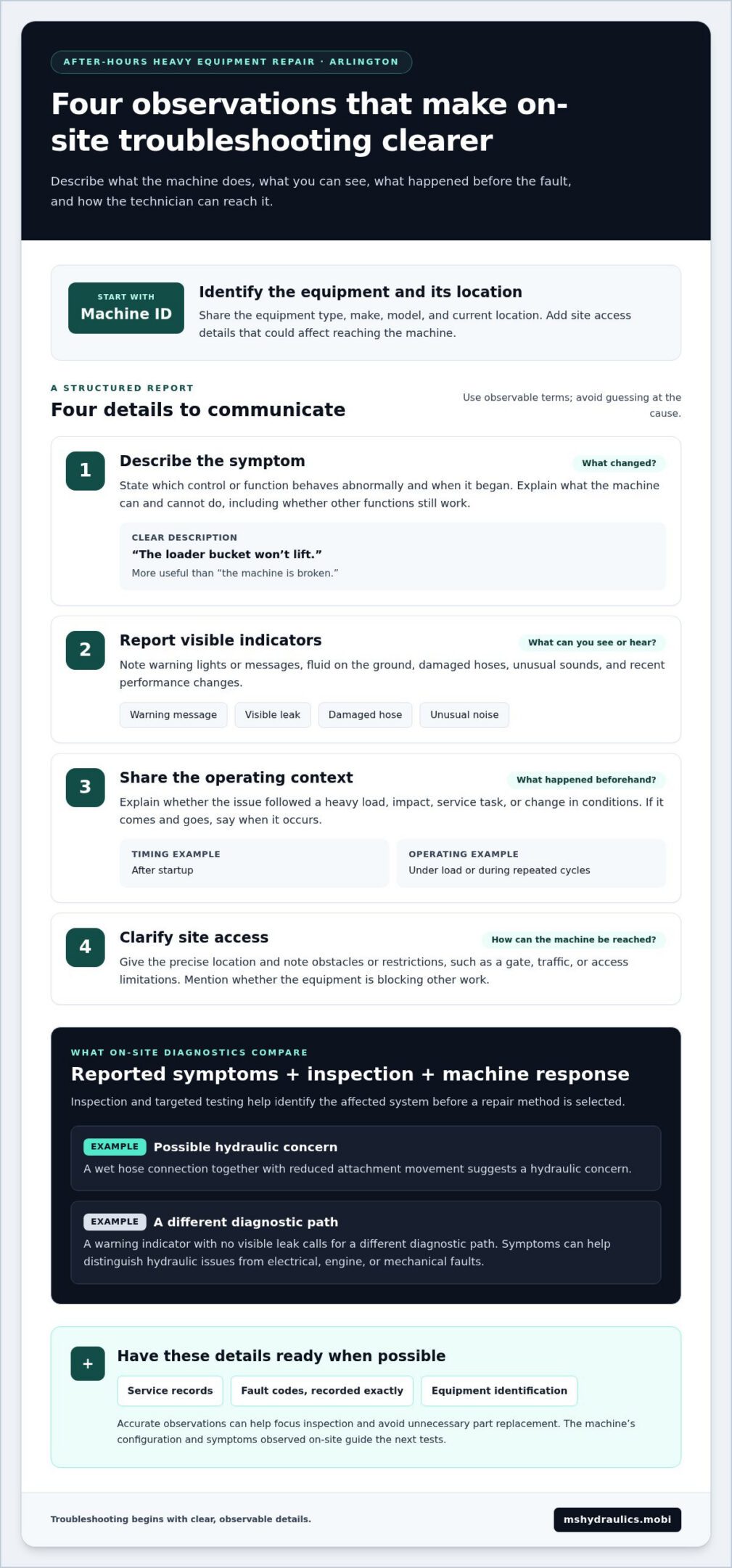
For after-hours heavy equipment repair in Arlington, troubleshooting starts with the machine’s symptoms and operating conditions. A diagnostic is more useful when the operator can describe what changed before the failure. For example, note whether an excavator suddenly lost boom movement or slowed during repeated cycles. Record warning lights, unusual sounds, leaks, and recent performance changes. These observations help distinguish a hydraulic issue from an electrical, engine, or mechanical fault.
Use a consistent sequence to report what the machine can and cannot do. Identify the equipment type, make, model, and current location, then describe the fault in observable terms. “The loader bucket won’t lift” is more useful than “the machine is broken.” Add whether other functions still work, such as steering, travel, or boom movement. If the problem comes and goes, explain when it occurs, such as after startup or under load.
- Describe the symptom: State which control or function behaves abnormally, and when it began.
- Report visible indicators: Identify warning messages, fluid on the ground, damaged hoses, or unusual noise.
- Share operating context: Explain whether the issue followed a heavy load, impact, service task, or change in conditions.
- Clarify site access: Give the location and note obstacles that could affect access to the machine.
On-site diagnostics narrow down the fault through inspection and targeted testing. A technician can compare the reported symptoms with visible component condition and machine response. For example, a wet hose connection and reduced attachment movement suggest a hydraulic concern, while a warning indicator with no visible leak calls for a different diagnostic path. The goal is to identify the affected system before selecting a repair method.
Accurate observations can also help avoid unnecessary part replacement. If a skid steer loses lift function but still travels, that distinction helps focus attention on the systems involved in lifting. If several functions fail together, diagnostics may need to consider a shared hydraulic or electrical cause. The machine’s configuration and symptoms observed on-site guide the next tests.
Have the machine’s service records, fault codes, and equipment identification ready when possible. Report a displayed code exactly as shown rather than interpreting it from memory. Clear information helps the technician prepare for the inspection and determine whether the next step involves troubleshooting, component repair, or further testing at the machine’s location.
Which heavy equipment repair companies in Arlington offer after-hours or 24/7 service?
For a disabled excavator or loader in Arlington, distinguish after-hours response from continuous repair coverage. “After-hours” can mean taking a call outside standard business hours, while “24/7” suggests a broader operating commitment. Neither phrase alone explains whether a technician can travel to the machine, diagnose the fault, or complete the repair on-site. Focus on the specific response the worksite needs.
Think of the process in three stages: initial contact, field response, and repair scope. A breakdown can be reported before a field technician is ready to respond. A mobile mechanic may travel to the site but need diagnostic time to identify the failed component. Repair completion can also depend on the machine’s condition, access, and required parts. These stages clarify what emergency service involves for a particular equipment failure.
- Call handling: Can the service request be recorded outside ordinary operating hours?
- Field response: Does the repair process involve travel to the equipment’s location?
- Repair scope: Does the work address the actual fault, such as a hydraulic component problem?
Match the repair capability to the symptom. A leaking hydraulic line, a cylinder that will not hold position, and a machine that will not start each point to a different diagnostic path. Mobile hydraulic repair is relevant when the failure involves hydraulic components. Broader maintenance needs may require inspection beyond the immediate symptom. A clear description helps define the appropriate repair process.
An Arlington worksite can also affect the response. A machine beside an accessible road presents different access conditions from equipment inside a restricted yard or on an active construction site. Give the precise location and describe any gate, traffic, or access constraints. Explain whether the equipment can be approached safely and whether it is blocking other work. These details help plan an on-site visit.
For a focused request, provide the equipment type, location, visible symptoms, and the time the problem began. If a hydraulic hose is visibly damaged, describe its position and the function affected. If the machine displays a fault message, record it exactly. This information supports triage without guessing at the cause. For Arlington-area work involving a hydraulic fault, review equipment repair service details as a relevant next step.
Which Arlington-area repair services provide emergency roadside or on-site heavy equipment repairs?
In Arlington, Texas, emergency field repairs generally involve mobile mechanics who travel to disabled equipment. The service may be described as roadside repair, mobile repair, or on-site repair. The label matters less than whether the technician can inspect the machine where it stopped. A loader at a worksite and an excavator beside an access road present different site conditions.
Match the repair category to the failure. A machine with a damaged hydraulic line may need hydraulic troubleshooting and component repair. A loader that will not move could have a hydraulic, electrical, or mechanical fault. A mobile technician can assess symptoms at the equipment and determine the repair path from inspection and diagnostic results. The initial description helps clarify whether field repair fits the situation.
Before arranging a visit, distinguish a machine that can be approached from one that blocks a road or occupies a restricted area. Give the site entrance, machine position, and access limitations. At a construction site, a gate code, narrow approach, or changing work activity can affect how a service vehicle reaches the equipment. State whether the machine is on public pavement, private property, or an active work zone.
- Mobile hydraulic repair: Relevant when symptoms point to a hydraulic hose, pump, motor, valve, or cylinder.
- On-site diagnostics: Useful when the failed system is not yet clear, such as a machine that loses several functions.
- Heavy equipment maintenance: Appropriate for planned service needs or recurring operating issues, rather than only one acute failure.
Different symptoms call for different assessments. A visible fluid leak may indicate a hydraulic fault, but the source could be a connection or another component. A machine that stalls without a leak needs broader assessment. Describing what still works, what stopped, and whether symptoms change during operation helps guide the initial evaluation.
For emergency service in the Arlington area, describe the machine and location first, then explain the symptoms and access conditions. This helps distinguish mobile field repair from a maintenance need or an issue requiring more extensive work. A precise request gives diagnostics a clear starting point without assuming the cause before inspection.
What information should I provide when calling for emergency heavy equipment repair?
Start with the machine’s identity and exact location. Give the equipment type, make, model, and serial number if available. For example, identify it as a tracked excavator rather than simply “a machine.” Provide the Arlington site address, nearest entrance, and equipment position. A precise location helps distinguish a machine inside a yard from one beside an access road.
Describe the failure using observable details. State which function stopped, what still works, and when the symptom began. “The boom won’t lower, but travel still works” gives more useful information than “the excavator is down.” Include whether the problem started during startup, while moving, or under a load. If it comes and goes, describe when it returns.
- Identify the equipment: Share its type, make, model, and serial number when accessible.
- Explain the failure: Name the affected function and describe any remaining operation.
- Report indicators: Read warning messages or fault codes exactly as displayed.
- Describe the site: Give the address, access point, and equipment position.
- Summarize recent changes: Mention recent maintenance, component replacement, or an impact before the fault.
Include diagnostic clues without guessing at the cause. Report visible fluid, a damaged hose, unusual noise, smoke, or a warning light. If a hydraulic attachment stopped moving, say whether other machine functions changed too. Avoid interpreting a fault code unless the machine display provides that description. Exact observations help the mechanic assess the issue.
Recent work can matter. If a hose, filter, battery, or another component was replaced before the breakdown, share the part and timing. Mention whether the machine showed the same symptom earlier. For example, a function that slowed before stopping may point diagnostics in a different direction from a sudden loss. Stick to the sequence of events.
Explain site conditions that affect access or communication. Identify gate procedures, restricted entrances, uneven ground, or a location that is difficult to find after dark. Provide a contact person’s name and working phone number, and say where they will meet the mechanic. If the machine has attachments or is carrying material, include that context. These details help plan the visit around the equipment’s actual condition.
Before ending the call, repeat the equipment location and main symptom. Confirm that the model information, displayed code, and contact details were recorded accurately. A concise report gives diagnostics a clear starting point and reduces confusion between the reported problem and what the mechanic finds on-site.
What safety steps should operators take while waiting for an emergency heavy equipment mechanic
When a machine develops a fault, stop work and assess the immediate area before approaching. In an Arlington work zone, moving vehicles, unstable ground, poor lighting, and nearby equipment can create additional hazards. Alert the site lead, keep other workers away from the disabled machine, and follow established site emergency procedures. If people face immediate danger, move to a safe location and contact emergency services.
Use the equipment’s normal shutdown procedure only if it is safe to do so. Don’t restart the engine to reproduce a symptom, move a machine with failed steering, or operate a leaking hydraulic system. A raised bucket, boom, or attachment can create a crush hazard. Keep clear of suspended components and never reach beneath an attachment, even if the machine appears switched off.
- Secure the area: Keep workers and pedestrians clear of the machine and its attachments.
- Stop operation: Don’t continue running equipment that has lost control, function, or stability.
- Avoid contact: Don’t touch leaking fluid, damaged hoses, hot surfaces, or exposed components.
- Preserve the scene: Note the machine’s position and visible warning indicators without approaching hazards.
- Communicate changes: Tell the site lead and incoming mechanic if conditions shift or a leak worsens.
Take particular care around a suspected hydraulic leak. Don’t use a hand or cloth to locate it, tighten a fitting, or test a hose. Keep people away from the affected area and report the leak’s location from a safe position. If fluid reaches a walkway or vehicle path, alert the site lead so they can manage access under site procedures.
At night, poor visibility can make a disabled machine harder to see. Keep personnel in a safe, visible location and use site-approved warning methods without entering traffic or approaching the equipment. Don’t rely on a phone flashlight to inspect beneath a chassis or around a raised attachment. Tell the mechanic about poor lighting, nearby traffic, and access restrictions before they arrive.
When the mechanic arrives, identify the operator and site lead, then point out hazards from a safe position. Share any changes since the initial call, such as a new leak or an attachment settling. Avoid restarting the machine for demonstration. For planned work that can help address recurring equipment issues, discuss heavy equipment maintenance.
Ms. Hydraulics: Hydraulic Hose Fabrication
Ms. Hydraulics LLC provides hydraulic hose manufacturing for equipment with a damaged or failed hose. When a hose issue affects machine operation, hose fabrication can address that component as part of the repair. Mobile hydraulic repair is also suited to hydraulic problems that need attention at the equipment’s location.
For related hydraulic concerns, Ms. Hydraulics LLC also performs hydraulic cylinder rebuilds and heavy equipment maintenance. The appropriate service depends on the affected component and the equipment’s condition. Share the machine details and describe the hydraulic symptoms to clarify the repair need.
Contact Ms. Hydraulics LLC to discuss hydraulic hose fabrication or related equipment repair needs.
Make the Next Repair Decision With Clear Information
For after-hours heavy equipment repair in Arlington, turn the breakdown details into a clear repair need. Describing the affected machine function and component helps focus the discussion on inspection, repair, or maintenance planning. The right approach depends on the equipment’s condition and the fault identified.
Ms. Hydraulics LLC provides hydraulic hose manufacturing, hydraulic cylinder rebuilds, and heavy equipment maintenance. These services address distinct equipment needs, from a damaged hydraulic hose to a cylinder requiring rebuild work or planned maintenance. Sharing the machine’s symptoms and relevant service history helps focus the conversation on the issue.
For a hydraulic hose concern or another equipment repair need, contact Ms. Hydraulics LLC about service. A precise starting point can help you plan the next step and move equipment maintenance forward with confidence.
Frequently Asked Questions
How quickly can you reach Arlington, Texas?
Ms. Hydraulics LLC serves Arlington, Texas, within the Dallas-Fort Worth region. Arrival timing depends on the job site’s location, road conditions, site access, and repair request. Provide the precise address and a recognizable entrance to help locate the equipment. Include access instructions for a large construction site, industrial facility, or gated yard so the mechanic can find the correct work area.
What types of heavy equipment can Arlington mobile repair services fix after hours?
Mobile repair and diagnostics can address hydraulic systems on equipment such as excavators, skid steers, and drill rigs. The work required depends on the affected component: a hydraulic pump, motor, valve, or cylinder may each call for different repairs. Describe the machine type and its application, such as excavation or drilling. This context helps identify the equipment and narrow down the relevant hydraulic repair need.
How quickly can an after-hours heavy equipment mechanic reach a job site in Arlington?
Arrival timing depends on the job site’s location, travel conditions, access requirements, and equipment failure details. An address may not pinpoint a machine inside a large construction area, so provide the entrance and a clear landmark. Explain whether the equipment is accessible from the road or positioned behind a gate or within an active work zone. These factors shape the route to the machine.
Do after-hours heavy equipment repair providers in Arlington service nearby cities and job sites?
Ms. Hydraulics LLC serves Arlington and nearby Texas communities, including Cleburne, Dallas-Fort Worth, Alvarado, Granbury, Crowley, Mansfield, Waxahachie, and Cedar Hill. Mobile hydraulic repair and on-site diagnostics can help when equipment needs attention at a job site. Include the city, site address, and machine location in your service request to clarify the worksite and help plan the visit.